The Roman De La Rose and the Thirteenth Century Prohibitions of Homosexuality
Moran (Cruz), Jo Ann Hoeppner (Department of History, Georgetown University, Washington, D.C.)
A paper prepared for the Georgetown University Cultural Studies Conference, “Cultural Frictions”, October 27-28, (1995)
Abstract
The Roman de la Rose, one of the most copied and commented on of medieval vernacular texts, has retained its enigmatic character through the centuries. Rich in meanings, elusive in meaning, it has generated a variety of interpretations in the nineteenth and twentieth centuries. Kevin Brownlee and Sylvia Huot have provided a synopsis of the literary debates surrounding the Roman de la Rose, ranging from the Christian allegorical school of D. W. Robertson to the philosophical perspectives of neo-Platonism and the more purely literary concerns of structure, genre and discourse. Most recently there has been attention paid to receptivity, both as a subject of intrinsic interest and as an entree into the meaning of a controversial text. The Roman de la Rose has not, to my knowledge, been placed within the context of the eleventh-, twelfth-and thirteenth-century debates over married clergy, homosexuality, and concerns over natural and unnatural love, perhaps because scholars have viewed it usually through the lens of courtly love literature and, more recently, Christine de Pizan’s assault on its misogyny.

The Roman De La Rose and the Thirteenth Century Prohibitions of Homosexuality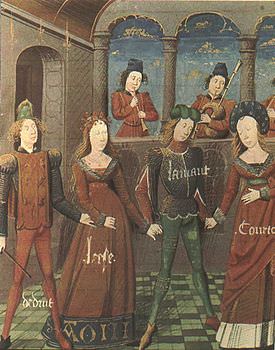
Moran (Cruz), Jo Ann Hoeppner (Department of History, Georgetown University, Washington, D.C.)
A paper prepared for the Georgetown University Cultural Studies Conference, “Cultural Frictions”, October 27-28, (1995)
Abstract
The Roman de la Rose, one of the most copied and commented on of medieval vernacular texts, has retained its enigmatic character through the centuries. Rich in meanings, elusive in meaning, it has generated a variety of interpretations in the nineteenth and twentieth centuries. Kevin Brownlee and Sylvia Huot have provided a synopsis of the literary debates surrounding the Roman de la Rose, ranging from the Christian allegorical school of D. W. Robertson to the philosophical perspectives of neo-Platonism and the more purely literary concerns of structure, genre and discourse. Most recently there has been attention paid to receptivity, both as a subject of intrinsic interest and as an entree into the meaning of a controversial text. The Roman de la Rose has not, to my knowledge, been placed within the context of the eleventh-, twelfth-and thirteenth-century debates over married clergy, homosexuality, and concerns over natural and unnatural love, perhaps because scholars have viewed it usually through the lens of courtly love literature and, more recently, Christine de Pizan’s assault on its misogyny.
Click here to read this paper given at “Cultural Frictions”
Subscribe to Medievalverse
Related Posts