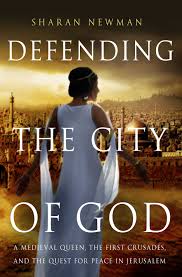
BOOK REVIEW: Defending the City of God: A Medieval Queen, the First Crusades, and the Quest for Peace in Jerusalem
Sharan Newman
Publisher: Palgrave MacMillan (2014)
Famed historical fiction writer and respected medieval historian, Sharan Newman, has returned with her latest offering, Defending the City of God: A Medieval Queen, the First Crusades, and the Quest for Peace in Jerusalem. This book is not historical fiction; it’s an alternative look at the First Crusade, its aftermath and the culture that grew out of Crusader’s lives once they settled in the Holy Land. Newman’s initial focus is Queen Melisande of Jerusalem (1105 – 1161), a remarkable woman who was raised in and later ruled the newly formed Crusader States. This book isn’t just a run-of-the-mill biography of Melisandre. The book is divided into segments based on Melisande’s life but spends a lot of time discussing the warring between the newly settled Crusaders and their Muslim enemies, cultural clashes and internal power struggles. Newman’s book takes an indepth, well researched look at life in the Holy Land.
Melisande’s life was not without a fair share of family problems. Her father, Count Baldwin of Edessa, (later King Baldwin II of Jerusalem) was absent due to his imprisonment until 1108, and again in 1123. Once he became king, he had to fight to retain his kingdom from regular incursions by the Seljuks. Since he had no sons, and four daughters, he named his eldest, Melisandre as his heir. What is interesting is that Melisandre was not relegated to a supporting role after marrying Fulk V, Count of Anjou; he was her co-ruler. She witnessed many charters and had a wider degree of influence in political matters than her European counterparts.
During the first part of their union, Fulk assumed power. His previous wife, Erembourg of Maine (1096 – 1126) wasn’t involved in political matters with Fulk so he wasn’t used to his wife asserting power. It wasn’t until his falling out with her cousin, Hugh Count of Jaffa that Melisandre let her voice be heard and established her place as a rightful ruler alongside Fulk. Prior to 1138, Fulk did not have her assent on charters even though it was made clear to him that she was to be co-ruler. After the revolt with Hugh, Melisandre makes her position known and her name once again appears on charters made by Fulk, “with the consent and approval of Queen Melisandre”.
Newman discusses at length the tensions between Crusading families, the constant switching of loyalties and alliances between Frankish lords and Muslim rulers, political intrigues and battles. While this is level of detail is informative, at certain points it can get overwhelming. The reader has to wade through a sea of names, dates and intricate family relationships. For the reader who is not well versed with the Crusades, it can get quite confusing and leaves one asking, “why is this piece of information relevant to the main storyline?”.
What was enjoyable about the book was the glimpse Newman offered into the customs of the Crusaders and people of the Holy Land and the merging of the two cultures. It was interesting to note that later arrivals to the Region tried to restrict this assimilation and mixture but it appeared to have been in vain. New generations were born and raised in the Crusader States far removed from the culture of their parents and grandparents. Melisandre was one such case, being the product of a French father and Armenian mother. Melisandre grew up speaking Armenian and Arabic fluently and spent much of her early years in Edessa where she saw a wide range of religions and cultures. Her upbringing influenced her rule and outlook.
Would I recommend this book? For those who are interested in the beginnings of the Crusader States and the Crusades in general, this is a great book. If you have background knowledge of the region and period, you will most certainly enjoy it. It’s interesting, very detailed and well researched. For those who are new to the subject, the complexity of the relationships between the main players may be somewhat daunting and confusing, however, having said that, it’s still not a dull read. It is an excellent look at the culture of the Crusader States, how women ruled there, and the politics of the time. Newman makes the life of Melisandre and those around her come to life on the page.
For more information on Sharan Newman and her books, please visit: www.sharonnewman.com

Sharan Newman
Publisher: Palgrave MacMillan (2014)
Famed historical fiction writer and respected medieval historian, Sharan Newman, has returned with her latest offering, Defending the City of God: A Medieval Queen, the First Crusades, and the Quest for Peace in Jerusalem. This book is not historical fiction; it’s an alternative look at the First Crusade, its aftermath and the culture that grew out of Crusader’s lives once they settled in the Holy Land. Newman’s initial focus is Queen Melisande of Jerusalem (1105 – 1161), a remarkable woman who was raised in and later ruled the newly formed Crusader States. This book isn’t just a run-of-the-mill biography of Melisandre. The book is divided into segments based on Melisande’s life but spends a lot of time discussing the warring between the newly settled Crusaders and their Muslim enemies, cultural clashes and internal power struggles. Newman’s book takes an indepth, well researched look at life in the Holy Land.
Melisande’s life was not without a fair share of family problems. Her father, Count Baldwin of Edessa, (later King Baldwin II of Jerusalem) was absent due to his imprisonment until 1108, and again in 1123. Once he became king, he had to fight to retain his kingdom from regular incursions by the Seljuks. Since he had no sons, and four daughters, he named his eldest, Melisandre as his heir. What is interesting is that Melisandre was not relegated to a supporting role after marrying Fulk V, Count of Anjou; he was her co-ruler. She witnessed many charters and had a wider degree of influence in political matters than her European counterparts.
During the first part of their union, Fulk assumed power. His previous wife, Erembourg of Maine (1096 – 1126) wasn’t involved in political matters with Fulk so he wasn’t used to his wife asserting power. It wasn’t until his falling out with her cousin, Hugh Count of Jaffa that Melisandre let her voice be heard and established her place as a rightful ruler alongside Fulk. Prior to 1138, Fulk did not have her assent on charters even though it was made clear to him that she was to be co-ruler. After the revolt with Hugh, Melisandre makes her position known and her name once again appears on charters made by Fulk, “with the consent and approval of Queen Melisandre”.
Newman discusses at length the tensions between Crusading families, the constant switching of loyalties and alliances between Frankish lords and Muslim rulers, political intrigues and battles. While this is level of detail is informative, at certain points it can get overwhelming. The reader has to wade through a sea of names, dates and intricate family relationships. For the reader who is not well versed with the Crusades, it can get quite confusing and leaves one asking, “why is this piece of information relevant to the main storyline?”.
What was enjoyable about the book was the glimpse Newman offered into the customs of the Crusaders and people of the Holy Land and the merging of the two cultures. It was interesting to note that later arrivals to the Region tried to restrict this assimilation and mixture but it appeared to have been in vain. New generations were born and raised in the Crusader States far removed from the culture of their parents and grandparents. Melisandre was one such case, being the product of a French father and Armenian mother. Melisandre grew up speaking Armenian and Arabic fluently and spent much of her early years in Edessa where she saw a wide range of religions and cultures. Her upbringing influenced her rule and outlook.
Would I recommend this book? For those who are interested in the beginnings of the Crusader States and the Crusades in general, this is a great book. If you have background knowledge of the region and period, you will most certainly enjoy it. It’s interesting, very detailed and well researched. For those who are new to the subject, the complexity of the relationships between the main players may be somewhat daunting and confusing, however, having said that, it’s still not a dull read. It is an excellent look at the culture of the Crusader States, how women ruled there, and the politics of the time. Newman makes the life of Melisandre and those around her come to life on the page.
For more information on Sharan Newman and her books, please visit: www.sharonnewman.com
Follow Sharan Newman on Facebook: Sharan Newman
Our review of Sharan Newman’s Death Before Compline
Subscribe to Medievalverse
Related Posts