These days when chivalry is everywhere on the decline, and no one dares to tourney anymore, and all knights are cowards, women are all the more courageous in battle.’
This plaintive voice, lamenting men’s loss of military prestige, sounds the alarm over the figure of women fighting during the high Middle Ages. On one level, it heralds the classic “world-upside-down” syndrome, teasing its thirteenth-century French public with an image of social disorder. On another, it fields the idea of women in a martial setting, bespeaking a thorny issue touching families and communities across medieval Europe.
Not only are such formulations rare, but they are made doubly difficult to interpret because of their ambiguous tone. Is this vision of the topsy-turvy conceived in jest? Or does it signal a controversy that challenges the prevailing order, just as it departs from medieval conventions of representing women? Given these conventions, many critics tend to treat such a pronouncement lightly. For them, narrative representation often opens up a space in which women are allowed to play out what is otherwise marked off-limits to them. Narratives of many types can offer tongue-in-cheek scenarios but little more. Yet if we consider the relation between representation and social realities from another angle, a different aspect of figuration comes into focus: the passage above conveys changing situations for women in high medieval society, indeed changes in the very means of textualizing them. From this perspective, what is represented as comedy or sheer fantasy belies a back-handed admission of the prospects for female militancy.
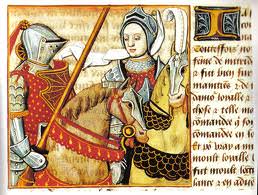
Following the lead of this evocative complaint, I aim to investigate various representations of the woman warrior. I shall concern my analysis with a little-known group of four thirteenth-century narratives, Li Tournoiement as dames (The Ladies’ Tournament), and most specifically with the version attributed to Pierre Gencien. The title of these texts is striking: placing knights on the field is one thing, but for a poet to portray women in combat breaks with the norm. The four Tournoiement introduce a cavalcade of aristocratic and bourgeois Parisian women who ride into view, booted and spurred. Virtually indistinguishable from the usual male combatants, the women show every intention of wielding their weaponry expertly. Their battle-preparedness comes to the test. A third of Gencien’s text describes a female melee. Here too, the women match male warriors in courage and physical strength. The male narrator reports the furious jousts between women – even the casualities – all of which he observes in a dream. A champion does finally emerge and is awarded the highest compliment of heroism for the Middle Ages: “No man has seen her like. Ah! Roland … if you had had women of such strength in your company.”

Figures of Female Militancy in Medieval France
Helen Solterer
Signs: Vol. 16, No. 3 (Spring, 1991)
Abstract
These days when chivalry is everywhere on the decline, and no one dares to tourney anymore, and all knights are cowards, women are all the more courageous in battle.’
This plaintive voice, lamenting men’s loss of military prestige, sounds the alarm over the figure of women fighting during the high Middle Ages. On one level, it heralds the classic “world-upside-down” syndrome, teasing its thirteenth-century French public with an image of social disorder. On another, it fields the idea of women in a martial setting, bespeaking a thorny issue touching families and communities across medieval Europe.
Not only are such formulations rare, but they are made doubly difficult to interpret because of their ambiguous tone. Is this vision of the topsy-turvy conceived in jest? Or does it signal a controversy that challenges the prevailing order, just as it departs from medieval conventions of representing women? Given these conventions, many critics tend to treat such a pronouncement lightly. For them, narrative representation often opens up a space in which women are allowed to play out what is otherwise marked off-limits to them. Narratives of many types can offer tongue-in-cheek scenarios but little more. Yet if we consider the relation between representation and social realities from another angle, a different aspect of figuration comes into focus: the passage above conveys changing situations for women in high medieval society, indeed changes in the very means of textualizing them. From this perspective, what is represented as comedy or sheer fantasy belies a back-handed admission of the prospects for female militancy.
Following the lead of this evocative complaint, I aim to investigate various representations of the woman warrior. I shall concern my analysis with a little-known group of four thirteenth-century narratives, Li Tournoiement as dames (The Ladies’ Tournament), and most specifically with the version attributed to Pierre Gencien. The title of these texts is striking: placing knights on the field is one thing, but for a poet to portray women in combat breaks with the norm. The four Tournoiement introduce a cavalcade of aristocratic and bourgeois Parisian women who ride into view, booted and spurred. Virtually indistinguishable from the usual male combatants, the women show every intention of wielding their weaponry expertly. Their battle-preparedness comes to the test. A third of Gencien’s text describes a female melee. Here too, the women match male warriors in courage and physical strength. The male narrator reports the furious jousts between women – even the casualities – all of which he observes in a dream. A champion does finally emerge and is awarded the highest compliment of heroism for the Middle Ages: “No man has seen her like. Ah! Roland … if you had had women of such strength in your company.”
Click here to read this article form Signs
Subscribe to Medievalverse
Related Posts