What did Mongol elite women actually wear — and what can art, travellers’ reports, and archaeology tell us about their hair and headgear? From looped braids to the towering boqta, the evidence reveals a distinctive courtly style that travelled across the Mongol Empire.
By Jack R. Wilson
In a previous article, we looked at hairstyles in 13th century northeastern Asia; focus there was on the hairs of Han Chinese, Jurchen, Khitan, Tangut and Mongolian men. To complement it, in this article we’ll look at how sources indicate Mongolian women wore their hair, and other aspects of their material culture.
While descriptions of the distinctive Mongolian nuqula hairstyle abound across both surviving written and visual sources (shaving the top of the head, leaving a rectangular lock on the forehead and twisting the remaining hair behind the ears in loops), rather less attention is given to how women wore their hair. In part, this is due to some of the clothing styles which obscured the hair from the view of travellers or in the paintings produced in the Mongol courts. Accordingly, sources comment instead on the hats the women wore, rather than how the hair looked beneath. Important to note is that our sources (both textual, visual but also archaeological) are overwhelmingly only providing data on upper-class women, making it hard to know how applicable these things would be for common people in the Mongolian plateau.
Figure 1: Qubilai Qa’an Hunting, ca. 1280. In this famous painting by the Yuan court artist Liu Guandao 劉貫道, Qubilai (r.1260−1294) is seen with one of his empresses, presumed to be his chief wife Chabi (d.1284)
But a few hairstyles associated with Mongolian women (or at least, women who were within the cultural sphere of the Chinggisid elite) can be observed. Some paintings surviving from the Yuan Dynasty (the continuation of the Mongol Empire ruling over China (until 1368) and Mongolia (until 1635)) depict a style where women’s hair falls in loops behind their ears, echoing the loops worn by men (šibülger).
Figure 2: A mural from the north wall of a Yuan-era tomb from Dong’er Village 洞耳村, Pucheng 蒲城, Shaanxi 陕西, China. The seated woman wears the clothing of an upper class Mongol woman. The standing woman is a servant, her looped braids visible resting on her shoulder.
This style of looped hair also appears in artwork from the western end of the Mongol Empire, the Ilkhanate, ruling over most of the modern Middle East. Several examples come from the illustrated Ilkhanid Shāhnāme. The Shāhnāme (‘Book of Kings’) is a Persian epic dating from the 10th century, but remained popular during Mongol rule. A number of richly illustrated manuscripts were produced under the patronage of the Ilkhanid court and nobility, of which several survive in varying states of preservation. The subjects, whether ancient Persian heroes or Alexander the Great (Sikandar as he became in Farsi) tend to be depicted with contemporary Mongolian clothing, armour and facial features. These productions were for the entertainment of the Chinggisid court, who wanted to see themselves reflected in it.
Figure 3. “Mihran Sitad Choosing One of the Qa’an’s Five Daughters,” from the Great Mongol Shāhnāme (“Demotte”). Ilkhanate, ca. 1335. MFABoston, 22.392. Firdawsi’s “Shahnama”: Mihran Sitad Choosing One of the Khagan’s Five Daughters – Works – Museum of Fine Arts, Boston
The level of detail of this style in the Ilkhanid art varies. As seen in Figure 3, the hair loops become black circles without the visible gap; this is likely to be a stylistic result of the painting, rather than a difference in how the hair was actually worn. While the hair of the women in Figure 3 is more elaborate due to the subjects being fictional princesses from the Shāhnāme, the bundle of hair visible below their ears is likely to be the stylised loops. Meanwhile, a less stylised example from a slightly earlier Shāhnāme can be seen in Figure 4.
Figure 4: “Gurdiya demonstrates to Khusraw Parviz how she defeated the Khaqan,” from the First Small Mongol Shāhnāme, ca. 1300, Ilkhanate. Chester Peatty Library, Per. 104.078 Shahnama Project : Shahnama (First Small)
Yet more commonly shown in Ilkhanid art than the hair loops, is women’s hair being worn in long braids. Figures 5−9 show some of the more detailed examples. Generally, the two long braids fall down the chest, in some cases all the way past the woman’s waist. As seen in Figure 7, other braids could also fall down the back, leaving the individual with multiple long braids. The hair here is also usually accompanied by jewellery and other adornments. In some cases, the men in the scene are also wearing their hair in a similar fashion (Figure 8). This is more likely to be artistic license (the Shāhnāme being set in a fictionalised past) given the legal associations of the nuqula hairstyle for men.
Figure 5: Depiction of an Ilkhanid queen from the frontispiece of the Mūnis al-āhrar fī daqā’īq al-āsh’ār, 1341. Produced in Isfahan in the final days of Ilkhanate, the identity of the royal couple is of great debate. It is often suggested (though not confirmed) to depict Suleiman Khan (r.1339−1341) and his wife, Sati Beg, a daughter of the Ilkhan Öljeitü (r.1304−1316). Mu’nis al-ahrar Frontipiece, 1341 – The Free Man’s Companion to the Niceties of Poems – WikipediaFigure 6: “Rudaba and Zal together,” from the First Small Mongol Shāhnāme, ca. 1300, Ilkhanate. Chester Peatty Library, Per. 104.005Figure 7: “Sudaba makes accusations against Siyavush,” from the First Small Mongol Shāhnāme, ca. 1300, Ilkhanate. Freer Gallery of Art, F1930.90Figure 8: “Caesar Gives his Daughter Katayun to Gushtasp,” from a Shāhnāme. Ilkhanate, ca.1330−40. MET 1974.290.22 Abu’l Qasim Firdausi – “Caesar Gives his Daughter Katayun to Gushtasp”, Folio from a Shahnama (Book of Kings) of Firdausi – The Metropolitan Museum of ArtFigure 9: “Farrukhruz weeping at the Sight of Gulru,” from Kitāb-i Samak ‘Ayār, part 3. Ilkhanate, ca. 1330s. Bodleian, MS.Ouseley 381.f.013b
A third feature of empire-era Mongolian women’s hair that is observable is a rather unique shaving custom which mirrors that which men wore. The Franciscan Friar William of Rubruck travelled to the Mongol imperial capital of Qaraqorum in the early 1250s, and wrote an account of his journey for King Louis IX of France (r.1226−1270). Rubruck’s account is one of the most valuable ‘ethnographies’ we have of the period, offering a detailed and reliable description of culture and costume that he observed in the Mongol Empire, even if Rubruck hated the experience. Regarding women’s clothing and hair, he states:
The girls’ dress does not differ from the men’s, except that it is a trifle longer. But the day after she is married, [a girl] shaves her head from the middle towards the forehead. She has a tunic as wide as a nun’s cowl, but with an altogether broader and longer opening at the front, and tied on the right. The Tartars differ here from the Turks, in that the Turks tie their tunics on the left and the Tartars always on the right. ~ The Mission of Friar William of Rubruck: His Journey to the Court of the Great Khan Möngke, 1253–1255, trans. Peter Jackson
Remarkably, Rubruck’s peculiar custom for married women —shaving the front of her head after her wedding— is actually attested in fourteenth century Yuan Dynasty portraits of empresses and concubines of the Great Khans, revealed by the see-through fronts of their boqta. Potential depictions of this custom in other Yuan or Ilkhanid artwork may simply be obstructed by the boqta lacking this sheer fabric.
Figure 10: Portrait of Dagi Khatun (d.1320), mother of Qayishan Külüg Qa’an (r.1307−1311) and Ayurbarwada Buyantu Qa’an (r.1311−1320).Figure 11: Portrait of a Yuan Dynasty Empress. Fourteenth century.
Figure 12: Portrait of a Yuan Dynasty Empress. Fourteenth Century.Figure 13: Portrait of an Empress of Shidebala Gegeen Qa’an (r.1321−1323). Yuan Dynasty.
The Clothing of Medieval Mongolian Women
The most iconic part of medieval Mongolian women’s dress has already been seen in several of the paintings above (Figure 2, Figures 10−13). This is the boqta (modern Mongolian: Богтаг). These tall hats consisted of wire or wooden frame, wrapped in fabric (for aristocratic women, silk). The ensuing tower fit through a hole in another cap, which was securely tied to the head. At the top of the boqta were placed decorative feathers (peacock being very desired) which made the ensemble even taller, and further adorned with precious gems and stones (gold and pearls being favoured). The result was a striking sight, and is the most remarked upon article of female Mongolian clothing in medieval accounts, described in Chinese, Arabic, Persian and European authors. A number of archaeological examples found in graves of the 13th−14th Mongol noblewomen have also been found (Figure 19), which show distinctive styles which researchers have placed into groups.
Figure 14: “Mongolische Thronszene.” Diez Albums, Diez A fol. 70, Page 103 S. 23 nr. 1. From a Jāmi’ al-Tawārīkh? Ilkhanate, ca. 1310
It was also a somewhat cumbersome item for daily life, making it difficult to go through doorways. Boqta were worn by married noblewomen, and there is little to suggest they were worn among lower-status women in the 1200s. They were worn for court events and ceremonies, a piece of formal clothing (Figure 14), and even these high-status women likely removed them for daily life for sake of convenience. If lower status or common women were wearing them, then they were likely much simpler, more manageable versions and not made of such rich materials.
As pointed out by Eiren Shea in Mongol Court Dress, Identity Formation, and Global Exchange, wimples (bukhnūq) are commonly worn in the later Ilkhanid artwork (figure 4), rather than the more iconic boqta. Whether this reflects changes in fashion, or simply artistic styles, is unknown but boqta again became prominent in Timürid art in the fifteenth century.
Arguments have also been made that the boqta influenced the development of the hennin, the famous headdress associated with medieval European princesses. However, reliable data for that theory, beyond vague similarities in the form of ‘tall headgear for high-status women’ (a very old trend in the steppe already long before the Mongols) is very slim. Further, the comparatively late appearance of the hennin (15th century) would suggest a 13th−14th century influence was, at best, very indirect.
Figure 15: Late Ilkhanid/Timürid depiction of a noblewoman and her servants carrying her skirts. “Mongolische Dame mit Dienerschaft.” Diez Albums, Diez A fol. 72, Page 29 S. 11 nr. 2. Ilkhanid/Timürid Iran, 14th−15th century(?).
Women’s robes (de’el) tended to match the cut of men’s, and were worn over the top of trousers and boots (qutul). As women were still expected to ride horses, the clothing still had to remain practical. This need for practicality, also meant that footbinding was not practiced among the Mongolian noblewomen in China during the Yuan Dynasty. Foot binding was by then, a relatively new trend and largely confined to the elite in the newly conquered southern China, who were not expected to ride horses, shoot bows or partake in yearly migrations between capital cities with Qubilai Qa’an’s court.
Figure 16: “Vorbereitungen zu einem mongolischen Fest.” Diez Albums, Diez A fol. 70, Page 84 S. 18 nr. 1. From a Jāmi’ al-Tawārīkh? Ilkhanate, ca. 1310
The greatest distinction, and again likely reserved for upper-class women, was that women’s robes tended to have more material (note the bulkier sleeves in figure 14 of the women compared to the men), and even skirts so long that they dragged on the ground (figures 15 and 16). As with anywhere in the medieval world, one of the ways in which individuals would show off their wealth was in the type of material their clothing was made of (for upper class Mongols, a silk-and-gold lampas weave called nasishi was by far the most prized), and the amount of material used. An excess of material far beyond what was necessary, was a means to show the bearer had wealth to spare. Especially for the Mongols, whose elite clothing still followed the general cut of the average herdsman’s de’el, these distinctions and decorations were required to make their status easily visible.
A belt and a hat were seen as distinguishing features of a man’s clothing, and the removal of them was a symbolic sign of submission or humiliation. Women in contrast were stereotyped as not wearing belts; they are never shown wearing them in artwork, and were poetically sometimes referred to as büse ügei; “beltless ones.” However, this was again an idealised thing more likely reserved for the upper-classes who were less responsible for their daily needs. Belts on steppe clothing were very practical items; as the de’el and similar garments (caftans) lacked pockets, the belt was the primary place to attach most of the utensils needed in a day, while the tightened belt also created a space in the robe on the chest which could be used as a pocket (something still done by Mongolians today who wear their traditional clothing). For most herdswomen, the utility of a belt would be hard to ignore and they likely wore them when it was needed. Meanwhile, mentions in the sources of Mongolian women walking around armed with bows, quiver and swords, such as the famous Baghdad Khatun, wife of Abu Sa’id Ilkhan (r.1316−1335), were presumably wearing belts, to which these accoutrements of battle were fastened.
Figure 17: Woman’s ceremonial outer coat, made of silk. Robe no. 5 from Nartiin Khad burial, Dornogovi aimag, Mongolia. Image from Ildikó Oka, “Mongol Clothing in the Yuan Period.” Acta Orientalia Academiae Scientiarum Hungaricae 68 no.4 (2015): 395
The man’s de’el is consistently described as fastening underneath the right arm, which textual sources, and most visual depictions, also assert for the woman’s de’el. However, a few depictions, and surviving examples excavated from tombs, show variation in this, such as on the de’el of the seated woman in the mural in figure 2, above.
Figure 18: Woman’s undercoat. Robe no. 4 from Nartiin Khad burial, Dornogovi aimag, Mongolia. Image from Ildikó Oka, “Mongol Clothing in the Yuan Period.” Acta Orientalia Academiae Scientiarum Hungaricae 68 no.4 (2015): 393
The 13th−14th century grave of an older woman buried in a cave on Mount Ikh Nartiin Khad in the eastern Gobi in Mongolia, provides some fascinating examples. Firstly, as is common for elite burials, she was laid to rest with a boqta placed beside her (figure 19). She was also buried with three robes. The first was a cegdeg, a garment worn under the other layers, in this case made of red tabby silk trimmed with patterned white brocade (figure 18). Interestingly, while it bears the collar typical of Mongolian robes, this collar is entirely decorative. That is, it does not actually open up in typical fashion, but has to be pulled over the head. Despite this, it was still made to visually appear to match the design of robes which do open. Another of the coats the Nartiin Khad woman was buried with was a ceremonial outer coat of red golden lampas, nashishi. This was the outermost layer to be worn; unlike the cegdeg, this coat does open up, yet, like mural of figure 2, was tied on the left side under the left arm (as opposed to the right side under the right arm, as it is typically described in texts or found in extant examples).
Figure 19: remains of the boqta from the Nartiin Khad burial. Image from Ulambayar Erdenebat, “Нартын хадны оршуулга,” Studia Archaeologica 4 no. 24 (2007): figure 15.
Jack Wilson completed his MA thesis at Central European University, where he offered a reassessment of the life and career of Nogai and his role in the late thirteenth-century Golden Horde. He is currently a Doctoral Candidate at CEU, focusing on the Golden Horde in the late thirteenth century. You can visit the educational videos he creates about the Mongol Empire on Youtube at The Jackmeister: Mongol History.

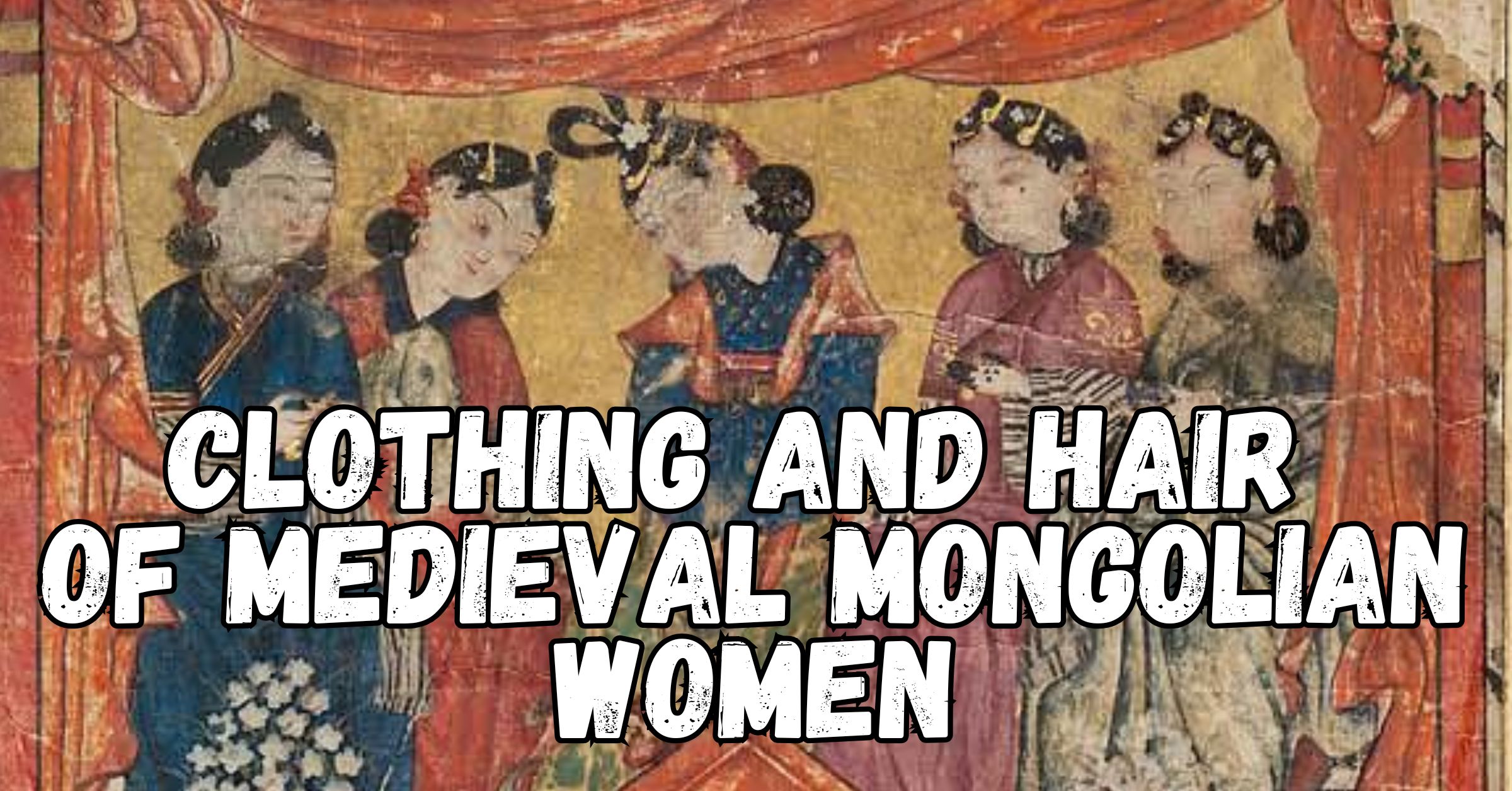
What did Mongol elite women actually wear — and what can art, travellers’ reports, and archaeology tell us about their hair and headgear? From looped braids to the towering boqta, the evidence reveals a distinctive courtly style that travelled across the Mongol Empire.
By Jack R. Wilson
In a previous article, we looked at hairstyles in 13th century northeastern Asia; focus there was on the hairs of Han Chinese, Jurchen, Khitan, Tangut and Mongolian men. To complement it, in this article we’ll look at how sources indicate Mongolian women wore their hair, and other aspects of their material culture.
While descriptions of the distinctive Mongolian nuqula hairstyle abound across both surviving written and visual sources (shaving the top of the head, leaving a rectangular lock on the forehead and twisting the remaining hair behind the ears in loops), rather less attention is given to how women wore their hair. In part, this is due to some of the clothing styles which obscured the hair from the view of travellers or in the paintings produced in the Mongol courts. Accordingly, sources comment instead on the hats the women wore, rather than how the hair looked beneath. Important to note is that our sources (both textual, visual but also archaeological) are overwhelmingly only providing data on upper-class women, making it hard to know how applicable these things would be for common people in the Mongolian plateau.
But a few hairstyles associated with Mongolian women (or at least, women who were within the cultural sphere of the Chinggisid elite) can be observed. Some paintings surviving from the Yuan Dynasty (the continuation of the Mongol Empire ruling over China (until 1368) and Mongolia (until 1635)) depict a style where women’s hair falls in loops behind their ears, echoing the loops worn by men (šibülger).
This style of looped hair also appears in artwork from the western end of the Mongol Empire, the Ilkhanate, ruling over most of the modern Middle East. Several examples come from the illustrated Ilkhanid Shāhnāme. The Shāhnāme (‘Book of Kings’) is a Persian epic dating from the 10th century, but remained popular during Mongol rule. A number of richly illustrated manuscripts were produced under the patronage of the Ilkhanid court and nobility, of which several survive in varying states of preservation. The subjects, whether ancient Persian heroes or Alexander the Great (Sikandar as he became in Farsi) tend to be depicted with contemporary Mongolian clothing, armour and facial features. These productions were for the entertainment of the Chinggisid court, who wanted to see themselves reflected in it.
The level of detail of this style in the Ilkhanid art varies. As seen in Figure 3, the hair loops become black circles without the visible gap; this is likely to be a stylistic result of the painting, rather than a difference in how the hair was actually worn. While the hair of the women in Figure 3 is more elaborate due to the subjects being fictional princesses from the Shāhnāme, the bundle of hair visible below their ears is likely to be the stylised loops. Meanwhile, a less stylised example from a slightly earlier Shāhnāme can be seen in Figure 4.
Yet more commonly shown in Ilkhanid art than the hair loops, is women’s hair being worn in long braids. Figures 5−9 show some of the more detailed examples. Generally, the two long braids fall down the chest, in some cases all the way past the woman’s waist. As seen in Figure 7, other braids could also fall down the back, leaving the individual with multiple long braids. The hair here is also usually accompanied by jewellery and other adornments. In some cases, the men in the scene are also wearing their hair in a similar fashion (Figure 8). This is more likely to be artistic license (the Shāhnāme being set in a fictionalised past) given the legal associations of the nuqula hairstyle for men.
A third feature of empire-era Mongolian women’s hair that is observable is a rather unique shaving custom which mirrors that which men wore. The Franciscan Friar William of Rubruck travelled to the Mongol imperial capital of Qaraqorum in the early 1250s, and wrote an account of his journey for King Louis IX of France (r.1226−1270). Rubruck’s account is one of the most valuable ‘ethnographies’ we have of the period, offering a detailed and reliable description of culture and costume that he observed in the Mongol Empire, even if Rubruck hated the experience. Regarding women’s clothing and hair, he states:
The girls’ dress does not differ from the men’s, except that it is a trifle longer. But the day after she is married, [a girl] shaves her head from the middle towards the forehead. She has a tunic as wide as a nun’s cowl, but with an altogether broader and longer opening at the front, and tied on the right. The Tartars differ here from the Turks, in that the Turks tie their tunics on the left and the Tartars always on the right. ~ The Mission of Friar William of Rubruck: His Journey to the Court of the Great Khan Möngke, 1253–1255, trans. Peter Jackson
Remarkably, Rubruck’s peculiar custom for married women —shaving the front of her head after her wedding— is actually attested in fourteenth century Yuan Dynasty portraits of empresses and concubines of the Great Khans, revealed by the see-through fronts of their boqta. Potential depictions of this custom in other Yuan or Ilkhanid artwork may simply be obstructed by the boqta lacking this sheer fabric.
The Clothing of Medieval Mongolian Women
The most iconic part of medieval Mongolian women’s dress has already been seen in several of the paintings above (Figure 2, Figures 10−13). This is the boqta (modern Mongolian: Богтаг). These tall hats consisted of wire or wooden frame, wrapped in fabric (for aristocratic women, silk). The ensuing tower fit through a hole in another cap, which was securely tied to the head. At the top of the boqta were placed decorative feathers (peacock being very desired) which made the ensemble even taller, and further adorned with precious gems and stones (gold and pearls being favoured). The result was a striking sight, and is the most remarked upon article of female Mongolian clothing in medieval accounts, described in Chinese, Arabic, Persian and European authors. A number of archaeological examples found in graves of the 13th−14th Mongol noblewomen have also been found (Figure 19), which show distinctive styles which researchers have placed into groups.
It was also a somewhat cumbersome item for daily life, making it difficult to go through doorways. Boqta were worn by married noblewomen, and there is little to suggest they were worn among lower-status women in the 1200s. They were worn for court events and ceremonies, a piece of formal clothing (Figure 14), and even these high-status women likely removed them for daily life for sake of convenience. If lower status or common women were wearing them, then they were likely much simpler, more manageable versions and not made of such rich materials.
As pointed out by Eiren Shea in Mongol Court Dress, Identity Formation, and Global Exchange, wimples (bukhnūq) are commonly worn in the later Ilkhanid artwork (figure 4), rather than the more iconic boqta. Whether this reflects changes in fashion, or simply artistic styles, is unknown but boqta again became prominent in Timürid art in the fifteenth century.
Arguments have also been made that the boqta influenced the development of the hennin, the famous headdress associated with medieval European princesses. However, reliable data for that theory, beyond vague similarities in the form of ‘tall headgear for high-status women’ (a very old trend in the steppe already long before the Mongols) is very slim. Further, the comparatively late appearance of the hennin (15th century) would suggest a 13th−14th century influence was, at best, very indirect.
Women’s robes (de’el) tended to match the cut of men’s, and were worn over the top of trousers and boots (qutul). As women were still expected to ride horses, the clothing still had to remain practical. This need for practicality, also meant that footbinding was not practiced among the Mongolian noblewomen in China during the Yuan Dynasty. Foot binding was by then, a relatively new trend and largely confined to the elite in the newly conquered southern China, who were not expected to ride horses, shoot bows or partake in yearly migrations between capital cities with Qubilai Qa’an’s court.
The greatest distinction, and again likely reserved for upper-class women, was that women’s robes tended to have more material (note the bulkier sleeves in figure 14 of the women compared to the men), and even skirts so long that they dragged on the ground (figures 15 and 16). As with anywhere in the medieval world, one of the ways in which individuals would show off their wealth was in the type of material their clothing was made of (for upper class Mongols, a silk-and-gold lampas weave called nasishi was by far the most prized), and the amount of material used. An excess of material far beyond what was necessary, was a means to show the bearer had wealth to spare. Especially for the Mongols, whose elite clothing still followed the general cut of the average herdsman’s de’el, these distinctions and decorations were required to make their status easily visible.
A belt and a hat were seen as distinguishing features of a man’s clothing, and the removal of them was a symbolic sign of submission or humiliation. Women in contrast were stereotyped as not wearing belts; they are never shown wearing them in artwork, and were poetically sometimes referred to as büse ügei; “beltless ones.” However, this was again an idealised thing more likely reserved for the upper-classes who were less responsible for their daily needs. Belts on steppe clothing were very practical items; as the de’el and similar garments (caftans) lacked pockets, the belt was the primary place to attach most of the utensils needed in a day, while the tightened belt also created a space in the robe on the chest which could be used as a pocket (something still done by Mongolians today who wear their traditional clothing). For most herdswomen, the utility of a belt would be hard to ignore and they likely wore them when it was needed. Meanwhile, mentions in the sources of Mongolian women walking around armed with bows, quiver and swords, such as the famous Baghdad Khatun, wife of Abu Sa’id Ilkhan (r.1316−1335), were presumably wearing belts, to which these accoutrements of battle were fastened.
The man’s de’el is consistently described as fastening underneath the right arm, which textual sources, and most visual depictions, also assert for the woman’s de’el. However, a few depictions, and surviving examples excavated from tombs, show variation in this, such as on the de’el of the seated woman in the mural in figure 2, above.
The 13th−14th century grave of an older woman buried in a cave on Mount Ikh Nartiin Khad in the eastern Gobi in Mongolia, provides some fascinating examples. Firstly, as is common for elite burials, she was laid to rest with a boqta placed beside her (figure 19). She was also buried with three robes. The first was a cegdeg, a garment worn under the other layers, in this case made of red tabby silk trimmed with patterned white brocade (figure 18). Interestingly, while it bears the collar typical of Mongolian robes, this collar is entirely decorative. That is, it does not actually open up in typical fashion, but has to be pulled over the head. Despite this, it was still made to visually appear to match the design of robes which do open. Another of the coats the Nartiin Khad woman was buried with was a ceremonial outer coat of red golden lampas, nashishi. This was the outermost layer to be worn; unlike the cegdeg, this coat does open up, yet, like mural of figure 2, was tied on the left side under the left arm (as opposed to the right side under the right arm, as it is typically described in texts or found in extant examples).
Jack Wilson completed his MA thesis at Central European University, where he offered a reassessment of the life and career of Nogai and his role in the late thirteenth-century Golden Horde. He is currently a Doctoral Candidate at CEU, focusing on the Golden Horde in the late thirteenth century. You can visit the educational videos he creates about the Mongol Empire on Youtube at The Jackmeister: Mongol History.
Click here to read more from Jack Wilson
Subscribe to Medievalverse
Related Posts