University of Arizona: Doctor of Philosophy, Department of History (1995)
Abstract
This thesis examines the role of women in the Parisian economy in the late thirteenth century. The Livre des metiers of Etienne Boileau offers normative provisions regarding societal structures that permitted but restricted the participation of women, while the tax rolls commonly known as the roles de la taille de Philippe le Bel furnish numbers which show their actual participation. While these sources are well known, they have not heretofore been rigorously examined. Conclusions about women based on them have been amorphous. Married women are nearly invisible in these records, but unmarried women and widows headed 13.6% of Parisian workshops. Women monopolized the Parisian silk industry. About one-third of Parisian women in the late thirteenth century worked in jobs traditionally considered “women’s work,” including the preparation of food and clothing, peddling food on the street, and providing personal services.
The other two-thirds did nearly every kind of work that men did. A “putting out” system was well in place in Paris at this time. Women classified as chambrieres or ouvrieres worked at home, spinning and weaving raw materials provided by an entrepreneur and selling back to the entrepreneur the finished product. Working at home allowed a woman to combine household duties with production for the marketplace. Girls usually learned a trade by working alongside their parents. Formal apprenticeships were less common for girls than for boys. While women could and did participate in nearly every trade, their numbers were concentrated in the lowest-paid metiers. The few women who practiced trades dominated by men were much more successful financially.

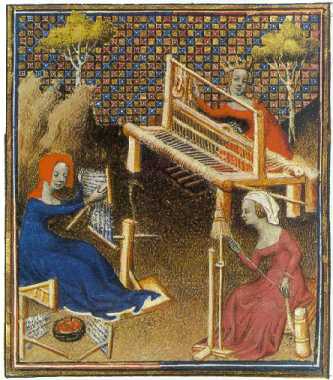
Working women in thirteenth-century Paris
Janice Marie Archer
University of Arizona: Doctor of Philosophy, Department of History (1995)
Abstract
This thesis examines the role of women in the Parisian economy in the late thirteenth century. The Livre des metiers of Etienne Boileau offers normative provisions regarding societal structures that permitted but restricted the participation of women, while the tax rolls commonly known as the roles de la taille de Philippe le Bel furnish numbers which show their actual participation. While these sources are well known, they have not heretofore been rigorously examined. Conclusions about women based on them have been amorphous. Married women are nearly invisible in these records, but unmarried women and widows headed 13.6% of Parisian workshops. Women monopolized the Parisian silk industry. About one-third of Parisian women in the late thirteenth century worked in jobs traditionally considered “women’s work,” including the preparation of food and clothing, peddling food on the street, and providing personal services.
The other two-thirds did nearly every kind of work that men did. A “putting out” system was well in place in Paris at this time. Women classified as chambrieres or ouvrieres worked at home, spinning and weaving raw materials provided by an entrepreneur and selling back to the entrepreneur the finished product. Working at home allowed a woman to combine household duties with production for the marketplace. Girls usually learned a trade by working alongside their parents. Formal apprenticeships were less common for girls than for boys. While women could and did participate in nearly every trade, their numbers were concentrated in the lowest-paid metiers. The few women who practiced trades dominated by men were much more successful financially.
Click here to read this thesis from the University of Arizona
Subscribe to Medievalverse
Related Posts