The jus primae noctis as a male power display: A review of historic sources with evolutionary interpretation
By Jörg Wettlaufer
Evolution and Human Behavior, Vol.21 (2000)
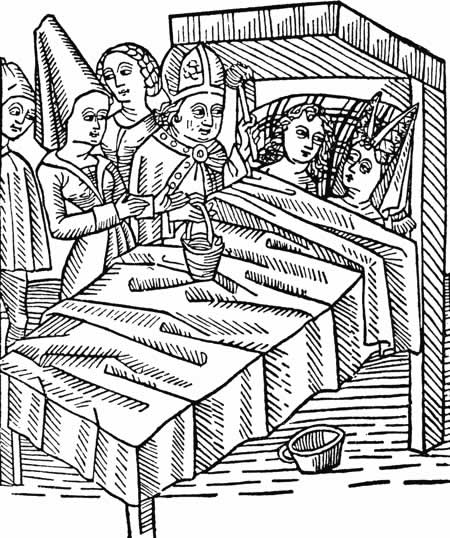
Abstract: The jus primae noctis was, in the European late medieval context, a widespread popular belief in an ancient privilege of the lord of the manor to share the wedding bed with his peasants’ brides. Symbolic gestures, reflecting this belief, were developed by the lords and used as humiliating signs of superiority over the dependent peasants in the fifteenth century, a time of diminishing status differences. Actual intercourse in the exercise of the alleged right is difficult to prove, and there is no hard evidence to suggest that it ever actually happened. However, the symbolic gestures can be best interpreted as a male power display, with a basis in the psychology of coercive social dominance, male competition, and male desire for sexual variety.
Several non-European cultures have accounts of a similar custom related to a young girl’s first sexual intercourse: ritual defloration by chiefs, priests, or strangers. This non-European custom differs from the jus primae noctis in its proximate details, but seems from an ultimate point of view, to be in conformity with the European evidence. In this article the origin, development, and relationship of both customs are discussed and interpreted in light of recent evolutionary studies of primate behavior and sexual psychology.

The jus primae noctis as a male power display: A review of historic sources with evolutionary interpretation
By Jörg Wettlaufer
Evolution and Human Behavior, Vol.21 (2000)
Abstract: The jus primae noctis was, in the European late medieval context, a widespread popular belief in an ancient privilege of the lord of the manor to share the wedding bed with his peasants’ brides. Symbolic gestures, reflecting this belief, were developed by the lords and used as humiliating signs of superiority over the dependent peasants in the fifteenth century, a time of diminishing status differences. Actual intercourse in the exercise of the alleged right is difficult to prove, and there is no hard evidence to suggest that it ever actually happened. However, the symbolic gestures can be best interpreted as a male power display, with a basis in the psychology of coercive social dominance, male competition, and male desire for sexual variety.
Several non-European cultures have accounts of a similar custom related to a young girl’s first sexual intercourse: ritual defloration by chiefs, priests, or strangers. This non-European custom differs from the jus primae noctis in its proximate details, but seems from an ultimate point of view, to be in conformity with the European evidence. In this article the origin, development, and relationship of both customs are discussed and interpreted in light of recent evolutionary studies of primate behavior and sexual psychology.
Click here to read this article from Evolution and Human Behavior
Subscribe to Medievalverse
Related Posts