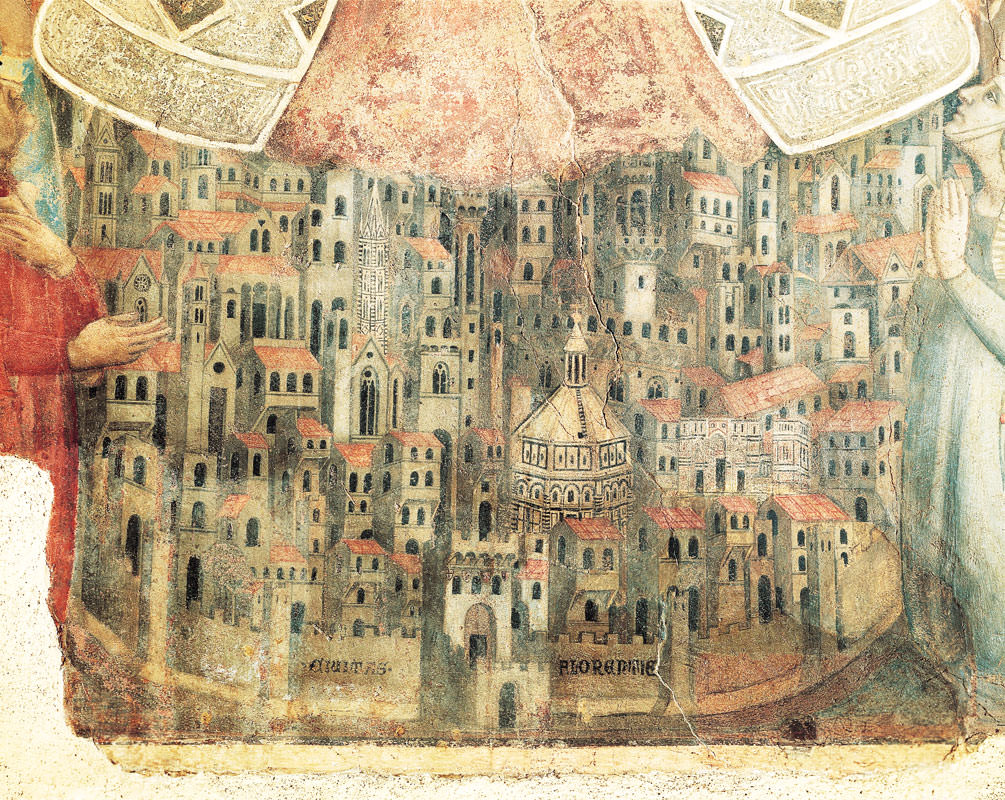
Madonna della Misericordia – depicting Florence (1342). School of Bernardo Daddi, Museo del Bigallo, Florence.
Palaces and the Street in Late-Medieval and Renaissance Italy
David Friedman
Urban Landscapes: International Perspectives, edited J.Whitehead and P. Larkham (London, 1992)
Abstract
The relationship between the private house and the environment of public space in the Italian city underwent a fundamental reordering in the late Middle Ages. The catalysts were, simultaneously, the new prominence given to the street as an instrumental of spatial organization by the merchant-artisan regimes that gained control of the state in this period and the monumentalization of the private residence by builders from the class of men that formed government. Despite the fact that officials who commissioned the new streets and the men who raised palaces were sometimes the same people, the two urban types did not, at first, enjoy an untroubled relationship. The new ruling class discovered the ideal form of the street well before they were willing, as individuals, to give up some traditional privileges associated with property ownership that contradicted it. It is not until the Renaissance that street and palace – and this statement is also true for modest domestic architecture – were set into the more or less symbiotic relationship in which they continued until the twentieth century.
The late Middle Ages was a period of spectacular urban growth throughout Italy. The city of Florence, for example, began a circuit of walls in 1284 that expanded the area of the city five-fold. The newly enclosed land was developed co-operatively by its owners and by the government. In all cases development was based on streets. The new streets were public streets, and as such only one of a variety of passages through the city. Distinctions were both physical and legal. A via vicinale, or neighbourhood street, was narrower than a public one.

Palaces and the Street in Late-Medieval and Renaissance Italy
David Friedman
Urban Landscapes: International Perspectives, edited J.Whitehead and P. Larkham (London, 1992)
Abstract
The relationship between the private house and the environment of public space in the Italian city underwent a fundamental reordering in the late Middle Ages. The catalysts were, simultaneously, the new prominence given to the street as an instrumental of spatial organization by the merchant-artisan regimes that gained control of the state in this period and the monumentalization of the private residence by builders from the class of men that formed government. Despite the fact that officials who commissioned the new streets and the men who raised palaces were sometimes the same people, the two urban types did not, at first, enjoy an untroubled relationship. The new ruling class discovered the ideal form of the street well before they were willing, as individuals, to give up some traditional privileges associated with property ownership that contradicted it. It is not until the Renaissance that street and palace – and this statement is also true for modest domestic architecture – were set into the more or less symbiotic relationship in which they continued until the twentieth century.
The late Middle Ages was a period of spectacular urban growth throughout Italy. The city of Florence, for example, began a circuit of walls in 1284 that expanded the area of the city five-fold. The newly enclosed land was developed co-operatively by its owners and by the government. In all cases development was based on streets. The new streets were public streets, and as such only one of a variety of passages through the city. Distinctions were both physical and legal. A via vicinale, or neighbourhood street, was narrower than a public one.
Click here to read this article from Urban Landscapes
Subscribe to Medievalverse
Related Posts