In the later Middle Ages, Iceland was known across northern Europe for its fish. Yet another resource—less visible, more volatile, and arguably just as important—helped tie the island into wider economic and political networks. Sulphur, drawn from Iceland’s volcanic landscape, became a key commodity that connected the North Atlantic to warfare, medicine, and industry.
In her article, “The Sulphur Trade of Iceland from the Viking Age to the End of the Hanseatic Period,” Natascha Mehler explores how the sulphur trade began on the island and how it became one of Iceland’s most important exports in the later Middle Ages.
A Resource from the Earth
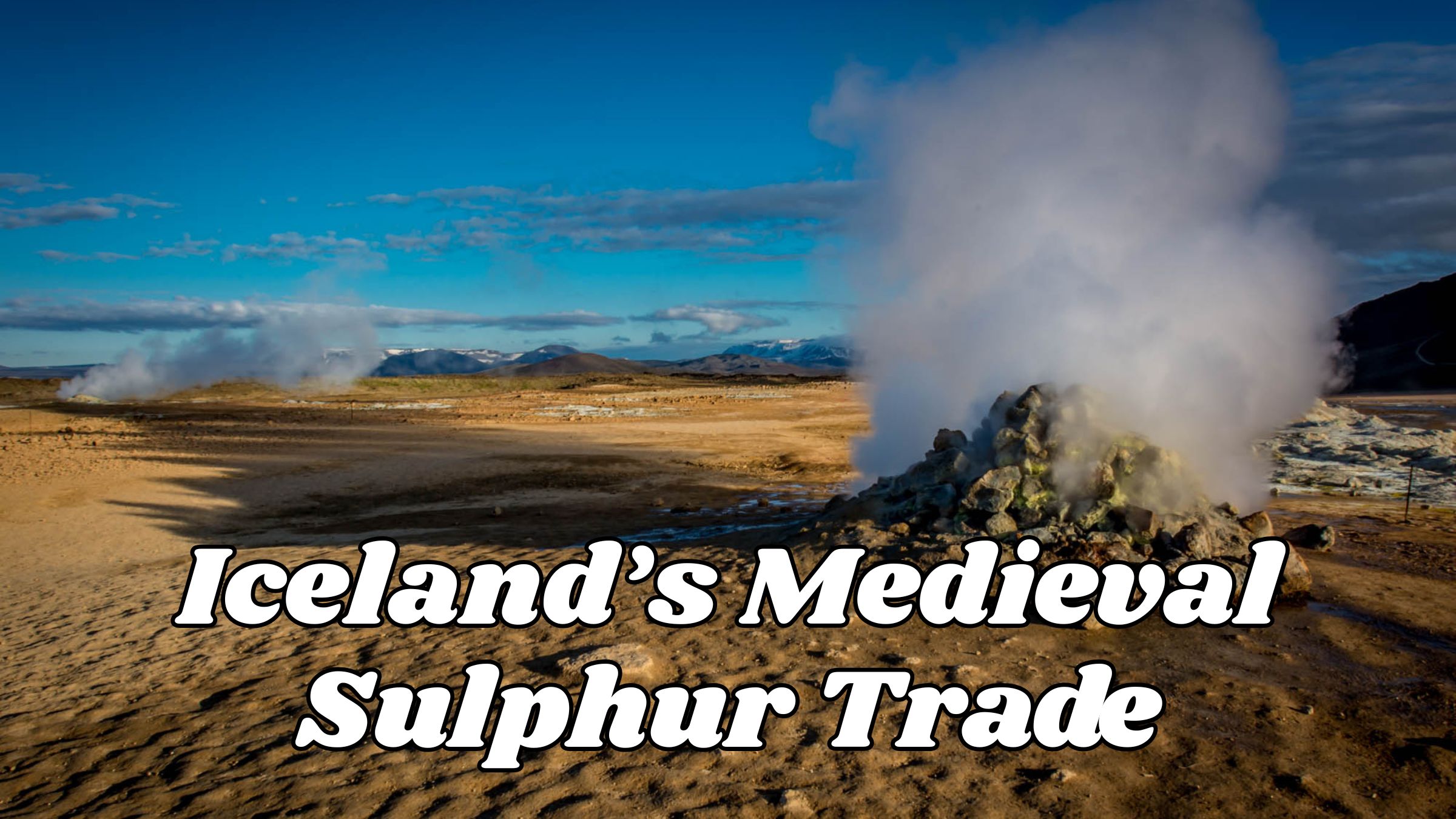
Hverarönd – Land of Brimstone and Fire – a geothermal region located near the volcano Krafla in northern Iceland. Photo by Bernd Thaller / Flickr
Iceland’s sulphur deposits were a product of its unique geology. Located along the Mid-Atlantic Ridge, the island contains numerous geothermal areas where gases rise through the earth’s crust. When hydrogen sulphide meets oxygen, it forms elemental sulphur, which accumulates in bright yellow deposits around volcanic vents and hot springs.
Unlike many other European regions, Iceland’s sulphur was found in a relatively pure, elemental form. This made it easier to collect and process than sulphur bound within minerals elsewhere. By the thirteenth century, knowledge of sulphur’s properties had spread widely across Europe, reaching even its more remote regions.
Mehler notes that “from the 13th century onwards, Iceland’s rich sulphur deposits attracted the attention of foreign merchants who soon began to export sulphur in great quantities.” Although other sources existed in places like Sicily, Poland, and Sweden, Iceland’s deposits became especially significant within northern European trade networks. Over time, sulphur emerged as one of the island’s most important exports, alongside fish and homespun cloth.
The Many Uses of Sulphur
Mehler explains that the demand for sulphur was driven by its versatility. She lists some of its uses during the Middle Ages:
In medieval medicine, it was valued for its antibacterial and stimulating properties. It was used in ointments to treat skin conditions such as haemorrhoids, psoriasis, and acne. Even Abbess Hildegard of Bingen (1098-1179) knew of a prescription to treat leprosy that contained sulphur.
Sulphur also played a role in artistic production. It was a key ingredient in the creation of vermilion, a bright red pigment widely used in manuscript illumination and wall painting.
Sulphur was used as a disinfectant and preservative. Burning sulphur inside barrels helped to sterilise them and prevent the spoilage of wine or beer. It also aided in preserving hops, making it important for brewing industries, particularly in northern Europe.
Mehler writes that sulphur was “greatly valued for its highly flammable properties and used to light fires, e.g. with a flint and strike-a-light. From the later medieval period onwards sulphur became increasingly important as a main ingredient in the production of gunpowder, which consisted of saltpetre (c. 74%), charcoal (c. 16%) and sulphur (c. 10%). Gunpowder made its way into Europe in the mid-13th century and the demand for it grew drastically with the development of firearms in the later Middle Ages.”
Mining the Volcanic Landscape
The richest sulphur deposits in Iceland were located in two main regions: the Mývatn district in the north and the Krýsuvík area on the Reykjanes Peninsula in the south. The northern fields, particularly those around Reykjahlíð, were the most productive. From these areas, sulphur was collected by digging it out of the ground, often in harsh and remote environments.
The work itself was seasonal. Farmers typically collected sulphur in the spring, after the snow had melted but before more important agricultural labour began. Once extracted, the raw sulphur was transported to nearby farms and then to coastal harbours. In the north, Húsavík became the principal export centre, with sulphur processed and shipped from its harbour. In the south, material from Krýsuvík was transported by horse to coastal points near present-day Reykjavík.
Processing and Refining
Miniature of a man at work extracting sulfur / sulphur. British Library MS Egerton 747 f. 88v
Sulphur could be exported in raw form, but it was often refined before shipment. Although detailed medieval descriptions of refining techniques are scarce, later accounts provide insight into the process. Sulphur was heated in iron pans and mixed with substances such as train oil. Impurities rose to the surface and were skimmed off, leaving purer sulphur behind.
The refined material was then poured into wooden moulds and allowed to cool into manageable pieces for transport. This process required fuel—often scarce in Iceland—and careful handling to avoid waste or contamination. It was a labour-intensive operation, involving multiple workers and specialised equipment.
Despite these challenges, sulphur was processed in Iceland from at least the late medieval period. Archaeological evidence from sites such as Gásir suggests that refining may have been taking place as early as the fourteenth century.
Trade Networks and Foreign Interest
Mehler notes that on Olaus Magnus’ map Carta Marina (1539) one can see along southern coastline of Iceland a barrel labelled SULVUR – Wikimedia Commons
The sulphur trade was shaped by shifting patterns of foreign involvement. Initially, Iceland was integrated into Norwegian trade networks, with Bergen serving as a major hub. From there, sulphur was redistributed across northern Europe.
By the fifteenth century, English merchants had become increasingly active in Icelandic waters, not only fishing but also acquiring goods such as sulphur. Soon after, merchants from the Hanseatic cities—particularly Hamburg and Bremen—established a dominant presence. These traders expanded their activities across the North Atlantic, linking Iceland with wider commercial networks.
The scale of the trade was significant. Estimates suggest that hundreds of tons of sulphur were exported annually during the sixteenth century. The profits could be substantial, with merchants benefiting from high mark-ups when selling the material in continental markets.
Given its value, sulphur became a focus of political control. In 1561, King Frederik II of Denmark-Norway established a royal monopoly over the sulphur trade. Foreign merchants were forbidden from exporting the resource, and Icelanders were ordered to sell it exclusively to the crown. This marked a major shift, bringing the trade under direct state control.
The monarchy also moved refining operations to Copenhagen, where sulphur could be processed more efficiently. Two ships were dispatched each year to Iceland to collect raw sulphur, usually picking up the goods at the port of Húsavík.
“The introduction of the sulphur monopoly naturally resulted in intensive smuggling,” Mehler writes. “There were not that many Danish officials in Iceland and the vast swathes of land were difficult to monitor. Because Húsavík was firmly in the hands of Danish officials sulphur was smuggled to other harbours. In August 1562, Kolbeinn Þorgrimsson was accused of having brought sulphur from the mines at Fremri-Námur to the harbour on the island of Flatey and to Straumur near Reykjavík; he must have transported the sulphur across the mountains on horseback. In 1566, a ship with illegal goods including five lasts of sulphur stranded in the Thy district in Jutland, Denmark. Because the sulphur was regarded as the king’s property it was seized by the authorities and transported to Thisted.”
Archaeological Evidence and Everyday Use
Although sulphur itself rarely survives in the archaeological record, several discoveries provide insight into its use. At Hofstaðir, a Viking Age site, sulphur was found in association with a smithy, suggesting it may have been used to help start fires. At the monastery of Skriðuklaustur, sulphur may have been used in medical preparations or artistic production.
Other finds, such as a sulphur-filled barrel recovered from a shipwreck off the German coast, illustrate the material’s role in long-distance trade. These discoveries help to fill gaps left by written sources, offering glimpses into how sulphur was produced, transported, and used.
While Mehler notes that “many aspects of the early history of Icelandic sulphur mining undoubtedly still lie in the dark and numerous questions remain unanswered,” her research reveals that this trade had “wide-ranging economic, political and cultural importance… by the later Middle Ages, sulphur had become an immensely powerful trade commodity which rulers were eager to control. It has been argued that in the 15th and 16th centuries, the role of sulphur as an export article was almost as important as that of fish.”
Natascha Mehler’s article, “The Sulphur Trade of Iceland from the Viking Age to the End of the Hanseatic Period,” is published in Nordic Middle Ages – Artefacts, Landscapes and Society. Essays in Honour of Ingvild Øye on her 70th Birthday, edited by Irene Baug, Janicke Larsen and Sigrid Samset Mygland. You can read it on her Academia.edu page.
Natascha Mehler is Professor of Medieval Archaeology at the University of Tübingen. Her research focuses on trade and connections between Europe and the North Atlantic.

In the later Middle Ages, Iceland was known across northern Europe for its fish. Yet another resource—less visible, more volatile, and arguably just as important—helped tie the island into wider economic and political networks. Sulphur, drawn from Iceland’s volcanic landscape, became a key commodity that connected the North Atlantic to warfare, medicine, and industry.
In her article, “The Sulphur Trade of Iceland from the Viking Age to the End of the Hanseatic Period,” Natascha Mehler explores how the sulphur trade began on the island and how it became one of Iceland’s most important exports in the later Middle Ages.
A Resource from the Earth
Iceland’s sulphur deposits were a product of its unique geology. Located along the Mid-Atlantic Ridge, the island contains numerous geothermal areas where gases rise through the earth’s crust. When hydrogen sulphide meets oxygen, it forms elemental sulphur, which accumulates in bright yellow deposits around volcanic vents and hot springs.
Unlike many other European regions, Iceland’s sulphur was found in a relatively pure, elemental form. This made it easier to collect and process than sulphur bound within minerals elsewhere. By the thirteenth century, knowledge of sulphur’s properties had spread widely across Europe, reaching even its more remote regions.
Mehler notes that “from the 13th century onwards, Iceland’s rich sulphur deposits attracted the attention of foreign merchants who soon began to export sulphur in great quantities.” Although other sources existed in places like Sicily, Poland, and Sweden, Iceland’s deposits became especially significant within northern European trade networks. Over time, sulphur emerged as one of the island’s most important exports, alongside fish and homespun cloth.
The Many Uses of Sulphur
Mehler explains that the demand for sulphur was driven by its versatility. She lists some of its uses during the Middle Ages:
Mining the Volcanic Landscape
The richest sulphur deposits in Iceland were located in two main regions: the Mývatn district in the north and the Krýsuvík area on the Reykjanes Peninsula in the south. The northern fields, particularly those around Reykjahlíð, were the most productive. From these areas, sulphur was collected by digging it out of the ground, often in harsh and remote environments.
The work itself was seasonal. Farmers typically collected sulphur in the spring, after the snow had melted but before more important agricultural labour began. Once extracted, the raw sulphur was transported to nearby farms and then to coastal harbours. In the north, Húsavík became the principal export centre, with sulphur processed and shipped from its harbour. In the south, material from Krýsuvík was transported by horse to coastal points near present-day Reykjavík.
Processing and Refining
Sulphur could be exported in raw form, but it was often refined before shipment. Although detailed medieval descriptions of refining techniques are scarce, later accounts provide insight into the process. Sulphur was heated in iron pans and mixed with substances such as train oil. Impurities rose to the surface and were skimmed off, leaving purer sulphur behind.
The refined material was then poured into wooden moulds and allowed to cool into manageable pieces for transport. This process required fuel—often scarce in Iceland—and careful handling to avoid waste or contamination. It was a labour-intensive operation, involving multiple workers and specialised equipment.
Despite these challenges, sulphur was processed in Iceland from at least the late medieval period. Archaeological evidence from sites such as Gásir suggests that refining may have been taking place as early as the fourteenth century.
Trade Networks and Foreign Interest
The sulphur trade was shaped by shifting patterns of foreign involvement. Initially, Iceland was integrated into Norwegian trade networks, with Bergen serving as a major hub. From there, sulphur was redistributed across northern Europe.
By the fifteenth century, English merchants had become increasingly active in Icelandic waters, not only fishing but also acquiring goods such as sulphur. Soon after, merchants from the Hanseatic cities—particularly Hamburg and Bremen—established a dominant presence. These traders expanded their activities across the North Atlantic, linking Iceland with wider commercial networks.
The scale of the trade was significant. Estimates suggest that hundreds of tons of sulphur were exported annually during the sixteenth century. The profits could be substantial, with merchants benefiting from high mark-ups when selling the material in continental markets.
Given its value, sulphur became a focus of political control. In 1561, King Frederik II of Denmark-Norway established a royal monopoly over the sulphur trade. Foreign merchants were forbidden from exporting the resource, and Icelanders were ordered to sell it exclusively to the crown. This marked a major shift, bringing the trade under direct state control.
The monarchy also moved refining operations to Copenhagen, where sulphur could be processed more efficiently. Two ships were dispatched each year to Iceland to collect raw sulphur, usually picking up the goods at the port of Húsavík.
“The introduction of the sulphur monopoly naturally resulted in intensive smuggling,” Mehler writes. “There were not that many Danish officials in Iceland and the vast swathes of land were difficult to monitor. Because Húsavík was firmly in the hands of Danish officials sulphur was smuggled to other harbours. In August 1562, Kolbeinn Þorgrimsson was accused of having brought sulphur from the mines at Fremri-Námur to the harbour on the island of Flatey and to Straumur near Reykjavík; he must have transported the sulphur across the mountains on horseback. In 1566, a ship with illegal goods including five lasts of sulphur stranded in the Thy district in Jutland, Denmark. Because the sulphur was regarded as the king’s property it was seized by the authorities and transported to Thisted.”
Archaeological Evidence and Everyday Use
Although sulphur itself rarely survives in the archaeological record, several discoveries provide insight into its use. At Hofstaðir, a Viking Age site, sulphur was found in association with a smithy, suggesting it may have been used to help start fires. At the monastery of Skriðuklaustur, sulphur may have been used in medical preparations or artistic production.
Other finds, such as a sulphur-filled barrel recovered from a shipwreck off the German coast, illustrate the material’s role in long-distance trade. These discoveries help to fill gaps left by written sources, offering glimpses into how sulphur was produced, transported, and used.
While Mehler notes that “many aspects of the early history of Icelandic sulphur mining undoubtedly still lie in the dark and numerous questions remain unanswered,” her research reveals that this trade had “wide-ranging economic, political and cultural importance… by the later Middle Ages, sulphur had become an immensely powerful trade commodity which rulers were eager to control. It has been argued that in the 15th and 16th centuries, the role of sulphur as an export article was almost as important as that of fish.”
Natascha Mehler’s article, “The Sulphur Trade of Iceland from the Viking Age to the End of the Hanseatic Period,” is published in Nordic Middle Ages – Artefacts, Landscapes and Society. Essays in Honour of Ingvild Øye on her 70th Birthday, edited by Irene Baug, Janicke Larsen and Sigrid Samset Mygland. You can read it on her Academia.edu page.
Natascha Mehler is Professor of Medieval Archaeology at the University of Tübingen. Her research focuses on trade and connections between Europe and the North Atlantic.
Top Image: Hverarönd, Iceland. Photo by Ron Kroetz / Flickr
Subscribe to Medievalverse
Related Posts