In the eighth century, an English nun named Leoba composed a short Latin poem that has quietly survived for more than a millennium. Though brief, the verse offers valuable insight into the education, literary culture, and spiritual ambitions of women in the early medieval Church.
By John Gallagher
Among the earliest surviving literature from medieval England is the work of the female author Leoba, also known as Leofgyth or Leobgytha. She was a nun who wrote in the first half of the eighth century in early medieval England. Born in Wessex, she entered the convent at Wimborne in Dorset where she was educated and professed her religious vows. Leoba composed poetry in Latin and can confidently claim the title of England’s earliest surviving female poet.
In early medieval England (CE 597–1066), educated and literary culture was bilingual. Clerics, monks, nuns, and others moved comfortably between Latin and Old English, the two languages of learning and devotion. Leoba (a native speaker of Old English) is no less of an English poet because she wrote in Latin rather than Old English. Latin was one of the languages used by English poets at this time and poets who wrote in Latin can certainly be considered English.
Of Leoba’s writings, a single Latin letter survives, addressed to her kinsman Saint Boniface, the celebrated English missionary to the Continent later known as the “Apostle to the Germans”. This letter preserves the sole surviving example of Leoba’s poetry: four lines of Latin hexameter. Yet despite holding the distinction of being the earliest woman poet whose work endures, Leoba remains a marginal and overlooked figure in accounts of early English literary history.
In her letter, Leoba addresses her beloved kinsman Boniface, asking for his prayers for her deceased father and her ailing mother. As an only child, she tells him she regards him as a brother, since there is no one else in whom she can place her trust. The letter reveals an intimate friendship sustained across the miles through correspondence, the exchange of gifts, and what Clare Lees and Gillian Overing have termed “communal literacy,” in which male and female monastics shared poetry, knowledge, and spiritual encouragement to their mutual benefit and growth.
In her letter, Leoba apologises for what she calls the “rustic” style of her Latin letter. She asks Boniface for an example of his elegant Latin writing for her own improvement and in return, offers a poem she composed “merely for practice”. Her self-deprecation is a classic example of the modesty topos (captatio benevolentiae) – a rhetorical strategy whereby an author downplays their ability in order to appear humble and win goodwill before putting forward their own work for critique. Needless to say, the Latin prose of Leoba’s letter is anything but “rustic”.
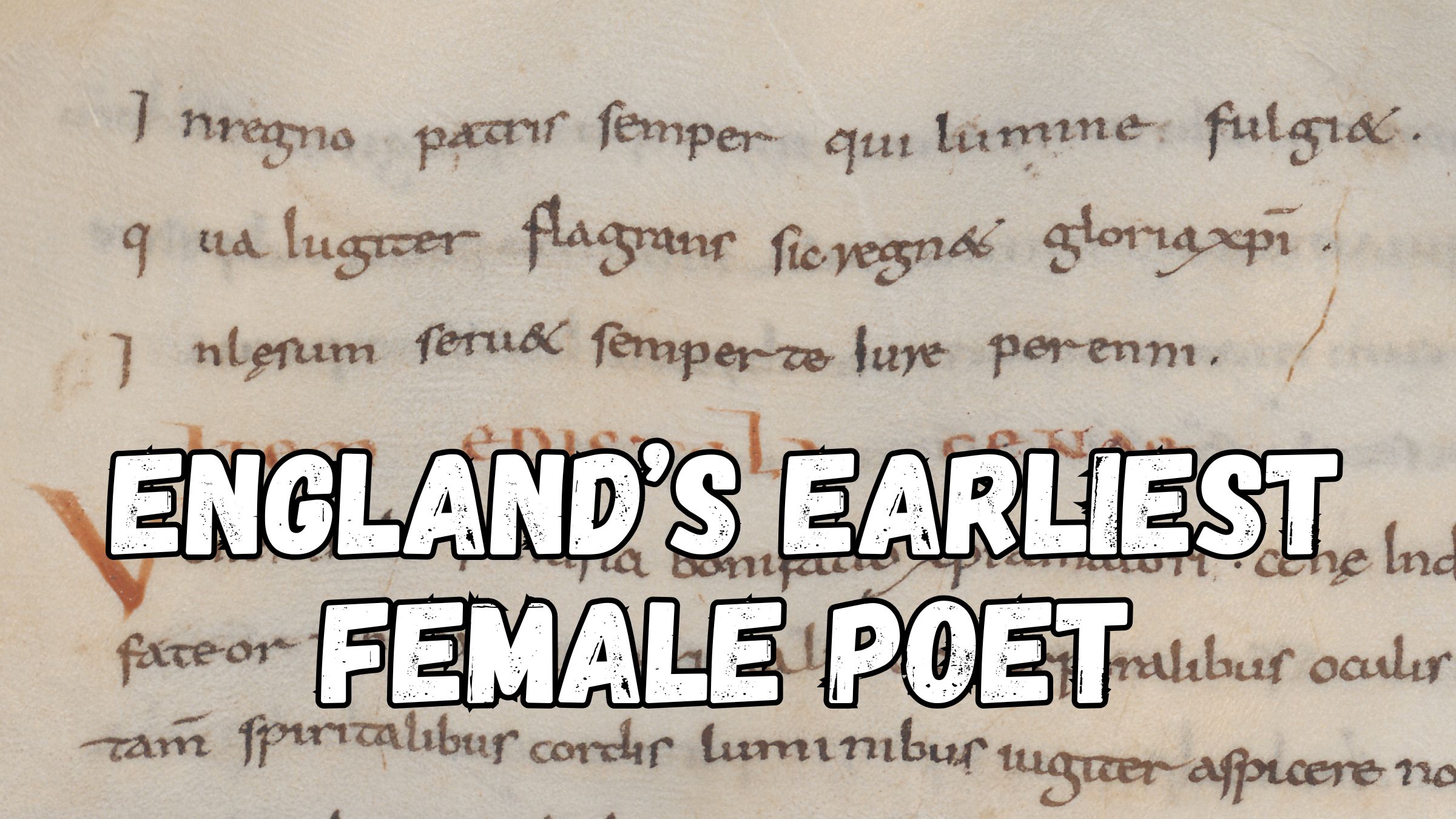
The first two lines of the poem are at the bottom of this folio – Vienna, Österreichische Nationalbibliothek, Cod. Lat. Vindobonensis 751, f. 21r
Leoba’s poem appears in her letter with the following introduction:
Vale, vivens aevo longiore, vita feliciore, interpellans pro me. Arbiter omnipotens, solus qui cuncta creavit, In regno patris semper qui lumine fulget, Qua iugiter flagrans sic regnet gloria Christi Inlesum servet semper te iure perenni.
(Tangl, Die Briefe des heiligen Bonifatius, §29)
Farewell, and may you live long and happily, making intercessions for me. The omnipotent Ruler who alone created everything, He who shines in splendour forever in His Father’s kingdom, The perpetual fire by which the glory of Christ reigns, May preserve you forever in perennial right.
In terms of its metre – the rhythmical pattern of stressed and unstressed syllables – the poem shows familiarity with the work of Aldhelm, one of early medieval England’s most accomplished Latin poets. Aldhelm is known not only for his intricate Latin verse, but also for his guidebooks on poetic metre. By writing using Aldhelm’s metrical forms, Leoba was working in the most cutting-edge poetic forms available to her. Her familiarity with Aldhelm’s metrical style suggests more than a basic education: it illustrates that she was attuned to the latest fashions, trends, and techniques in the Latin poetry circulating in England at this time.
The remaining three lines of Leoba’s poem – Vienna, Österreichische Nationalbibliothek, Cod. Lat. Vindobonensis 751, f. 22v
It was because of her learning and intellectual acumen that Boniface invited her to join him at the missionary frontier in Germany and made her Abbess of Tauberbischofsheim where she went on to have a distinguished career transforming the community into a renowned centre of learning. Two of her own pupils there would go on to lead major monastic centres of study in Germany.
After her death, her remarkable life was recorded by Rudolf of Fulda who tells us that she studied at Wimborne under Abbess Tetta. In her letter to Boniface, she relates how she studied and perfected the art of Latin poetry under Eadburgha of Minster-in-Thanet, near Ebbsfleet in Kent – who was herself another correspondent of Boniface. That both Tetta and Eadburgha were accomplished in Latin and transmitted their expertise to the next generation points to a broader culture of female Latinity in early medieval England. Aldhelm himself noted that the nuns of Barking Abbey were also accomplished in the arena of Latin poetry, indicating a wider culture of high-level Latin literacy among female religious in the seventh and eighth centuries. Together, these sources reveal the sophisticated and vibrant nature of female monastic education in the eighth century, which included subjects as advanced as Latin poetic composition, complex metrical forms, and the art of rhetoric.
Statue of Leoba in Germany – photo by Kandschwar / Wikimedia Commons
So where does Leoba stand in relation to the earliest poetic traditions of early medieval England? Famously, the Venerable Bede recounts in his Ecclesiastical History of the English People (4.22) that the first vernacular poem composed in England came from an unlikely figure – the illiterate cowherd, Caedmon. According to Bede, Cædmon, by divine grace, was miraculously inspired to compose beautiful Old English verse. His creation song, entitled “Cædmon’s Hymn”, praises and honours God in nine simple but highly effective and formally precise lines of alliterative Old English verse. Although Bede recorded Cædmon’s poem in Latin, Old English versions of the text appear as marginal annotations in manuscripts of Bede’s Ecclesiastical History, preserving what is supposedly the earliest Old English poem.
Bede informs us that Cædmon worked at Whitby Abbey under Saint Hilda who encouraged him in his poetic vocation. While Cædmon may be remembered as England’s earliest vernacular poet, Abbess Hilda could be seen as one of the country’s first literary patrons in that she urged Cædmon to join the Whitby community formally by taking monastic vows and encouraged him to continue to compose “delightful and moving” poetry based on the scriptures. It is striking that the earliest surviving poem by a woman in England is also, arguably, a creation hymn. Leoba’s poem, like Cædmon’s, praises God the Father and God the Son as Creator, but in the form of Latin hexameters, rather than Cædmon’s Old English alliterative verse.
Other important poetic works from early medieval England that may have been written by female poets – or from the perspective of female speakers – include the haunting Old English elegies, Wulf and Eadwacer and The Wife’s Lament.
The earliest datable Latin verse that survives from England includes the poetry of Lutting of Lindisfarne, dedicated to his teacher, named Bede (a different Bede from the Venerable one) who died in 681. These poems display a particularly Irish character in their use of Latin and show close familiarity with the classical Roman authors of Latin poetry.
Around this time, Theodore of Tarsus (602–690), the seventh Archbishop of Canterbury who hailed from the Byzantine Empire, wrote a short six-line poem that is also among the earliest verse to survive from England. This short piece was composed by Theodore for Hæddi, the Bishop of Winchester. Although only six lines, Theodore’s little poem marks the beginning of Latin poetry in the southern English context. Of course, Latin by Romano-British and early medieval British (that is, Celtic) authors also survives in addition to these examples from early England.
In the story of England’s earliest poetry, Leoba’s achievement is too often overlooked. Yet her life and story remind us that female monastics at this time could be every bit as intellectually accomplished as their male counterparts. Leoba stands as a significant early figure in the history of English literature whose writing bears witness to a robust tradition of female learning and education. That so little of Leoba’s work has survived is a genuine loss, not only to literature but to our understanding of the scope of female scholarship and literary activity in early medieval England.
John Gallagher is a Post-doctoral Mellon Fellow at the Pontifical Institute of Mediaeval Studies, which is part of the University of Toronto

In the eighth century, an English nun named Leoba composed a short Latin poem that has quietly survived for more than a millennium. Though brief, the verse offers valuable insight into the education, literary culture, and spiritual ambitions of women in the early medieval Church.
By John Gallagher
Among the earliest surviving literature from medieval England is the work of the female author Leoba, also known as Leofgyth or Leobgytha. She was a nun who wrote in the first half of the eighth century in early medieval England. Born in Wessex, she entered the convent at Wimborne in Dorset where she was educated and professed her religious vows. Leoba composed poetry in Latin and can confidently claim the title of England’s earliest surviving female poet.
In early medieval England (CE 597–1066), educated and literary culture was bilingual. Clerics, monks, nuns, and others moved comfortably between Latin and Old English, the two languages of learning and devotion. Leoba (a native speaker of Old English) is no less of an English poet because she wrote in Latin rather than Old English. Latin was one of the languages used by English poets at this time and poets who wrote in Latin can certainly be considered English.
Of Leoba’s writings, a single Latin letter survives, addressed to her kinsman Saint Boniface, the celebrated English missionary to the Continent later known as the “Apostle to the Germans”. This letter preserves the sole surviving example of Leoba’s poetry: four lines of Latin hexameter. Yet despite holding the distinction of being the earliest woman poet whose work endures, Leoba remains a marginal and overlooked figure in accounts of early English literary history.
In her letter, Leoba addresses her beloved kinsman Boniface, asking for his prayers for her deceased father and her ailing mother. As an only child, she tells him she regards him as a brother, since there is no one else in whom she can place her trust. The letter reveals an intimate friendship sustained across the miles through correspondence, the exchange of gifts, and what Clare Lees and Gillian Overing have termed “communal literacy,” in which male and female monastics shared poetry, knowledge, and spiritual encouragement to their mutual benefit and growth.
In her letter, Leoba apologises for what she calls the “rustic” style of her Latin letter. She asks Boniface for an example of his elegant Latin writing for her own improvement and in return, offers a poem she composed “merely for practice”. Her self-deprecation is a classic example of the modesty topos (captatio benevolentiae) – a rhetorical strategy whereby an author downplays their ability in order to appear humble and win goodwill before putting forward their own work for critique. Needless to say, the Latin prose of Leoba’s letter is anything but “rustic”.
Leoba’s poem appears in her letter with the following introduction:
Vale, vivens aevo longiore, vita feliciore, interpellans pro me.
Arbiter omnipotens, solus qui cuncta creavit,
In regno patris semper qui lumine fulget,
Qua iugiter flagrans sic regnet gloria Christi
Inlesum servet semper te iure perenni.
(Tangl, Die Briefe des heiligen Bonifatius, §29)
Farewell, and may you live long and happily, making intercessions for me.
The omnipotent Ruler who alone created everything,
He who shines in splendour forever in His Father’s kingdom,
The perpetual fire by which the glory of Christ reigns,
May preserve you forever in perennial right.
In terms of its metre – the rhythmical pattern of stressed and unstressed syllables – the poem shows familiarity with the work of Aldhelm, one of early medieval England’s most accomplished Latin poets. Aldhelm is known not only for his intricate Latin verse, but also for his guidebooks on poetic metre. By writing using Aldhelm’s metrical forms, Leoba was working in the most cutting-edge poetic forms available to her. Her familiarity with Aldhelm’s metrical style suggests more than a basic education: it illustrates that she was attuned to the latest fashions, trends, and techniques in the Latin poetry circulating in England at this time.
It was because of her learning and intellectual acumen that Boniface invited her to join him at the missionary frontier in Germany and made her Abbess of Tauberbischofsheim where she went on to have a distinguished career transforming the community into a renowned centre of learning. Two of her own pupils there would go on to lead major monastic centres of study in Germany.
After her death, her remarkable life was recorded by Rudolf of Fulda who tells us that she studied at Wimborne under Abbess Tetta. In her letter to Boniface, she relates how she studied and perfected the art of Latin poetry under Eadburgha of Minster-in-Thanet, near Ebbsfleet in Kent – who was herself another correspondent of Boniface. That both Tetta and Eadburgha were accomplished in Latin and transmitted their expertise to the next generation points to a broader culture of female Latinity in early medieval England. Aldhelm himself noted that the nuns of Barking Abbey were also accomplished in the arena of Latin poetry, indicating a wider culture of high-level Latin literacy among female religious in the seventh and eighth centuries. Together, these sources reveal the sophisticated and vibrant nature of female monastic education in the eighth century, which included subjects as advanced as Latin poetic composition, complex metrical forms, and the art of rhetoric.
So where does Leoba stand in relation to the earliest poetic traditions of early medieval England? Famously, the Venerable Bede recounts in his Ecclesiastical History of the English People (4.22) that the first vernacular poem composed in England came from an unlikely figure – the illiterate cowherd, Caedmon. According to Bede, Cædmon, by divine grace, was miraculously inspired to compose beautiful Old English verse. His creation song, entitled “Cædmon’s Hymn”, praises and honours God in nine simple but highly effective and formally precise lines of alliterative Old English verse. Although Bede recorded Cædmon’s poem in Latin, Old English versions of the text appear as marginal annotations in manuscripts of Bede’s Ecclesiastical History, preserving what is supposedly the earliest Old English poem.
Bede informs us that Cædmon worked at Whitby Abbey under Saint Hilda who encouraged him in his poetic vocation. While Cædmon may be remembered as England’s earliest vernacular poet, Abbess Hilda could be seen as one of the country’s first literary patrons in that she urged Cædmon to join the Whitby community formally by taking monastic vows and encouraged him to continue to compose “delightful and moving” poetry based on the scriptures. It is striking that the earliest surviving poem by a woman in England is also, arguably, a creation hymn. Leoba’s poem, like Cædmon’s, praises God the Father and God the Son as Creator, but in the form of Latin hexameters, rather than Cædmon’s Old English alliterative verse.
Other important poetic works from early medieval England that may have been written by female poets – or from the perspective of female speakers – include the haunting Old English elegies, Wulf and Eadwacer and The Wife’s Lament.
The earliest datable Latin verse that survives from England includes the poetry of Lutting of Lindisfarne, dedicated to his teacher, named Bede (a different Bede from the Venerable one) who died in 681. These poems display a particularly Irish character in their use of Latin and show close familiarity with the classical Roman authors of Latin poetry.
Around this time, Theodore of Tarsus (602–690), the seventh Archbishop of Canterbury who hailed from the Byzantine Empire, wrote a short six-line poem that is also among the earliest verse to survive from England. This short piece was composed by Theodore for Hæddi, the Bishop of Winchester. Although only six lines, Theodore’s little poem marks the beginning of Latin poetry in the southern English context. Of course, Latin by Romano-British and early medieval British (that is, Celtic) authors also survives in addition to these examples from early England.
In the story of England’s earliest poetry, Leoba’s achievement is too often overlooked. Yet her life and story remind us that female monastics at this time could be every bit as intellectually accomplished as their male counterparts. Leoba stands as a significant early figure in the history of English literature whose writing bears witness to a robust tradition of female learning and education. That so little of Leoba’s work has survived is a genuine loss, not only to literature but to our understanding of the scope of female scholarship and literary activity in early medieval England.
John Gallagher is a Post-doctoral Mellon Fellow at the Pontifical Institute of Mediaeval Studies, which is part of the University of Toronto
Subscribe to Medievalverse
Related Posts