An Ancient Greek inscription newly discovered at the base of a column inside the Great Mosque of Homs in Syria is strengthening a long-running argument that the medieval mosque may stand on the remains of a much older sacred site: a Roman-era Temple of the Sun.
Homs, located in western Syria north of Damascus, was known in antiquity as Emesa. The city has long been noted for its historic landmarks, especially the Great Mosque, which is often highlighted for its distinctive layout. The mosque is also associated with the 12th-century Zengid ruler Nur ad-Din, adding another layer to a site that has been linked—by tradition and scholarship alike—to earlier sacred architecture.
A new study published in the archaeology journal Shedet argues that the inscription may provide an important clue in determining whether the Great Mosque stands above the remains of the Temple of Elagabalus (also known as the Temple of the Sun), or whether the temple should instead be located elsewhere in the city.
A long-running question about Emesa’s sacred centre
Interior of the Great Mosque of al-Nuri in Homs, Syria. Photo by Zozo2kx / Wikimedia Commons
For years, scholars have worked with textual references, coin evidence, and archaeological observations to understand whether the Great Mosque site represents a sequence of sacred buildings: a pagan temple, then a Christian church, and finally a mosque. Until recently, the debate has been difficult to settle due to the lack of definitive material evidence.
Dr. Maamoun Saleh Abdulkarim, professor of archaeology and history at the University of Sharjah and author of the study, believes the inscription is a key development in this discussion.
“This inscription, uncovered during restoration work, provides new evidence in a long-standing debate: Was the Temple of Elagabalus located beneath the current Great Mosque in the city center, or was it situated in the archaeological layers atop the tell (mound), where the remains of the Islamic Citadel of Homs now stand?” explains Professor Abdulkarim.
He argues that the inscription strengthens the case for continuity at the site—suggesting that religious change in Emesa may have unfolded through reuse and reinterpretation of sacred space rather than a complete break.
“If its association with solar cult symbolism is confirmed, it may indicate a spatial continuity between the pagan sanctuary and the later religious structures built on the same site,” he said, adding, “Such evidence would significantly strengthen the argument that religious transformation in Emesa occurred through architectural layering and reinterpretation rather than a complete break. It also underscores the importance of interdisciplinary collaboration between archaeology, epigraphy, architectural history, and heritage conservation.”
What the inscription looks like
The inscription was discovered in the Great Mosque of Homs in Syria. The writing in the inscription image is symmetrical, formal, and spaced in horizontal lines, a style common in formal dedication or commemorative texts. The text adopts a heroic and militaristic tone, portraying a warrior-king likened to the wind, the storm, and the leopard, as he defeats enemies and exacts tribute with commanding royal authority. Credit: Teriz Lyoun.
The inscription is carved directly into a granite column base inside the Great Mosque. Archaeologist Teriz Lyoun, head of the Excavation Department in Homs, says it had been buried beneath the mosque’s floor and was first uncovered during excavations in 2016.
The base measures about 1×1 metre, with the inscribed panel taking up most of the front face. The text itself is written in Greek and reads:
He soars in the sky to crush the warring barbarians. He comes with a screaming voice, piercing the air. He smashes shields with his sword, tearing the enemy into pieces. He instantly transforms into a tiger, facing the foe. From the top of the hill, you hear his roar as he strikes with strength and ferocity. His royal power is derived from the god of war during the day.
Lyoun also notes that the lettering is laid out in evenly spaced horizontal lines in a formal style often seen in dedication or commemorative inscriptions. “The writing in the inscription image appears symmetrical, formal, and spaced in horizontal lines, a style common in formal dedication or commemorative texts,” she explained. “The design is a multi-line inscription arranged in straight horizontal lines, and the plaque is framed by a decorative top border.”
Abdulkarim adds that the Greek includes grammatical irregularities—something he considers consistent with Roman Syria’s linguistic setting, where Aramaic was widely spoken and Greek was not always used with classical precision.
From temple to church to mosque
At the centre of Abdulkarim’s argument is the idea that Emesa’s religious life passed through major phases—paganism, Christianity, and Islam—while retaining a strong spatial focus in the city’s core. In his view, the inscription offers support for locating the Temple of the Sun on the same site as the Great Mosque, with later religious communities adapting the space over time.
“This Greek inscription, even if it is epic in nature and not very detailed, provides clues to the connection between this mosque and a pagan building, perhaps the Temple of the Sun, especially since researchers have long proposed this connection. Thus, every inscription from the Roman era that is uncovered in this mosque will add more knowledge to our understanding of the subject,” Abdulkarim noted.
The study also frames Emesa as a strategically positioned city, linked to major routes across the Levant, and argues that its sacred centre was closely tied to political authority and civic identity.
The Syrian priest who became Roman emperor
Marble bust of Roman emperor Elagabalus, ca. 221 AD, Capitoline Museums – photo by Carole Raddato / Wikimedia Commons
The Temple of the Sun in Emesa is inseparable from the figure of Elagabalus, the priest of the city’s solar cult who became Roman emperor in 218 AD and took the divine name as his own. His four-year reign is one reason the temple has drawn such sustained attention in ancient history.
In discussing the city’s later religious changes, Abdulkarim emphasises that “Christianity did not replace paganism abruptly. Instead, both communities coexisted for generations.”
For now, the inscription does not close the debate on its own—but Abdulkarim argues it shifts the evidence in a meaningful way. Further discoveries during restoration or future archaeological work at the mosque may add additional material that helps clarify whether the Roman Temple of the Sun truly lay beneath the medieval Great Mosque at the heart of modern Homs.
The article, “Religious Transformation in the City of Emesa, Syria:
From Paganism to Christianity During the Roman and EarlyByzantine Periods,” by Maamoun Abdulkarim, is published in Shedet. Click here to read it.
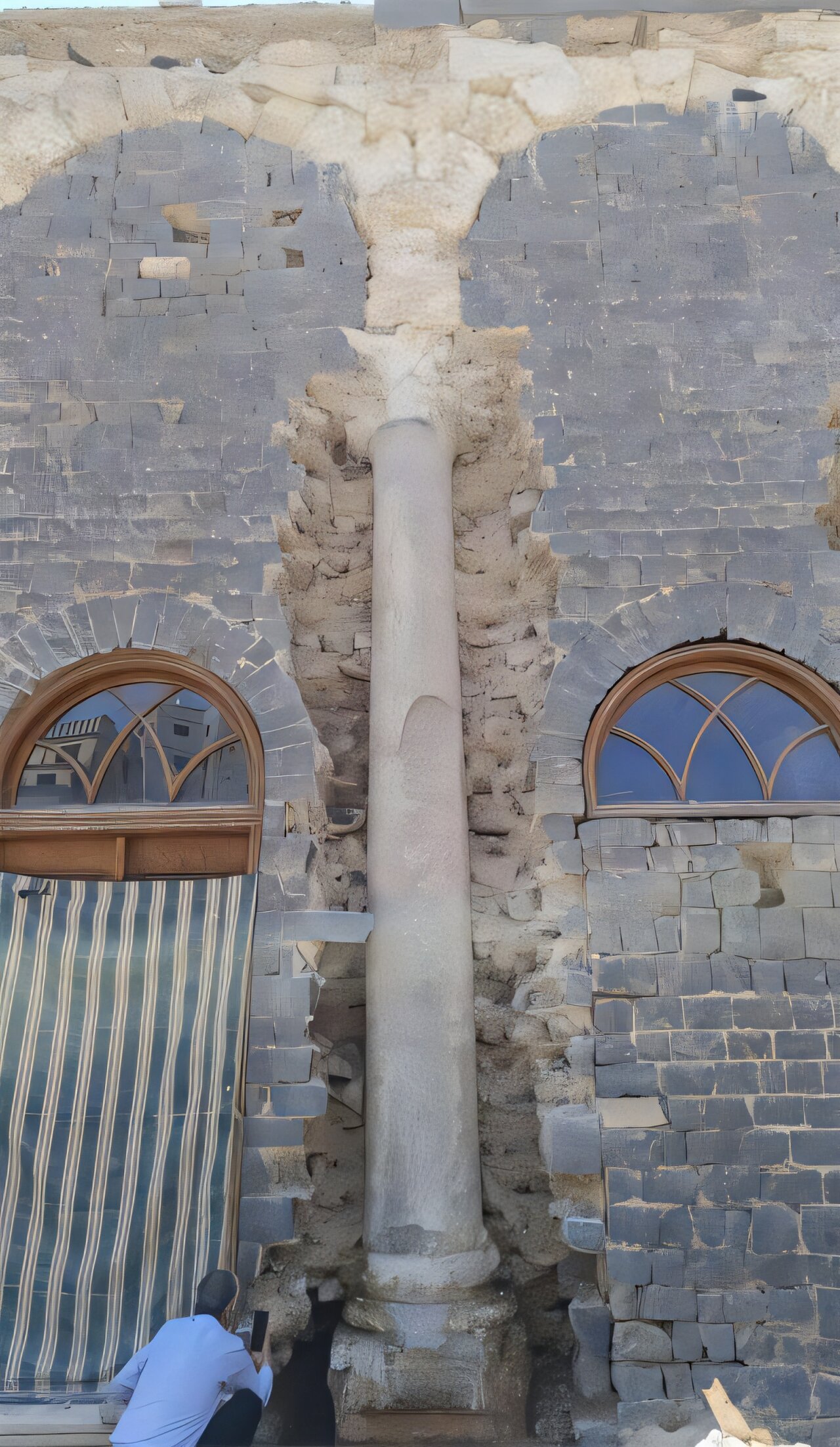
Top Image: The column on whose base the Greek inscription was discovered. Scholars deciphering ancient Greek inscriptions in Syria point to orthographic or grammatical deviations, reflecting the Syriac (Aramaic) linguistic background of the local population. Credit: Abdulhadi Al-Najjar.

An Ancient Greek inscription newly discovered at the base of a column inside the Great Mosque of Homs in Syria is strengthening a long-running argument that the medieval mosque may stand on the remains of a much older sacred site: a Roman-era Temple of the Sun.
Homs, located in western Syria north of Damascus, was known in antiquity as Emesa. The city has long been noted for its historic landmarks, especially the Great Mosque, which is often highlighted for its distinctive layout. The mosque is also associated with the 12th-century Zengid ruler Nur ad-Din, adding another layer to a site that has been linked—by tradition and scholarship alike—to earlier sacred architecture.
A new study published in the archaeology journal Shedet argues that the inscription may provide an important clue in determining whether the Great Mosque stands above the remains of the Temple of Elagabalus (also known as the Temple of the Sun), or whether the temple should instead be located elsewhere in the city.
A long-running question about Emesa’s sacred centre
For years, scholars have worked with textual references, coin evidence, and archaeological observations to understand whether the Great Mosque site represents a sequence of sacred buildings: a pagan temple, then a Christian church, and finally a mosque. Until recently, the debate has been difficult to settle due to the lack of definitive material evidence.
Dr. Maamoun Saleh Abdulkarim, professor of archaeology and history at the University of Sharjah and author of the study, believes the inscription is a key development in this discussion.
“This inscription, uncovered during restoration work, provides new evidence in a long-standing debate: Was the Temple of Elagabalus located beneath the current Great Mosque in the city center, or was it situated in the archaeological layers atop the tell (mound), where the remains of the Islamic Citadel of Homs now stand?” explains Professor Abdulkarim.
He argues that the inscription strengthens the case for continuity at the site—suggesting that religious change in Emesa may have unfolded through reuse and reinterpretation of sacred space rather than a complete break.
“If its association with solar cult symbolism is confirmed, it may indicate a spatial continuity between the pagan sanctuary and the later religious structures built on the same site,” he said, adding, “Such evidence would significantly strengthen the argument that religious transformation in Emesa occurred through architectural layering and reinterpretation rather than a complete break. It also underscores the importance of interdisciplinary collaboration between archaeology, epigraphy, architectural history, and heritage conservation.”
What the inscription looks like
The inscription is carved directly into a granite column base inside the Great Mosque. Archaeologist Teriz Lyoun, head of the Excavation Department in Homs, says it had been buried beneath the mosque’s floor and was first uncovered during excavations in 2016.
The base measures about 1×1 metre, with the inscribed panel taking up most of the front face. The text itself is written in Greek and reads:
He soars in the sky to crush the warring barbarians. He comes with a screaming voice, piercing the air. He smashes shields with his sword, tearing the enemy into pieces. He instantly transforms into a tiger, facing the foe. From the top of the hill, you hear his roar as he strikes with strength and ferocity. His royal power is derived from the god of war during the day.
Lyoun also notes that the lettering is laid out in evenly spaced horizontal lines in a formal style often seen in dedication or commemorative inscriptions. “The writing in the inscription image appears symmetrical, formal, and spaced in horizontal lines, a style common in formal dedication or commemorative texts,” she explained. “The design is a multi-line inscription arranged in straight horizontal lines, and the plaque is framed by a decorative top border.”
Abdulkarim adds that the Greek includes grammatical irregularities—something he considers consistent with Roman Syria’s linguistic setting, where Aramaic was widely spoken and Greek was not always used with classical precision.
From temple to church to mosque
At the centre of Abdulkarim’s argument is the idea that Emesa’s religious life passed through major phases—paganism, Christianity, and Islam—while retaining a strong spatial focus in the city’s core. In his view, the inscription offers support for locating the Temple of the Sun on the same site as the Great Mosque, with later religious communities adapting the space over time.
“This Greek inscription, even if it is epic in nature and not very detailed, provides clues to the connection between this mosque and a pagan building, perhaps the Temple of the Sun, especially since researchers have long proposed this connection. Thus, every inscription from the Roman era that is uncovered in this mosque will add more knowledge to our understanding of the subject,” Abdulkarim noted.
The study also frames Emesa as a strategically positioned city, linked to major routes across the Levant, and argues that its sacred centre was closely tied to political authority and civic identity.
The Syrian priest who became Roman emperor
The Temple of the Sun in Emesa is inseparable from the figure of Elagabalus, the priest of the city’s solar cult who became Roman emperor in 218 AD and took the divine name as his own. His four-year reign is one reason the temple has drawn such sustained attention in ancient history.
In discussing the city’s later religious changes, Abdulkarim emphasises that “Christianity did not replace paganism abruptly. Instead, both communities coexisted for generations.”
For now, the inscription does not close the debate on its own—but Abdulkarim argues it shifts the evidence in a meaningful way. Further discoveries during restoration or future archaeological work at the mosque may add additional material that helps clarify whether the Roman Temple of the Sun truly lay beneath the medieval Great Mosque at the heart of modern Homs.
The article, “Religious Transformation in the City of Emesa, Syria:
From Paganism to Christianity During the Roman and EarlyByzantine Periods,” by Maamoun Abdulkarim, is published in Shedet. Click here to read it.
Top Image: The column on whose base the Greek inscription was discovered. Scholars deciphering ancient Greek inscriptions in Syria point to orthographic or grammatical deviations, reflecting the Syriac (Aramaic) linguistic background of the local population. Credit: Abdulhadi Al-Najjar.
Subscribe to Medievalverse
Related Posts