Among the gold and weapon fittings of the Staffordshire Hoard lies one object unlike any other. Now, researchers believe this enigmatic piece may once have been worn on the head of a holy warrior on the early medieval battlefield.
By Lorris Chevalier
When the Staffordshire Hoard was unearthed by a metal detectorist in 2009, its glittering fragments transformed our understanding of early Anglo-Saxon craftsmanship and warfare. Now recognised as the largest Anglo-Saxon gold hoard ever discovered, it contains an astonishing 5 kg of gold, representing roughly 75% of the hoard’s total metal content, and 1.3 kg of silver. Found in a Staffordshire field in central England, the deposit consists of over 1,500 objects, most of which are unmistakably military: more than 300 sword-hilt fittings, 92 pommels, 10 sword pendants, and numerous other warrior-related items.
An initial assessment places the hoard in the 7th and 8th centuries, during the height of the kingdom of Mercia, one of the most dominant powers in early medieval Britain. Yet despite the wealth of material, the purpose of the hoard remains unresolved. Scholars continue to debate whether this extraordinary deposit was assembled for Christian or pagan reasons, and why such a rich cache of martial splendour was buried at all.
Amid these objects, however, lies a single piece that stands apart in both form and function: the mystery object, an artefact for which no parallel has been found anywhere in Europe.
A Unique Artefact With No Known Parallel
Photo courtesy Lorris Chevalier
Unlike the vast majority of the hoard, which consists of recognisable martial fittings, the mystery object is unprecedented. Its shape, construction, and symbolic motifs resist easy classification. The absence of archaeological context—common in hoard discoveries—only deepens the enigma.
A decade-long research programme suggests that the piece may have been part of an ornamental headdress, possibly worn by a priest or bishop in the mid-7th century. The design incorporates up to seven cross motifs, a powerful indicator of religious significance.
Visual and Literary Parallels: Ezra, Bede, and the Sacred Books
One of the most evocative potential parallels comes from the great Northumbrian Bible known as the Codex Amiatinus. Produced at the monasteries of Wearmouth–Jarrow around 700 CE, it contains a celebrated illustration on Folio 5r showing Ezra the scribe seated in his study.
In this image, preserved today in Florence at the Biblioteca Medicea Laurenziana (MS Amiatinus 1), Ezra is depicted at work restoring the sacred books after they were consumed in the fires of war. His pose, attire, and regalia, including a distinctive head ornament, bear a notable resemblance to the Staffordshire mystery object. Though the connection cannot be proven, the visual parallel strongly suggests that similar ceremonial headdresses may have been part of the iconography—or even the lived reality—of high-ranking religious figures.
Image courtesy Lorris Chevalier
This imagery finds further resonance in the writings of the Venerable Bede. In his De Tabernaculo, Bede describes priestly vestments and ritual adornments that conceptually echo the form and symbolic vocabulary of the Staffordshire piece.
A Priest on the Battlefield?
Photo courtesy Lorris Chevalier
If the mystery object was indeed a religious headpiece, its presence among martial treasures invites a compelling interpretation. It may have belonged to a priest accompanying a Mercian warband, part of a mobile ecclesiastical pack used during a campaign. In an age when warfare and Christian ritual were inseparable, priests blessed warriors, carried relics, and performed rites before battle.
The hoard comprises more than 1,500 objects, among them finely crafted gold and silver fittings removed from the weapons to which they originally belonged, including sixty-six sword-hilt rings and numerous gold plates from hilts, some featuring cloisonné garnet inlays in zoomorphic designs.
Staffordshire Hoard – photo courtesy Staffordshire County Council
The only items that appear to have a visibly non-military purpose are two (possibly three) crosses. The largest cross, although missing a few ornaments, is otherwise intact and may once have been an altar crucifix or a processional cross.
One object, a small gold strip, bears on both sides a Latin quotation from the Old Testament (Numbers 10:35): surge dne disepentur inimici tui et fugent qui oderunt te a facie tua—“Rise up, O Lord, and let thine enemies be scattered; and let those that hate thee flee before thee”.
The strip of gold with the Biblical inscription from Numbers – photo courtesy Portable Antiquities Scheme
Almost all other objects in the hoard appear to have been associated with warfare, and this strip may originally have been affixed to a shield or a belt.
In this light, even the element that was almost certainly intended to be worn on the head should be understood within a religious and mostly military context, since the remainder of the deposit is overwhelmingly martial in nature.
The idea of a ceremonial headdress also resonates with early Christian symbolism, particularly the biblical notion of the “helmet of salvation” described in Ephesians 6:17. For early medieval believers, this metaphor formed part of the “Armour of God”, a spiritual counterpart to earthly weaponry. A priest or bishop wearing a distinctive, cross-adorned headdress in the midst of a warband would have embodied this fusion of physical and spiritual warfare. In this sense, the Staffordshire mystery object may not only have marked religious authority but may also have served as a powerful visual representation of divine protection on the battlefield.
A distinctive headpiece, bright with cross motifs, would have marked such a figure as a bearer of divine authority, “part of God’s armoury on the battlefield”. Visible, identifiable, and symbolically charged, it would have stood out amidst weapons and armour.
Dr Lorris Chevalier, who has a Ph.D. in medieval literature, is a historical advisor for movies, including The Last Duel and Napoleon. Click here to view his website.

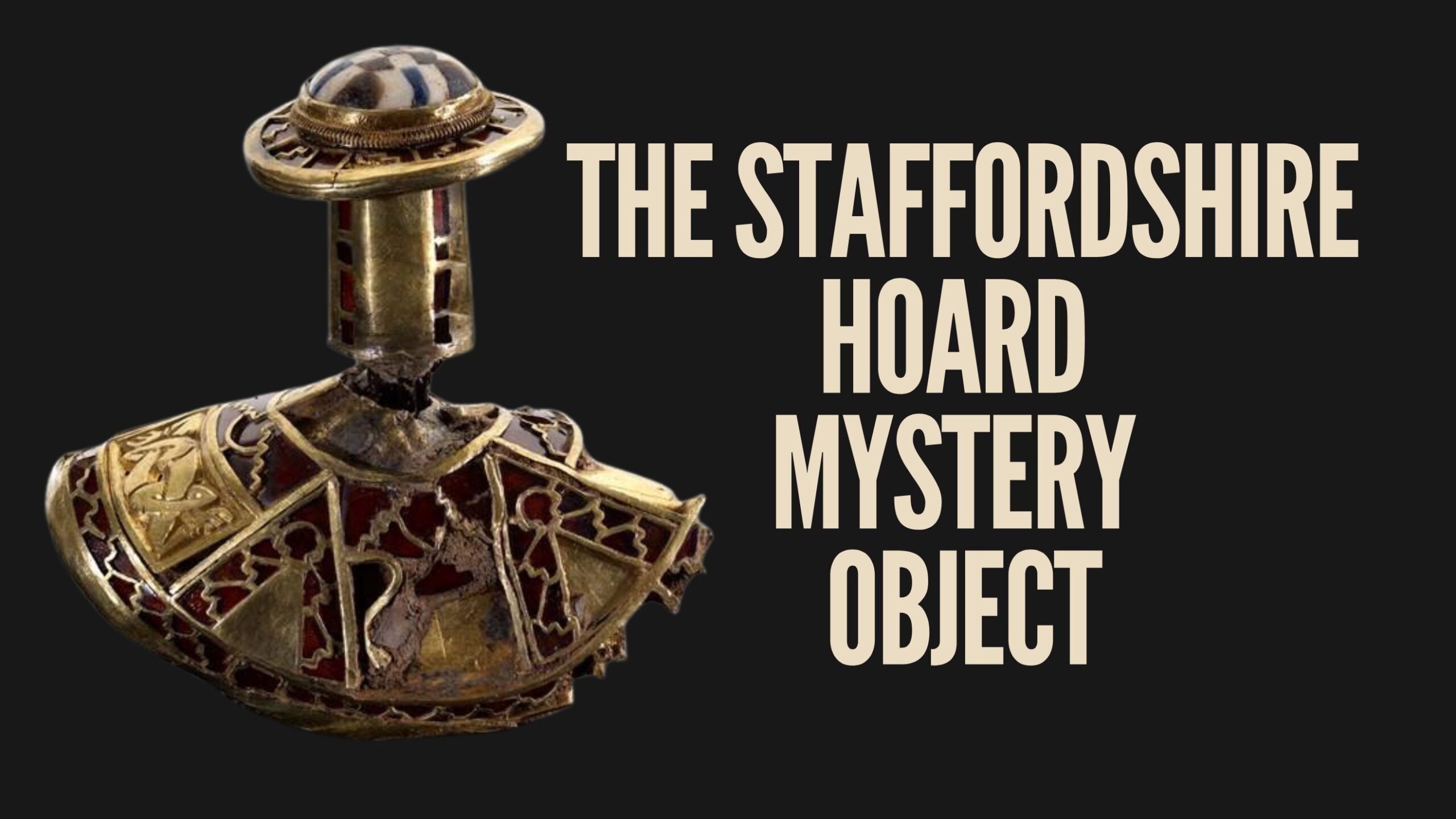
Among the gold and weapon fittings of the Staffordshire Hoard lies one object unlike any other. Now, researchers believe this enigmatic piece may once have been worn on the head of a holy warrior on the early medieval battlefield.
By Lorris Chevalier
When the Staffordshire Hoard was unearthed by a metal detectorist in 2009, its glittering fragments transformed our understanding of early Anglo-Saxon craftsmanship and warfare. Now recognised as the largest Anglo-Saxon gold hoard ever discovered, it contains an astonishing 5 kg of gold, representing roughly 75% of the hoard’s total metal content, and 1.3 kg of silver. Found in a Staffordshire field in central England, the deposit consists of over 1,500 objects, most of which are unmistakably military: more than 300 sword-hilt fittings, 92 pommels, 10 sword pendants, and numerous other warrior-related items.
An initial assessment places the hoard in the 7th and 8th centuries, during the height of the kingdom of Mercia, one of the most dominant powers in early medieval Britain. Yet despite the wealth of material, the purpose of the hoard remains unresolved. Scholars continue to debate whether this extraordinary deposit was assembled for Christian or pagan reasons, and why such a rich cache of martial splendour was buried at all.
Amid these objects, however, lies a single piece that stands apart in both form and function: the mystery object, an artefact for which no parallel has been found anywhere in Europe.
A Unique Artefact With No Known Parallel
Unlike the vast majority of the hoard, which consists of recognisable martial fittings, the mystery object is unprecedented. Its shape, construction, and symbolic motifs resist easy classification. The absence of archaeological context—common in hoard discoveries—only deepens the enigma.
A decade-long research programme suggests that the piece may have been part of an ornamental headdress, possibly worn by a priest or bishop in the mid-7th century. The design incorporates up to seven cross motifs, a powerful indicator of religious significance.
Visual and Literary Parallels: Ezra, Bede, and the Sacred Books
One of the most evocative potential parallels comes from the great Northumbrian Bible known as the Codex Amiatinus. Produced at the monasteries of Wearmouth–Jarrow around 700 CE, it contains a celebrated illustration on Folio 5r showing Ezra the scribe seated in his study.
In this image, preserved today in Florence at the Biblioteca Medicea Laurenziana (MS Amiatinus 1), Ezra is depicted at work restoring the sacred books after they were consumed in the fires of war. His pose, attire, and regalia, including a distinctive head ornament, bear a notable resemblance to the Staffordshire mystery object. Though the connection cannot be proven, the visual parallel strongly suggests that similar ceremonial headdresses may have been part of the iconography—or even the lived reality—of high-ranking religious figures.
This imagery finds further resonance in the writings of the Venerable Bede. In his De Tabernaculo, Bede describes priestly vestments and ritual adornments that conceptually echo the form and symbolic vocabulary of the Staffordshire piece.
A Priest on the Battlefield?
If the mystery object was indeed a religious headpiece, its presence among martial treasures invites a compelling interpretation. It may have belonged to a priest accompanying a Mercian warband, part of a mobile ecclesiastical pack used during a campaign. In an age when warfare and Christian ritual were inseparable, priests blessed warriors, carried relics, and performed rites before battle.
The hoard comprises more than 1,500 objects, among them finely crafted gold and silver fittings removed from the weapons to which they originally belonged, including sixty-six sword-hilt rings and numerous gold plates from hilts, some featuring cloisonné garnet inlays in zoomorphic designs.
The only items that appear to have a visibly non-military purpose are two (possibly three) crosses. The largest cross, although missing a few ornaments, is otherwise intact and may once have been an altar crucifix or a processional cross.
One object, a small gold strip, bears on both sides a Latin quotation from the Old Testament (Numbers 10:35): surge dne disepentur inimici tui et fugent qui oderunt te a facie tua—“Rise up, O Lord, and let thine enemies be scattered; and let those that hate thee flee before thee”.
Almost all other objects in the hoard appear to have been associated with warfare, and this strip may originally have been affixed to a shield or a belt.
In this light, even the element that was almost certainly intended to be worn on the head should be understood within a religious and mostly military context, since the remainder of the deposit is overwhelmingly martial in nature.
The idea of a ceremonial headdress also resonates with early Christian symbolism, particularly the biblical notion of the “helmet of salvation” described in Ephesians 6:17. For early medieval believers, this metaphor formed part of the “Armour of God”, a spiritual counterpart to earthly weaponry. A priest or bishop wearing a distinctive, cross-adorned headdress in the midst of a warband would have embodied this fusion of physical and spiritual warfare. In this sense, the Staffordshire mystery object may not only have marked religious authority but may also have served as a powerful visual representation of divine protection on the battlefield.
A distinctive headpiece, bright with cross motifs, would have marked such a figure as a bearer of divine authority, “part of God’s armoury on the battlefield”. Visible, identifiable, and symbolically charged, it would have stood out amidst weapons and armour.
Dr Lorris Chevalier, who has a Ph.D. in medieval literature, is a historical advisor for movies, including The Last Duel and Napoleon. Click here to view his website.
Click here to read more from Lorris Chevalier
Subscribe to Medievalverse
Related Posts