Stone castles, brick churches, and orderly new towns still line the Baltic coast—evidence of how the Baltic Crusades remade a medieval frontier. Aleksander Pluskowski traces the routes of conquest and conversion through the sites you can visit today.
By Aleksander Pluskowski
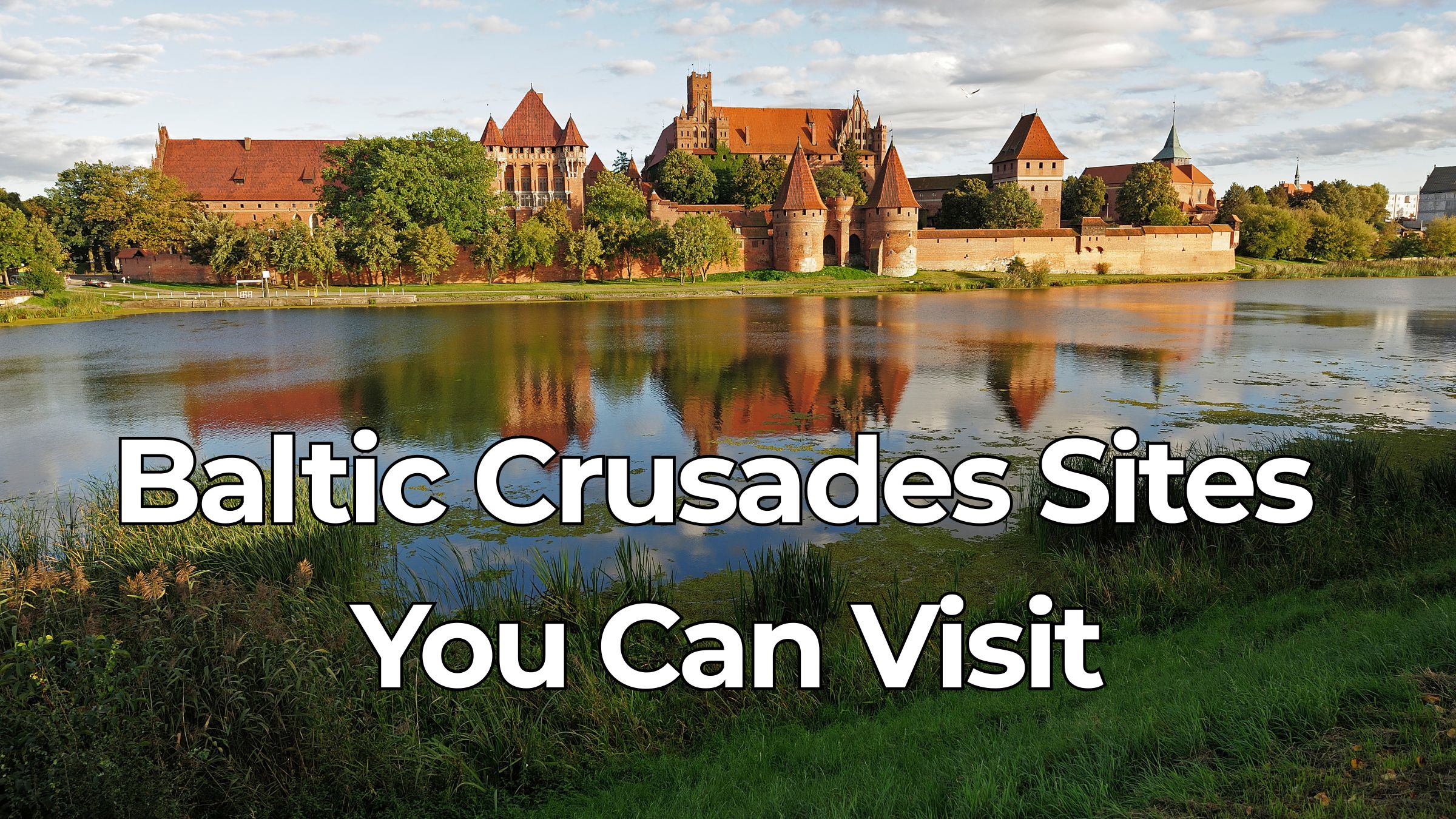
Standing in the shadow of Malbork Castle in northern Poland, it can be easy to forget that this vast red-brick fortress was once the nerve centre of a religious war. Today its courtyards host school groups and concerts, its souvenir shops sell magnets, postcards and toy weapons. Yet Malbork, formerly Marienburg (Mary’s Castle), and dozens of other castles found today in parts of Germany, Poland, Lithuania, Latvia, Estonia, Finland and Russia, were built during or in the wake of crusades. These were campaigns of conquest, colonisation and Christianisation waged between the 12th and 15th centuries against indigenous pagan societies. In the process these societies were completely transformed, laying the foundations for the Europe we know today.
One of the aims of my book The Black Cross: A History of the Baltic Crusades was to inspire readers to visit the monuments and landscapes associated with these crusades. This heritage is a powerful reminder of how religious violence and migration shaped medieval Europe, and it continues to influence cultural memories of this formative era. Here I’ve listed some of the places where the impact of the Baltic Crusades can still be seen, organised into three key themes.
Conquest
Gross Raden Archaeological Open Air Museum. Photo by Wolfgang Sauber / Wikimedia Commons
The military campaigns that targeted the Slavic Wends, Balts and Baltic Finns were marked by the destruction of indigenous political and religious centres, and the construction of new fortified complexes by the conquering regimes.
A number of Wendish strongholds in northern Germany have been explored archaeologically, but few have left visible traces in the landscape. Earthen ramparts are still visible at the former centres of the Obotrites at Michelenburg, the Wagri at Starigard in Oldenburg and the Rani at Garz on Rügen, whilst other sites such as the Obotrite stronghold at Dobin (which was a target of the 1147 crusade) preserve only faint traces of earthworks. Outdoor museums offer excellent reconstructions of Wendish strongholds and settlements before and during the period of crusading, such as Gross Raden Archaeological Open Air Museum.
All indigenous strongholds in Prussia were destroyed or repurposed by the Teutonic Order, which led crusades in the region between 1230 and 1283. Many have left traces in the landscape, some with archaeological evidence of the conflict such as Zamkowa Góra in Stary Dzierzgon. The Order would become the most prolific castle builder in the medieval Baltic. In 1309, its headquarters were relocated from Venice to Marienburg – today Malbork Castle Museum and a UNESCO World Heritage Site. Although heavily restored, it remains the most spectacular visual symbol of militarised Christianity in the North. There are several other brick castles built by the Order in the historical territory of Prussia in varying states of ruin and restoration, including Gniew, Radzyń Chełmiński, Ostróda and Nidzica.
Ruins of Viljandi castle, Estonia – photo by Ivar Leidus / Wikimedia Commons
In Livonia, many indigenous strongholds were also destroyed by crusaders, and Estonia has some of the most dramatic remains, such as on the island of Muhu, at Lõhavere and Viljandi. The latter would be remodelled as a castle, named Fellin, whilst the others, of no strategic importance to the new regime, were abandoned. Stone was a much more important building material here than in Prussia, and is well represented by the castles in Tallinn, Põltsamaa, Rakvere and Sigulda. Riga Castle served as the Order’s principal convent in Livonia, whilst Cēsis Castle (Wenden) was later used as the residence of the Livonian master.
In Finland, castles gradually replaced the network of indigenous political centres, represented by strongholds such as Liedon Vanhalinna. The most important castles built by the new regime include Turku and Häme, consolidating royal power in what became a broad frontier between the north-eastern edge of Catholic Christendom and Orthodox Rus’ Novgorod. Those located on the medieval borderland – St Olaf’s Castle in Finland, Vyborg Castle and Neman Castle in Russia, and Narva Castle in Estonia – represent the limits of Catholic Christendom’s expansion.
Kuressaare Castle on the Island of Saaremaa, Estonia, formerly Arensburg in Livonia. Photo by Stefan Hiienurm / Wikimedia Commons
Bishops and their cathedral chapters also built castles. The best examples include Kuressaare and Haapsalu in Estonia, Turaida (although heavily restored) in Latvia, and Kwidzyn, Lidzbark Warmińskiand Reszel in Poland.
Members of the Xiążęca Drużyna re-enacting the Teutonic Order’s campaigns through the ‘Great Wilderness’. The Forest of Augustów in Poland represents some of the last fragments of this former frontier. Photo by Magnus Elander.
Persistent indigenous resistance is represented by some of the strongholds of western Lithuania, particularly Medvėgalis, and by the Kernavė Archaeological Site and Vilnius Castle, both on UNESCO’s World Heritage List. These were besieged several times by the Order, leading to the eventual abandonment of Medvėgalis and Kernavė, whilst Vilnius itself withstood the attacks. To experience the ‘Great Wilderness’ which defined the frontier with the Grand Duchy of Lithuania, visit Augustów Forest, which sprawls across the modern Polish-Lithuanian-Belarusian border.
Christianisation
Turku Cathedral – photo by Otto Jula / Wikimedia Commons
Baltic societies encountered Christianity long before the crusades, however the conquests were accompanied by the institutionalisation of the new religion. This was represented above all by the construction of cathedrals. Those at Brandenburg and Havelberg are especially powerful symbols of the reassertion of Christianisation in the decades following the Wendish Crusade. In Latvia, the ruins of the church associated with the first missionary bishop can still be seen at Ikšķile, but when Riga was founded by Bishop Albert in collaboration with the local Livs, it became the entry point for the crusades that created Livonia, with its cathedral built on an indigenous sacred site.
Turku Cathedral served as a key centre of Christianisation and administration for the Swedish regime, although the memory of the first Finnish bishop, St. Henry was preserved in the 15th-century church in Nousiainen, where his cenotaph is decorated with depictions of the Swedish Crusades. The heavily restored Kaliningrad Cathedral was the centre of the Sambian episcopate in Königsberg and played an important role for the guest knights of the Order’s crusades against Lithuania throughout the 14th century, whilst Kwidzyn Cathedral contains the tombs of several of the Teutonic Order’s grand masters.
Monasteries were a core instrument of Christianisation and colonisation in the Wendish lands, where several examples can still be seen, such as Lehnin (which also contains the remains of a probable sacred Wendish tree), Chorin and the spectacular ruins of Eldena. There were significantly fewer in the eastern Baltic, with examples of mendicant churches still visible in Elbląg, Toruń and Riga, whilst better-preserved structures can be found in Estonia, particularly Padise and Pirita. The former was destroyed at the start of the indigenous St George’s Night Uprising in 1343 and later rebuilt. The latter, the largest of its type in Livonia, was destroyed during the same conflict that swept away the last ties to the crusading past – the Livonian War. Finland has even fewer, and only archaeological traces of mendicant houses have been found in Turku.
The oak of Mingėla in the Plungė district of Samogitia, Lithuania is estimated to be 400-500 years old. It is remembered in folklore as a sacred tree, and oaks such as this were associated with Perkūnas, the Baltic god of thunder. Photo by Vykintas Vaitkevičius.
Some indigenous sacred sites were destroyed by crusaders. The earthen ramparts of the Rani’s former religious centre at Arkona on Rügen capture the spectacular moment of the violent religious overthrow by Danish crusaders in 1168. Elsewhere, many continued to be used in one form or another. Birutė Hill in Palanga was a Couronian sacred centre that endured despite crusader attacks, and Lithuania (especially Samogitia) is particularly rich in surviving and remembered sites, including Šatrija Hill, the Oak of Mingėla and the Oak of Laumėnai.
There is also evidence for continuity alongside the adoption of Christianity. The Jesuit church at Święta Lipka in Warmia-Masuria is an impressive baroque structure that showcases the Counter Reformation’s battle for souls, but it preserves the memory of an earlier Marian pilgrimage site that, in turn, retains that of an older sacred lime tree.
Colonisation
Tallinn’s Old Town, one of the best preserved medieval towns in Europe. Photo by Ivar Leidus / Wikimedia Commons
The creation of urban colonies was a fundamental part of the conquests associated with the crusades, resulting in a profound architectural legacy. The few with significant medieval structures are on UNESCO’s World Heritage List. Riga, which has the best-preserved group of medieval churches in Latvia, has few other visible medieval structures. In contrast, Tallinn with its densely packed merchant houses, churches and circuit of walls and towers, is one of the best-preserved medieval towns not just in the Baltic, but in Europe.
The so-called ‘Wendish Towns’ in northern Germany remain important records of the intensity of urbanisation accompanying the conquests of the region. Of these, Lübeck has the most abundant medieval domestic and religious structures. It served as an important urban template and centre for crusading, although it is better known as the central node of the Hanse which emerged alongside the eastwards expansion of Catholic states. Its European Hansemuseum tells this story in a very engaging way.
There are also many smaller towns whose origins date back to the crusades. Their churches and street plans represent the main survivals from the medieval period, but preserved examples of townscapes are unusual. It is for this reason that Toruń’s Old Town has been included on UNESCO’s World Heritage List. The town was the relocated first settlement founded by the Teutonic Order in the lands that it conquered in what became known as Prussia. This quickly grew into a Hanseatic trading city, and has exceptionally well-preserved brick Gothic merchant houses, churches, walls and towers. The Order’s urban planning is also clearly legible in the Old Town of Kuldīga, recently added to UNESCO’s World Heritage List, and Cēsis.
Many of the villages populated by the settlers who colonised the Wendish, Prussian and Finnish countryside at the encouragement of the new regimes are still there today, although some grew into towns. Their medieval buildings have largely vanished, with the exception of some of their churches. The best examples can be found in the historical territory of Prussia within modern Poland, as at Bierzgłowo, Grzybno, Sątoczno and Parys. The church in Prątnica has what appears to be a Prussian sculpture incorporated into its wall, perhaps another expression of the triumph over paganism.

Stone castles, brick churches, and orderly new towns still line the Baltic coast—evidence of how the Baltic Crusades remade a medieval frontier. Aleksander Pluskowski traces the routes of conquest and conversion through the sites you can visit today.
By Aleksander Pluskowski
Standing in the shadow of Malbork Castle in northern Poland, it can be easy to forget that this vast red-brick fortress was once the nerve centre of a religious war. Today its courtyards host school groups and concerts, its souvenir shops sell magnets, postcards and toy weapons. Yet Malbork, formerly Marienburg (Mary’s Castle), and dozens of other castles found today in parts of Germany, Poland, Lithuania, Latvia, Estonia, Finland and Russia, were built during or in the wake of crusades. These were campaigns of conquest, colonisation and Christianisation waged between the 12th and 15th centuries against indigenous pagan societies. In the process these societies were completely transformed, laying the foundations for the Europe we know today.
One of the aims of my book The Black Cross: A History of the Baltic Crusades was to inspire readers to visit the monuments and landscapes associated with these crusades. This heritage is a powerful reminder of how religious violence and migration shaped medieval Europe, and it continues to influence cultural memories of this formative era. Here I’ve listed some of the places where the impact of the Baltic Crusades can still be seen, organised into three key themes.
Conquest
The military campaigns that targeted the Slavic Wends, Balts and Baltic Finns were marked by the destruction of indigenous political and religious centres, and the construction of new fortified complexes by the conquering regimes.
A number of Wendish strongholds in northern Germany have been explored archaeologically, but few have left visible traces in the landscape. Earthen ramparts are still visible at the former centres of the Obotrites at Michelenburg, the Wagri at Starigard in Oldenburg and the Rani at Garz on Rügen, whilst other sites such as the Obotrite stronghold at Dobin (which was a target of the 1147 crusade) preserve only faint traces of earthworks. Outdoor museums offer excellent reconstructions of Wendish strongholds and settlements before and during the period of crusading, such as Gross Raden Archaeological Open Air Museum.
All indigenous strongholds in Prussia were destroyed or repurposed by the Teutonic Order, which led crusades in the region between 1230 and 1283. Many have left traces in the landscape, some with archaeological evidence of the conflict such as Zamkowa Góra in Stary Dzierzgon. The Order would become the most prolific castle builder in the medieval Baltic. In 1309, its headquarters were relocated from Venice to Marienburg – today Malbork Castle Museum and a UNESCO World Heritage Site. Although heavily restored, it remains the most spectacular visual symbol of militarised Christianity in the North. There are several other brick castles built by the Order in the historical territory of Prussia in varying states of ruin and restoration, including Gniew, Radzyń Chełmiński, Ostróda and Nidzica.
In Livonia, many indigenous strongholds were also destroyed by crusaders, and Estonia has some of the most dramatic remains, such as on the island of Muhu, at Lõhavere and Viljandi. The latter would be remodelled as a castle, named Fellin, whilst the others, of no strategic importance to the new regime, were abandoned. Stone was a much more important building material here than in Prussia, and is well represented by the castles in Tallinn, Põltsamaa, Rakvere and Sigulda. Riga Castle served as the Order’s principal convent in Livonia, whilst Cēsis Castle (Wenden) was later used as the residence of the Livonian master.
In Finland, castles gradually replaced the network of indigenous political centres, represented by strongholds such as Liedon Vanhalinna. The most important castles built by the new regime include Turku and Häme, consolidating royal power in what became a broad frontier between the north-eastern edge of Catholic Christendom and Orthodox Rus’ Novgorod. Those located on the medieval borderland – St Olaf’s Castle in Finland, Vyborg Castle and Neman Castle in Russia, and Narva Castle in Estonia – represent the limits of Catholic Christendom’s expansion.
Bishops and their cathedral chapters also built castles. The best examples include Kuressaare and Haapsalu in Estonia, Turaida (although heavily restored) in Latvia, and Kwidzyn, Lidzbark Warmiński and Reszel in Poland.
Persistent indigenous resistance is represented by some of the strongholds of western Lithuania, particularly Medvėgalis, and by the Kernavė Archaeological Site and Vilnius Castle, both on UNESCO’s World Heritage List. These were besieged several times by the Order, leading to the eventual abandonment of Medvėgalis and Kernavė, whilst Vilnius itself withstood the attacks. To experience the ‘Great Wilderness’ which defined the frontier with the Grand Duchy of Lithuania, visit Augustów Forest, which sprawls across the modern Polish-Lithuanian-Belarusian border.
Christianisation
Baltic societies encountered Christianity long before the crusades, however the conquests were accompanied by the institutionalisation of the new religion. This was represented above all by the construction of cathedrals. Those at Brandenburg and Havelberg are especially powerful symbols of the reassertion of Christianisation in the decades following the Wendish Crusade. In Latvia, the ruins of the church associated with the first missionary bishop can still be seen at Ikšķile, but when Riga was founded by Bishop Albert in collaboration with the local Livs, it became the entry point for the crusades that created Livonia, with its cathedral built on an indigenous sacred site.
Turku Cathedral served as a key centre of Christianisation and administration for the Swedish regime, although the memory of the first Finnish bishop, St. Henry was preserved in the 15th-century church in Nousiainen, where his cenotaph is decorated with depictions of the Swedish Crusades. The heavily restored Kaliningrad Cathedral was the centre of the Sambian episcopate in Königsberg and played an important role for the guest knights of the Order’s crusades against Lithuania throughout the 14th century, whilst Kwidzyn Cathedral contains the tombs of several of the Teutonic Order’s grand masters.
Monasteries were a core instrument of Christianisation and colonisation in the Wendish lands, where several examples can still be seen, such as Lehnin (which also contains the remains of a probable sacred Wendish tree), Chorin and the spectacular ruins of Eldena. There were significantly fewer in the eastern Baltic, with examples of mendicant churches still visible in Elbląg, Toruń and Riga, whilst better-preserved structures can be found in Estonia, particularly Padise and Pirita. The former was destroyed at the start of the indigenous St George’s Night Uprising in 1343 and later rebuilt. The latter, the largest of its type in Livonia, was destroyed during the same conflict that swept away the last ties to the crusading past – the Livonian War. Finland has even fewer, and only archaeological traces of mendicant houses have been found in Turku.
Some indigenous sacred sites were destroyed by crusaders. The earthen ramparts of the Rani’s former religious centre at Arkona on Rügen capture the spectacular moment of the violent religious overthrow by Danish crusaders in 1168. Elsewhere, many continued to be used in one form or another. Birutė Hill in Palanga was a Couronian sacred centre that endured despite crusader attacks, and Lithuania (especially Samogitia) is particularly rich in surviving and remembered sites, including Šatrija Hill, the Oak of Mingėla and the Oak of Laumėnai.
There is also evidence for continuity alongside the adoption of Christianity. The Jesuit church at Święta Lipka in Warmia-Masuria is an impressive baroque structure that showcases the Counter Reformation’s battle for souls, but it preserves the memory of an earlier Marian pilgrimage site that, in turn, retains that of an older sacred lime tree.
Colonisation
The creation of urban colonies was a fundamental part of the conquests associated with the crusades, resulting in a profound architectural legacy. The few with significant medieval structures are on UNESCO’s World Heritage List. Riga, which has the best-preserved group of medieval churches in Latvia, has few other visible medieval structures. In contrast, Tallinn with its densely packed merchant houses, churches and circuit of walls and towers, is one of the best-preserved medieval towns not just in the Baltic, but in Europe.
The so-called ‘Wendish Towns’ in northern Germany remain important records of the intensity of urbanisation accompanying the conquests of the region. Of these, Lübeck has the most abundant medieval domestic and religious structures. It served as an important urban template and centre for crusading, although it is better known as the central node of the Hanse which emerged alongside the eastwards expansion of Catholic states. Its European Hansemuseum tells this story in a very engaging way.
There are also many smaller towns whose origins date back to the crusades. Their churches and street plans represent the main survivals from the medieval period, but preserved examples of townscapes are unusual. It is for this reason that Toruń’s Old Town has been included on UNESCO’s World Heritage List. The town was the relocated first settlement founded by the Teutonic Order in the lands that it conquered in what became known as Prussia. This quickly grew into a Hanseatic trading city, and has exceptionally well-preserved brick Gothic merchant houses, churches, walls and towers. The Order’s urban planning is also clearly legible in the Old Town of Kuldīga, recently added to UNESCO’s World Heritage List, and Cēsis.
Many of the villages populated by the settlers who colonised the Wendish, Prussian and Finnish countryside at the encouragement of the new regimes are still there today, although some grew into towns. Their medieval buildings have largely vanished, with the exception of some of their churches. The best examples can be found in the historical territory of Prussia within modern Poland, as at Bierzgłowo, Grzybno, Sątoczno and Parys. The church in Prątnica has what appears to be a Prussian sculpture incorporated into its wall, perhaps another expression of the triumph over paganism.
Aleksander Pluskowski is Professor of Medieval Archaeology at the University of Reading, where he specializes in medieval frontier societies. His new book is The Black Cross: A History of the Baltic Crusades, published by Yale University Press.
Top Image: Malbork Castle in Poland, formerly Marienburg in Prussia. View from the west overlooking the Nogat river. Photo by Magnus Elander.
Subscribe to Medievalverse
Related Posts