A gold ring with a deep-blue, oval setting — decorated with fine spirals of filigree and tiny granulated beads — has been recovered from medieval deposits in Tønsberg, a historic town in southeastern Norway. The ring was found during an excavation in the modern town centre, where archaeologists have been investigating layers of urban life preserved beneath today’s streets.
The discovery was made within the protected archaeological area known as Tønsberg Medieval Town. Archaeologists from Norsk institutt for kulturminneforskning (NIKU) have been excavating there for two seasons on behalf of Tønsberg Municipality, with the work connected to municipal stormwater management.
Found just centimetres below the surface
Archaeologist Linda Åsheim made the find last summer – Photo: Johanne Torheim, NIKU.
The ring was recovered about 7 cm down in a cultivation layer. That layer has not been directly dated, but material from above it offers an important clue: a spruce twig in the layer above was dated to 1167–1269. While that does not establish the ring’s exact date, it supports a medieval timeframe for activity in the deposits where it was found.
Project manager Hanne Ekstrøm Jordahl underscored the rarity of the object in the local archaeological record: “It has been 15 years since we last found a gold ring in Tønsberg, and this one is a fantastically beautiful and rare specimen.”
Filigree, granulation, and a blue “gem”
The ring’s workmanship is the heart of the story. It features an oval blue stone set into the bezel, and the gold near the setting is decorated with filigree — thin metal threads twisted and soldered into intricate patterns — alongside granulation, where tiny gold beads are attached as part of the design. These are skilled techniques, and their combination is one reason specialists see the ring as an elite object rather than ordinary personal jewellery.
Although the find context points to the Middle Ages, stylistic analysis suggests the ring draws on design traditions with earlier roots. “The design of the spirals at the top of the ring rail in particular resembles finger rings dating to the 9th-11th centuries,” explains Marianne Vedeler, a professor at the Museum of Cultural History (UiO). “The combination of filigree and granulation came to Norway in the early Middle Ages from the Byzantine area, partly via Carolingian goldsmithing.”
Vedeler adds that Norway has at least one comparable example — though not a direct match: “From Norway we have a finger ring with a box-set stone and filigree decoration from Ullensaker in Akershus. It is similar, but not a direct parallel.”
Rings with similar spiral decoration have been found in England and dated to the 10th and early 11th centuries, though (with one exception) they lack a set stone. Vedeler also highlights parallels in Denmark, saying “Two rings with set stones and granulation have been found in Roskilde, also from the 11th century.”
The ring seconds after it was discovered during excavations in central Tønsberg. Photo: Linda Åsheim, NIKU.
The blue stone at the centre of the ring looks like a sapphire, but specialists involved in the assessment suggest it is probably made of glass. If so, that does not make it insignificant. Glass could be deliberately chosen to create the appearance of a gemstone, and the desire to imitate sapphire hints at fashion, symbolism, and status display.
Researchers note that glass could be coloured blue by adding cobalt, and that there are techniques in which metal foil was placed behind a stone or glass to alter its colour — though such a foil technique does not appear to have been used on this ring.
The ring is described as relatively small, estimated at 50–55 in ring size, and it is suggested it likely belonged to a woman. Beyond that, the ring’s rich decoration and precious metal value strongly suggest it belonged to someone from the upper social strata.
A medieval town with deep layers
The excavation area in the center of Tønsberg. Photo: NIKU.
Tønsberg is often described as one of Norway’s major medieval centres. The town developed below the royal castle complex Tunsberghus, and the discovery was made in an area known to contain substantial medieval remains — a setting that helps explain why high-status objects can appear in its archaeological layers.
The excavation has also produced evidence of medieval urban structures and activity. Archaeologists have uncovered several houses, a possible street feature, a burnt building with a preserved roof, and a bulwark. Against that backdrop, the ring is not just a beautiful object — it is part of a wider record of medieval town life.
Top Image: The ring is beautifully decorated with intricate goldsmithing, and the stone in the center has a deep, midnight blue color. Photo: NIKU.

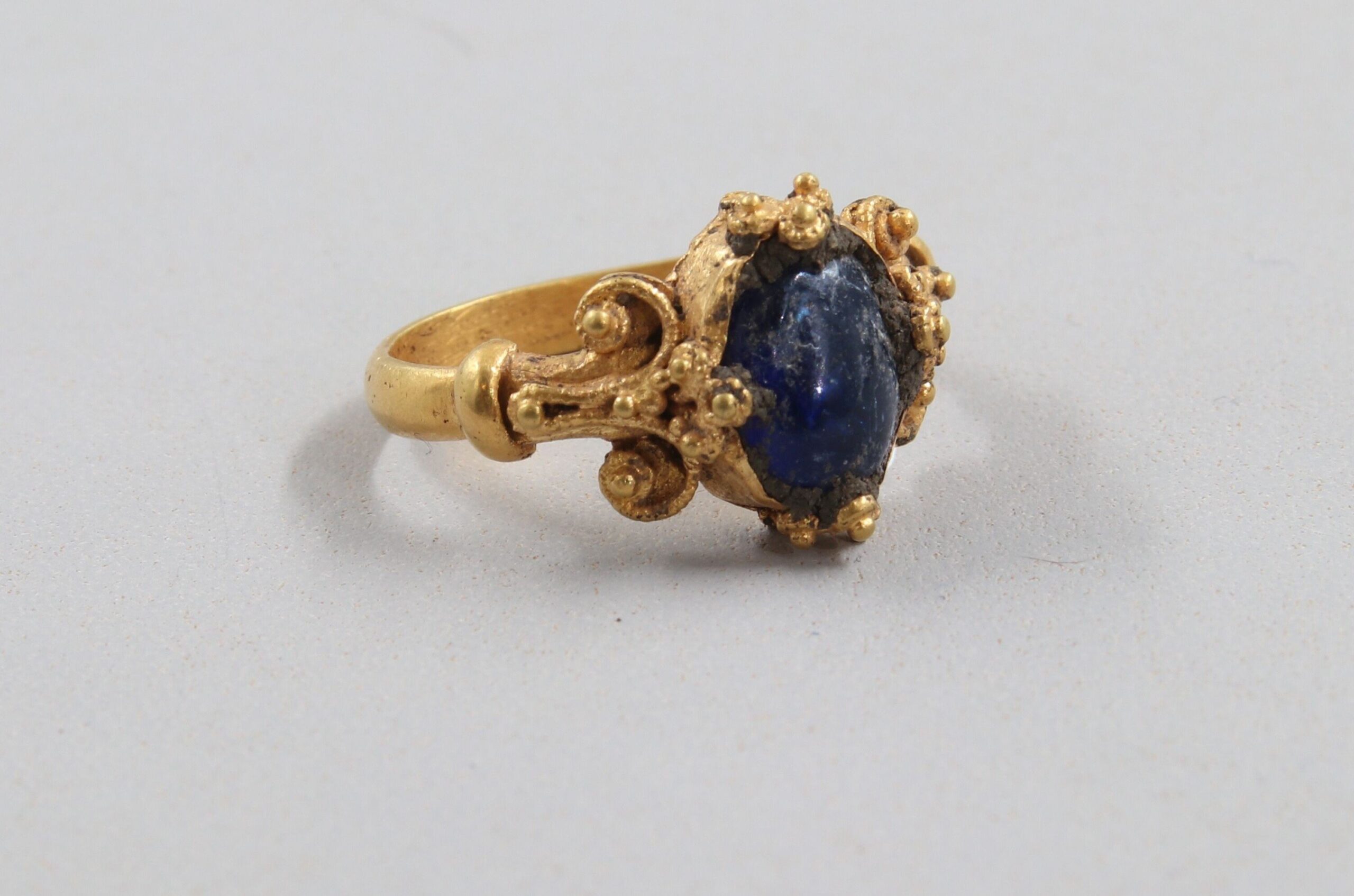
A gold ring with a deep-blue, oval setting — decorated with fine spirals of filigree and tiny granulated beads — has been recovered from medieval deposits in Tønsberg, a historic town in southeastern Norway. The ring was found during an excavation in the modern town centre, where archaeologists have been investigating layers of urban life preserved beneath today’s streets.
The discovery was made within the protected archaeological area known as Tønsberg Medieval Town. Archaeologists from Norsk institutt for kulturminneforskning (NIKU) have been excavating there for two seasons on behalf of Tønsberg Municipality, with the work connected to municipal stormwater management.
Found just centimetres below the surface
The ring was recovered about 7 cm down in a cultivation layer. That layer has not been directly dated, but material from above it offers an important clue: a spruce twig in the layer above was dated to 1167–1269. While that does not establish the ring’s exact date, it supports a medieval timeframe for activity in the deposits where it was found.
Project manager Hanne Ekstrøm Jordahl underscored the rarity of the object in the local archaeological record: “It has been 15 years since we last found a gold ring in Tønsberg, and this one is a fantastically beautiful and rare specimen.”
Filigree, granulation, and a blue “gem”
The ring’s workmanship is the heart of the story. It features an oval blue stone set into the bezel, and the gold near the setting is decorated with filigree — thin metal threads twisted and soldered into intricate patterns — alongside granulation, where tiny gold beads are attached as part of the design. These are skilled techniques, and their combination is one reason specialists see the ring as an elite object rather than ordinary personal jewellery.
Although the find context points to the Middle Ages, stylistic analysis suggests the ring draws on design traditions with earlier roots. “The design of the spirals at the top of the ring rail in particular resembles finger rings dating to the 9th-11th centuries,” explains Marianne Vedeler, a professor at the Museum of Cultural History (UiO). “The combination of filigree and granulation came to Norway in the early Middle Ages from the Byzantine area, partly via Carolingian goldsmithing.”
Vedeler adds that Norway has at least one comparable example — though not a direct match: “From Norway we have a finger ring with a box-set stone and filigree decoration from Ullensaker in Akershus. It is similar, but not a direct parallel.”
Rings with similar spiral decoration have been found in England and dated to the 10th and early 11th centuries, though (with one exception) they lack a set stone. Vedeler also highlights parallels in Denmark, saying “Two rings with set stones and granulation have been found in Roskilde, also from the 11th century.”
The blue stone at the centre of the ring looks like a sapphire, but specialists involved in the assessment suggest it is probably made of glass. If so, that does not make it insignificant. Glass could be deliberately chosen to create the appearance of a gemstone, and the desire to imitate sapphire hints at fashion, symbolism, and status display.
Researchers note that glass could be coloured blue by adding cobalt, and that there are techniques in which metal foil was placed behind a stone or glass to alter its colour — though such a foil technique does not appear to have been used on this ring.
The ring is described as relatively small, estimated at 50–55 in ring size, and it is suggested it likely belonged to a woman. Beyond that, the ring’s rich decoration and precious metal value strongly suggest it belonged to someone from the upper social strata.
A medieval town with deep layers
Tønsberg is often described as one of Norway’s major medieval centres. The town developed below the royal castle complex Tunsberghus, and the discovery was made in an area known to contain substantial medieval remains — a setting that helps explain why high-status objects can appear in its archaeological layers.
The excavation has also produced evidence of medieval urban structures and activity. Archaeologists have uncovered several houses, a possible street feature, a burnt building with a preserved roof, and a bulwark. Against that backdrop, the ring is not just a beautiful object — it is part of a wider record of medieval town life.
Top Image: The ring is beautifully decorated with intricate goldsmithing, and the stone in the center has a deep, midnight blue color. Photo: NIKU.
Subscribe to Medievalverse
Related Posts