A new exhibition at the J. Paul Getty Museum examines how medieval artists visualized the Biblical story of Creation and how those images continue to shape artistic interpretations today. Beginnings: The Story of Creation in the Middle Ages brings together medieval manuscripts and contemporary artworks to explore how ideas about the world’s origins were understood, debated, and reimagined across centuries.
On view at the Getty Center from January 27 through April 19, 2026, the exhibition features fifteen medieval manuscripts from the Getty Museum’s collection alongside four contemporary paintings by Los Angeles–based artist Harmonia Rosales. Together, these works trace the enduring influence of Creation narratives from the Middle Ages to the present day.
“The biblical story of Creation formed the basis of how medieval Christians viewed the world and continues to exert a strong influence on many artists today, seeing it both as an etiological origin story and as a metaphor for the human condition,” says Timothy Potts, the Director of the Getty Museum. “Alongside contemporary works by Harmonia Rosales, the Museum objects in the exhibition explore traditional and divergent interpretations of Creation, challenging and reframing medieval works of art in the process.”
Visualising Creation in the Middle Ages
The Creation of the World from the Stammheim Missal, probably 1170s – Getty Museum Ms. 64 (97.MG.21), fol. 10v
The exhibition is organised around several thematic sections, including Visualizing the Creation, Creation in the Abrahamic Faiths, The Introduction of Evil, and Beginnings and Ends, as well as a focused section devoted to Adam and Eve. Together, these themes highlight how medieval artists translated abstract theological concepts into vivid visual forms.
In Visualizing the Creation, visitors encounter medieval attempts to depict the seven days of Creation in ways that were accessible to contemporary audiences. One featured work, The Creation of the World, shows God presiding from above while holding a disc divided into circular scenes that represent the days of Creation arranged clockwise. The creation of Eve is emphasised at the centre, while inscriptions from Genesis surround each roundel, describing the unfolding events. Bold colours and geometric forms heighten the drama of the narrative.
Adam, Eve, and Medieval Ideas of Gender
The Creation of Eve (detail) from Concerning Famous Women, written about 1470; illuminated about 1515 – 20 Artist: Étienne Colaud – Getty Museum Ms. 129 (2024.156), fol. 3
A central part of the exhibition focuses on Adam and Eve and the powerful role their story played in shaping medieval ideas about human behaviour and gender roles. Medieval interpretations of Eve’s creation and actions contributed to long-lasting assumptions about feminine weakness and moral responsibility.
Among the works on view is Creation of Eve from a recently acquired manuscript by the artist Étienne Colaud. In this image, God creates Eve from Adam’s rib, presenting her as Adam’s “helper,” an interpretation that reinforced medieval views of women as secondary to men. Such imagery, widely circulated in manuscripts, helped encode sociocultural beliefs that extended far beyond the biblical narrative itself.
This section also places medieval artworks in dialogue with contemporary responses that reinterpret and challenge these inherited visual traditions. Harmonia Rosales’s Portrait of Eve reimagines the biblical figure through the lens of West African Yoruba mythology. Eve is depicted in profile within a large circular ori, a decorated, halo-like form symbolising destiny and spiritual transformation. Surrounding golden roundels illustrate cycles of life and suffering, encompassing both Eve’s experience and that of her descendants in America. With her eyes closed, Eve becomes a figure bearing collective trauma while also suggesting the possibility of breaking its repetition.
“I approach my paintings as a way to reclaim stories long erased, using Yoruba cosmology to restore strength and presence to figures often left out of history,” says Rosales. “In dialogue with Getty’s medieval manuscripts, my work bridges past and present, exploring resilience, identity, and what it means to envision the world’s beginnings through a lineage that has always existed.”
Creation Across the Abrahamic Faiths
The Fall of the Rebel Angels from Book of Good Manners, about 1430 – Getty Museum Ms. Ludwig XIV 9 (83.MQ.170), fol. 3v
Another section of the exhibition explores how the Creation story appears in Christian, Jewish, and Islamic traditions, emphasising their shared narrative roots while also highlighting important differences in interpretation. Medieval artists and writers across these faiths drew on common scriptural material but expressed it through distinct visual and textual traditions.
Works in this section include pages from the Rothschild Pentateuch, a French Historical Bible, and The Wonders of Creation, a widely circulated medieval Islamic text devoted to God’s works in the celestial realm. By presenting these objects together, the exhibition underscores both the interconnectedness and diversity of medieval religious cultures.
The section titled The Introduction of Evil examines medieval Christian ideas about free will and moral choice. According to medieval theology, evil was not created by God but emerged from the choices made by humans and angels. This belief is powerfully visualised in images such as The Fall of the Rebel Angels, where Lucifer and his followers are expelled from heaven and cast into the flaming mouth of a monstrous Hell.
The exhibition concludes with Beginnings and Ends, which juxtaposes the opening of the Bible with its apocalyptic conclusion. Medieval artists often depicted the end of the world in vivid, unsettling detail. In The Fourteenth Sign Before the Day of Judgment, violent winds and flames convey the chaos believed to precede Christ’s second coming and God’s final judgment of humanity.
Curating Medieval Creation
Beginnings: The Story of Creation in the Middle Ages is curated by Elizabeth Morrison, senior curator of manuscripts at the Getty Museum, and Larisa Grollemond, associate curator of manuscripts. By combining medieval manuscripts with contemporary artworks, the exhibition invites visitors to reconsider how Creation stories have been used to explain the world, define human identity, and confront questions of suffering, responsibility, and renewal across time.
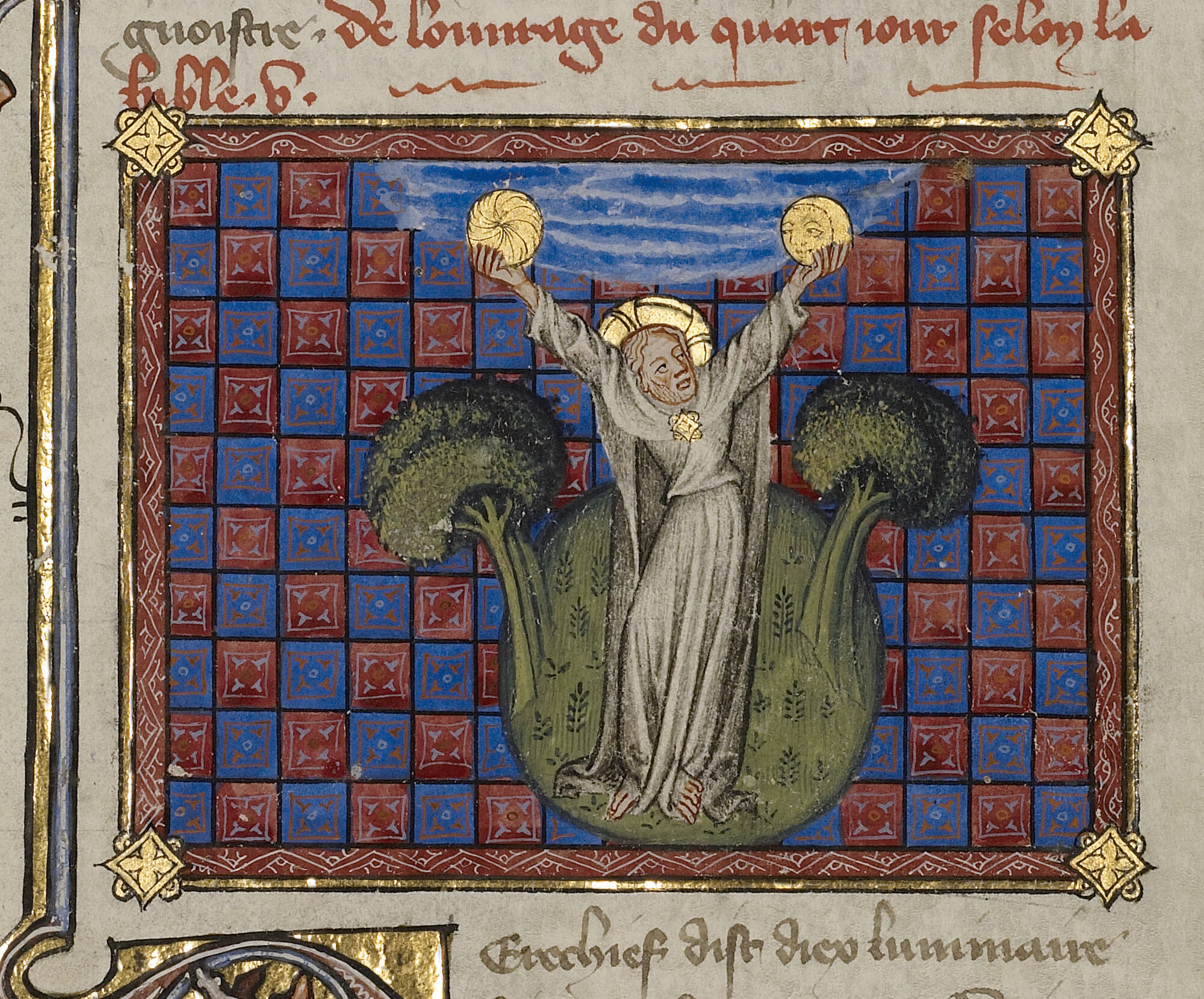
Top Image: The Creation of the Sun and the Moon (detail) from the Historical Bible, about 1360 –70 Master of Jean de Mandeville – Getty Museum Ms. 1, vol. 1 (84.MA.40.1), fol. 5

A new exhibition at the J. Paul Getty Museum examines how medieval artists visualized the Biblical story of Creation and how those images continue to shape artistic interpretations today. Beginnings: The Story of Creation in the Middle Ages brings together medieval manuscripts and contemporary artworks to explore how ideas about the world’s origins were understood, debated, and reimagined across centuries.
On view at the Getty Center from January 27 through April 19, 2026, the exhibition features fifteen medieval manuscripts from the Getty Museum’s collection alongside four contemporary paintings by Los Angeles–based artist Harmonia Rosales. Together, these works trace the enduring influence of Creation narratives from the Middle Ages to the present day.
“The biblical story of Creation formed the basis of how medieval Christians viewed the world and continues to exert a strong influence on many artists today, seeing it both as an etiological origin story and as a metaphor for the human condition,” says Timothy Potts, the Director of the Getty Museum. “Alongside contemporary works by Harmonia Rosales, the Museum objects in the exhibition explore traditional and divergent interpretations of Creation, challenging and reframing medieval works of art in the process.”
Visualising Creation in the Middle Ages
The exhibition is organised around several thematic sections, including Visualizing the Creation, Creation in the Abrahamic Faiths, The Introduction of Evil, and Beginnings and Ends, as well as a focused section devoted to Adam and Eve. Together, these themes highlight how medieval artists translated abstract theological concepts into vivid visual forms.
In Visualizing the Creation, visitors encounter medieval attempts to depict the seven days of Creation in ways that were accessible to contemporary audiences. One featured work, The Creation of the World, shows God presiding from above while holding a disc divided into circular scenes that represent the days of Creation arranged clockwise. The creation of Eve is emphasised at the centre, while inscriptions from Genesis surround each roundel, describing the unfolding events. Bold colours and geometric forms heighten the drama of the narrative.
Adam, Eve, and Medieval Ideas of Gender
A central part of the exhibition focuses on Adam and Eve and the powerful role their story played in shaping medieval ideas about human behaviour and gender roles. Medieval interpretations of Eve’s creation and actions contributed to long-lasting assumptions about feminine weakness and moral responsibility.
Among the works on view is Creation of Eve from a recently acquired manuscript by the artist Étienne Colaud. In this image, God creates Eve from Adam’s rib, presenting her as Adam’s “helper,” an interpretation that reinforced medieval views of women as secondary to men. Such imagery, widely circulated in manuscripts, helped encode sociocultural beliefs that extended far beyond the biblical narrative itself.
This section also places medieval artworks in dialogue with contemporary responses that reinterpret and challenge these inherited visual traditions. Harmonia Rosales’s Portrait of Eve reimagines the biblical figure through the lens of West African Yoruba mythology. Eve is depicted in profile within a large circular ori, a decorated, halo-like form symbolising destiny and spiritual transformation. Surrounding golden roundels illustrate cycles of life and suffering, encompassing both Eve’s experience and that of her descendants in America. With her eyes closed, Eve becomes a figure bearing collective trauma while also suggesting the possibility of breaking its repetition.
“I approach my paintings as a way to reclaim stories long erased, using Yoruba cosmology to restore strength and presence to figures often left out of history,” says Rosales. “In dialogue with Getty’s medieval manuscripts, my work bridges past and present, exploring resilience, identity, and what it means to envision the world’s beginnings through a lineage that has always existed.”
Creation Across the Abrahamic Faiths
Another section of the exhibition explores how the Creation story appears in Christian, Jewish, and Islamic traditions, emphasising their shared narrative roots while also highlighting important differences in interpretation. Medieval artists and writers across these faiths drew on common scriptural material but expressed it through distinct visual and textual traditions.
Works in this section include pages from the Rothschild Pentateuch, a French Historical Bible, and The Wonders of Creation, a widely circulated medieval Islamic text devoted to God’s works in the celestial realm. By presenting these objects together, the exhibition underscores both the interconnectedness and diversity of medieval religious cultures.
Free Will, Evil, and the End of the World
The section titled The Introduction of Evil examines medieval Christian ideas about free will and moral choice. According to medieval theology, evil was not created by God but emerged from the choices made by humans and angels. This belief is powerfully visualised in images such as The Fall of the Rebel Angels, where Lucifer and his followers are expelled from heaven and cast into the flaming mouth of a monstrous Hell.
The exhibition concludes with Beginnings and Ends, which juxtaposes the opening of the Bible with its apocalyptic conclusion. Medieval artists often depicted the end of the world in vivid, unsettling detail. In The Fourteenth Sign Before the Day of Judgment, violent winds and flames convey the chaos believed to precede Christ’s second coming and God’s final judgment of humanity.
Curating Medieval Creation
Beginnings: The Story of Creation in the Middle Ages is curated by Elizabeth Morrison, senior curator of manuscripts at the Getty Museum, and Larisa Grollemond, associate curator of manuscripts. By combining medieval manuscripts with contemporary artworks, the exhibition invites visitors to reconsider how Creation stories have been used to explain the world, define human identity, and confront questions of suffering, responsibility, and renewal across time.
Top Image: The Creation of the Sun and the Moon (detail) from the Historical Bible, about 1360 –70 Master of Jean de Mandeville – Getty Museum Ms. 1, vol. 1 (84.MA.40.1), fol. 5
Subscribe to Medievalverse
Related Posts