The Boar’s Head Carol is one of the most enduring and fascinating carols of the English medieval Christmas repertoire. This macaronic carol, dating back to at least the early 15th century, describes the ceremonial presentation of a wild boar’s head at the Christmas feast, a custom that survives most notably today at Queen’s College, Oxford, where the tradition has been continuously maintained for centuries.
The custom of serving a wild boar’s head as the principal dish at grand feasts, especially at Christmas, has ancient roots. While the exact reason for the boar’s head’s prestigious status is uncertain, it likely stems from the danger and valor involved in hunting such a fierce animal, making its presentation a powerful trophy and symbol of victory.
In medieval England, the boar’s head was brought to the table with great ceremony: preceded by trumpeters and attendants, it was borne aloft on a gilded platter, richly decorated with bays and rosemary. This tradition is documented in numerous royal and collegiate records. For example, at the coronation of Henry II’s son in 1170, the king himself is recorded as carrying the boar’s head into the hall with trumpets sounding. Queen’s College, Oxford, founded in 1340, has preserved this custom to the present day, marked by an elaborate procession and carol singing.
The boar’s head feast also echoes older, pagan Yule rituals, including the Norse sacrifice of a boar to the god Freyr, signifying fertility and good fortune, elements which were adapted into Christian festivities. Noted scholars such as Jacob Grimm have linked this banquet tradition to the sonargöltr boar of Germanic paganism.
The Ceremony at Queen’s College, Oxford
Serving up the Boar’s Head at Queen’s College, Oxford, on Christmas Day. Illustration for The Graphic, 27 December 1873.
During the 19th century, the Boar’s Head Feast at Queen’s College was a highlight of the Christmas calendar. On Christmas Day, the largest and finest boar’s head is decorated with garlands of bays and rosemary, carried ceremoniously on the shoulders of two senior college servants. They are followed by members of the college and the choir.
As the procession moves to the high table, the carol is sung by a fellow of the college, with the choir responding in chorus. Upon reaching the Provost’s seat, the boar’s head is placed before him; slices are distributed to those at the high table, and then the head is passed around the hall for all to partake.
Contrary to some claims, the boar’s head has never been replaced by a wooden substitute in this tradition.
The Legend of the Student and the Wild Boar
BnF.MS Français 9140 fol. 112r
A charming Oxford tradition tells of a student of Queen’s College, who, while reading Aristotle in Shotover Forest, was attacked by a wild boar. Thinking quickly, the student thrust his book down the beast’s throat, crying “Græcum est!” (“It is Greek!”), choking the wild animal with the “sage.” This witty tale symbolises both scholarly wit and bravery and has inspired humorous verses associated with the feast.
The first one, entitled ‘A carol bringyng in the bores heed’, was found printed in a work from 1521:
The boar’s head in hand bring I, with garlands gay and rosemary I pray you all sing merrily, Qui estis in convivio.
The boar’s head, I understand, Is the chief service in this land; Look wherever it be found, Servite cum cantico.
Be glad, lords, both more or less. For this hath ordained our steward To cheer you all this Christmas, The boar’s head with mustard.
Here is a carol found in a 15th-century manuscript:
At the beginning of the meat Of a boar’s head ye shall eat. And in the mustard ye shall wet And ye shall singen ere ye go.
Welcome be ye that be here, And ye shall have right good cheer, And also a right good fare, And ye shall singen ere ye go.
Welcome be ye every one, For ye shall sing right anon; Hie ye fast that ye had done. And ye shall singen ere ye go.
The same manuscript also has another carol:
Tidings I bring you for to tell. What me in wild forest befel. When me must with a wild beast mell With a boar so bryme.
A boar so bryme that me pursued, Me for to kill so sharply moved, That brymly beast so cruel and unrude, There tamed I him, And reft from him both life and limb.
Truly, to show you that this is true. His head with my sword I hew, To make this day to you mirth new, Now eat thereof anon.
Eat, and much good do it you; Take your bread and mustard thereto. Joy with me that I have thus done, I pray you be glad every one,
And joy all in one.
Dr Lorris Chevalier, who has a Ph.D. in medieval literature, is a historical advisor for movies, including The Last Duel and Napoleon. Click here to view his website.

By Lorris Chevalier
The Boar’s Head Carol is one of the most enduring and fascinating carols of the English medieval Christmas repertoire. This macaronic carol, dating back to at least the early 15th century, describes the ceremonial presentation of a wild boar’s head at the Christmas feast, a custom that survives most notably today at Queen’s College, Oxford, where the tradition has been continuously maintained for centuries.
The custom of serving a wild boar’s head as the principal dish at grand feasts, especially at Christmas, has ancient roots. While the exact reason for the boar’s head’s prestigious status is uncertain, it likely stems from the danger and valor involved in hunting such a fierce animal, making its presentation a powerful trophy and symbol of victory.
In medieval England, the boar’s head was brought to the table with great ceremony: preceded by trumpeters and attendants, it was borne aloft on a gilded platter, richly decorated with bays and rosemary. This tradition is documented in numerous royal and collegiate records. For example, at the coronation of Henry II’s son in 1170, the king himself is recorded as carrying the boar’s head into the hall with trumpets sounding. Queen’s College, Oxford, founded in 1340, has preserved this custom to the present day, marked by an elaborate procession and carol singing.
The boar’s head feast also echoes older, pagan Yule rituals, including the Norse sacrifice of a boar to the god Freyr, signifying fertility and good fortune, elements which were adapted into Christian festivities. Noted scholars such as Jacob Grimm have linked this banquet tradition to the sonargöltr boar of Germanic paganism.
The Ceremony at Queen’s College, Oxford
During the 19th century, the Boar’s Head Feast at Queen’s College was a highlight of the Christmas calendar. On Christmas Day, the largest and finest boar’s head is decorated with garlands of bays and rosemary, carried ceremoniously on the shoulders of two senior college servants. They are followed by members of the college and the choir.
As the procession moves to the high table, the carol is sung by a fellow of the college, with the choir responding in chorus. Upon reaching the Provost’s seat, the boar’s head is placed before him; slices are distributed to those at the high table, and then the head is passed around the hall for all to partake.
Contrary to some claims, the boar’s head has never been replaced by a wooden substitute in this tradition.
The Legend of the Student and the Wild Boar
A charming Oxford tradition tells of a student of Queen’s College, who, while reading Aristotle in Shotover Forest, was attacked by a wild boar. Thinking quickly, the student thrust his book down the beast’s throat, crying “Græcum est!” (“It is Greek!”), choking the wild animal with the “sage.” This witty tale symbolises both scholarly wit and bravery and has inspired humorous verses associated with the feast.
The first one, entitled ‘A carol bringyng in the bores heed’, was found printed in a work from 1521:
The boar’s head in hand bring I,
with garlands gay and rosemary
I pray you all sing merrily,
Qui estis in convivio.
The boar’s head, I understand,
Is the chief service in this land;
Look wherever it be found,
Servite cum cantico.
Be glad, lords, both more or less.
For this hath ordained our steward
To cheer you all this Christmas,
The boar’s head with mustard.
Here is a carol found in a 15th-century manuscript:
At the beginning of the meat
Of a boar’s head ye shall eat.
And in the mustard ye shall wet
And ye shall singen ere ye go.
Welcome be ye that be here,
And ye shall have right good cheer,
And also a right good fare,
And ye shall singen ere ye go.
Welcome be ye every one,
For ye shall sing right anon;
Hie ye fast that ye had done.
And ye shall singen ere ye go.
The same manuscript also has another carol:
Tidings I bring you for to tell.
What me in wild forest befel.
When me must with a wild beast mell
With a boar so bryme.
A boar so bryme that me pursued,
Me for to kill so sharply moved,
That brymly beast so cruel and unrude,
There tamed I him, And reft from him both life and limb.
Truly, to show you that this is true.
His head with my sword I hew,
To make this day to you mirth new,
Now eat thereof anon.
Eat, and much good do it you;
Take your bread and mustard thereto.
Joy with me that I have thus done,
I pray you be glad every one,
And joy all in one.
Dr Lorris Chevalier, who has a Ph.D. in medieval literature, is a historical advisor for movies, including The Last Duel and Napoleon. Click here to view his website.
Click here to read more from Lorris Chevalier
Further Readings:
Husk, William Henry. Songs of the Nativity Being Christmas Carols, Ancient and Modern. London: John Camden Hotten, 1868.
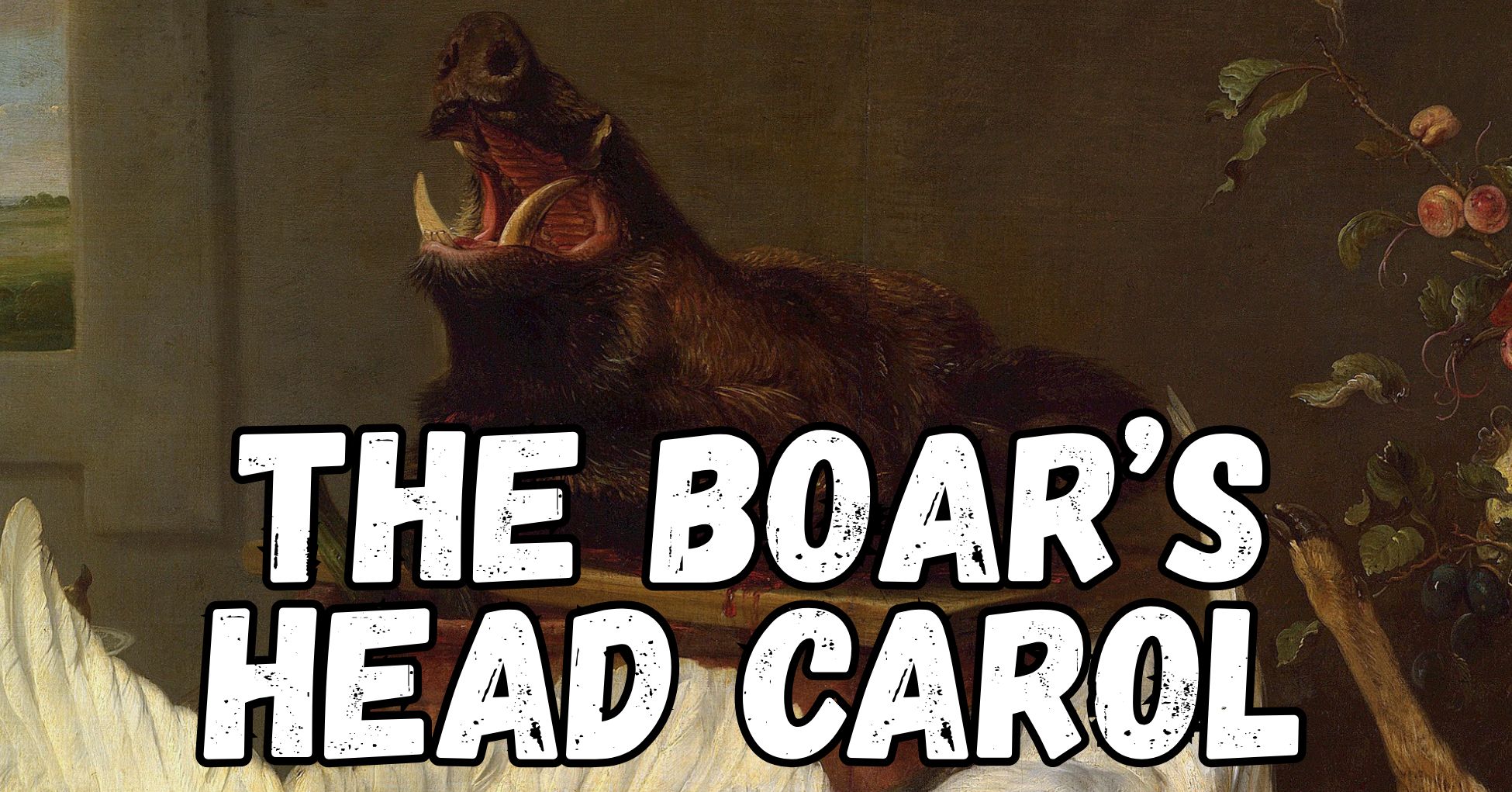
Top Image: Detail from a 17th-century painting by Frans Snyders (1579–1657)
Subscribe to Medievalverse
Related Posts