What if one of the greatest rulers of the Middle Ages was once told to become a thief? A curious medieval tale preserved in sagas and poems reveals an unexpected side of Charlemagne.
By Beth Rogers
The famous Frankish emperor Charlemagne (r. 800–814) is sometimes called the “Father of Europe” for uniting Western Europe for the first time since the Roman Empire. He is immortalized in dozens of French chansons de geste, or songs of heroic deeds. From the original French works, these stories of the great king and his knights began to spread through Europe, translated into a number of languages.
Some of these stories, such as “The Tale of Basin,” have been lost in the original French manuscripts, but remain in other versions such as the thirteenth-century Karlmagnús saga and some other German translations of the poems. In her 2011 work, Translations at the Court of Hákon Hákonarson: A Well-Planned and Highly Selective Programme, Liliane Irlenbusch-Reynard explains that monarchs such as Norway’s Hákon IV (r. 1217–1263) had these works translated in a deliberate plan not only to demonstrate proper courtly behavior and values, but to match the great literary courts of England and France, with writers such as Marie de France (1160–1215) and Chrétien de Troyes (†12th c.) producing poems and romances for their noble patrons. These moral tales are the legacy of Charlemagne and his reign, with the emperor revered as a model king and court in the same fashion as King Arthur and the Knights of the Round Table.
Page from a 19th-century printed version of Karlamagnus saga – Wikimedia Commons
“The Tale of Basin” in the first section of Karlmagnús saga, which details the king’s youth, tells of an adventure with a thief named Basin. Following the death of his father, King Pippin of France, an angel is sent by God to Karl Magnús (English: Charles the Great) to warn him of a plot against him. Karl is then visited by a second angel who tells him to “rise up and go steal” with the thief, Basin. Karl is at first resistant to the idea, but eventually locates Basin and they set off together as companions. Karl travels under the alias of Magnús, and together they find lodging with a poor couple. One night, Karl and Basin ride to the estate of Earl Renfrei to rob him, as Karl was ordered by the angels in his visions.
Basin attempts to take the earl’s horse, but the animal makes noise and rouses the earl’s men. Basin and Karl hide, and Karl overhears the earl’s plot with eleven others to overthrow Karl and murder him at his coming coronation. Karl then defeats the conspirators and strips them of their lands and titles. Earl Renfrei’s wife and lands go to Basin as a reward.
The following Faroese poem from 1822 retells the story of the emperor Karl Magnús and the thief Basin (here called Aligast). The name change alone is an interesting feature; by all evidence, the poems were written after the original French version was lost, after which the Norwegian saga was the only extant copy.
A drawing thought possibly to represent Emperor Charlemagne (c 800) in the inside front cover of the Fulda codex of the Aix capitulary, Wolfenbuettel Cod. Guelf. 496a
Scholars such as Gustav Storm (1845–1903), in his 1874 work Sagnkredsene, have theorized that the name change comes into the story from Dutch or German adaptations of the Matter of Charlemagne printed in Denmark in the fifteenth and sixteenth centuries, with Storm pointing out that Denmark’s first book printer came from Holland in about the same year. This Dutch printer, Storm surmises, may have substituted the name for one that he was familiar with in the course of printing the Danish editions.
In the poems, the religious aspect is downplayed, with Karl Magnús receiving prophetic dreams without mention of angels. Rather than being sent to “go steal,” he is specifically sent to retrieve a golden saddle, rather than a horse, which may have originated in Germanic tellings of the story. This beautiful saddle belonged to Karl Magnús’ father and was given to his sister.
The poem is also more violent than the longer version of the tale, emphasizing the traitor’s violence against his wife when she professes that she wishes Karl Magnús, her brother, would learn of the danger. The final line indicates that Karl fights the urge to leap out and defend his sister against violence; this restraint presumably allows Karl Magnús to triumph against his enemy later. It is not clear why the poem does not bother to explain Karl Magnús’ victory as described in the prose source material; perhaps the story was so well known that it was an assumed conclusion for such a heroic man.
Charlemagne dreamt That which he did not like
Charlemagne dreamt thusly That he had to go steal
“Why would such a thing appear in a dream, That I must become a thief?”
“So many things occur in dreams, It can’t all be true.”
Charlemagne requests of two squires: “Ask Aligast to appear before me!”
Before they had finished the sentence Aligast was by the table.
Aligast falls upon his own knees: “Christ bless you, king, what do you wish of me?”
“You shall me the saddle steal, Which Mrs. Gortra inherited from her father.”
“If I must steal it, and you would have it, You yourself must come with me.”
Aligast walks to the stable, Inspects all the horses [lit. “walkers,” a poetic term]
He inspects the brown, he inspects the grey, the beast he placed a saddle on.
Charlemagne rode so hard All the walls crumbled down
Aligast rode so cleverly Not a leaf stirred, nor branch.
Charlemagne crushed the wall, Aligast snuck through
When they came to the ridge of the roof, All the golden bells [on the saddle] began tolling.
Answered the queen, who lay awake: “Why do our golden bells ring so?”
“It is Hemingur the horse-master Inspecting your saddle’s cleanliness.”
“Inspect it well and make it so, In the morning shall we ride on it.
We ride to the Þing, To put Charlemagne in fetters.”
Replied the queen, who lay awake: “Christ willing, my brother would hear this.”
He gave her a smack to the cheek, Blood ran down her beautiful skin.
Mouth and nose drenched in blood, Yet Charlemagne kept his gloves.
Another version of this poem has a much jauntier opening, dropping even more of the religious overtones from the original text.
I know of a rhyme, Which has waited a long time, Wrought about Emperor Charlemagne And other hardy boys.
I know of a rhyme, Hither to me was sent, About the emperor Charlemagne And all his feats of strength.
Charlemagne, son of Pippin, Child of Ingibjörg, Pleases both the wolf and eagle, In blood he tempers steel.
In stanza 9, Aligast has been upgraded from a common thief to a knight and one of Karl Magnús’ men: “Request of the knight Aligast, / to appear in my hall before me!” Again, in three of the four versions of the poem, violence is emphasized. While the blood dripping from the queen’s mouth and nose is described in various ways, in one poem the queen’s husband beat her with “fingergold,” indicating that he wore heavy gold rings. Where the translation above says only that “Charlemagne kept his gloves,” the other versions say that his gloves were bloody or even “filled with blood,” indicating his rage at this betrayal and being forced to listen to a man beat his sister, but again, his restraint led to victory.
As mentioned, the moral of the story in the original story seems to have been a lesson about obeying God as a proper vassal should, according to the medieval worldview. In the prose version, Karlmagnús saga, Karl hesitates to obey the angel sent to him with a message from God and he judges the thief Basin. By learning to follow the orders of his divine Lord, Karl Magnús becomes a good king and his crown is ultimately saved, despite theft by itself being a sinful act.
Hákon IV, it can be surmised, may have selected these stories to be translated into the Matter of the North to spread this shining example of obedience to God and king, which was then filtered through possible Danish, German, and even Dutch influences to become these remarkable poems in the small island nation of the Faroe Islands.
Beth Rogers is a PhD student and Instructor at the University of Iceland. Check out her website World War Food.
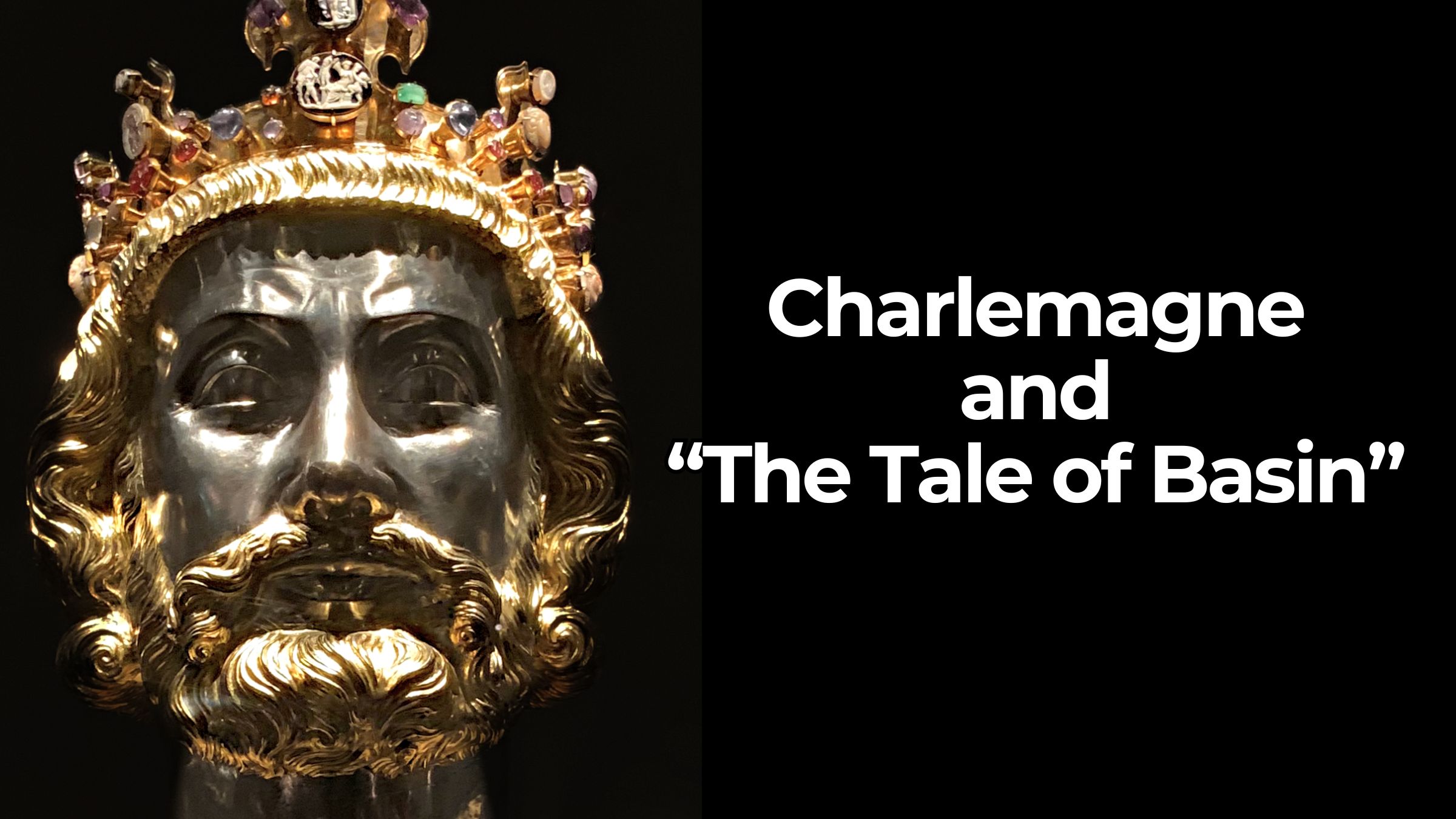
Top Image: The Bust of Charlemagne is a reliquary from around 1350 which is said to contain the top part of Charlemagne’s skull. Photo by Florian B. Gutsch / Wikimedia Commons

What if one of the greatest rulers of the Middle Ages was once told to become a thief? A curious medieval tale preserved in sagas and poems reveals an unexpected side of Charlemagne.
By Beth Rogers
The famous Frankish emperor Charlemagne (r. 800–814) is sometimes called the “Father of Europe” for uniting Western Europe for the first time since the Roman Empire. He is immortalized in dozens of French chansons de geste, or songs of heroic deeds. From the original French works, these stories of the great king and his knights began to spread through Europe, translated into a number of languages.
Some of these stories, such as “The Tale of Basin,” have been lost in the original French manuscripts, but remain in other versions such as the thirteenth-century Karlmagnús saga and some other German translations of the poems. In her 2011 work, Translations at the Court of Hákon Hákonarson: A Well-Planned and Highly Selective Programme, Liliane Irlenbusch-Reynard explains that monarchs such as Norway’s Hákon IV (r. 1217–1263) had these works translated in a deliberate plan not only to demonstrate proper courtly behavior and values, but to match the great literary courts of England and France, with writers such as Marie de France (1160–1215) and Chrétien de Troyes (†12th c.) producing poems and romances for their noble patrons. These moral tales are the legacy of Charlemagne and his reign, with the emperor revered as a model king and court in the same fashion as King Arthur and the Knights of the Round Table.
“The Tale of Basin” in the first section of Karlmagnús saga, which details the king’s youth, tells of an adventure with a thief named Basin. Following the death of his father, King Pippin of France, an angel is sent by God to Karl Magnús (English: Charles the Great) to warn him of a plot against him. Karl is then visited by a second angel who tells him to “rise up and go steal” with the thief, Basin. Karl is at first resistant to the idea, but eventually locates Basin and they set off together as companions. Karl travels under the alias of Magnús, and together they find lodging with a poor couple. One night, Karl and Basin ride to the estate of Earl Renfrei to rob him, as Karl was ordered by the angels in his visions.
Basin attempts to take the earl’s horse, but the animal makes noise and rouses the earl’s men. Basin and Karl hide, and Karl overhears the earl’s plot with eleven others to overthrow Karl and murder him at his coming coronation. Karl then defeats the conspirators and strips them of their lands and titles. Earl Renfrei’s wife and lands go to Basin as a reward.
The following Faroese poem from 1822 retells the story of the emperor Karl Magnús and the thief Basin (here called Aligast). The name change alone is an interesting feature; by all evidence, the poems were written after the original French version was lost, after which the Norwegian saga was the only extant copy.
Scholars such as Gustav Storm (1845–1903), in his 1874 work Sagnkredsene, have theorized that the name change comes into the story from Dutch or German adaptations of the Matter of Charlemagne printed in Denmark in the fifteenth and sixteenth centuries, with Storm pointing out that Denmark’s first book printer came from Holland in about the same year. This Dutch printer, Storm surmises, may have substituted the name for one that he was familiar with in the course of printing the Danish editions.
In the poems, the religious aspect is downplayed, with Karl Magnús receiving prophetic dreams without mention of angels. Rather than being sent to “go steal,” he is specifically sent to retrieve a golden saddle, rather than a horse, which may have originated in Germanic tellings of the story. This beautiful saddle belonged to Karl Magnús’ father and was given to his sister.
The poem is also more violent than the longer version of the tale, emphasizing the traitor’s violence against his wife when she professes that she wishes Karl Magnús, her brother, would learn of the danger. The final line indicates that Karl fights the urge to leap out and defend his sister against violence; this restraint presumably allows Karl Magnús to triumph against his enemy later. It is not clear why the poem does not bother to explain Karl Magnús’ victory as described in the prose source material; perhaps the story was so well known that it was an assumed conclusion for such a heroic man.
Charlemagne dreamt
That which he did not like
Charlemagne dreamt thusly
That he had to go steal
“Why would such a thing appear in a dream,
That I must become a thief?”
“So many things occur in dreams,
It can’t all be true.”
Charlemagne requests of two squires:
“Ask Aligast to appear before me!”
Before they had finished the sentence
Aligast was by the table.
Aligast falls upon his own knees:
“Christ bless you, king, what do you wish of me?”
“You shall me the saddle steal,
Which Mrs. Gortra inherited from her father.”
“If I must steal it, and you would have it,
You yourself must come with me.”
Aligast walks to the stable,
Inspects all the horses [lit. “walkers,” a poetic term]
He inspects the brown, he inspects the grey,
the beast he placed a saddle on.
Charlemagne rode so hard
All the walls crumbled down
Aligast rode so cleverly
Not a leaf stirred, nor branch.
Charlemagne crushed the wall,
Aligast snuck through
When they came to the ridge of the roof,
All the golden bells [on the saddle] began tolling.
Answered the queen, who lay awake:
“Why do our golden bells ring so?”
“It is Hemingur the horse-master
Inspecting your saddle’s cleanliness.”
“Inspect it well and make it so,
In the morning shall we ride on it.
We ride to the Þing,
To put Charlemagne in fetters.”
Replied the queen, who lay awake:
“Christ willing, my brother would hear this.”
He gave her a smack to the cheek,
Blood ran down her beautiful skin.
Mouth and nose drenched in blood,
Yet Charlemagne kept his gloves.
Another version of this poem has a much jauntier opening, dropping even more of the religious overtones from the original text.
I know of a rhyme,
Which has waited a long time,
Wrought about Emperor Charlemagne
And other hardy boys.
I know of a rhyme,
Hither to me was sent,
About the emperor Charlemagne
And all his feats of strength.
Charlemagne, son of Pippin,
Child of Ingibjörg,
Pleases both the wolf and eagle,
In blood he tempers steel.
In stanza 9, Aligast has been upgraded from a common thief to a knight and one of Karl Magnús’ men: “Request of the knight Aligast, / to appear in my hall before me!” Again, in three of the four versions of the poem, violence is emphasized. While the blood dripping from the queen’s mouth and nose is described in various ways, in one poem the queen’s husband beat her with “fingergold,” indicating that he wore heavy gold rings. Where the translation above says only that “Charlemagne kept his gloves,” the other versions say that his gloves were bloody or even “filled with blood,” indicating his rage at this betrayal and being forced to listen to a man beat his sister, but again, his restraint led to victory.
As mentioned, the moral of the story in the original story seems to have been a lesson about obeying God as a proper vassal should, according to the medieval worldview. In the prose version, Karlmagnús saga, Karl hesitates to obey the angel sent to him with a message from God and he judges the thief Basin. By learning to follow the orders of his divine Lord, Karl Magnús becomes a good king and his crown is ultimately saved, despite theft by itself being a sinful act.
Hákon IV, it can be surmised, may have selected these stories to be translated into the Matter of the North to spread this shining example of obedience to God and king, which was then filtered through possible Danish, German, and even Dutch influences to become these remarkable poems in the small island nation of the Faroe Islands.
Beth Rogers is a PhD student and Instructor at the University of Iceland. Check out her website World War Food.
Top Image: The Bust of Charlemagne is a reliquary from around 1350 which is said to contain the top part of Charlemagne’s skull. Photo by Florian B. Gutsch / Wikimedia Commons
Subscribe to Medievalverse
Related Posts