Researchers studying a famous prehistoric monument in southern Spain have uncovered new evidence showing that it continued to hold symbolic importance more than four thousand years after it was built. A new genetic and archaeological study reveals that two medieval men were buried in the atrium of the Menga dolmen, a massive Neolithic structure located near Antequera in the province of Málaga.
The findings, published in the Journal of Archaeological Science: Reports, come from an international team of researchers from the University of Seville, the University of Huddersfield, the Francis Crick Institute in London, and Harvard University. By combining archaeogenetics with archaeological analysis, the team was able to shed new light on two individuals buried at the site between the eighth and eleventh centuries.
Medieval burials in a Neolithic monument
Inside the Menga Dolmen -photo by Ángel M. Felicísimo / Wikimedia Commons
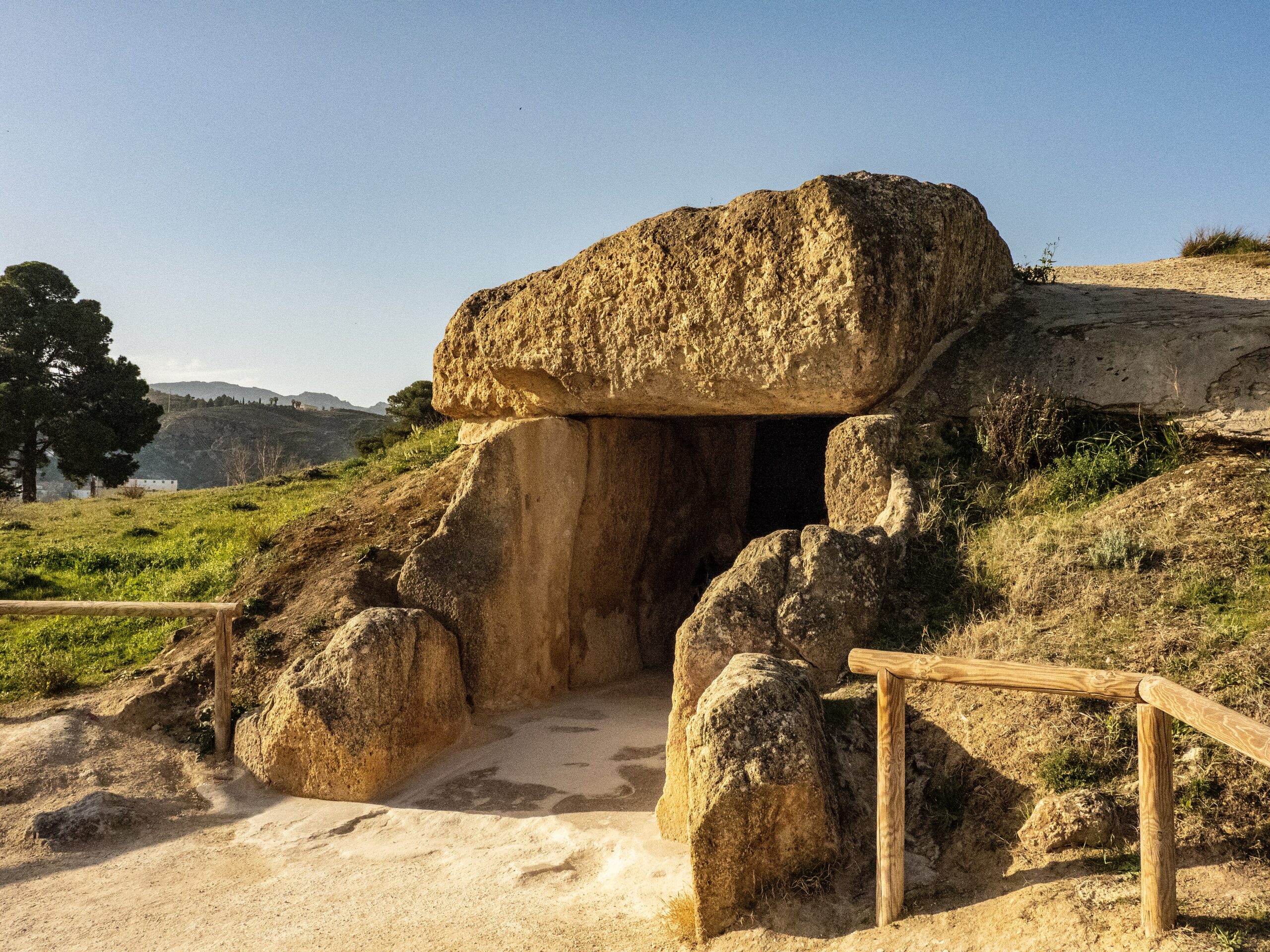
The Menga dolmen is one of the largest megalithic monuments in Europe. Built between roughly 3800 and 3600 BC, it forms part of the Antequera Dolmens Site, which is listed as a UNESCO World Heritage Site. Although constructed during the Neolithic period, the monument continued to attract visitors and activity throughout later historical periods.
Archaeologists discovered the two medieval burials during excavations in 2005. Both individuals were older adult men, each estimated to have been over 45 years of age at death. They were buried in simple pits in the atrium of the dolmen without any grave goods.
The bodies were placed face down, with their heads resting on their right side and oriented toward the southwest. Notably, the burials were carefully aligned with the axis of symmetry of the dolmen, a placement that suggests a deliberate relationship between the deceased and the ancient monument.
Radiocarbon dating showed that the two men were buried about 190 years apart, suggesting that the site was reused repeatedly during the early medieval period.
Extracting DNA from poorly preserved remains
Exhumations carried out during the investigation. Photo credit Verónica Navarrete and Luis Efrén Fernández
Researchers attempted to analyse DNA from both individuals in order to determine their ancestry and possible relationship to each other. However, the remains proved extremely difficult to study genetically. Less than one percent of the DNA recovered from the bones belonged to the individuals themselves, with the rest degraded or contaminated.
To overcome this challenge, the team used a specialised technique that targets around 1.2 million specific genetic markers. Even with this method, usable genetic data could only be recovered from one of the individuals.
The surviving genetic profile revealed a mixture of ancestries typical of populations living in southern Iberia during the early medieval period. The man carried genetic markers commonly found in European populations, including a Y-chromosome lineage that has been present in Iberia since prehistoric times. At the same time, his mitochondrial DNA and broader genetic profile showed connections to North African and Levantine populations.
This combination reflects the cultural and demographic diversity of al-Andalus, the region of the Iberian Peninsula ruled by Islamic states during this period.
A multicultural society in medieval Iberia
From the eighth century onward, southern Iberia was home to communities of Muslims, Christians, Jews, and possibly groups maintaining older religious traditions. In such a diverse society, genetic ancestry alone cannot determine an individual’s religion or cultural identity.
Archaeological evidence from the Menga burials provides some clues. The orientation of the bodies is broadly compatible with Islamic burial practices in al-Andalus, which typically involved single graves without grave goods and bodies positioned toward Mecca. However, the careful alignment of the graves with the axis of the prehistoric monument does not resemble nearby Islamic cemeteries.
This unusual combination makes the burials difficult to interpret. Instead of representing a standard cemetery, the site may have served a special religious or symbolic function.
A prehistoric monument reused in the Middle Ages
Photo by Ángel M. Felicísimo / Wikimedia Commons
The reuse of prehistoric monuments during the Middle Ages is a phenomenon known from several sites across the Iberian Peninsula. Ancient tombs, stone circles, and other megalithic structures were sometimes repurposed for burials, habitation, or religious activity.
In the case of the Menga dolmen, the researchers suggest that the monument may have functioned as a rural hermitage or shrine. In medieval Islamic societies, small sanctuaries known as qubbas were often built in remote locations and associated with revered holy individuals.
Historical sources hint that medieval communities were fascinated by ancient structures. As the researchers explain:
accounts by medieval western Islamic geographers mention the reuse and repurpose of pre-Islamic buildings and highlight an evident interest in talismanic objects, which could have stretched to older, prehistoric monuments. Although difficult to assess, it is assumed that in rural areas there was considerable continuity over centuries, and possibly millennia, in seeing places as sacred. The Christian burials from Xancra suggest that this was likely not a religion-specific phenomenon.
If this interpretation is correct, the dolmen may have been seen not simply as a relic of the distant past, but as a meaningful landmark in the medieval landscape.
A sacred place across five millennia
The two medieval burials illustrate how ancient monuments could continue to shape cultural practices long after their original builders were gone. Even thousands of years after its construction, the Menga dolmen remained a place where people chose to bury the dead.
As the researchers conclude:
Whoever these two individuals were – and regardless of what faith they practised – the fact that they were both given inhumations aligned with the axis of a megalithic monument, in a site of remarkable prominence in the landscape of Antequera, approximately two centuries apart, highlights the continuity of Menga as a symbolic location for over 5000 years – and possibly even longer – well beyond the Neolithic period.
The discovery adds another chapter to the long history of the Menga dolmen, showing how a monument built in the Neolithic era continued to hold meaning for people living in medieval Iberia.
The article, “Genetic and historical perspectives on the early medieval inhumations from the Menga dolmen, Antequera (Spain),” by Marina Silva, Leonardo García Sanjuán, Alessandro Fichera, Gonzalo Oteo-García, M. George B. Foody, Luis Efrén Fernández Rodríguez, Verónica Navarrete Pendón, Amira K. Bennison, Maria Pala, Pedro Soares, David Reich, Ceiridwen J. Edwards and Martin B. Richards, is published in Journal of Archaeological Science: Reports. Click here to read it.
Top Image: Photo by Tony Makepeace / Wikimedia Commons

Researchers studying a famous prehistoric monument in southern Spain have uncovered new evidence showing that it continued to hold symbolic importance more than four thousand years after it was built. A new genetic and archaeological study reveals that two medieval men were buried in the atrium of the Menga dolmen, a massive Neolithic structure located near Antequera in the province of Málaga.
The findings, published in the Journal of Archaeological Science: Reports, come from an international team of researchers from the University of Seville, the University of Huddersfield, the Francis Crick Institute in London, and Harvard University. By combining archaeogenetics with archaeological analysis, the team was able to shed new light on two individuals buried at the site between the eighth and eleventh centuries.
Medieval burials in a Neolithic monument
The Menga dolmen is one of the largest megalithic monuments in Europe. Built between roughly 3800 and 3600 BC, it forms part of the Antequera Dolmens Site, which is listed as a UNESCO World Heritage Site. Although constructed during the Neolithic period, the monument continued to attract visitors and activity throughout later historical periods.
Archaeologists discovered the two medieval burials during excavations in 2005. Both individuals were older adult men, each estimated to have been over 45 years of age at death. They were buried in simple pits in the atrium of the dolmen without any grave goods.
The bodies were placed face down, with their heads resting on their right side and oriented toward the southwest. Notably, the burials were carefully aligned with the axis of symmetry of the dolmen, a placement that suggests a deliberate relationship between the deceased and the ancient monument.
Radiocarbon dating showed that the two men were buried about 190 years apart, suggesting that the site was reused repeatedly during the early medieval period.
Extracting DNA from poorly preserved remains
Researchers attempted to analyse DNA from both individuals in order to determine their ancestry and possible relationship to each other. However, the remains proved extremely difficult to study genetically. Less than one percent of the DNA recovered from the bones belonged to the individuals themselves, with the rest degraded or contaminated.
To overcome this challenge, the team used a specialised technique that targets around 1.2 million specific genetic markers. Even with this method, usable genetic data could only be recovered from one of the individuals.
The surviving genetic profile revealed a mixture of ancestries typical of populations living in southern Iberia during the early medieval period. The man carried genetic markers commonly found in European populations, including a Y-chromosome lineage that has been present in Iberia since prehistoric times. At the same time, his mitochondrial DNA and broader genetic profile showed connections to North African and Levantine populations.
This combination reflects the cultural and demographic diversity of al-Andalus, the region of the Iberian Peninsula ruled by Islamic states during this period.
A multicultural society in medieval Iberia
From the eighth century onward, southern Iberia was home to communities of Muslims, Christians, Jews, and possibly groups maintaining older religious traditions. In such a diverse society, genetic ancestry alone cannot determine an individual’s religion or cultural identity.
Archaeological evidence from the Menga burials provides some clues. The orientation of the bodies is broadly compatible with Islamic burial practices in al-Andalus, which typically involved single graves without grave goods and bodies positioned toward Mecca. However, the careful alignment of the graves with the axis of the prehistoric monument does not resemble nearby Islamic cemeteries.
This unusual combination makes the burials difficult to interpret. Instead of representing a standard cemetery, the site may have served a special religious or symbolic function.
A prehistoric monument reused in the Middle Ages
The reuse of prehistoric monuments during the Middle Ages is a phenomenon known from several sites across the Iberian Peninsula. Ancient tombs, stone circles, and other megalithic structures were sometimes repurposed for burials, habitation, or religious activity.
In the case of the Menga dolmen, the researchers suggest that the monument may have functioned as a rural hermitage or shrine. In medieval Islamic societies, small sanctuaries known as qubbas were often built in remote locations and associated with revered holy individuals.
Historical sources hint that medieval communities were fascinated by ancient structures. As the researchers explain:
accounts by medieval western Islamic geographers mention the reuse and repurpose of pre-Islamic buildings and highlight an evident interest in talismanic objects, which could have stretched to older, prehistoric monuments. Although difficult to assess, it is assumed that in rural areas there was considerable continuity over centuries, and possibly millennia, in seeing places as sacred. The Christian burials from Xancra suggest that this was likely not a religion-specific phenomenon.
If this interpretation is correct, the dolmen may have been seen not simply as a relic of the distant past, but as a meaningful landmark in the medieval landscape.
A sacred place across five millennia
The two medieval burials illustrate how ancient monuments could continue to shape cultural practices long after their original builders were gone. Even thousands of years after its construction, the Menga dolmen remained a place where people chose to bury the dead.
As the researchers conclude:
Whoever these two individuals were – and regardless of what faith they practised – the fact that they were both given inhumations aligned with the axis of a megalithic monument, in a site of remarkable prominence in the landscape of Antequera, approximately two centuries apart, highlights the continuity of Menga as a symbolic location for over 5000 years – and possibly even longer – well beyond the Neolithic period.
The discovery adds another chapter to the long history of the Menga dolmen, showing how a monument built in the Neolithic era continued to hold meaning for people living in medieval Iberia.
The article, “Genetic and historical perspectives on the early medieval inhumations from the Menga dolmen, Antequera (Spain),” by Marina Silva, Leonardo García Sanjuán, Alessandro Fichera, Gonzalo Oteo-García, M. George B. Foody, Luis Efrén Fernández Rodríguez, Verónica Navarrete Pendón, Amira K. Bennison, Maria Pala, Pedro Soares, David Reich, Ceiridwen J. Edwards and Martin B. Richards, is published in Journal of Archaeological Science: Reports. Click here to read it.
Top Image: Photo by Tony Makepeace / Wikimedia Commons
Subscribe to Medievalverse
Related Posts