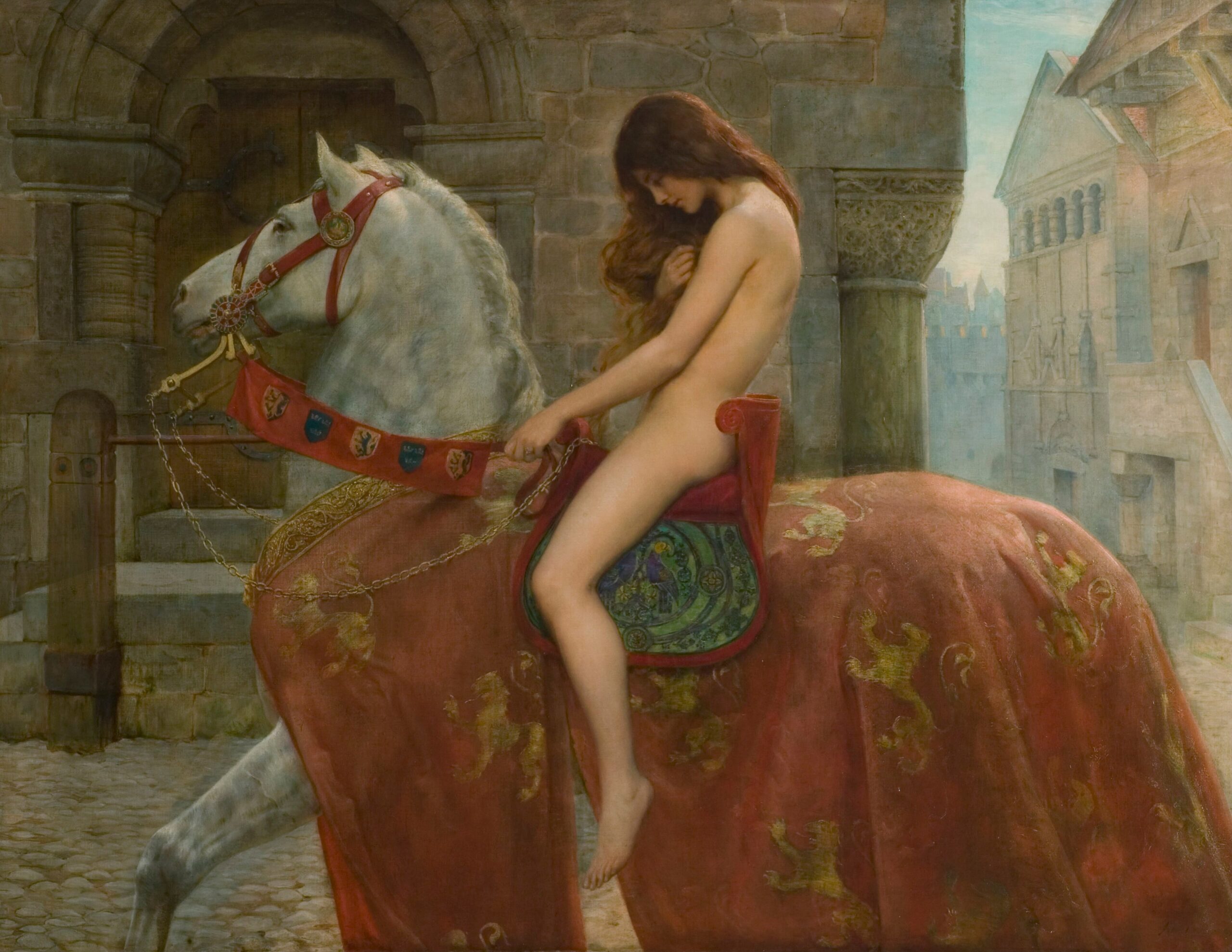
A new study is taking a closer look at how the story of Lady Godiva—an eleventh-century noblewoman best known for her legendary ride through Coventry—has continued to shape protest movements, artistic expression, and popular culture for centuries.
Writing in M/C Journal, Elizabeth Reid Boyd of Edith Cowan University explores how the tale has been repeatedly retold and reinterpreted from the medieval period to the present day. Historians continue to debate the truth behind the story, but Lady Godiva herself was a real historical figure—and her cultural influence has endured far beyond her lifetime.
Giant puppet of Lady Godiva walking through the streets of Coventry in September 2015 – photo by Tony Hisgett / Wikimedia Commons
According to the legend, first recorded in the 13th century, Godiva rode unclothed through the streets of Coventry to persuade her husband to lift an oppressive tax on the town’s inhabitants. Out of respect, the townspeople averted their gaze—except for the infamous ‘Peeping Tom,’ who was punished for spying on her. Moved by her courage, the tax was repealed.
While often treated as a moral tale about sacrifice or charity, the study argues that Godiva’s ride may also reflect deeper social tensions in medieval urban life. Rather than simply a personal act of devotion, the story can be understood as a symbolic renegotiation of civic authority, placing a noblewoman between public and private spheres, obedience and rebellion. In this sense, the legend captures a moment in which political power, economic grievance, and gender expectations intersect.
Coventry halfpenny 1792 with Lady Godiva (right) depicted on the reverse – Wikimedia Commons
Dr Reid Boyd suggests that Godiva’s body in the story becomes a form of symbolic exchange—offered in protest against unjust taxation, but also subjected to scrutiny and moral judgement. This dynamic has helped make the legend adaptable across time, allowing later audiences to reinterpret it in response to their own concerns about justice, authority, and the public role of women.
The article also draws on fan studies theory to describe how Godiva’s story has not merely been remembered but actively performed. From Coventry’s long-running Godiva Procession, which saw women publicly portray the figure on horseback, to suffragist theatre and modern demonstrations, reenactments of the ride have allowed communities to reinterpret its meaning. In these cases, retelling the legend becomes a participatory act—one that transforms a medieval narrative into a form of political or cultural expression.
Over the centuries, Lady Godiva has appeared in Victorian sculpture, the paintings of Salvador Dalí, commercial branding, and contemporary media. References to her can be found in The Simpsons, DC Comics, and even the London 2012 Olympics opening ceremony. Today, her legacy has been invoked by climate activists such as Extinction Rebellion, whose demonstrations echo the story’s symbolism of protest through public vulnerability.
Cover for Beyonce’s ‘Renaissance’ album
While the legend has often been commercialised or sexualised, Dr Reid Boyd argues that it continues to offer opportunities for reinterpretation and resistance. Each retelling can challenge how women’s bodies are represented in public space, allowing the story to be reclaimed in new social and political contexts.
Elizabeth Reid Boyd, who also writes historical fiction under the pen name Eliza Redgold, has explored the story in another medium as well. Her romance novel Naked: A Novel of Lady Godiva offers a fictionalised retelling of the medieval noblewoman’s life and legend.
The article, “Like Lady Godiva: Lady Godiva’s Fandom from Fiction to Activism,” by Elizabeth Reid Boyd, is published in M/C Journal. Click here to read it.
Top Image: Lady Godiva by John Collier, c. 1897, in the Herbert Art Gallery and Museum, Coventry.

A new study is taking a closer look at how the story of Lady Godiva—an eleventh-century noblewoman best known for her legendary ride through Coventry—has continued to shape protest movements, artistic expression, and popular culture for centuries.
Writing in M/C Journal, Elizabeth Reid Boyd of Edith Cowan University explores how the tale has been repeatedly retold and reinterpreted from the medieval period to the present day. Historians continue to debate the truth behind the story, but Lady Godiva herself was a real historical figure—and her cultural influence has endured far beyond her lifetime.
According to the legend, first recorded in the 13th century, Godiva rode unclothed through the streets of Coventry to persuade her husband to lift an oppressive tax on the town’s inhabitants. Out of respect, the townspeople averted their gaze—except for the infamous ‘Peeping Tom,’ who was punished for spying on her. Moved by her courage, the tax was repealed.
While often treated as a moral tale about sacrifice or charity, the study argues that Godiva’s ride may also reflect deeper social tensions in medieval urban life. Rather than simply a personal act of devotion, the story can be understood as a symbolic renegotiation of civic authority, placing a noblewoman between public and private spheres, obedience and rebellion. In this sense, the legend captures a moment in which political power, economic grievance, and gender expectations intersect.
Dr Reid Boyd suggests that Godiva’s body in the story becomes a form of symbolic exchange—offered in protest against unjust taxation, but also subjected to scrutiny and moral judgement. This dynamic has helped make the legend adaptable across time, allowing later audiences to reinterpret it in response to their own concerns about justice, authority, and the public role of women.
The article also draws on fan studies theory to describe how Godiva’s story has not merely been remembered but actively performed. From Coventry’s long-running Godiva Procession, which saw women publicly portray the figure on horseback, to suffragist theatre and modern demonstrations, reenactments of the ride have allowed communities to reinterpret its meaning. In these cases, retelling the legend becomes a participatory act—one that transforms a medieval narrative into a form of political or cultural expression.
Over the centuries, Lady Godiva has appeared in Victorian sculpture, the paintings of Salvador Dalí, commercial branding, and contemporary media. References to her can be found in The Simpsons, DC Comics, and even the London 2012 Olympics opening ceremony. Today, her legacy has been invoked by climate activists such as Extinction Rebellion, whose demonstrations echo the story’s symbolism of protest through public vulnerability.
While the legend has often been commercialised or sexualised, Dr Reid Boyd argues that it continues to offer opportunities for reinterpretation and resistance. Each retelling can challenge how women’s bodies are represented in public space, allowing the story to be reclaimed in new social and political contexts.
Elizabeth Reid Boyd, who also writes historical fiction under the pen name Eliza Redgold, has explored the story in another medium as well. Her romance novel Naked: A Novel of Lady Godiva offers a fictionalised retelling of the medieval noblewoman’s life and legend.
The article, “Like Lady Godiva: Lady Godiva’s Fandom from Fiction to Activism,” by Elizabeth Reid Boyd, is published in M/C Journal. Click here to read it.
Top Image: Lady Godiva by John Collier, c. 1897, in the Herbert Art Gallery and Museum, Coventry.
Subscribe to Medievalverse
Related Posts