For centuries, the Great Schism of 1054 has been presented as the dramatic moment when the Christian world split in two—but this familiar story is deeply misleading.
Most popular retellings of the Great Schism follow a simple, dramatic arc. For centuries, the story goes, tensions simmered between the Latin West and the Greek East, fuelled by disputes over doctrine and ritual. Then, in 1054, the conflict finally boiled over.
In this version, Pope Leo IX sends legates to Constantinople to confront Patriarch Michael Cerularius. After negotiations collapse, Cardinal Humbert marches into Hagia Sophia and places a bull of excommunication on the altar. The patriarch responds by excommunicating the legates in return. With that exchange—so the narrative continues—the unity of Christendom is shattered: the Roman Catholic and Eastern Orthodox churches become permanently separated.
To modern readers, the appeal of this account is obvious. It offers a clear date, a vivid scene, and a clean cause-and-effect explanation. But as Eugene Webb points out, that tidy story is exactly the problem—and it risks turning a long, complicated medieval process into a single “break” that never truly happened in that way.
Webb, a Professor Emeritus in the University of Washington, lays out his argument in an article written for The Cambridge History of the Papacy. Explaining that “the breach between East and West developed in its various facets, institutional, theological, and conceptual,” he details several aspects of the traditional story that are wrong.
1. The Events of 1054 are Misunderstood
Michael Cerularius meets with the Papal envoys, from the Madrid Skylitzes
Webb begins by noting that the delegation sent by Pope Leo IX to Constantinople in 1054 was not necessarily meant to provoke a showdown. The Papacy was in fact seeking an alliance with the Byzantine Empire against the Normans, who were attacking both Rome and Imperial territories in southern Italy.
However, the three-person delegation sent by Leo was led by Cardinal Humbert of Silva Candida, and he seems to have been more interested in arguing religious differences between the Latin and Greek churches, starting with what kind of bread to use during Communion. The legates criticised the Orthodox practice of using leavened bread, while the West had come to prefer unleavened bread.
When Humbert failed to persuade Michael Cerularius about this issue and several others (more on this later), he then insisted that the Orthodox church needed to follow Roman practices because the Pope was the supreme head of all Christians. The Patriarch of Constantinople rejected this – they and other Eastern churches never saw the Bishop of Rome as having authority over any other bishops.
Webb writes what happened next:
Cardinal Humbert of Silva Candida, accompanied by two fellow legates, marched into Haghia Sophia Cathedral in Constantinople on Saturday, July 16 of that year and, at the beginning of the Divine Liturgy, laid on the high altar a bull of excommunication that he had written against Michael Cerularius, the patriarch of Constantinople, “and those who support his folly” (“et eius stultitiae fautores”). The three legates then walked out, turning at the threshold, and shouted, “Videat Deus et judicet!” (“May God see and judge!”), and symbolically shook the dust of the cathedral from their feet.
Four days later, Cerularius held a synod where he excommunicated the three legates.
2. If there was a schism in 1054, few noticed
July 16, 1054 has long been seen as the date when the Great Schism took place – a break between churches. However, what really happened that day (and four days later) was excommunications placed on a few individuals. Neither side had condemned the other side’s entire church.
Moreover, a problem soon emerged with Humbert’s actions – he had been sent as a Papal Legate but while he was in Constantinople, Pope Leo IX had died. This would seemingly mean that the legate’s authority was void.
For decades afterward, the episode did not function as the clear “start date” of a permanent split. But it gradually was becoming clear that a divide was emerging between the Catholic and Orthodox churches, with a more serious breach happening in 1204 when Crusaders captured and looted Constantinople.
3. The Schism actually happened centuries before
The Holy Spirit coming from both the Father and the Son, detail of the Boulbon Altarpiece, c. 1450. Originally from the high altar of the Chapelle Saint-Marcellin, Boulbon, France, now in the Louvre, Paris. – Wikimedia Commons
Paradoxically, it can be said that the Great Schism started over 250 years before 1054. Webb explains that the deeper roots of the divide lie in the slow transformation of Western European theological and political culture from the Early Middle Ages onward.
Central to this story is the way Western Christians increasingly reinterpreted their relationship to doctrine, authority, and tradition. Differences between Greek and Latin Christianity had existed for centuries without producing a permanent breach. What changed was not simply the existence of disagreement, but how disagreement itself was understood.
One of the most famous theological issues associated with the schism—the filioque clause in the Nicene Creed—illustrates this process clearly. Originally, the Christian belief was that the Holy Spirit came from God the Father. This was set out back in the fourth century, but over time Western Christians developed different ideas on this matter, and by the end of the eighth century they were insisting that the Holy Spirit came from both God the Father and Jesus the Son.
Webb writes how the opening shot in this dispute took place at:
the Council of Friuli in 796 by a Carolingian bishop, Paulinus of Aquileia, and in proposing it he did so explicitly in opposition to what he called the “manifest heretics” in the Eastern Church “who whisper [that] the Holy Spirit exists from the Father alone and proceeds from the Father alone.”
4. It was more political than religious
A 19th-century depiction of Charlemagne’s court by Oscar Pletsch (1830–1888
Webb also insists that the medieval schism cannot be understood without recognising how deeply political it was. The dispute took place just as the Carolingian ruler Charlemagne was making his claim to imperial status. When he was crowned emperor in 800, the act carried enormous symbolic weight. It implied that the true continuation of Roman imperial authority now resided in the West.
From a Byzantine perspective, this was an extraordinary and deeply provocative claim. The Roman Empire, after all, had never ceased to exist. Constantinople remained its political and cultural centre. This created a rivalry that spilled into ecclesiastical and theological arenas. Competing visions of empire encouraged competing visions of Christian authority.
Webb explains:
If one is to identify a particular time and set of circumstances in which the schism between the Eastern and Western Churches had its formal origin, it would seem, then, to lie in the time of Charlemagne’s failed effort to acquire for his own realm the charisma of imperial legitimacy, first by getting recognition from the imperial throne in Constantinople, and when that failed, by casting the entire Eastern Christian world as heretical and therefore illegitimate. As Charlemagne’s son and successor Louis the Pious put it, “We have received the government of the Roman Empire for our orthodoxy, while the Greeks have ceased to be emperors of the Romans for their cacodoxy.”
5. The Papacy didn’t originally want to be part of this dispute
One of the major issues Humbert raised when he went to Constantinople in 1054 was that the Pope in Rome was the head of all Christians. However, the situation at the turn of the ninth century was much different, as the papacy was simply a “subordinate” to Charlemagne and the view in Western Europe was that the Carolingian emperor was the real head of all Christians.
When this dispute over the filioque clause was taking place, the popes kept a low profile as they did not want to go against Charlemagne nor disagree with decisions that had been made centuries before. And they certainly were not trying to assert their supremacy.
Webb ends his article on a sober, even pessimistic note. He points out that there have been repeated efforts—both in the Middle Ages and in more recent centuries—to heal the breach and “re-unify” the Church, yet a basic divide still stands in the way. The Roman Catholic Church understands unity through a strongly centralised structure, culminating in the doctrine of papal infallibility, while the Eastern Orthodox tradition sees the Church as fundamentally collegial: a communion of bishops and churches whose decisions are made together in council. As long as these two visions of authority and unity remain irreconcilable, Webb suggests, the schism is likely to endure.
Eugene Webb’s article, “The Schism of 1054,” appears in the first volume of The Cambridge History of the Papacy. This three volume-work, published in 2025, offers a comprehensive account of current research into this institution.

For centuries, the Great Schism of 1054 has been presented as the dramatic moment when the Christian world split in two—but this familiar story is deeply misleading.
Most popular retellings of the Great Schism follow a simple, dramatic arc. For centuries, the story goes, tensions simmered between the Latin West and the Greek East, fuelled by disputes over doctrine and ritual. Then, in 1054, the conflict finally boiled over.
In this version, Pope Leo IX sends legates to Constantinople to confront Patriarch Michael Cerularius. After negotiations collapse, Cardinal Humbert marches into Hagia Sophia and places a bull of excommunication on the altar. The patriarch responds by excommunicating the legates in return. With that exchange—so the narrative continues—the unity of Christendom is shattered: the Roman Catholic and Eastern Orthodox churches become permanently separated.
To modern readers, the appeal of this account is obvious. It offers a clear date, a vivid scene, and a clean cause-and-effect explanation. But as Eugene Webb points out, that tidy story is exactly the problem—and it risks turning a long, complicated medieval process into a single “break” that never truly happened in that way.
Webb, a Professor Emeritus in the University of Washington, lays out his argument in an article written for The Cambridge History of the Papacy. Explaining that “the breach between East and West developed in its various facets, institutional, theological, and conceptual,” he details several aspects of the traditional story that are wrong.
1. The Events of 1054 are Misunderstood
Webb begins by noting that the delegation sent by Pope Leo IX to Constantinople in 1054 was not necessarily meant to provoke a showdown. The Papacy was in fact seeking an alliance with the Byzantine Empire against the Normans, who were attacking both Rome and Imperial territories in southern Italy.
However, the three-person delegation sent by Leo was led by Cardinal Humbert of Silva Candida, and he seems to have been more interested in arguing religious differences between the Latin and Greek churches, starting with what kind of bread to use during Communion. The legates criticised the Orthodox practice of using leavened bread, while the West had come to prefer unleavened bread.
When Humbert failed to persuade Michael Cerularius about this issue and several others (more on this later), he then insisted that the Orthodox church needed to follow Roman practices because the Pope was the supreme head of all Christians. The Patriarch of Constantinople rejected this – they and other Eastern churches never saw the Bishop of Rome as having authority over any other bishops.
Webb writes what happened next:
Cardinal Humbert of Silva Candida, accompanied by two fellow legates, marched into Haghia Sophia Cathedral in Constantinople on Saturday, July 16 of that year and, at the beginning of the Divine Liturgy, laid on the high altar a bull of excommunication that he had written against Michael Cerularius, the patriarch of Constantinople, “and those who support his folly” (“et eius stultitiae fautores”). The three legates then walked out, turning at the threshold, and shouted, “Videat Deus et judicet!” (“May God see and judge!”), and symbolically shook the dust of the cathedral from their feet.
Four days later, Cerularius held a synod where he excommunicated the three legates.
2. If there was a schism in 1054, few noticed
July 16, 1054 has long been seen as the date when the Great Schism took place – a break between churches. However, what really happened that day (and four days later) was excommunications placed on a few individuals. Neither side had condemned the other side’s entire church.
Moreover, a problem soon emerged with Humbert’s actions – he had been sent as a Papal Legate but while he was in Constantinople, Pope Leo IX had died. This would seemingly mean that the legate’s authority was void.
For decades afterward, the episode did not function as the clear “start date” of a permanent split. But it gradually was becoming clear that a divide was emerging between the Catholic and Orthodox churches, with a more serious breach happening in 1204 when Crusaders captured and looted Constantinople.
3. The Schism actually happened centuries before
Paradoxically, it can be said that the Great Schism started over 250 years before 1054. Webb explains that the deeper roots of the divide lie in the slow transformation of Western European theological and political culture from the Early Middle Ages onward.
Central to this story is the way Western Christians increasingly reinterpreted their relationship to doctrine, authority, and tradition. Differences between Greek and Latin Christianity had existed for centuries without producing a permanent breach. What changed was not simply the existence of disagreement, but how disagreement itself was understood.
One of the most famous theological issues associated with the schism—the filioque clause in the Nicene Creed—illustrates this process clearly. Originally, the Christian belief was that the Holy Spirit came from God the Father. This was set out back in the fourth century, but over time Western Christians developed different ideas on this matter, and by the end of the eighth century they were insisting that the Holy Spirit came from both God the Father and Jesus the Son.
Webb writes how the opening shot in this dispute took place at:
the Council of Friuli in 796 by a Carolingian bishop, Paulinus of Aquileia, and in proposing it he did so explicitly in opposition to what he called the “manifest heretics” in the Eastern Church “who whisper [that] the Holy Spirit exists from the Father alone and proceeds from the Father alone.”
4. It was more political than religious
Oscar Pletsch (1830–1888
Webb also insists that the medieval schism cannot be understood without recognising how deeply political it was. The dispute took place just as the Carolingian ruler Charlemagne was making his claim to imperial status. When he was crowned emperor in 800, the act carried enormous symbolic weight. It implied that the true continuation of Roman imperial authority now resided in the West.
From a Byzantine perspective, this was an extraordinary and deeply provocative claim. The Roman Empire, after all, had never ceased to exist. Constantinople remained its political and cultural centre. This created a rivalry that spilled into ecclesiastical and theological arenas. Competing visions of empire encouraged competing visions of Christian authority.
Webb explains:
If one is to identify a particular time and set of circumstances in which the schism between the Eastern and Western Churches had its formal origin, it would seem, then, to lie in the time of Charlemagne’s failed effort to acquire for his own realm the charisma of imperial legitimacy, first by getting recognition from the imperial throne in Constantinople, and when that failed, by casting the entire Eastern Christian world as heretical and therefore illegitimate. As Charlemagne’s son and successor Louis the Pious put it, “We have received the government of the Roman Empire for our orthodoxy, while the Greeks have ceased to be emperors of the Romans for their cacodoxy.”
5. The Papacy didn’t originally want to be part of this dispute
One of the major issues Humbert raised when he went to Constantinople in 1054 was that the Pope in Rome was the head of all Christians. However, the situation at the turn of the ninth century was much different, as the papacy was simply a “subordinate” to Charlemagne and the view in Western Europe was that the Carolingian emperor was the real head of all Christians.
When this dispute over the filioque clause was taking place, the popes kept a low profile as they did not want to go against Charlemagne nor disagree with decisions that had been made centuries before. And they certainly were not trying to assert their supremacy.
Webb ends his article on a sober, even pessimistic note. He points out that there have been repeated efforts—both in the Middle Ages and in more recent centuries—to heal the breach and “re-unify” the Church, yet a basic divide still stands in the way. The Roman Catholic Church understands unity through a strongly centralised structure, culminating in the doctrine of papal infallibility, while the Eastern Orthodox tradition sees the Church as fundamentally collegial: a communion of bishops and churches whose decisions are made together in council. As long as these two visions of authority and unity remain irreconcilable, Webb suggests, the schism is likely to endure.
Eugene Webb’s article, “The Schism of 1054,” appears in the first volume of The Cambridge History of the Papacy. This three volume-work, published in 2025, offers a comprehensive account of current research into this institution.
You can buy these books through Amazon.com | Amazon.ca | Amazon.co.uk
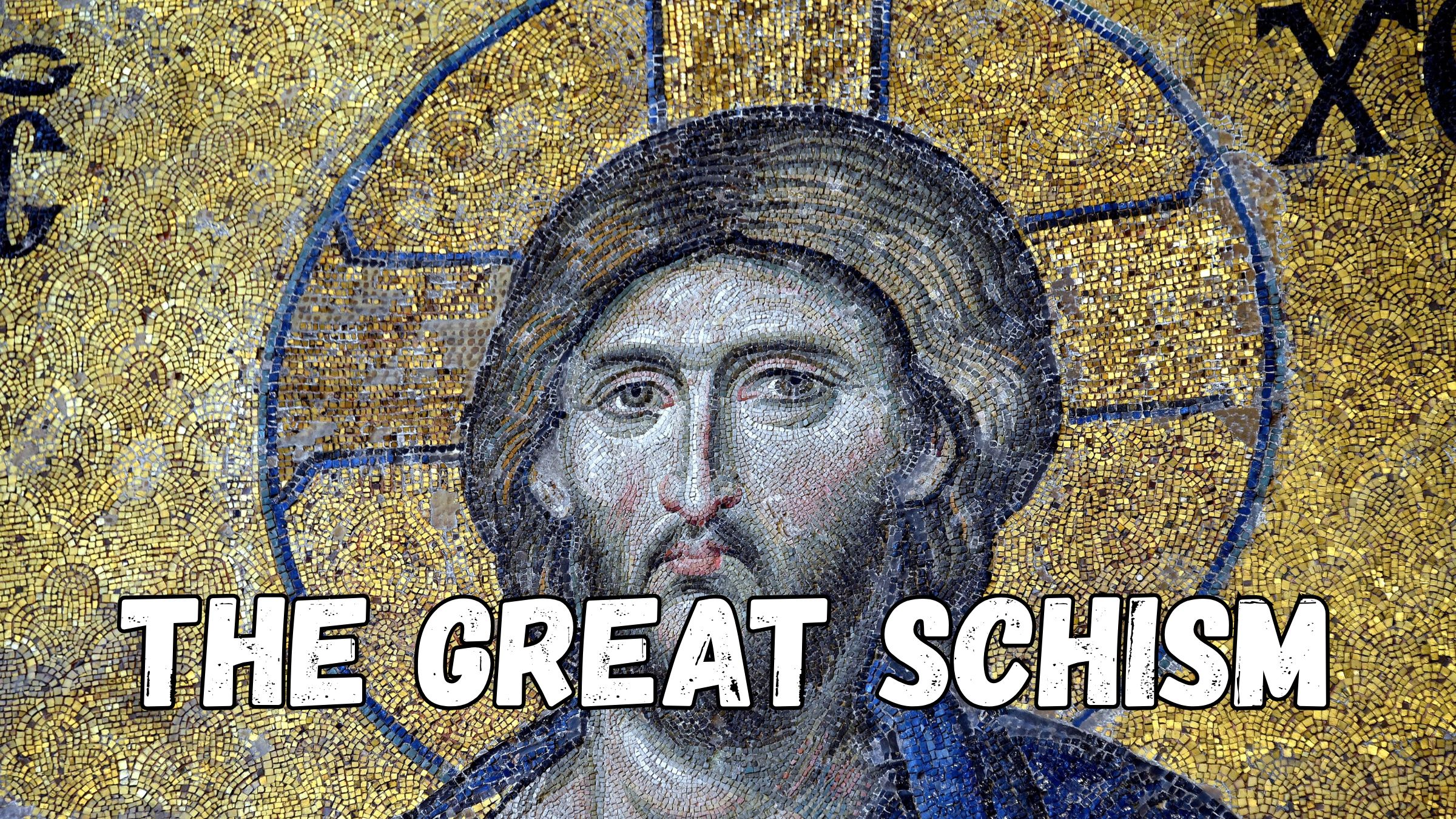
Top Image: Deësis mosaic of Christ in Hagia Sophia – photo by Osama Shukir Muhammed Amin FRCP(Glasg) / Wikimedia Commons
Subscribe to Medievalverse
Related Posts