A major Nordic research effort is taking a fresh look at the earliest written culture in medieval Finland—by studying not only what documents say, but what they are made of.
The work is part of CHARM (Combining Humanities And natural science Research), led by Tuomas Heikkilä at the University of Helsinki. The project “explores the ecosystem of Finland’s oldest written culture,” focusing on how writing spread and adapted during the Middle Ages, and why local practices of writing remain poorly understood despite Finland’s strong links to the Christian and Latin cultural sphere.
Silvia Russo and Helena Berg from the National Antiquities Board work with analysis using X-ray fluorescence. Photo: Thea Winther ( CC BY-NC-ND )
Three writing centres, and a bigger question: how did writing take root?
CHARM is built around a large-scale survey of material connected to three major writing centres—Turku, Naantali, and Viipuri—in the 15th century. By comparing charters and book fragments together, the researchers aim to map how writing practices were adopted, modified, and localised, and what that meant for society and administration in a region that was then part of the Swedish realm.
Reading the page itself: inks, pigments, parchment, and craft
A key feature of CHARM is its deliberately cross-disciplinary approach. Alongside palaeography, content analysis, and codicology, the project uses non-invasive techniques to study writing supports and materials—especially parchment and inks—rather than focusing only on textual content.
Part of the advanced equipment that can reveal new details in the material. Photo: National Heritage Board ( CC0 )
The project’s methods include:
Palaeography, content analysis, and codicology to help date manuscripts, identify scribes or scriptoria, and examine physical layout and colour use.
Biocodicology, including non-invasive ZooMS to identify animal species used for parchment, and PQI (Parchment Quality Index) to assess production patterns and quality.
Pigment and ink analysis aimed at identifying pigments, colourants, and binders—evidence that can help with chronology, locality, and even connections to particular scribes. The project description lists XRF, FTIR, and multispectral imaging among its techniques.
As Helena Berg, project manager at the Swedish National Heritage Board, explained: “We use, among other things, X-ray fluorescence, reflectance spectroscopy and multispectral analysis to understand the composition of the pigments and ink. We hope this will provide new insights into where and when the letters and fragments were created.”
Some of CHARM’s current work is being carried out at the Sweden’s National Archives in Stockholm, where specialists from the Swedish National Heritage Board and the Archives are examining medieval letters and fragments from the Nordic region.
Thea Winther, National Archives, preparing material from the Middle Ages for analysis. Photo: National Antiquities Board ( CC BY-NC-ND )
A Swedish report on the project notes that advanced equipment from the National Heritage Board’s Cultural Heritage Laboratory has been used on site, and that analyses can reveal details not visible to the naked eye—such as evidence that different inks were used on the same fragment.
The same report highlights the scale of the surviving material, pointing to major holdings in Stockholm and Helsinki that together include tens of thousands of charters and fragments—preserved, in part, because manuscript leaves were reused (for example, as bindings) after the Reformation.
“There is material in our archives that has been preserved for over 400 years. By constantly developing and combining several different disciplines of research, we are discovering new layers of information in the material. It is fantastic,” said Thea Winther, conservator and preservation specialist at Sweden’s National Archives.
Silvia Russo, a heritage scientist at the National Heritage Board, added: “Being able to contribute with our advanced equipment on site here at the National Archives in Stockholm gives us the opportunity to contribute to important research about our common cultural heritage in a relatively short time.”
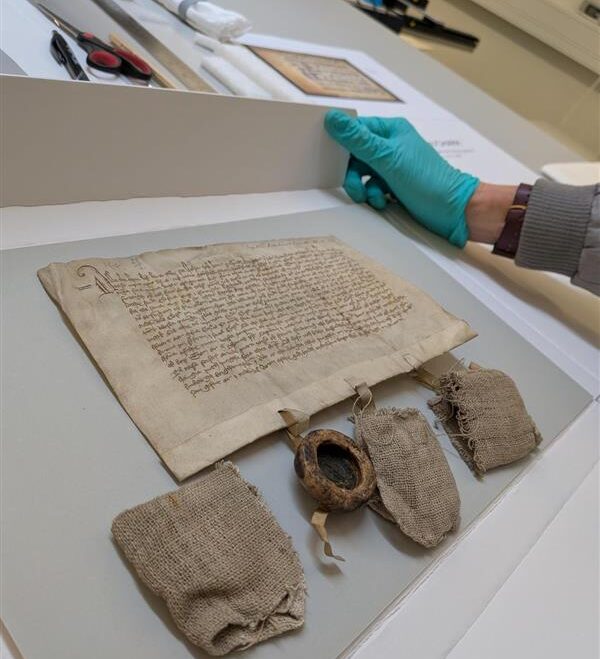
Top Image: Detail of writing and other objects from the Middle Ages. Photo: National Heritage Board (CC0)

A major Nordic research effort is taking a fresh look at the earliest written culture in medieval Finland—by studying not only what documents say, but what they are made of.
The work is part of CHARM (Combining Humanities And natural science Research), led by Tuomas Heikkilä at the University of Helsinki. The project “explores the ecosystem of Finland’s oldest written culture,” focusing on how writing spread and adapted during the Middle Ages, and why local practices of writing remain poorly understood despite Finland’s strong links to the Christian and Latin cultural sphere.
Three writing centres, and a bigger question: how did writing take root?
CHARM is built around a large-scale survey of material connected to three major writing centres—Turku, Naantali, and Viipuri—in the 15th century. By comparing charters and book fragments together, the researchers aim to map how writing practices were adopted, modified, and localised, and what that meant for society and administration in a region that was then part of the Swedish realm.
Reading the page itself: inks, pigments, parchment, and craft
A key feature of CHARM is its deliberately cross-disciplinary approach. Alongside palaeography, content analysis, and codicology, the project uses non-invasive techniques to study writing supports and materials—especially parchment and inks—rather than focusing only on textual content.
Photo: National Heritage Board ( CC0 )
The project’s methods include:
As Helena Berg, project manager at the Swedish National Heritage Board, explained: “We use, among other things, X-ray fluorescence, reflectance spectroscopy and multispectral analysis to understand the composition of the pigments and ink. We hope this will provide new insights into where and when the letters and fragments were created.”
Some of CHARM’s current work is being carried out at the Sweden’s National Archives in Stockholm, where specialists from the Swedish National Heritage Board and the Archives are examining medieval letters and fragments from the Nordic region.
A Swedish report on the project notes that advanced equipment from the National Heritage Board’s Cultural Heritage Laboratory has been used on site, and that analyses can reveal details not visible to the naked eye—such as evidence that different inks were used on the same fragment.
The same report highlights the scale of the surviving material, pointing to major holdings in Stockholm and Helsinki that together include tens of thousands of charters and fragments—preserved, in part, because manuscript leaves were reused (for example, as bindings) after the Reformation.
“There is material in our archives that has been preserved for over 400 years. By constantly developing and combining several different disciplines of research, we are discovering new layers of information in the material. It is fantastic,” said Thea Winther, conservator and preservation specialist at Sweden’s National Archives.
Silvia Russo, a heritage scientist at the National Heritage Board, added: “Being able to contribute with our advanced equipment on site here at the National Archives in Stockholm gives us the opportunity to contribute to important research about our common cultural heritage in a relatively short time.”
Top Image: Detail of writing and other objects from the Middle Ages.
Photo: National Heritage Board (CC0)
Subscribe to Medievalverse
Related Posts