A remarkably well-preserved mosaic uncovered in southern Turkey is offering a vivid—and surprisingly humorous—glimpse into life in the late Roman and early Byzantine world.
Archaeologists working at the ancient city of Syedra, near modern-day Alanya on the Mediterranean coast, have discovered a mosaic floor dating to around the 5th or 6th century AD. Measuring approximately 4.5 by 4.5 metres, the mosaic features intricate geometric and floral designs alongside two Greek inscriptions that have drawn particular attention for their tone and meaning.
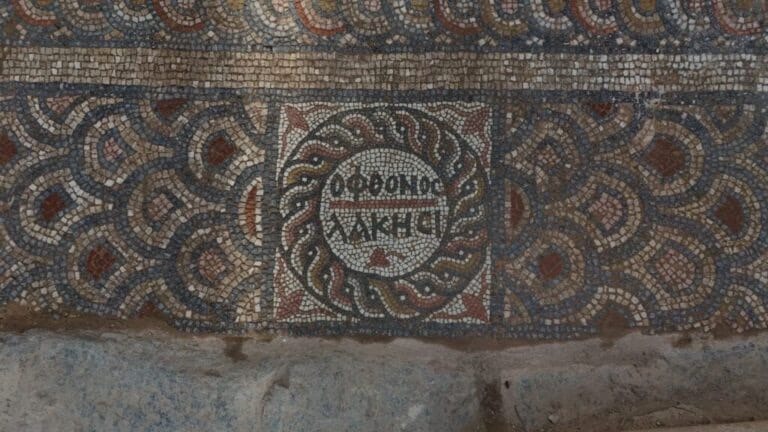
One inscription, placed at the centre of the mosaic, conveys a welcoming message—variously translated as “Use it with joy” or “Enjoy it.” The second, located near the entrance within a circular border, carries a more playful and pointed sentiment: a phrase that can be understood as “May the envious burst with jealousy” or, as excavation director Ertuğ Ergürer explains, an expression “that corresponds to the phrase ‘let the jealous one burst’ that we still use today.”
Ergürer, a professor at Alanya Alaaddin Keykubat University, added, “Encountering such an expression at the entrance of a structure built approximately 1500 years ago was a great surprise for us.”
The mosaic was found in what archaeologists believe to be one of Syedra’s important residential buildings. Its location at the entrance area suggests it would have been one of the first features seen by visitors, combining hospitality with a touch of wit—and perhaps a subtle warning to ill-intentioned guests.
Such inscriptions were not uncommon in domestic mosaics of late antiquity. Homeowners sometimes used them to express pride, extend greetings, or ward off envy and misfortune. In this case, the pairing of a warm welcome with a cheeky jab at jealous onlookers provides a rare and personal insight into the attitudes and social behaviours of the building’s inhabitants.
The floor itself is in exceptionally good condition, a factor that has allowed archaeologists to study both its decorative and textual elements in detail. Following its discovery, conservation and restoration work has been carried out to ensure the mosaic’s long-term preservation.
The discovery also sheds light on the broader historical significance of Syedra, a city that played an active role in regional trade and politics during antiquity. Coins minted in the city from the time of the Roman Emperor Tiberius (r. 14–37 CE) point to a thriving urban centre with strong connections across the Mediterranean world.
Syedra also appears in early Christian writings. In 374 CE, the theologian Epiphanius of Salamis addressed the local church in his work Ancoratus (“The Well-Anchored Man”), urging it to remain steadfast—an indication of the city’s place within the developing Christian landscape of the eastern Mediterranean.
Modern excavations at Syedra began in 1994 under the direction of the Alanya Museum. Archaeologists have since uncovered parts of the city’s main street, as well as a cave decorated with Christian iconography that may have been used for baptisms. Ongoing work continues to reveal new aspects of the site’s urban and religious life.
Ongoing Research in the Region
The mosaic discovery forms part of a broader programme of archaeological research supported by Alanya Alaaddin Keykubat University, which has been actively involved in excavations at Syedra. Scholars from the university are also undertaking new survey work in the nearby ancient city of Selinus, using advanced techniques such as GIS mapping, 3D modelling, and aerial imaging to document the region’s cultural heritage.
Together, these efforts are helping to build a more detailed picture of the historical landscape along Turkey’s southern coast, from the Hellenistic period through the Byzantine and Seljuk eras.
Top Image: The mosaic discovered at Syedra, featuring geometric designs and Greek inscriptions. Photo courtesy Directorate General of Cultural Assets and Museums of Türkiye

A remarkably well-preserved mosaic uncovered in southern Turkey is offering a vivid—and surprisingly humorous—glimpse into life in the late Roman and early Byzantine world.
Archaeologists working at the ancient city of Syedra, near modern-day Alanya on the Mediterranean coast, have discovered a mosaic floor dating to around the 5th or 6th century AD. Measuring approximately 4.5 by 4.5 metres, the mosaic features intricate geometric and floral designs alongside two Greek inscriptions that have drawn particular attention for their tone and meaning.
One inscription, placed at the centre of the mosaic, conveys a welcoming message—variously translated as “Use it with joy” or “Enjoy it.” The second, located near the entrance within a circular border, carries a more playful and pointed sentiment: a phrase that can be understood as “May the envious burst with jealousy” or, as excavation director Ertuğ Ergürer explains, an expression “that corresponds to the phrase ‘let the jealous one burst’ that we still use today.”
Ergürer, a professor at Alanya Alaaddin Keykubat University, added, “Encountering such an expression at the entrance of a structure built approximately 1500 years ago was a great surprise for us.”
A Window into Late Antique Life
The mosaic was found in what archaeologists believe to be one of Syedra’s important residential buildings. Its location at the entrance area suggests it would have been one of the first features seen by visitors, combining hospitality with a touch of wit—and perhaps a subtle warning to ill-intentioned guests.
Such inscriptions were not uncommon in domestic mosaics of late antiquity. Homeowners sometimes used them to express pride, extend greetings, or ward off envy and misfortune. In this case, the pairing of a warm welcome with a cheeky jab at jealous onlookers provides a rare and personal insight into the attitudes and social behaviours of the building’s inhabitants.
The floor itself is in exceptionally good condition, a factor that has allowed archaeologists to study both its decorative and textual elements in detail. Following its discovery, conservation and restoration work has been carried out to ensure the mosaic’s long-term preservation.
Syedra and Its Wider Context
The discovery also sheds light on the broader historical significance of Syedra, a city that played an active role in regional trade and politics during antiquity. Coins minted in the city from the time of the Roman Emperor Tiberius (r. 14–37 CE) point to a thriving urban centre with strong connections across the Mediterranean world.
Syedra also appears in early Christian writings. In 374 CE, the theologian Epiphanius of Salamis addressed the local church in his work Ancoratus (“The Well-Anchored Man”), urging it to remain steadfast—an indication of the city’s place within the developing Christian landscape of the eastern Mediterranean.
Modern excavations at Syedra began in 1994 under the direction of the Alanya Museum. Archaeologists have since uncovered parts of the city’s main street, as well as a cave decorated with Christian iconography that may have been used for baptisms. Ongoing work continues to reveal new aspects of the site’s urban and religious life.
Ongoing Research in the Region
The mosaic discovery forms part of a broader programme of archaeological research supported by Alanya Alaaddin Keykubat University, which has been actively involved in excavations at Syedra. Scholars from the university are also undertaking new survey work in the nearby ancient city of Selinus, using advanced techniques such as GIS mapping, 3D modelling, and aerial imaging to document the region’s cultural heritage.
Together, these efforts are helping to build a more detailed picture of the historical landscape along Turkey’s southern coast, from the Hellenistic period through the Byzantine and Seljuk eras.
Top Image: The mosaic discovered at Syedra, featuring geometric designs and Greek inscriptions. Photo courtesy Directorate General of Cultural Assets and Museums of Türkiye
Subscribe to Medievalverse
Related Posts