Did people in the Middle Ages really suffer from terrible teeth and foul breath? A closer look at medieval medical texts and hygiene practices reveals a more complex picture of dental care and everyday health.
By Lorris Chevalier
The widespread belief that people in the Middle Ages universally suffered from rotten teeth and foul breath has long been part of the modern imagination. According to this stereotype, medieval society lacked both the knowledge and the concern necessary to maintain oral hygiene. However, historical sources tell a more complex story. Literary narratives, medical treatises, and archaeological evidence all indicate that medieval people were aware of dental problems, attentive to the appearance of their teeth, and concerned about the smell of the mouth.
The texts examined here, ranging from literary works such as Ci nous dit, Aucassin et Nicolette, and Yvain ou le Chevalier au lion to medical writings such as De curis mulierum, Catholica magistri Salerni, and the works of Hildegard of Bingen and Henri de Mondeville, reveal a society that recognised the importance of oral health.
Dental Condition and Tooth Loss in the Middle Ages
15th-century depiction of St. Apolonia of Alexandria, the patron saint of dentists, toothache sufferers, and people with dental diseases – Badische Landesbibliothek Karlsruhe, Cod. Don. 117
Finally, even an imaginary story such as the one about “The Matron of Ephesus” in Ci nous dit is probably not unrelated to the reality of the dental condition of people in the Middle Ages and to the possible means of identification that it could provide.
The story tells of a woman mourning the death of her husband. She lit a fire beside his body in the cemetery and declared that she would never leave him. One night a young man came to warm himself by her fire. As he departed, he discovered that the corpse of the hanged man he had been guarding had been stolen, even though he had powerful friends who expected him to protect it. He returned to the widow and said, “Alas, I am disgraced; the hanged man I was guarding has been stolen.” She replied, “If you wish to marry me, we will hang my husband in his place.”
He eagerly agreed. It was she herself who hanged him, broke two of his teeth, and gouged out one of his eyes so that he would resemble the stolen corpse.
Although the story is fictional, it reflects the idea that the condition of a person’s teeth could be recognised and used as a means of identification. Archaeological evidence confirms that dental problems were common but not universal in medieval populations. Studies of skeletal remains show a rate of tooth loss before death of around seven per cent. This rate varied depending on social status and living conditions, and in some contexts it could reach fourteen per cent of individuals, as in the cemetery of the Abbey of Saint-Pierre de l’Almanarre in the Var, used between the thirteenth and fourteenth centuries.
These figures suggest that many medieval people retained most of their teeth during their lifetime, although tooth decay, damage, and loss certainly occurred. Dental health therefore formed part of the everyday physical realities of medieval life.
The Appearance of Teeth in Medieval Literature
King John’s teeth and thumb bone. Photo courtesy of the British Library
Despite the existence of dental problems, the texts examined here demonstrate a clear concern with the appearance of visible teeth, especially their whiteness. This is particularly evident in literary descriptions of unattractive characters, whose teeth are sometimes depicted as dark or yellow.
In Aucassin et Nicolette, for example, the cowherd encountered by the protagonists is described in deliberately grotesque terms. His hair is said to be “blacker than coal”, his nostrils wide, his lips redder than embers, and his teeth large, yellow, and ugly. Similarly, in Chrétien de Troyes’ Yvain ou le Chevalier au lion, the guardian of the bulls is portrayed as having a mouth split like that of a wolf and teeth resembling those of a boar, sharp and reddish. Such descriptions emphasise the contrast between refined and rustic figures and show that non-white teeth were associated with coarseness and unattractiveness.
During the scholarly discussions devoted to these texts, attention has also been drawn to the difficulty of distinguishing between whiteness and brightness in medieval descriptions of teeth. Nevertheless, it seems clear that, unlike certain other cultures of the same period, the Latin West considered the darkening of teeth undesirable.
A useful comparison can be made with medieval Japan, where blackened teeth were considered an aesthetic ideal. In Western Europe, by contrast, authors and medical writers consistently sought ways to prevent or reverse the darkening of teeth.
Medieval Toothpastes and Dental Treatments
Perhaps a depiction of Trotula in an early 14th-century manuscript – London, Wellcome Library, MS 544
Medical authors of the Middle Ages provided numerous recipes intended to whiten the teeth and strengthen the gums. Pliny the Elder had already suggested restoring the natural colour of teeth with a toothpaste made from nitre, and medieval authors continued to develop more elaborate preparations.
One important source is the De curis mulierum, associated with the medical tradition of the School of Salerno and attributed to Trota of Salerno. This text transmits two recipes for dentifrices designed “to whiten the teeth”. One of these preparations focuses primarily on whitening, while the other also aims to strengthen worn gums and restore pleasant breath.
To combat blackened teeth, the text recommends rubbing them with a powder made from burned pumice stone mixed with salt, cinnamon, and cloves. Another preparation involves grinding together cinnamon, cloves, spikenard, mastic, frankincense, wheat, wormwood, crab shell, and the pits of dates and olives.
The Catholica magistri Salerni proposes a different formula based on powdered mastic, ivory, marble, and pumice stone, which was believed both to strengthen and whiten the teeth. The text also suggests rubbing the teeth with powdered marble mixed with cinnamon, costus, cassia wood, or amomum. According to the author, this treatment would make the teeth stronger and whiter while leaving the mouth pleasantly scented.
A century later similar recipes appear in the medical writings of Aldebrandin of Siena. He recommends a preparation intended to strengthen the gums and whiten the teeth composed of white marble, white coral, cuttlefish bone, rock salt, incense, and mastic, all ground into a fine powder. The powder was placed in a small cloth bag and rubbed on the teeth, after which the mouth was rinsed with wine and the teeth polished with a cloth.
Another of Aldebrandin’s formulas was designed for gums that bled easily, for whitening the teeth, and for producing good breath. It included nutmeg, sea foam, roasted salt, burnt deer horn, alum, nitre, pomegranate, gall, balautie, pennyroyal, spikenard, costus, lignaloes, and cardamom, all reduced to powder and applied to the teeth.
Bad Breath in Medieval Medical Thought
Medieval dentistry. Initial ‘D’, a scene representing teeth [dentes]. A dentist with silver forceps and a necklace of large teeth, extracting the tooth of a seated man – British Library MS Royal 6 E. VI, fol. 503vThe search for white teeth was closely connected with concern about the smell of the mouth. Medieval medical texts frequently addressed the problem of bad breath, known in Latin as fetor oris. In many cases it was believed that unpleasant breath resulted from problems in the stomach or from the corruption of bodily humours.
De curis mulierum offers a remedy against foul breath caused by stomach problems consisting of wine mixed with the tops of myrtle. Similarly, Flos medicinae Salerni attributes several virtues to wine soup, including the purification of the stomach and the resulting freshness of the breath.
Hildegard of Bingen also devoted attention to the question of breath. She suggested that its quality could be influenced both by diet and by medicinal substances. Among her recommendations was the advice not to go to sleep immediately after eating. She also described a powder made from aromatic ingredients such as galangal, fennel, and nutmeg. Unlike tooth powders, this mixture was meant to be ingested frequently so that the fragrance of the herbs would reach the lungs and prevent unpleasant breath.
Later medical writers continued to develop treatments for this problem. In the thirteenth century Taddeo Alderotti recommended pills made from wine and strongly scented ingredients such as galangal, cloves, musk, camphor, pyrethrum, aloe, and mustard. These pills were intended to combat foul odours produced by the putrefaction of phlegmatic humours.
The surgeon Henri de Mondeville, writing in the early fourteenth century, showed particular concern for bodily odours. In his surgical treatise he discussed unpleasant smells from the armpits, the hair, the nose, and the mouth. According to him, foul odours from the nose were difficult to cure and could only be masked. He recommended chewing cinnamon or preparing aromatic pills made from marjoram, basil, nutmeg, cinnamon, aloe, and amber. Two of these pills were to be swallowed in the morning and two others kept in the mouth “to perfume the breath so that no one may smell it”.
If the unpleasant smell originated in the mouth itself, Mondeville proposed several solutions. These included the same aromatic remedies used for nasal odours, treatments similar to those used for armpit smells, or the extraction of a decayed tooth when the problem was clearly dental. He also advised regulating the diet, purging the harmful matter believed to cause the smell, and placing aromatic substances such as nutmeg, bay leaves, musk in small quantities, wormwood, mastic, or wild thyme under the tongue. According to him, these remedies were “easy and proven”.
Oral Hygiene as a Social Concern
These various prescriptions show that medieval physicians regarded the smell of the mouth as an important aspect of personal presentation. In the medical literature of Salerno, pleasant scent formed part of what could be described as the proper ornament or appearance of the mouth and teeth. Concerns about odour appear in medical headings such as De fetore oris and De fetore narium, reflecting the belief that unpleasant smells could originate both in the mouth and in the nose.
The attention devoted to breath suggests that oral hygiene was not simply a matter of physical health but also of social interaction. A mouth that smelled pleasant or neutral made communication easier and avoided causing discomfort to others. This social dimension of oral hygiene is further confirmed by the presence of such themes not only in medical treatises but also in literary narratives and exempla, which circulated widely in medieval society.
Dr Lorris Chevalier, who has a Ph.D. in medieval literature, is a historical advisor for movies, including The Last Duel and Napoleon. Click here to view his website.

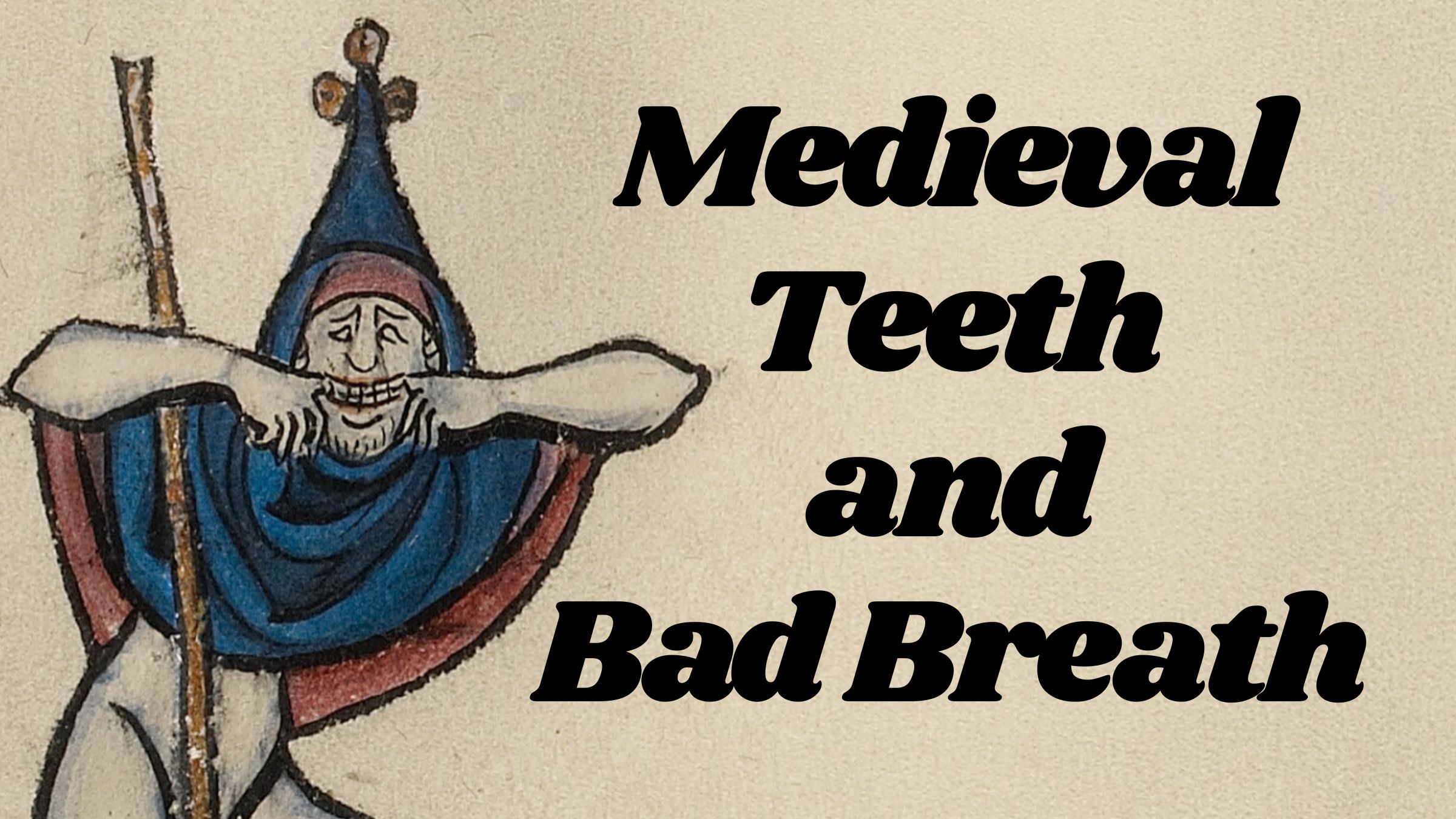
Did people in the Middle Ages really suffer from terrible teeth and foul breath? A closer look at medieval medical texts and hygiene practices reveals a more complex picture of dental care and everyday health.
By Lorris Chevalier
The widespread belief that people in the Middle Ages universally suffered from rotten teeth and foul breath has long been part of the modern imagination. According to this stereotype, medieval society lacked both the knowledge and the concern necessary to maintain oral hygiene. However, historical sources tell a more complex story. Literary narratives, medical treatises, and archaeological evidence all indicate that medieval people were aware of dental problems, attentive to the appearance of their teeth, and concerned about the smell of the mouth.
The texts examined here, ranging from literary works such as Ci nous dit, Aucassin et Nicolette, and Yvain ou le Chevalier au lion to medical writings such as De curis mulierum, Catholica magistri Salerni, and the works of Hildegard of Bingen and Henri de Mondeville, reveal a society that recognised the importance of oral health.
Dental Condition and Tooth Loss in the Middle Ages
Finally, even an imaginary story such as the one about “The Matron of Ephesus” in Ci nous dit is probably not unrelated to the reality of the dental condition of people in the Middle Ages and to the possible means of identification that it could provide.
The story tells of a woman mourning the death of her husband. She lit a fire beside his body in the cemetery and declared that she would never leave him. One night a young man came to warm himself by her fire. As he departed, he discovered that the corpse of the hanged man he had been guarding had been stolen, even though he had powerful friends who expected him to protect it. He returned to the widow and said, “Alas, I am disgraced; the hanged man I was guarding has been stolen.” She replied, “If you wish to marry me, we will hang my husband in his place.”
He eagerly agreed. It was she herself who hanged him, broke two of his teeth, and gouged out one of his eyes so that he would resemble the stolen corpse.
Although the story is fictional, it reflects the idea that the condition of a person’s teeth could be recognised and used as a means of identification. Archaeological evidence confirms that dental problems were common but not universal in medieval populations. Studies of skeletal remains show a rate of tooth loss before death of around seven per cent. This rate varied depending on social status and living conditions, and in some contexts it could reach fourteen per cent of individuals, as in the cemetery of the Abbey of Saint-Pierre de l’Almanarre in the Var, used between the thirteenth and fourteenth centuries.
These figures suggest that many medieval people retained most of their teeth during their lifetime, although tooth decay, damage, and loss certainly occurred. Dental health therefore formed part of the everyday physical realities of medieval life.
The Appearance of Teeth in Medieval Literature
Despite the existence of dental problems, the texts examined here demonstrate a clear concern with the appearance of visible teeth, especially their whiteness. This is particularly evident in literary descriptions of unattractive characters, whose teeth are sometimes depicted as dark or yellow.
In Aucassin et Nicolette, for example, the cowherd encountered by the protagonists is described in deliberately grotesque terms. His hair is said to be “blacker than coal”, his nostrils wide, his lips redder than embers, and his teeth large, yellow, and ugly. Similarly, in Chrétien de Troyes’ Yvain ou le Chevalier au lion, the guardian of the bulls is portrayed as having a mouth split like that of a wolf and teeth resembling those of a boar, sharp and reddish. Such descriptions emphasise the contrast between refined and rustic figures and show that non-white teeth were associated with coarseness and unattractiveness.
During the scholarly discussions devoted to these texts, attention has also been drawn to the difficulty of distinguishing between whiteness and brightness in medieval descriptions of teeth. Nevertheless, it seems clear that, unlike certain other cultures of the same period, the Latin West considered the darkening of teeth undesirable.
A useful comparison can be made with medieval Japan, where blackened teeth were considered an aesthetic ideal. In Western Europe, by contrast, authors and medical writers consistently sought ways to prevent or reverse the darkening of teeth.
Medieval Toothpastes and Dental Treatments
Medical authors of the Middle Ages provided numerous recipes intended to whiten the teeth and strengthen the gums. Pliny the Elder had already suggested restoring the natural colour of teeth with a toothpaste made from nitre, and medieval authors continued to develop more elaborate preparations.
One important source is the De curis mulierum, associated with the medical tradition of the School of Salerno and attributed to Trota of Salerno. This text transmits two recipes for dentifrices designed “to whiten the teeth”. One of these preparations focuses primarily on whitening, while the other also aims to strengthen worn gums and restore pleasant breath.
To combat blackened teeth, the text recommends rubbing them with a powder made from burned pumice stone mixed with salt, cinnamon, and cloves. Another preparation involves grinding together cinnamon, cloves, spikenard, mastic, frankincense, wheat, wormwood, crab shell, and the pits of dates and olives.
The Catholica magistri Salerni proposes a different formula based on powdered mastic, ivory, marble, and pumice stone, which was believed both to strengthen and whiten the teeth. The text also suggests rubbing the teeth with powdered marble mixed with cinnamon, costus, cassia wood, or amomum. According to the author, this treatment would make the teeth stronger and whiter while leaving the mouth pleasantly scented.
A century later similar recipes appear in the medical writings of Aldebrandin of Siena. He recommends a preparation intended to strengthen the gums and whiten the teeth composed of white marble, white coral, cuttlefish bone, rock salt, incense, and mastic, all ground into a fine powder. The powder was placed in a small cloth bag and rubbed on the teeth, after which the mouth was rinsed with wine and the teeth polished with a cloth.
Another of Aldebrandin’s formulas was designed for gums that bled easily, for whitening the teeth, and for producing good breath. It included nutmeg, sea foam, roasted salt, burnt deer horn, alum, nitre, pomegranate, gall, balautie, pennyroyal, spikenard, costus, lignaloes, and cardamom, all reduced to powder and applied to the teeth.
Bad Breath in Medieval Medical Thought
De curis mulierum offers a remedy against foul breath caused by stomach problems consisting of wine mixed with the tops of myrtle. Similarly, Flos medicinae Salerni attributes several virtues to wine soup, including the purification of the stomach and the resulting freshness of the breath.
Hildegard of Bingen also devoted attention to the question of breath. She suggested that its quality could be influenced both by diet and by medicinal substances. Among her recommendations was the advice not to go to sleep immediately after eating. She also described a powder made from aromatic ingredients such as galangal, fennel, and nutmeg. Unlike tooth powders, this mixture was meant to be ingested frequently so that the fragrance of the herbs would reach the lungs and prevent unpleasant breath.
Later medical writers continued to develop treatments for this problem. In the thirteenth century Taddeo Alderotti recommended pills made from wine and strongly scented ingredients such as galangal, cloves, musk, camphor, pyrethrum, aloe, and mustard. These pills were intended to combat foul odours produced by the putrefaction of phlegmatic humours.
The surgeon Henri de Mondeville, writing in the early fourteenth century, showed particular concern for bodily odours. In his surgical treatise he discussed unpleasant smells from the armpits, the hair, the nose, and the mouth. According to him, foul odours from the nose were difficult to cure and could only be masked. He recommended chewing cinnamon or preparing aromatic pills made from marjoram, basil, nutmeg, cinnamon, aloe, and amber. Two of these pills were to be swallowed in the morning and two others kept in the mouth “to perfume the breath so that no one may smell it”.
If the unpleasant smell originated in the mouth itself, Mondeville proposed several solutions. These included the same aromatic remedies used for nasal odours, treatments similar to those used for armpit smells, or the extraction of a decayed tooth when the problem was clearly dental. He also advised regulating the diet, purging the harmful matter believed to cause the smell, and placing aromatic substances such as nutmeg, bay leaves, musk in small quantities, wormwood, mastic, or wild thyme under the tongue. According to him, these remedies were “easy and proven”.
Oral Hygiene as a Social Concern
These various prescriptions show that medieval physicians regarded the smell of the mouth as an important aspect of personal presentation. In the medical literature of Salerno, pleasant scent formed part of what could be described as the proper ornament or appearance of the mouth and teeth. Concerns about odour appear in medical headings such as De fetore oris and De fetore narium, reflecting the belief that unpleasant smells could originate both in the mouth and in the nose.
The attention devoted to breath suggests that oral hygiene was not simply a matter of physical health but also of social interaction. A mouth that smelled pleasant or neutral made communication easier and avoided causing discomfort to others. This social dimension of oral hygiene is further confirmed by the presence of such themes not only in medical treatises but also in literary narratives and exempla, which circulated widely in medieval society.
Dr Lorris Chevalier, who has a Ph.D. in medieval literature, is a historical advisor for movies, including The Last Duel and Napoleon. Click here to view his website.
Click here to read more from Lorris Chevalier
Further Readings:
Laurence Moulinier. Hygiène et cosmétique de la bouche au Moyen Âge. Colloque Dents, dentistes et art dentaire. Histoire, pratiques et représentations. Université de Paris 13, Villetaneuse-Université de Paris-Ouest Nanterre -Université de Versailles Saint-Quentin, Mar 2012, Versailles-Saint-Quentin, France. pp.221-239.
Top Image: A smiling fool in the Bute Psalter – Getty Museum MS 42 fol. 72
Subscribe to Medievalverse
Related Posts