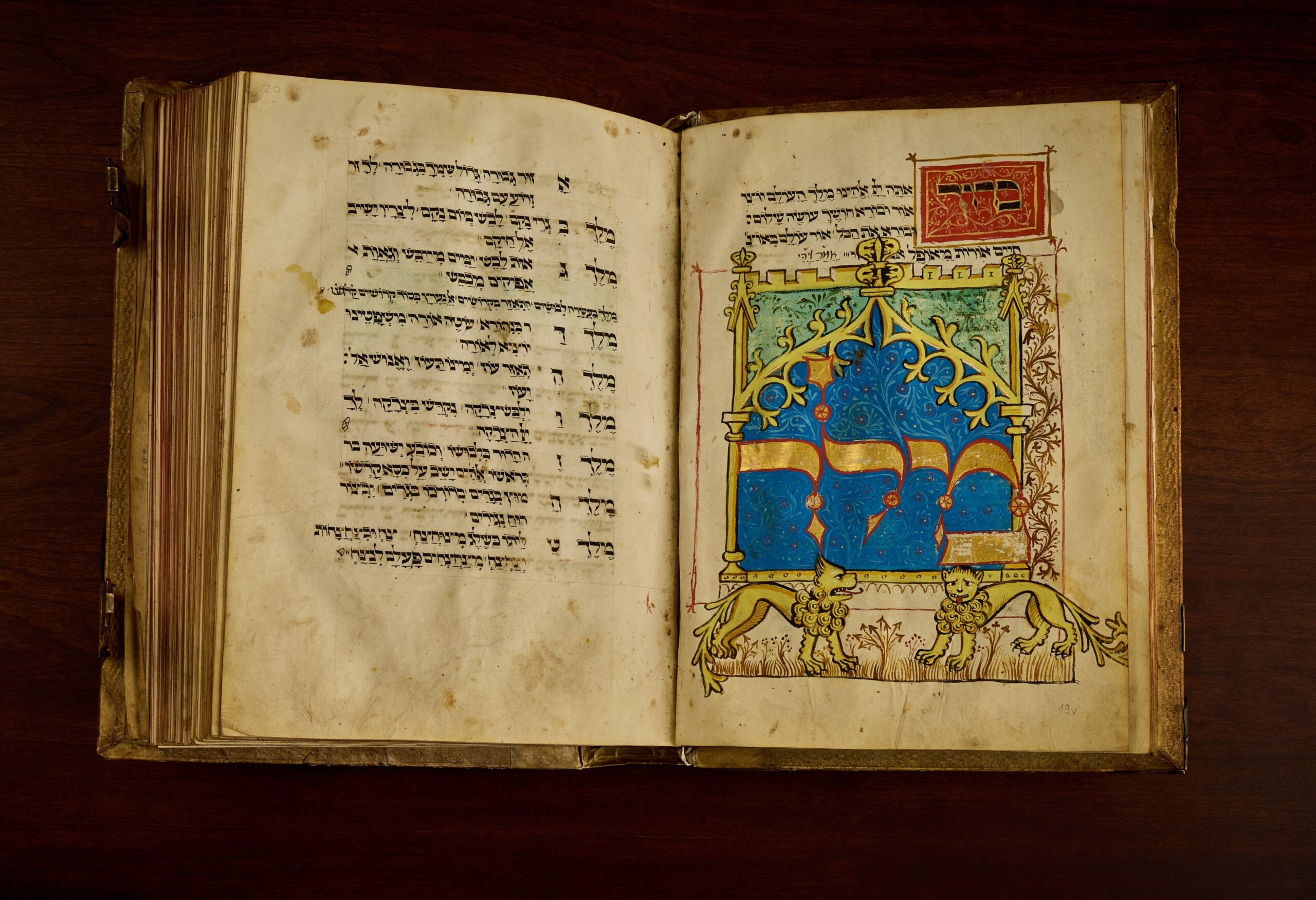
A lavishly illuminated medieval Hebrew prayerbook known as the Rothschild Vienna Mahzor will be offered at Sotheby’s New York this February, with an estimate of $5–7 million US. Completed in 1415 for the High Holidays, the manuscript is among the rare illustrated mahzorim to survive from the Ashkenazi world.
Mahzorim are Hebrew prayerbooks containing the liturgy for the Jewish High Holidays and festivals, and only a small number of illustrated examples from the Middle Ages are known to survive. Sotheby’s notes that the Rothschild Vienna Mahzor is among fewer than twenty such manuscripts, and that it is only the second medieval illustrated mahzor to appear at auction in more than a century.
A comparable benchmark came in 2021, when the Luzzatto High Holiday Mahzor sold for $8.3 million, setting an auction record for an illustrated Hebrew manuscript. The new estimate for the Rothschild Vienna Mahzor places it in the same rarefied market for top-tier medieval Judaica.
A 15th-century Prayerbook
Rothschild Vienna Mahzor folio 19v – Photo Courtesy of Ardon Bar Hama / Sotheby’s
The Rothschild Vienna Mahzor was completed in 1415 by a Jewish scribe named Moses, son of Menachem, with its scale and splendour suggesting that it was made for communal use rather than private devotion. The manuscript’s decoration is described as dense with animals and fantastical creatures framed by Gothic architecture, with curling scrollwork and gold panels. The book’s vivid colour palette—lapis blues, copper greens, and cinnabar reds—is still bright after six centuries.
Its illumination also reflects the influence of the Lake Constance school, an artistic tradition associated with southern Germany, Switzerland, and Austria in the fourteenth century. One theory suggests Jewish refugees may have brought illuminated manuscripts to Vienna after the devastation of the Black Death of 1348–49, making the Rothschild Vienna Mahzor a later artistic descendant of that regional style.
Rothschild Vienna Mahzor folio 190r – Photo courtesy of Ardon Bar Hama / Sotheby’s
Yet the manuscript was created on the eve of catastrophe for Vienna’s medieval Jewish community. The Vienna Gesera took place in the years 1420 to 1421, when Duke Albert V of Austria ordered a pogrom that included forced conversions, expulsions and the execution of over 200 Jews, leading to the effective end of the medieval Jewish community of Vienna. The book continued to travel, and its margins later recorded adaptations to Western Ashkenazi rites—evidence of new readers and new settings.
“Rarely does a single manuscript encompass so many worlds at once—faith and artistry, persecution and survival,” says Sharon Liberman Mintz, a specialist at Sotheby’s. “The Rothschild Vienna Mahzor stands not only as a masterpiece of medieval illumination but also as a symbol of extraordinary historical perseverance. Its six-century journey mirrors the broader story of Jewish resilience.”
From the Rothschild collection to Nazi seizure—and back
The Rothschild Vienna Mahzor, 1415 – Prayers for the Morning Services of Rosh Hashana – Photo Courtesy of Sotheby’s
The mahzor takes its modern name from its nineteenth-century owners, the Viennese branch of the Rothschild family. Salomon Mayer von Rothschild acquired the manuscript in 1842 as a gift for his son, and it later passed through generations of the family’s collections.
A key piece of evidence for its Rothschild ownership is a Hebrew inscription recorded on the manuscript’s title page, which includes the circumstances of the purchase:
I bought this book in the city of Nuremberg for one hundred and fifty-one gold coins and gave it as a gift to my dear and pleasant son, crowned with virtues and merits, Anselm Baron von Rothschild may he be blessed with a long life, for safekeeping for generations to come, so that the Torah of God may forever be in our mouths, amen selah. Frankfurt am Main, Friday, the eve of the month of Elul in the year, 5602 [5 August 1842].
Everything changed in 1938 when Germany annexed Austria. Nazi authorities seized the Rothschild Palais in Vienna and its contents, stripping the family of legal ownership, and dispersing parts of the collection. A portion of the library—including the mahzor—was sent to the Austrian National Library, where it remained for decades and went unrecognized as Nazi-looted property.
It was only when scholars from the Center for Jewish Art comprehensively researched the illuminated Hebrew manuscripts of the Vienna National Library in 1998-1999 that a detailed description of the Mahzor’s contents, art historical significance, and provenance was made, including identification of the Rothschild coat of arms and dedicatory inscription.
The Rothschild Vienna Mahzor, 1415 – Photo Courtesy of Sotheby’s
The mahzor re-emerged publicly in 2021, when it was loaned for an exhibition in Vienna on the Rothschild family legacy, and was later restituted to the heirs. In June 2023, Austria’s Art Restitution Advisory Board formally recommended its return under the country’s Art Restitution Law.
“The restitution of the Mahzor is a moment of both justice and remembrance;” Mintz adds, “its reemergence invites us to honor not only its beauty, but the lasting power of memory and faith it embodies.”
The auction will take place at Sotheby’s New York on February 5. More details are available on Sotheby’s website.
Top Image: The Rothschild Vienna Mahzor, 1415 – Prayers for the Morning Services of Rosh Hashana – Photo Courtesy of Sotheby’s

A lavishly illuminated medieval Hebrew prayerbook known as the Rothschild Vienna Mahzor will be offered at Sotheby’s New York this February, with an estimate of $5–7 million US. Completed in 1415 for the High Holidays, the manuscript is among the rare illustrated mahzorim to survive from the Ashkenazi world.
Mahzorim are Hebrew prayerbooks containing the liturgy for the Jewish High Holidays and festivals, and only a small number of illustrated examples from the Middle Ages are known to survive. Sotheby’s notes that the Rothschild Vienna Mahzor is among fewer than twenty such manuscripts, and that it is only the second medieval illustrated mahzor to appear at auction in more than a century.
A comparable benchmark came in 2021, when the Luzzatto High Holiday Mahzor sold for $8.3 million, setting an auction record for an illustrated Hebrew manuscript. The new estimate for the Rothschild Vienna Mahzor places it in the same rarefied market for top-tier medieval Judaica.
A 15th-century Prayerbook
The Rothschild Vienna Mahzor was completed in 1415 by a Jewish scribe named Moses, son of Menachem, with its scale and splendour suggesting that it was made for communal use rather than private devotion. The manuscript’s decoration is described as dense with animals and fantastical creatures framed by Gothic architecture, with curling scrollwork and gold panels. The book’s vivid colour palette—lapis blues, copper greens, and cinnabar reds—is still bright after six centuries.
Its illumination also reflects the influence of the Lake Constance school, an artistic tradition associated with southern Germany, Switzerland, and Austria in the fourteenth century. One theory suggests Jewish refugees may have brought illuminated manuscripts to Vienna after the devastation of the Black Death of 1348–49, making the Rothschild Vienna Mahzor a later artistic descendant of that regional style.
Yet the manuscript was created on the eve of catastrophe for Vienna’s medieval Jewish community. The Vienna Gesera took place in the years 1420 to 1421, when Duke Albert V of Austria ordered a pogrom that included forced conversions, expulsions and the execution of over 200 Jews, leading to the effective end of the medieval Jewish community of Vienna. The book continued to travel, and its margins later recorded adaptations to Western Ashkenazi rites—evidence of new readers and new settings.
“Rarely does a single manuscript encompass so many worlds at once—faith and artistry, persecution and survival,” says Sharon Liberman Mintz, a specialist at Sotheby’s. “The Rothschild Vienna Mahzor stands not only as a masterpiece of medieval illumination but also as a symbol of extraordinary historical perseverance. Its six-century journey mirrors the broader story of Jewish resilience.”
From the Rothschild collection to Nazi seizure—and back
The mahzor takes its modern name from its nineteenth-century owners, the Viennese branch of the Rothschild family. Salomon Mayer von Rothschild acquired the manuscript in 1842 as a gift for his son, and it later passed through generations of the family’s collections.
A key piece of evidence for its Rothschild ownership is a Hebrew inscription recorded on the manuscript’s title page, which includes the circumstances of the purchase:
I bought this book in the city of Nuremberg for one hundred and fifty-one gold coins and gave it as a gift to my dear and pleasant son, crowned with virtues and merits, Anselm Baron von Rothschild may he be blessed with a long life, for safekeeping for generations to come, so that the Torah of God may forever be in our mouths, amen selah. Frankfurt am Main, Friday, the eve of the month of Elul in the year, 5602 [5 August 1842].
Everything changed in 1938 when Germany annexed Austria. Nazi authorities seized the Rothschild Palais in Vienna and its contents, stripping the family of legal ownership, and dispersing parts of the collection. A portion of the library—including the mahzor—was sent to the Austrian National Library, where it remained for decades and went unrecognized as Nazi-looted property.
It was only when scholars from the Center for Jewish Art comprehensively researched the illuminated Hebrew manuscripts of the Vienna National Library in 1998-1999 that a detailed description of the Mahzor’s contents, art historical significance, and provenance was made, including identification of the Rothschild coat of arms and dedicatory inscription.
The mahzor re-emerged publicly in 2021, when it was loaned for an exhibition in Vienna on the Rothschild family legacy, and was later restituted to the heirs. In June 2023, Austria’s Art Restitution Advisory Board formally recommended its return under the country’s Art Restitution Law.
“The restitution of the Mahzor is a moment of both justice and remembrance;” Mintz adds, “its reemergence invites us to honor not only its beauty, but the lasting power of memory and faith it embodies.”
The auction will take place at Sotheby’s New York on February 5. More details are available on Sotheby’s website.
Top Image: The Rothschild Vienna Mahzor, 1415 – Prayers for the Morning Services of Rosh Hashana – Photo Courtesy of Sotheby’s
Subscribe to Medievalverse
Related Posts