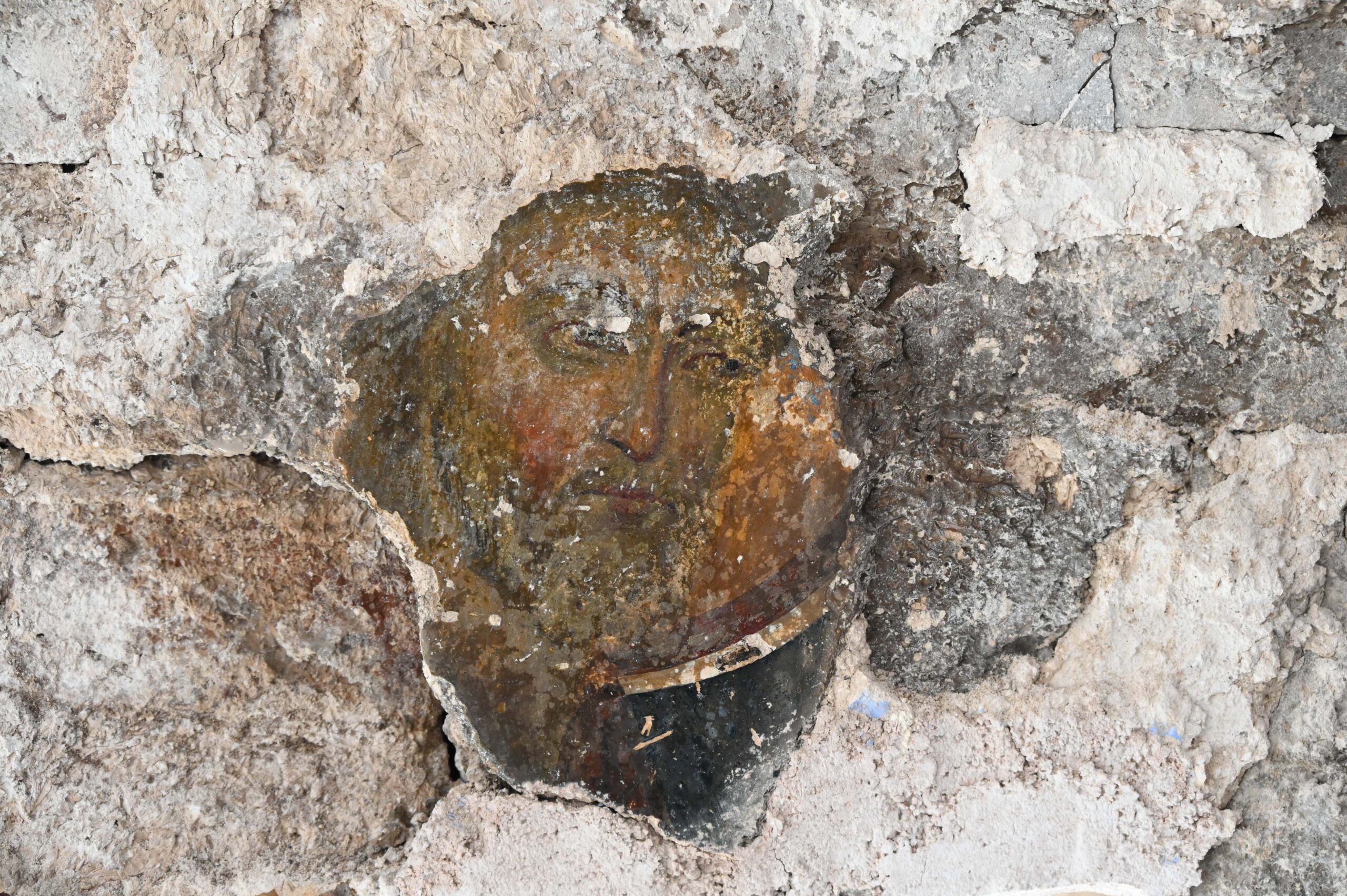
Medieval wall paintings long hidden beneath plaster and limewash are reappearing inside the Byzantine monastery church of Agios Nikolaos (Saint Nicholas) in Mesopotamos, Albania, after conservators uncovered previously unknown frescoes during a continuing restoration programme.
The discovery was announced last year by the European Centre for Byzantine and Post-Byzantine Monuments (EKBMM), which has been working with Albania’s Ministry of Culture and other local authorities to restore the 13th-century church, once part of an Orthodox monastery in what is now southern Albania.
Photo courtesy European Centre for Byzantine and Post-Byzantine Monuments
Last June and July, conservators began removing layers of plaster and lime coatings near the ceiling of the church—more than eight metres high—and uncovered several previously unknown frescoes.
“This doesn’t happen often,” says Flora Karagianni, director of EKBMM. “Usually, we already know about the frescoes and we restore them. To see white walls suddenly reveal figures and faces is a moment of great joy and revelation. This did not happen elsewhere. In other monuments we’ve preserved outside Greece, the frescoes were known and we simply did cleaning and stabilization. The joy of such a discovery, we truly experienced at the Church of Saint Nicholas.”
Photo courtesy European Centre for Byzantine and Post-Byzantine Monuments
The monastery is believed to have been built in 1224 or 1225 on the site of an ancient temple dating back to the 3rd or 4th century BC. Most of the monastery buildings were demolished during Albania’s communist era, but the church itself survived intact.
Photo courtesy European Centre for Byzantine and Post-Byzantine Monuments
The restoration project began in 2021, with a conservation study approved in 2024. During the first phase, the team uncovered frescoes on the lower sections of the church and used non-destructive imaging and spectroscopic diagnostics to analyse the pigments used in the artwork.
Photo courtesy European Centre for Byzantine and Post-Byzantine MonumentsPhoto courtesy European Centre for Byzantine and Post-Byzantine MonumentsPhoto courtesy European Centre for Byzantine and Post-Byzantine MonumentsPhoto courtesy European Centre for Byzantine and Post-Byzantine Monuments

Medieval wall paintings long hidden beneath plaster and limewash are reappearing inside the Byzantine monastery church of Agios Nikolaos (Saint Nicholas) in Mesopotamos, Albania, after conservators uncovered previously unknown frescoes during a continuing restoration programme.
The discovery was announced last year by the European Centre for Byzantine and Post-Byzantine Monuments (EKBMM), which has been working with Albania’s Ministry of Culture and other local authorities to restore the 13th-century church, once part of an Orthodox monastery in what is now southern Albania.
Last June and July, conservators began removing layers of plaster and lime coatings near the ceiling of the church—more than eight metres high—and uncovered several previously unknown frescoes.
“This doesn’t happen often,” says Flora Karagianni, director of EKBMM. “Usually, we already know about the frescoes and we restore them. To see white walls suddenly reveal figures and faces is a moment of great joy and revelation. This did not happen elsewhere. In other monuments we’ve preserved outside Greece, the frescoes were known and we simply did cleaning and stabilization. The joy of such a discovery, we truly experienced at the Church of Saint Nicholas.”
The monastery is believed to have been built in 1224 or 1225 on the site of an ancient temple dating back to the 3rd or 4th century BC. Most of the monastery buildings were demolished during Albania’s communist era, but the church itself survived intact.
The restoration project began in 2021, with a conservation study approved in 2024. During the first phase, the team uncovered frescoes on the lower sections of the church and used non-destructive imaging and spectroscopic diagnostics to analyse the pigments used in the artwork.
Subscribe to Medievalverse
Related Posts