When François I received an illuminated Roman de la Rose, he was given more than a beautiful book—he was given a vision of how to interpret it. This manuscript opens a window onto the poem’s two authors, two voices, and two competing understandings of love.
Among the extant manuscripts of the Roman de la Rose, none equals the exquisite beauty of the version presented to François I, King of France, shortly after 1521. From the first glimpse of its magnificent illuminations and fine calligraphy, the work transfixes the reader. That fascination begins on the first illuminated folio: a sumptuous painting of a royal coat of arms and the stunning visual impression made by the juxtaposition of the blazon with the folio showing the portrait of François I receiving this unique manuscript from the hands of the kneeling scribe, Girard Acarie, who planned and executed it. The Roman de la Rose was one of this humanist king’s favourite books. He relished its vast array of classical philosophy, myth, literature, and science that assured its place as the first, but also the most controversial French classic.
First of all, it was what is known today as a breakthrough book, unlike anything that had come before. This was due not so much to the fact that it had two authors, Guillaume de Lorris and Jean de Meun, but to the fact that the two parts of the book, written c. 1235 and c. 1280, were disparate in length—4,000 versus 18,000 lines approximately—but even more varied in style, approach, and content. Guillaume de Lorris is a poet in tune with the idealised love lyric of the twelfth and early thirteenth century. A gifted lyricist who evokes lively scenes of nature, ekphrastic images rivaling in vividness the paintings they depict, and lifelike personifications, Guillaume charts new pathways for the genre of romance.
Jean de Meun, writing some fifty years later, c. 1280, was part of a philosophical revolution, for which Thomas Aquinas was a leader. Grounded in Aristotelian materialism rather than Platonic idealism, these philosophers used the materiality of language to study philosophical questions. Jean himself takes pains to point out the absurdity of using euphemistic rather than natural terms to refer, for example, to body parts. His poem satirises Guillaume’s, whose approximately 4,000 lines employ only euphemisms for the sexual passion it takes as its theme.
As a poet, Jean prefers dialectical exchanges to lyrical description. He makes constant use of classical myths which serve as parables, as illustrations, or to emphasise his philosophical agenda. In accord with his preference for ordinary language, Jean redeploys Guillaume’s personifications so that their actions perform their names, e.g. Jealous Husband (Le Jaloux) verbally berates and physically beats his wife (as the coloured miniatures delight in depicting). This is Jean’s way of marking the contrast between euphemism and ordinary language.
Guillaume de Lorris: The Poet of Images, Sound, and Courtly Love
If poets may be said to ‘write images and sounds’, then Guillaume de Lorris was the first French poet to perfect the technique. From the opening lines, seeing and hearing dictate the lyric. The prologue affirms the significance of dream visions, saying that although many people claim that dreams are nothing more than lies and fables, an authority named Macrobius testifies that it is possible to dream things that one later finds to be true. In the Lover’s own case, he declares: ‘I was sleeping soundly one night some years ago when I saw a beautiful dream that pleased me greatly,’ and, because it subsequently came true, ‘I want to rhyme my dream.’
The poet’s younger self (now called the Lover) awakens to a May morning where nature displays herself with leafy verdure, and the earth proudly wears ‘a new dress of more than a hundred colors.’ Similarly, ‘the birds are so happy in May that they show their delight by loudly singing.’ We see the Lover arising from his bed, washing his hands, and slipping on his shoes. Heading towards a stream ‘whose burbling I could hear nearby … its water rushed down from a small hill; it was as clear, and cold as a well or fountain,’ he states: ‘I had never seen water flowing so well. It was refreshing to wash my face in such limpid, sparkling water.’ Going a little farther, he continues to focus on visual and auditory sensations: ‘I saw a broad garden, surrounded by a high, crenellated wall having gold and azure images portrayed on the outside and inscribed with rich writings. I gladly looked at the images and paintings on the wall. Now, I will willingly recount and describe the images and likenesses to you.’
The profusion of sights and sounds that open Guillaume’s poem sensitises the reader to the use of images to portend meaning consonant with the purpose announced in the prologue: ‘le Rommant de la Rose, / ou l’art d’amours est toute enclose’. The prologue also assures us that images, as components of the dream Guillaume is ‘rhyming’—that is, putting into sound and image—constitute the substance of l’art d’amours. Indeed, the images portrayed on the exterior wall, and many more the reader will shortly encounter within the garden, are personified moral and psychological emotions, attitudes, desires, fears, or feelings favourable or unfavourable to love. When the Lover reaches the garden to stand before the portraits, his carefree outing comes face to face with the poet’s purpose: to initiate the youth to love—its laws, conventions, thrills, and depressions.
Guillaume’s poem is an allegory, a literary mode of indirect narration which—at least in medieval and early modern literature—substitutes personification of abstract concepts for humans as characters. Personifications are one-dimensional humanoids whose actions perform their names (e.g. ‘Jealousy’, ‘Avarice’). The collective names of the abstractions indicate the intention of the allegory, which in this case is to reveal, as the poet tells us, the code of fin’amors (courtly love). When the Lover begins to describe the portraits on the Garden wall, he finds ten negative moral qualities antithetical to fin’amors: Hatred, Criminality, Villainy, Cupidity, Avarice, Envy, Sorrow, Old Age, Religious Hypocrisy, Poverty.
Once the gatekeeper Idleness admits the Lover to the Garden of Delight, he is confronted with a profusion of natural sights—singing birds, flowering plants, fruit trees, verdant turf, cute animals—described at length by the poet in lyrical terms that generate yet more image and sound. As the Lover makes his way through the garden, we recognise a narrowing of image events from those simply illustrative of the garden’s name, like the dance led by Delight and his consort, Joy, to the more significant figure of the God of Love (Amour), to a principal figure-event, the fountain of Narcissus, where the Lover’s drama begins in earnest. It is while looking into the fountain that the Lover espies and is smitten by the Rose. Love then reappears—not as an observer this time—but as the agent of fin’amors who exacerbates the youth’s growing passion by piercing his heart with five golden arrows: Beauty, Simplicity, Nobility, Company, Fair Appearance. Love also possesses five very different arrows of iron, ‘blacker than fiends from Hell’: Pride, Villainy, Shame, Cupidity, and Despair. The Lover’s quest (and fate) will oscillate between the states signified by the golden and iron arrows for the remainder of Guillaume’s poem.
While his image-based verse offers ample scope for lyrical description, its reliance on one-dimensional personification precludes deeper narrative meaning. Enmeshed in a two-dimensional world of hope and despair, the Lover lacks the ability—or indeed the context—to develop personality. Similarly, the rigid code of conduct that the God of Love imposes on the Lover hinders Guillaume’s Rose from advancing a multifaceted analysis of love.
Jean de Meun: A New Philosophy of Love in a Changing Medieval World
Fifty years later, thirteenth-century advances in philosophy, science, and literature meant that Jean de Meun could propose a radically different exposition of love. While we do not know why he chose to expound his startlingly heterodox views by continuing Guillaume’s unfinished poem, it did provide ‘safe cover’, allowing him to anchor his monumental satire within the framework and themes of a popular and innocuously conventional work.
Seamlessly, Jean begins his continuation with the lament the Lover had begun at the moment Guillaume’s poem stops. But this Lover reveals a very different persona: he is still obtuse, but with more dimensions to his personality, allowing him to debate and think, albeit unimaginatively. In Jean’s rendering, the Lover’s lament unfolds as a debate between his head and his heart, revealing far more introspection, however misguided, than Guillaume’s fatuous youth. Similarly, the personification of Reason who descends from her tower is a very different figure from the one who makes a brief appearance to chastise the Lover in Guillaume’s Rose. Trained in dialectic, philosophy, and history, she begins by posing a series of questions to the Lover about his lord, the God of Love. In the face of her probing, the youth unconvincingly defends his fealty to Love without adducing persuasive evidence for his belief.
Reason is the first of a series of interlocutors to confront and counsel the Lover, others being Friend, the God of Love, False Appearance, the Old Woman, Nature, and Genius. In the mode of satire, each espouses a distinct doctrine about the various dimensions of love, the behaviour of lovers, and the women they woo. Since these views are contradictory, we recognise a satiric pattern rather than a literal exposition of Jean’s own beliefs. At the same time, some of their views—such as False Appearance’s invective against the mendicant religious orders—may indeed align with his own outlook.
The increased importance Jean attributes to Reason’s confrontation of the Lover not only makes for more interesting reading, but it also underlines a radical shift in poetic method and mode. In place of image-driven personifications, Jean’s allegorical characters argue dialectically using language that reveals underlying tensions and desires in their interlocutor’s beliefs. Reason introduces this mode when she challenges the one-dimensional view of love instilled in the Lover by the God of Love. More devastating to Guillaume’s concept of fin’amors than demonstrating the Lover’s ignorance of the meaning of love is the way Reason exposes his ignorance of the underlying tensions and contradictions in the language of love.
All of Jean’s personified interlocutors engage the Lover—though few with Reason’s rigor—and all their conversations with the Lover contain examples drawn from classical myth, history, or epic. Considered authoritative and therefore true, classical myths also encapsulate stories, usually with a moral. Jean’s mention of the birth of Venus shows how astutely he weaves mythical exempla into his dialectic. At this point the reader has no way to know that Venus will play a major role in the dénouement of the Lover’s quest, but her arrival stands out. Born of a parricide from her father’s semen cast into the sea, Venus signals disruption. This was her role in Hesiod’s Theogony (and other classical works), and it is her role in Jean’s poem. Indeed, Reason’s point in mentioning the castration of Saturn was its role as a dividing line between a primal Golden Age of justice and subsequent ages rife with greed, hypocrisy, violence, and pain.
The issue of procreation first raised in Reason’s discourse becomes a major theme in the second part of Jean’s Rose, where he pursues two different but related modes: one narrative, the other philosophical. Jean abruptly interrupts the Rose narrative just at the point where Venus has been summoned by her son, the God of Love, to liberate Fair Welcome by storming Jealousy’s castle. He suspends the main story at this exciting juncture in order to interpolate a philosophical excursus, which turns out to be the longest sustained episode in his poem: 43 folios or 86 pages in Girard Acarie’s Rose. While readers may find the narrative action more absorbing than the philosophical interlude, it is the latter that gives Jean’s poem its encyclopaedic scope and intellectual ballast that assured its importance, fame, and translation into every major European language (including Chaucer’s English version).
By way of giving his narrative philosophical and religious justification, Jean introduces two extended exemplary personifications, Nature and Genius. Each engages in lengthy excursuses. Nature describes the cosmos, her unceasing struggle to maintain the human race in the face of death’s depredations, the science of perception, optics, and theories of vision, mirrors, divine foresight, and finally human disregard for her laws (especially in avoiding reproduction). In his discourse, Genius returns to the theme of the primal Golden Age before Jupiter castrated Saturn, usurped his throne, and brought about the present Age of Iron. Genius suggests that this secular world, like the Garden of Delight that ensnared Guillaume, can be alleviated by aspiring to another park, more eternal than the Golden Age: the Park of the White Lamb.
Jean’s conclusion appears to offer the successful end of the Lover’s quest that Guillaume did not live to write. Yet the increase in sexual innuendo in the language of his closing section drives home the radical difference between the two poems. To Guillaume’s conventional beginning, Jean appends a continuation that engages many of the debates and controversies of the intellectually turbulent thirteenth century under the guise of long and varied discussions on the myriad aspects of love. As one finishes the poem, the question arises as to whether it is possible to find a meaningful synthesis for so encyclopaedic an exposition. This challenge did not deter Girard Acarie. In preparing his magnificent manuscript for François I, he sought to impose coherence on the work as a whole, shaping his presentation of the Rose in accordance with what he believed to be its underlying unity—and offering his royal reader a visual and interpretive key to this complex masterpiece.
This article is adapted from Stephen G. Nichols’ Introduction to the commentary volume of the Roman de la Rose of François I.
The facsimile editions of The Roman de la Rose of François I and other illuminated manuscripts are available at www.moleiro.com.

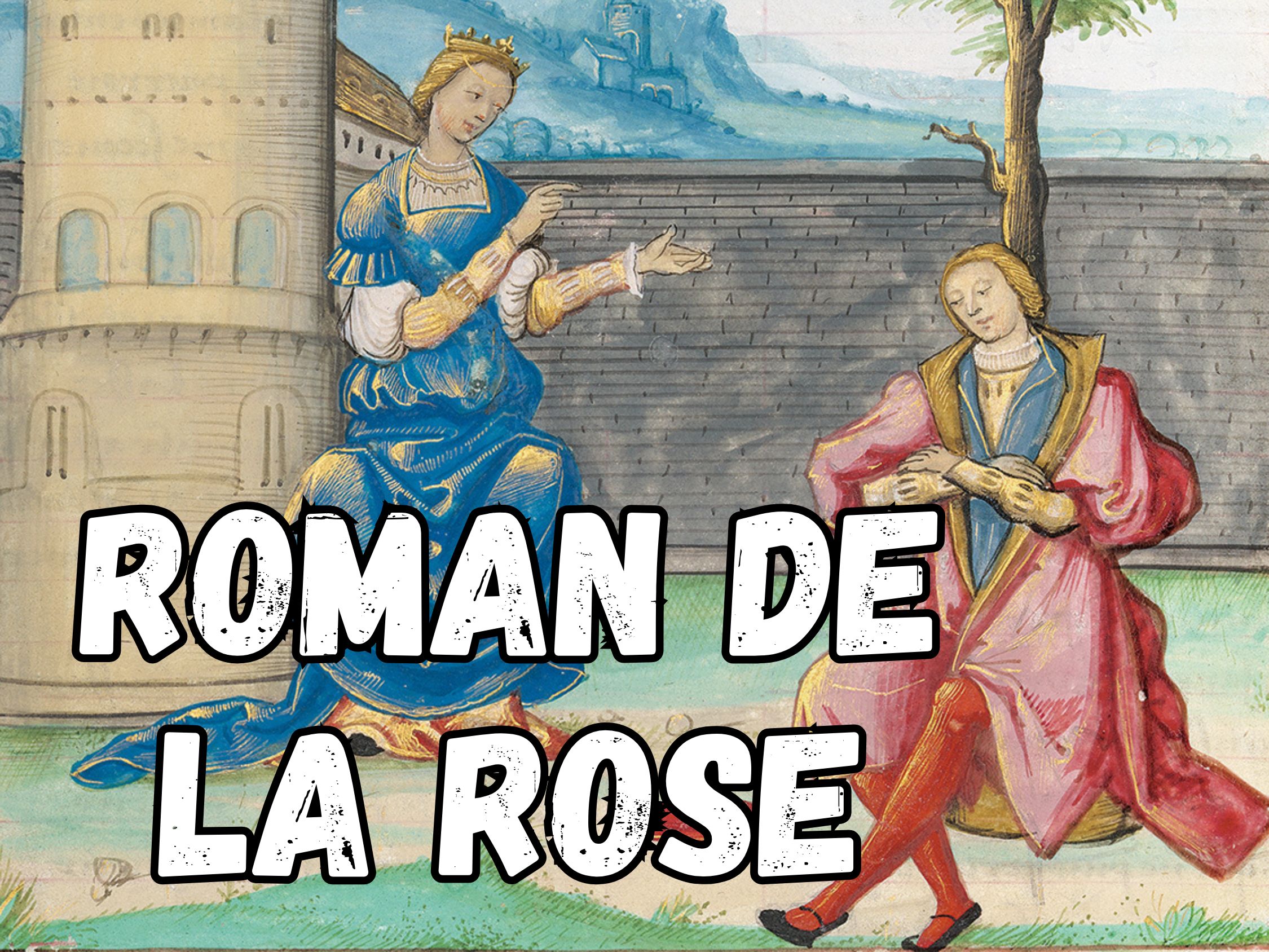
When François I received an illuminated Roman de la Rose, he was given more than a beautiful book—he was given a vision of how to interpret it. This manuscript opens a window onto the poem’s two authors, two voices, and two competing understandings of love.
Among the extant manuscripts of the Roman de la Rose, none equals the exquisite beauty of the version presented to François I, King of France, shortly after 1521. From the first glimpse of its magnificent illuminations and fine calligraphy, the work transfixes the reader. That fascination begins on the first illuminated folio: a sumptuous painting of a royal coat of arms and the stunning visual impression made by the juxtaposition of the blazon with the folio showing the portrait of François I receiving this unique manuscript from the hands of the kneeling scribe, Girard Acarie, who planned and executed it. The Roman de la Rose was one of this humanist king’s favourite books. He relished its vast array of classical philosophy, myth, literature, and science that assured its place as the first, but also the most controversial French classic.
What is the Roman de la Rose?
First of all, it was what is known today as a breakthrough book, unlike anything that had come before. This was due not so much to the fact that it had two authors, Guillaume de Lorris and Jean de Meun, but to the fact that the two parts of the book, written c. 1235 and c. 1280, were disparate in length—4,000 versus 18,000 lines approximately—but even more varied in style, approach, and content. Guillaume de Lorris is a poet in tune with the idealised love lyric of the twelfth and early thirteenth century. A gifted lyricist who evokes lively scenes of nature, ekphrastic images rivaling in vividness the paintings they depict, and lifelike personifications, Guillaume charts new pathways for the genre of romance.
Jean de Meun, writing some fifty years later, c. 1280, was part of a philosophical revolution, for which Thomas Aquinas was a leader. Grounded in Aristotelian materialism rather than Platonic idealism, these philosophers used the materiality of language to study philosophical questions. Jean himself takes pains to point out the absurdity of using euphemistic rather than natural terms to refer, for example, to body parts. His poem satirises Guillaume’s, whose approximately 4,000 lines employ only euphemisms for the sexual passion it takes as its theme.
As a poet, Jean prefers dialectical exchanges to lyrical description. He makes constant use of classical myths which serve as parables, as illustrations, or to emphasise his philosophical agenda. In accord with his preference for ordinary language, Jean redeploys Guillaume’s personifications so that their actions perform their names, e.g. Jealous Husband (Le Jaloux) verbally berates and physically beats his wife (as the coloured miniatures delight in depicting). This is Jean’s way of marking the contrast between euphemism and ordinary language.
Guillaume de Lorris: The Poet of Images, Sound, and Courtly Love
If poets may be said to ‘write images and sounds’, then Guillaume de Lorris was the first French poet to perfect the technique. From the opening lines, seeing and hearing dictate the lyric. The prologue affirms the significance of dream visions, saying that although many people claim that dreams are nothing more than lies and fables, an authority named Macrobius testifies that it is possible to dream things that one later finds to be true. In the Lover’s own case, he declares: ‘I was sleeping soundly one night some years ago when I saw a beautiful dream that pleased me greatly,’ and, because it subsequently came true, ‘I want to rhyme my dream.’
The poet’s younger self (now called the Lover) awakens to a May morning where nature displays herself with leafy verdure, and the earth proudly wears ‘a new dress of more than a hundred colors.’ Similarly, ‘the birds are so happy in May that they show their delight by loudly singing.’ We see the Lover arising from his bed, washing his hands, and slipping on his shoes. Heading towards a stream ‘whose burbling I could hear nearby … its water rushed down from a small hill; it was as clear, and cold as a well or fountain,’ he states: ‘I had never seen water flowing so well. It was refreshing to wash my face in such limpid, sparkling water.’ Going a little farther, he continues to focus on visual and auditory sensations: ‘I saw a broad garden, surrounded by a high, crenellated wall having gold and azure images portrayed on the outside and inscribed with rich writings. I gladly looked at the images and paintings on the wall. Now, I will willingly recount and describe the images and likenesses to you.’
The profusion of sights and sounds that open Guillaume’s poem sensitises the reader to the use of images to portend meaning consonant with the purpose announced in the prologue: ‘le Rommant de la Rose, / ou l’art d’amours est toute enclose’. The prologue also assures us that images, as components of the dream Guillaume is ‘rhyming’—that is, putting into sound and image—constitute the substance of l’art d’amours. Indeed, the images portrayed on the exterior wall, and many more the reader will shortly encounter within the garden, are personified moral and psychological emotions, attitudes, desires, fears, or feelings favourable or unfavourable to love. When the Lover reaches the garden to stand before the portraits, his carefree outing comes face to face with the poet’s purpose: to initiate the youth to love—its laws, conventions, thrills, and depressions.
Guillaume’s poem is an allegory, a literary mode of indirect narration which—at least in medieval and early modern literature—substitutes personification of abstract concepts for humans as characters. Personifications are one-dimensional humanoids whose actions perform their names (e.g. ‘Jealousy’, ‘Avarice’). The collective names of the abstractions indicate the intention of the allegory, which in this case is to reveal, as the poet tells us, the code of fin’amors (courtly love). When the Lover begins to describe the portraits on the Garden wall, he finds ten negative moral qualities antithetical to fin’amors: Hatred, Criminality, Villainy, Cupidity, Avarice, Envy, Sorrow, Old Age, Religious Hypocrisy, Poverty.
Once the gatekeeper Idleness admits the Lover to the Garden of Delight, he is confronted with a profusion of natural sights—singing birds, flowering plants, fruit trees, verdant turf, cute animals—described at length by the poet in lyrical terms that generate yet more image and sound. As the Lover makes his way through the garden, we recognise a narrowing of image events from those simply illustrative of the garden’s name, like the dance led by Delight and his consort, Joy, to the more significant figure of the God of Love (Amour), to a principal figure-event, the fountain of Narcissus, where the Lover’s drama begins in earnest. It is while looking into the fountain that the Lover espies and is smitten by the Rose. Love then reappears—not as an observer this time—but as the agent of fin’amors who exacerbates the youth’s growing passion by piercing his heart with five golden arrows: Beauty, Simplicity, Nobility, Company, Fair Appearance. Love also possesses five very different arrows of iron, ‘blacker than fiends from Hell’: Pride, Villainy, Shame, Cupidity, and Despair. The Lover’s quest (and fate) will oscillate between the states signified by the golden and iron arrows for the remainder of Guillaume’s poem.
While his image-based verse offers ample scope for lyrical description, its reliance on one-dimensional personification precludes deeper narrative meaning. Enmeshed in a two-dimensional world of hope and despair, the Lover lacks the ability—or indeed the context—to develop personality. Similarly, the rigid code of conduct that the God of Love imposes on the Lover hinders Guillaume’s Rose from advancing a multifaceted analysis of love.
Jean de Meun: A New Philosophy of Love in a Changing Medieval World
Fifty years later, thirteenth-century advances in philosophy, science, and literature meant that Jean de Meun could propose a radically different exposition of love. While we do not know why he chose to expound his startlingly heterodox views by continuing Guillaume’s unfinished poem, it did provide ‘safe cover’, allowing him to anchor his monumental satire within the framework and themes of a popular and innocuously conventional work.
Seamlessly, Jean begins his continuation with the lament the Lover had begun at the moment Guillaume’s poem stops. But this Lover reveals a very different persona: he is still obtuse, but with more dimensions to his personality, allowing him to debate and think, albeit unimaginatively. In Jean’s rendering, the Lover’s lament unfolds as a debate between his head and his heart, revealing far more introspection, however misguided, than Guillaume’s fatuous youth. Similarly, the personification of Reason who descends from her tower is a very different figure from the one who makes a brief appearance to chastise the Lover in Guillaume’s Rose. Trained in dialectic, philosophy, and history, she begins by posing a series of questions to the Lover about his lord, the God of Love. In the face of her probing, the youth unconvincingly defends his fealty to Love without adducing persuasive evidence for his belief.
Reason is the first of a series of interlocutors to confront and counsel the Lover, others being Friend, the God of Love, False Appearance, the Old Woman, Nature, and Genius. In the mode of satire, each espouses a distinct doctrine about the various dimensions of love, the behaviour of lovers, and the women they woo. Since these views are contradictory, we recognise a satiric pattern rather than a literal exposition of Jean’s own beliefs. At the same time, some of their views—such as False Appearance’s invective against the mendicant religious orders—may indeed align with his own outlook.
The increased importance Jean attributes to Reason’s confrontation of the Lover not only makes for more interesting reading, but it also underlines a radical shift in poetic method and mode. In place of image-driven personifications, Jean’s allegorical characters argue dialectically using language that reveals underlying tensions and desires in their interlocutor’s beliefs. Reason introduces this mode when she challenges the one-dimensional view of love instilled in the Lover by the God of Love. More devastating to Guillaume’s concept of fin’amors than demonstrating the Lover’s ignorance of the meaning of love is the way Reason exposes his ignorance of the underlying tensions and contradictions in the language of love.
All of Jean’s personified interlocutors engage the Lover—though few with Reason’s rigor—and all their conversations with the Lover contain examples drawn from classical myth, history, or epic. Considered authoritative and therefore true, classical myths also encapsulate stories, usually with a moral. Jean’s mention of the birth of Venus shows how astutely he weaves mythical exempla into his dialectic. At this point the reader has no way to know that Venus will play a major role in the dénouement of the Lover’s quest, but her arrival stands out. Born of a parricide from her father’s semen cast into the sea, Venus signals disruption. This was her role in Hesiod’s Theogony (and other classical works), and it is her role in Jean’s poem. Indeed, Reason’s point in mentioning the castration of Saturn was its role as a dividing line between a primal Golden Age of justice and subsequent ages rife with greed, hypocrisy, violence, and pain.
The issue of procreation first raised in Reason’s discourse becomes a major theme in the second part of Jean’s Rose, where he pursues two different but related modes: one narrative, the other philosophical. Jean abruptly interrupts the Rose narrative just at the point where Venus has been summoned by her son, the God of Love, to liberate Fair Welcome by storming Jealousy’s castle. He suspends the main story at this exciting juncture in order to interpolate a philosophical excursus, which turns out to be the longest sustained episode in his poem: 43 folios or 86 pages in Girard Acarie’s Rose. While readers may find the narrative action more absorbing than the philosophical interlude, it is the latter that gives Jean’s poem its encyclopaedic scope and intellectual ballast that assured its importance, fame, and translation into every major European language (including Chaucer’s English version).
By way of giving his narrative philosophical and religious justification, Jean introduces two extended exemplary personifications, Nature and Genius. Each engages in lengthy excursuses. Nature describes the cosmos, her unceasing struggle to maintain the human race in the face of death’s depredations, the science of perception, optics, and theories of vision, mirrors, divine foresight, and finally human disregard for her laws (especially in avoiding reproduction). In his discourse, Genius returns to the theme of the primal Golden Age before Jupiter castrated Saturn, usurped his throne, and brought about the present Age of Iron. Genius suggests that this secular world, like the Garden of Delight that ensnared Guillaume, can be alleviated by aspiring to another park, more eternal than the Golden Age: the Park of the White Lamb.
Jean’s conclusion appears to offer the successful end of the Lover’s quest that Guillaume did not live to write. Yet the increase in sexual innuendo in the language of his closing section drives home the radical difference between the two poems. To Guillaume’s conventional beginning, Jean appends a continuation that engages many of the debates and controversies of the intellectually turbulent thirteenth century under the guise of long and varied discussions on the myriad aspects of love. As one finishes the poem, the question arises as to whether it is possible to find a meaningful synthesis for so encyclopaedic an exposition. This challenge did not deter Girard Acarie. In preparing his magnificent manuscript for François I, he sought to impose coherence on the work as a whole, shaping his presentation of the Rose in accordance with what he believed to be its underlying unity—and offering his royal reader a visual and interpretive key to this complex masterpiece.
This article is adapted from Stephen G. Nichols’ Introduction to the commentary volume of the Roman de la Rose of François I.
The facsimile editions of The Roman de la Rose of François I and other illuminated manuscripts are available at www.moleiro.com.
Subscribe to Medievalverse
Related Posts