A new study offers a striking re-evaluation of the Augustinian Order, revealing that its medieval reputation rested not on urban preaching or scholastic learning, but on miracles rooted in the countryside: healing livestock, restoring barren land, multiplying crops, and even defeating dragons.
Cambridge University historian Krisztina Ilko presents the findings in her new book, The Sons of St Augustine, published today by Oxford University Press. She contends that historians have long misunderstood the Augustinians’ place in medieval and early Renaissance religion. “Bleeding hosts and stigmatisations are the best-known medieval miracles,” she notes. “The Augustinians get very little credit for miraculously making land fertile, healing livestock and bringing fruit trees back to life.”
Her findings highlight a forgotten world where divine interventions were profoundly practical—ensuring food production, protecting rural communities, and countering the environmental dangers that shaped medieval life.
Dragons, Swamps, and the Battle for Fertile Land
Holy hermit, possibly Guglielmo of Malavalle, 1330–1337, wall painting, Siena, Sant’Agostino, chapter house. Photo by Krisztina Ilko
One of the most vivid examples is the twelfth-century hermit Guglielmo of Malavalle, celebrated by the Augustinians not for theological teaching but for slaying a dragon with a wooden staff shaped like a pitchfork. In medieval Europe, dragons were widely associated with disease, crop failure, and poisoned air—especially in swampy, storm-ravaged regions.
Guglielmo settled in Malavalle, “the bad valley” in Tuscany’s Maremma, where storms and mists had rendered the land “so dark, and terrible” that even hunters avoided it. Dr Ilko argues that his veneration stemmed from transforming this hostile landscape into fertile ground.
“Guglielmo was a pitchfork-wielding dragon slayer and divine gardener all at once,” she explains. “Commanding the weather, securing a good harvest, and restoring the health of livestock must have seemed the most desirable divine interventions in the late medieval countryside. They were matters of life and death.”
Miracles in Manuscripts
The ruins of the hermitage of San Guglielmo at Malavalle ‘the bad valley’ in Tuscany, Italy. Photo by Krisztina Ilko
Dr Ilko’s decade-long research took her through two dozen archives and dozens of Augustinian sites—many remote or in ruins today. She uncovered overlooked evidence in frescoes, manuscripts, hagiographies, misattributed letters, and early collections of saints’ lives.
One key manuscript in the Biblioteca Medicea Laurenziana preserves stories scholars had long dismissed as too rural to matter. Its opening life, written in the 1320s, tells of Giovanni of Florence, who founded the hermitage of Santa Lucia in Larniano with local farmers. His miracles include healing the broken leg of an ox—a critical intervention for any medieval farm.
Another account describes Jacopo of Rosia, who ordered an unreliable apple tree to bear fruit every year and miraculously multiplied cabbages.
Dr Ilko argues that such miracles show how deeply the Augustinians were embedded in the agricultural rhythms of medieval life. Their power came not from urban prestige but from their role in safeguarding the land and those who worked it.
“When people think about religious orders and their massive role in the Renaissance, they usually turn their attention to cities like Rome, Florence and Siena,” she says. “Not many people realise that the Augustinians drew most of their power from the countryside. Their miracles were very green-fingered, agricultural.”
How Nature Sustained a Medieval Order
Dr Krisztina Ilko at the hermitage of Santa Lucia in Rosia, Tuscany, Italy. Photo by Krisztina Ilko
The book also reframes the survival strategy of the Order of the Hermits of St Augustine, founded in 1256. Because the order lacked a single charismatic founder and faced papal scrutiny over its legitimacy, the friars turned to their physical surroundings—forests, mountains, and coastal landscapes—to assert antiquity and spiritual authority.
“Direct contact with nature gave the friars legitimacy, special spiritual powers and access to valuable natural resources including timber, crops and wild animals,” Dr Ilko explains.
Even when the order shifted toward urban foundations, it deliberately chose liminal sites. The Augustinian convent of Santa Maria del Popolo in Rome rose at a wooded gateway to the city—a location previously rejected by the Franciscans because it was too remote “to sustain the body” and long associated with demonic hauntings beneath an ancient walnut tree.
Recovering a Lost Medieval Landscape
Dr Krisztina Ilko exploring the ruins of the hermitage of Montespecchio, Tuscany, Italy. Photo by Krisztina Ilko
Many of the hermitages Dr Ilko visited are now decaying or difficult to reach. She emphasises that their preservation is essential for understanding the medieval religious landscape beyond famous cities and cathedrals.
Her study restores the Augustinians to a central place in the rural religious life of medieval Italy—one defined by environmental challenges, agricultural labour, and a belief in miracles that kept communities alive.
“St Francis of Assisi remains the most famous ‘nature saint’, best known for preaching to birds,” Dr Ilko notes. “In a more eco-conscious world, the Augustinians deserve much more attention.”
Krisztina Ilko’s new book The Sons of St Augustine: Art and Memory in the Augustinian Churches of Central Italy, 1256–1370, is published by Oxford University Press. Please visit the publisher’s site or buy the book through Amazon.com.
Book cover plan, now complete with the blurb on the back! 📕
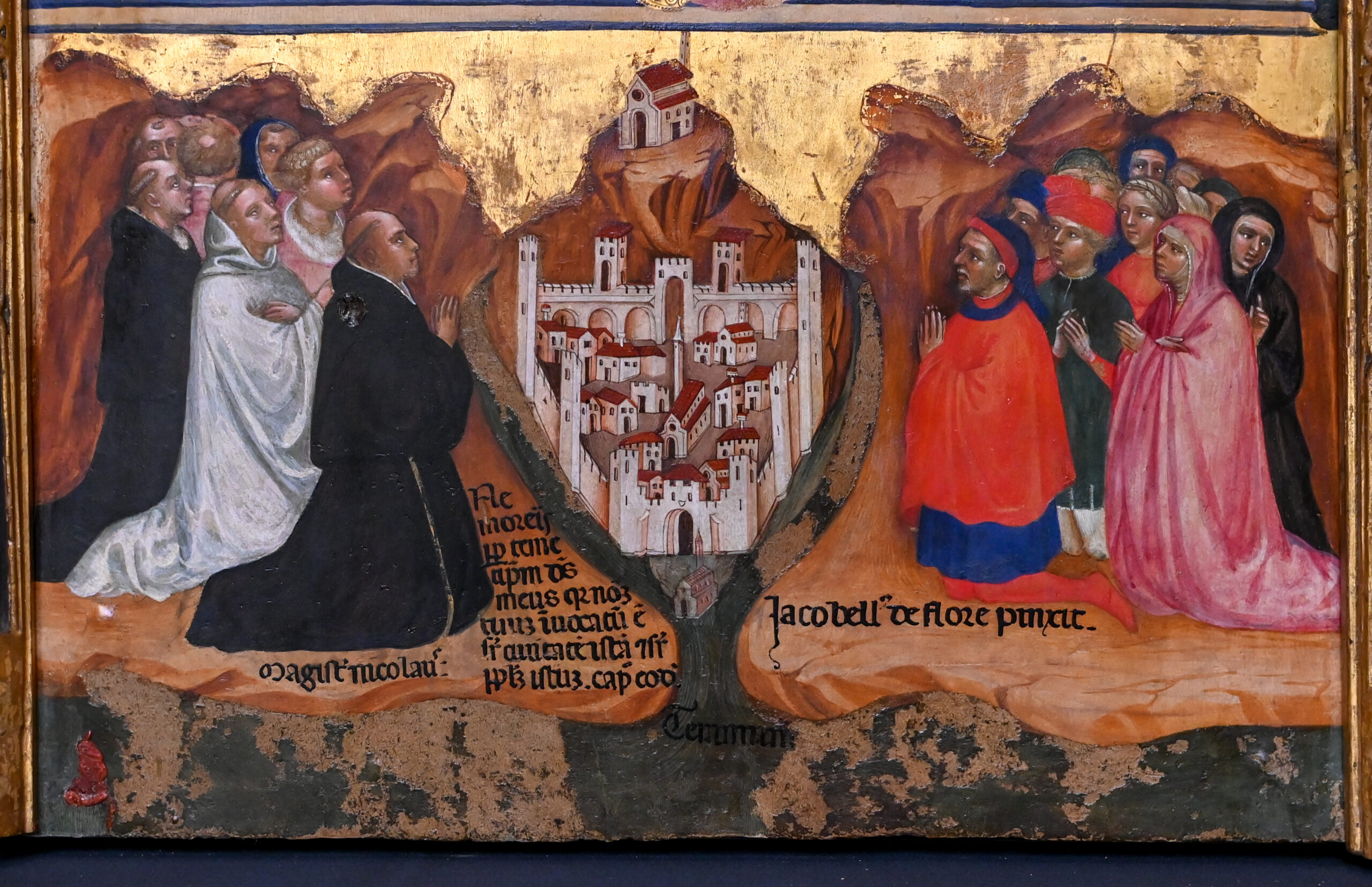
Top Image: Commune of Teramo framed by citizens and Augustinian friars on Jacobello del Fiore’s altarpiece (1407-10), Cathedral of Santa Maria Assunta, Photo by Krisztina Ilko

A new study offers a striking re-evaluation of the Augustinian Order, revealing that its medieval reputation rested not on urban preaching or scholastic learning, but on miracles rooted in the countryside: healing livestock, restoring barren land, multiplying crops, and even defeating dragons.
Cambridge University historian Krisztina Ilko presents the findings in her new book, The Sons of St Augustine, published today by Oxford University Press. She contends that historians have long misunderstood the Augustinians’ place in medieval and early Renaissance religion. “Bleeding hosts and stigmatisations are the best-known medieval miracles,” she notes. “The Augustinians get very little credit for miraculously making land fertile, healing livestock and bringing fruit trees back to life.”
Her findings highlight a forgotten world where divine interventions were profoundly practical—ensuring food production, protecting rural communities, and countering the environmental dangers that shaped medieval life.
Dragons, Swamps, and the Battle for Fertile Land
One of the most vivid examples is the twelfth-century hermit Guglielmo of Malavalle, celebrated by the Augustinians not for theological teaching but for slaying a dragon with a wooden staff shaped like a pitchfork. In medieval Europe, dragons were widely associated with disease, crop failure, and poisoned air—especially in swampy, storm-ravaged regions.
Guglielmo settled in Malavalle, “the bad valley” in Tuscany’s Maremma, where storms and mists had rendered the land “so dark, and terrible” that even hunters avoided it. Dr Ilko argues that his veneration stemmed from transforming this hostile landscape into fertile ground.
“Guglielmo was a pitchfork-wielding dragon slayer and divine gardener all at once,” she explains. “Commanding the weather, securing a good harvest, and restoring the health of livestock must have seemed the most desirable divine interventions in the late medieval countryside. They were matters of life and death.”
Miracles in Manuscripts
Dr Ilko’s decade-long research took her through two dozen archives and dozens of Augustinian sites—many remote or in ruins today. She uncovered overlooked evidence in frescoes, manuscripts, hagiographies, misattributed letters, and early collections of saints’ lives.
One key manuscript in the Biblioteca Medicea Laurenziana preserves stories scholars had long dismissed as too rural to matter. Its opening life, written in the 1320s, tells of Giovanni of Florence, who founded the hermitage of Santa Lucia in Larniano with local farmers. His miracles include healing the broken leg of an ox—a critical intervention for any medieval farm.
Another account describes Jacopo of Rosia, who ordered an unreliable apple tree to bear fruit every year and miraculously multiplied cabbages.
Dr Ilko argues that such miracles show how deeply the Augustinians were embedded in the agricultural rhythms of medieval life. Their power came not from urban prestige but from their role in safeguarding the land and those who worked it.
“When people think about religious orders and their massive role in the Renaissance, they usually turn their attention to cities like Rome, Florence and Siena,” she says. “Not many people realise that the Augustinians drew most of their power from the countryside. Their miracles were very green-fingered, agricultural.”
How Nature Sustained a Medieval Order
The book also reframes the survival strategy of the Order of the Hermits of St Augustine, founded in 1256. Because the order lacked a single charismatic founder and faced papal scrutiny over its legitimacy, the friars turned to their physical surroundings—forests, mountains, and coastal landscapes—to assert antiquity and spiritual authority.
“Direct contact with nature gave the friars legitimacy, special spiritual powers and access to valuable natural resources including timber, crops and wild animals,” Dr Ilko explains.
Even when the order shifted toward urban foundations, it deliberately chose liminal sites. The Augustinian convent of Santa Maria del Popolo in Rome rose at a wooded gateway to the city—a location previously rejected by the Franciscans because it was too remote “to sustain the body” and long associated with demonic hauntings beneath an ancient walnut tree.
Recovering a Lost Medieval Landscape
Many of the hermitages Dr Ilko visited are now decaying or difficult to reach. She emphasises that their preservation is essential for understanding the medieval religious landscape beyond famous cities and cathedrals.
Her study restores the Augustinians to a central place in the rural religious life of medieval Italy—one defined by environmental challenges, agricultural labour, and a belief in miracles that kept communities alive.
“St Francis of Assisi remains the most famous ‘nature saint’, best known for preaching to birds,” Dr Ilko notes. “In a more eco-conscious world, the Augustinians deserve much more attention.”
Krisztina Ilko’s new book The Sons of St Augustine: Art and Memory in the Augustinian Churches of Central Italy, 1256–1370, is published by Oxford University Press. Please visit the publisher’s site or buy the book through Amazon.com.
Top Image: Commune of Teramo framed by citizens and Augustinian friars on Jacobello del Fiore’s altarpiece (1407-10), Cathedral of Santa Maria Assunta, Photo by Krisztina Ilko
Subscribe to Medievalverse
Related Posts