Archaeologists in Germany have unearthed a fascinating medieval structure during a recent excavation along the waterway. This discovery reveals a significant land reclamation effort from around 800 years ago.
Since April, a specialist archaeological company, in collaboration with LWL Archaeology for Westphalia, has been excavating a significant wooden structure along the waterway in Wiedenbrück, located in Western Germany. The excavation area, just 30 square meters in size, revealed what appears to be a medieval bank reinforcement.
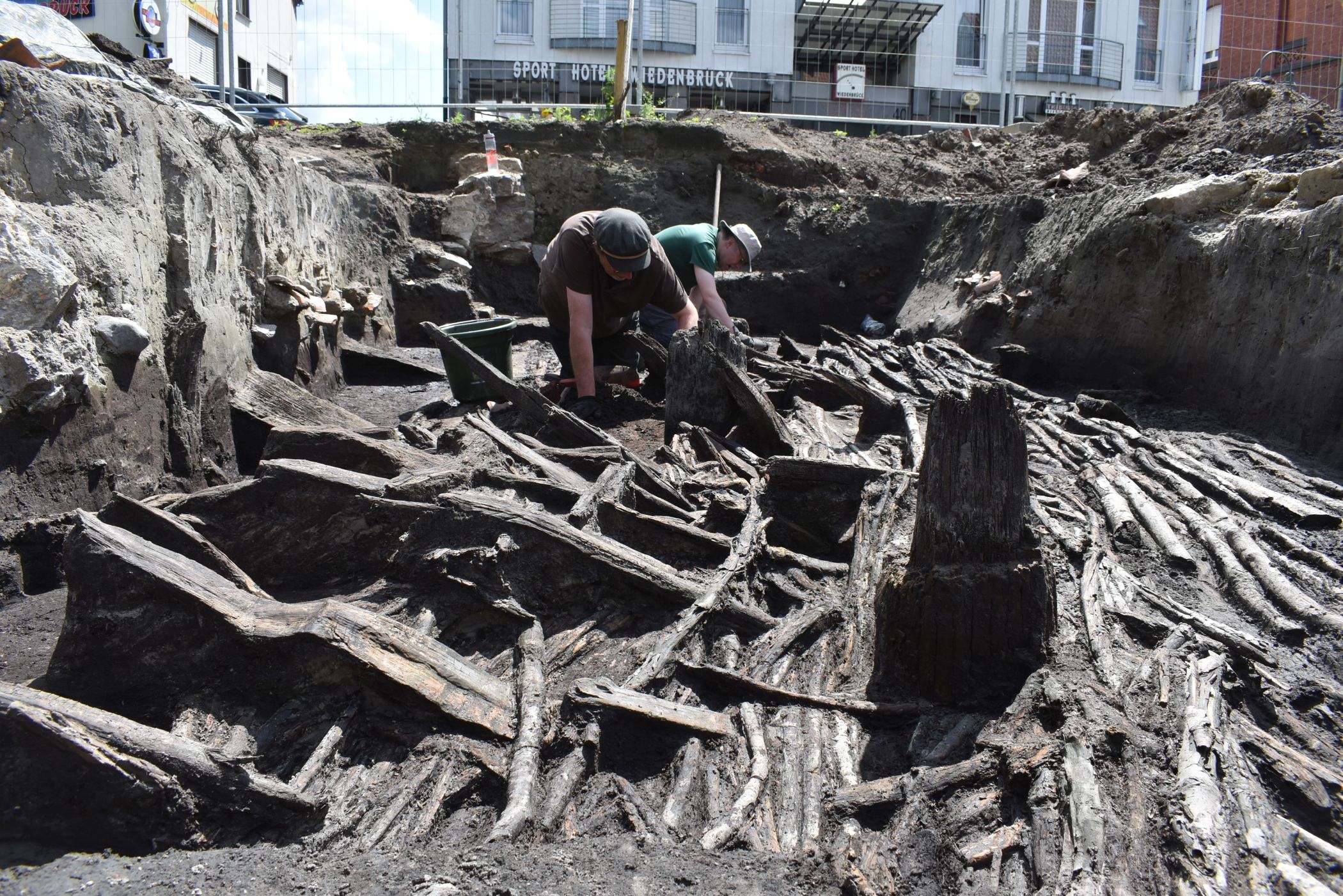
“The complex construction consisted of two to three rows one behind the other, running east-west, each made up of stakes and willow rods woven in between,” says excavation manager Ulrich Holtfester. “These rows, also known as fascines, were intended to provide support for the sloping terrain.”
The exposed wooden construction in the overall view. Photo: Archäologie am Hellweg eG/Ulrich Holtfester.
The team discovered both natural branches and processed wooden slats used as stakes, with birch twigs placed to secure the subsoil. These twigs, up to ten centimeters in diameter and chipped at the ends, were often covered with mat-like remains of smaller branches. “The orientation of the entire construction suggests that it was intended to protect the area to the south from water ingress,” Holtfester suspects.
In addition to the wooden structure, the excavation unearthed a wealth of artifacts, including 13th-century ceramics, animal bones, and leather shoe soles. “The latter, like the wood, were very well preserved here due to the damp subsoil,” explains Julia Hallenkamp-Lumpe from the Bielefeld branch of LWL Archaeology for Westphalia. These discoveries provide a glimpse into Wiedenbrück’s growth during the 13th century.
Sven Spiong, head of the Bielefeld branch, explains, “The elaborate wooden construction was probably built during the construction of the new town shortly before the middle of the 13th century in order to make use of a peaty depression east of an old arm of the Ems that had always been unsuitable for settlement.” This type of medieval land reclamation is a recurring theme in historical studies, with similar projects seen in Minden and Rietberg.
The land’s continued use is evident from 14th or 15th-century embankments that raised and dried the land. The final settlement of the area is marked by two-meter-long posts driven through the older embankment and wooden structure. One of these posts was found to be a reused, slightly charred half-timbered beam. Scientific research will now investigate whether these posts could relate to Wiedenbrück’s first written records of development from around 1500.
This excavation not only uncovers the physical remnants of medieval engineering but also offers a window into the historical development of Wiedenbrück. As research progresses, we look forward to learning more about how the town evolved over the centuries.
Top Image: Archäologie am Hellweg eG/Ulrich Holtfeste

Archaeologists in Germany have unearthed a fascinating medieval structure during a recent excavation along the waterway. This discovery reveals a significant land reclamation effort from around 800 years ago.
Since April, a specialist archaeological company, in collaboration with LWL Archaeology for Westphalia, has been excavating a significant wooden structure along the waterway in Wiedenbrück, located in Western Germany. The excavation area, just 30 square meters in size, revealed what appears to be a medieval bank reinforcement.
“The complex construction consisted of two to three rows one behind the other, running east-west, each made up of stakes and willow rods woven in between,” says excavation manager Ulrich Holtfester. “These rows, also known as fascines, were intended to provide support for the sloping terrain.”
Photo: Archäologie am Hellweg eG/Ulrich Holtfester.
The team discovered both natural branches and processed wooden slats used as stakes, with birch twigs placed to secure the subsoil. These twigs, up to ten centimeters in diameter and chipped at the ends, were often covered with mat-like remains of smaller branches. “The orientation of the entire construction suggests that it was intended to protect the area to the south from water ingress,” Holtfester suspects.
In addition to the wooden structure, the excavation unearthed a wealth of artifacts, including 13th-century ceramics, animal bones, and leather shoe soles. “The latter, like the wood, were very well preserved here due to the damp subsoil,” explains Julia Hallenkamp-Lumpe from the Bielefeld branch of LWL Archaeology for Westphalia. These discoveries provide a glimpse into Wiedenbrück’s growth during the 13th century.
Sven Spiong, head of the Bielefeld branch, explains, “The elaborate wooden construction was probably built during the construction of the new town shortly before the middle of the 13th century in order to make use of a peaty depression east of an old arm of the Ems that had always been unsuitable for settlement.” This type of medieval land reclamation is a recurring theme in historical studies, with similar projects seen in Minden and Rietberg.
The land’s continued use is evident from 14th or 15th-century embankments that raised and dried the land. The final settlement of the area is marked by two-meter-long posts driven through the older embankment and wooden structure. One of these posts was found to be a reused, slightly charred half-timbered beam. Scientific research will now investigate whether these posts could relate to Wiedenbrück’s first written records of development from around 1500.
This excavation not only uncovers the physical remnants of medieval engineering but also offers a window into the historical development of Wiedenbrück. As research progresses, we look forward to learning more about how the town evolved over the centuries.
Top Image: Archäologie am Hellweg eG/Ulrich Holtfeste
Subscribe to Medievalverse
Related Posts