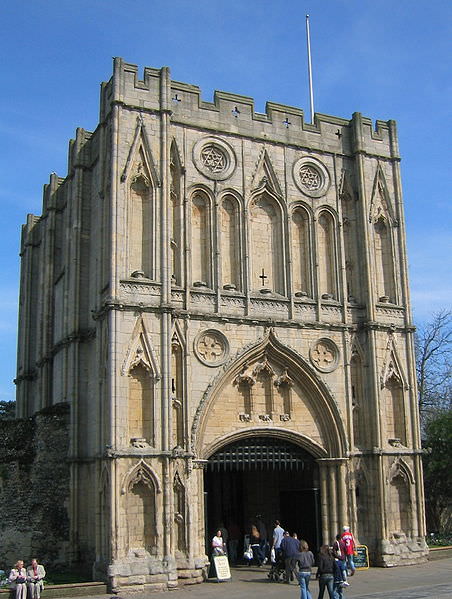
The Evolution Of English
A video lecture on the origin and vagaries of the English language up to the 15th century
The Importance of Being English: A Look at French and Latin Loanwords in English
This essay examines twenty six synonym pairs in English, looks at their etymology and briefly explains where they come from and how they work in a sentence.
Changing views on Vikings
In this article changing views, not only of Viking activities, but also of the etymology and meaning of the word viking will be discussed.

Constructions of Gender in Medieval Welsh Literature
The discussion of gender in medieval literary criticism is generally considered
to be a relatively new field, having achieved real momentum only in the latter half of the twentieth century. However, since it was the early fifteenth century when Christine de Pisan wrote a response to Jean de Meun’s Romance of the Rose, it cannot really be imagined that the medieval audience was too primitive to be fully aware of the subtext inside their stories.

Beowulf, a Christian poem: an approach to certain difficulties
This work has for its object to show that Beowulf is a Christian poem, written by a Christian poet, for a Christian audience of the eighth century.

Recreating Beowulf’s “Pregnant Moment of Poise”: Pagan Doom and Christian Eucatastrophe Made Incarnate in the Dark Age Setting of The Lord of the Rings
The following chapters will explore how Tolkien fuses themes and imagery from the pagan Norse apocalyptic myth of Ragnarök with Christian apocalyptic imagery and themes in a recreated Dark Age historical setting to create The Lord of the Rings.

The Verb in Beowulf
Thus, in a paper of the nature of this thesis, the Beowulfian novice is limited in scope and must be satisfied, at best, to open a small breach in the subject, examine one segment, focus his attention on one aspect, single out one featture of it, and channel the efforts of his research towards some contribution, no matter how small, to the overall scholarship in the field.
On bilingualism in the Danelaw
Little can be known about those bilingual speakers of the language varieties related to Old English and Old Norse, who wandered in the Danelaw during the Viking Age, as no direct evidence has come down to us to support this argumentation.

The Runic System as a Reinterpretation of Classical Influences and as an Expression of Scandinavian Cultural Affiliation
Accompanying discussions of the runic system’s graphical origins are arguments concerning its geographical origins. Von Friesen’s theory that runes derived from Greek characters looked east to the Gothic territories, while scholars arguing for North Italic origins have pointed towards the Alps. Moltke, who looked to a largely Latin source for the runic characters, suggested a runic origin in Denmark.

The mandrake plant and its legend: a new perspective
As a specialist in German mediaeval studies, until the time Peter Bierbaumer introduced me to Old English plant names and approached me with the idea of republishing and updating his Der botanische Wortschatz des AltenglischenI had no idea how fascinating Old English could be.

VAGANTES: “What has Beowulf to do with a Christian King?” Heroic Legend as Poetic Speculum Principis
Through a rhetorical analysis based in grounded theory that analyzes fifteen speeches and their contexts made by Hroðgar, Beowulf, and Wiglaf, I will show how the poet appropriated the Beowulf legend to present a dramatized speculum principis using the rhetorical devices common to oral-traditional narratives to articulate the three traits of kingship most highly valued by both secular and sacred authorities: generosity, faith, and protectiveness.
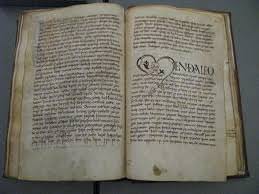
VAGANTES: Hālnes and hǽlþ:Anglo-Saxon Bodily Wellness
Since most of the surviving mentions of wellness relate to the health of the soul, it is not clear what constituted a healthy Anglo-Saxon body. This paper will use the Old English poem Soul and Body and Old English medical texts to explore Anglo-Saxon bodily wellness.

Alfred the Great’s Burnt Boethius
One can trace the reason for these curious editorial developments to two factors: (1) the inaccessibility of the tenth-century manuscript, which everyone thought was destroyed in the 1731 fire, until its burnt remains were recovered at the British Museum in the 1830s; and (2) an overpowering edition-in-progress of the twelfth-century manuscript by the great seventeenth-century scholar Francis Junius, with extensive collations from the missing tenth-century manuscript.
Writing Land in Anglo-Saxon England
In using writing as a means to contain dispute over time, the Anglo-Saxons repeatedly inscribed the troubling evidence of past dispute and anticipated loss into their thinking about land.
Old MacDonald had a Fyrm, eo, eo, y: two marginal developments of < eo > in Old and Middle English
It is widely accepted that the Old English diphthong /e(:)o/ generally monophthongized, around the eleventh century, to the central rounded /ø(:)/.
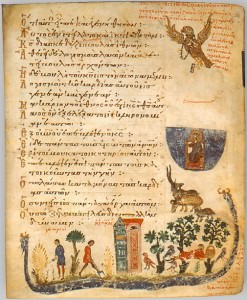
Manuscript Variation in Multiple-Recension Old English Poetic Texts: The Technical Problem and Poetical Art
Twenty-six poems and fragments of poems are known to have survived the Anglo-Saxon period in more than one witness. These include poems from a variety of genres and material contexts: biblical narrative, religious poetry, riddles, charms, liturgical translations, proverbs, a preface and an epilogue, occasional pieces like ‘Durham,’ and historical poems like the Battle of Brunanburh.

Jaunts, Jottings, and Jetsam in Anglo-Saxon Manuscripts
In British Library, MS Egerton 1993, a collection of Middle English saints’ lives, a late hand has entered in ink a memorable drawing that proudly displays its own rubric: “this is man” (fig. 1). Precisely what manner of beast man was occupied the attention of a number of doodlers who laid hands on Anglo-Saxon manuscripts.

The Liturgical Context of Ælfric’s Homilies for Rogation
To search out Ælfric’s sources is also to inquire into his method of composition, to guess at the principles that guided him to some sources and away from others. Malcolm Godden has provided a remarkably full list of Ælfric’s sources, and suggests that Ælfric relied on relatively few volumes to compose his homilies.
The Wife’s Lament: A Poem of the Living Dead
I tell this tale about my sorrowfulness / About my own fate. That I may speak of / What misfortunes I have endured since I grew up / New or old, never more than now.
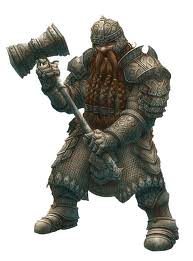
Dreaming of dwarves: Nightmares and Shamanism in Anglo-Saxon Poetics and the Wid Dweorh Charm
Psychological and psychiatric ailments must have baffled early medical practitioners.
Ingeld and Christ: A Medieval Problem
Students of Beowulf are familiar with the notion that the poem can be read as an attempt to answer Alcuin’s question, ‘Quid enim Hinieldus cum Christo?’ (What has Ingeld to do with Christ?).

Beowulf, Orality and the Anglo-Saxon Conversion
There is no source quite like the Beowulf manuscript, as it is the longest poem and the only epic composed in Old English which has survived to the modern era, and thus is central to any understanding of Anglo-Saxon literature.
Old English se: from demonstrative to article
Contributing to the ongoing debate about the existence of a definite article in Old English, the present thesis discusses patterns of nominal determination in Old English and their influence on the phenomenon of the emergence of the category ‘article’