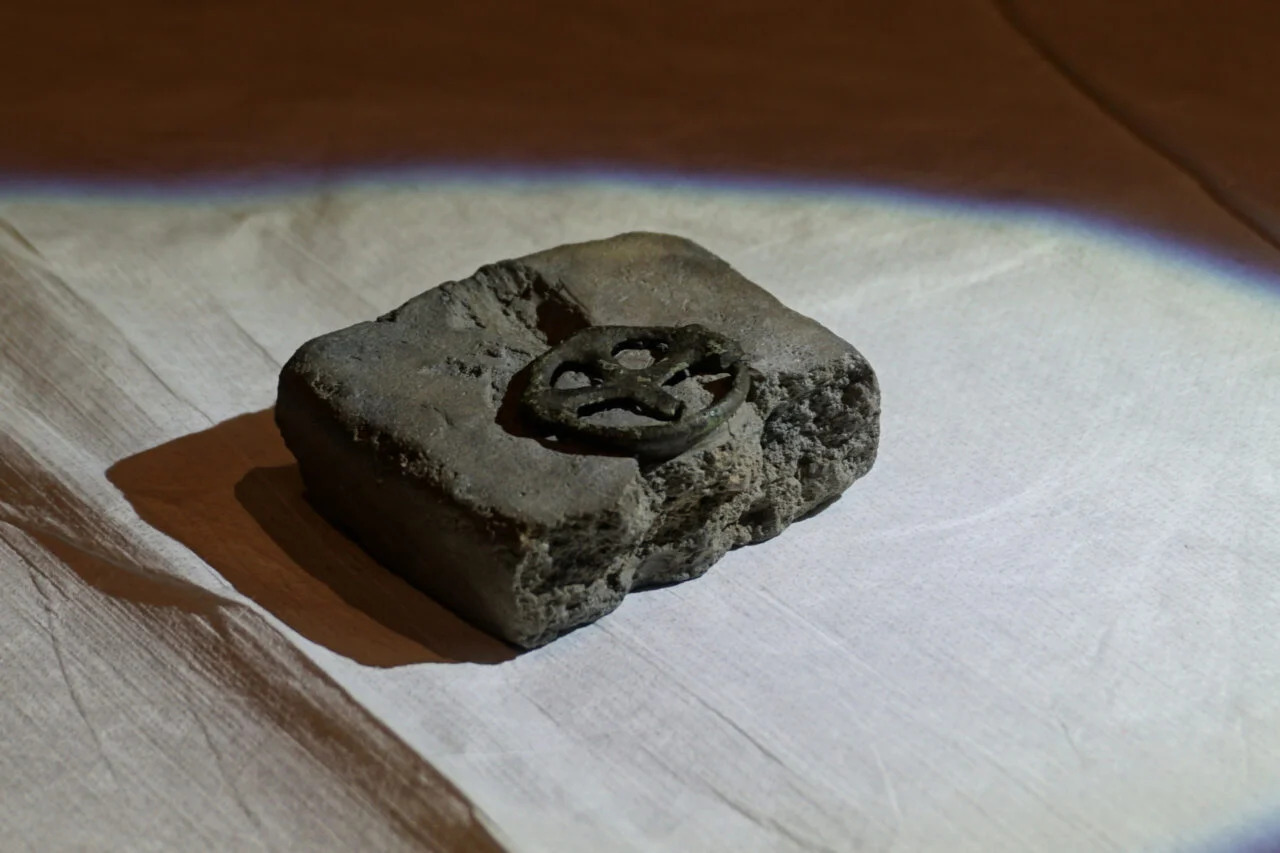
An extraordinary archaeological discovery in eastern Germany has reunited a medieval bronze cross with the mould used to cast it—more than four decades after the mould itself was found. The object, a so-called wheel cross dating to the 10th or 11th century, offers rare and tangible evidence of early Christianisation among the Slavic populations of the region between the Elbe and Oder rivers.
The cross was discovered in the western Havelland region of Brandenburg by Juliane Rangnow, a volunteer archaeological monument conservator, during authorised metal-detecting surveys. Alongside it were other finds from the same period, including coins, fragments of partially gilded jewellery, and iron weapons, indicating that the site had been active and connected to wider networks of exchange.
What makes this discovery exceptional, however, is not only the cross itself but how it was made.
The bronze object was cast in a mould that archaeologists had already found in 1983 during excavations at the Slavic hillfort in Berlin-Spandau. That mould—known to researchers as the “Spandau Cross”—has long been regarded as one of the earliest pieces of archaeological evidence for Christianity in the region. Yet until now, no cast made from it had ever been identified.
After restoration and precise measurement at the Brandenburg State Office for Monument Preservation and Archaeological State Museum (BLDAM), the newly discovered cross was compared to the Spandau mould, which is kept at the Museum of Prehistory and Early History in Berlin. The match is exact. For the first time, archaeologists can point to both the tool and the object it produced.
“A cast from this mould had not previously been found—neither in Spandau nor anywhere else,” the BLDAM explained. “The current discovery of a matching piece is therefore unique.”
A Personal Discovery, a Historical Bridge
The finder and volunteer archaeological monument conservator Juliane Rangnow, Prof. Dr. Matthias Wemhoff, Berlin State Archaeologist and Director of the Museum of Prehistory and Early History in Berlin (center), and Prof. Dr. Franz Schopper, State Archaeologist and Director of the BLDAM (right). Photo: A.-M. Graatz, BLDAM
For Rangnow, the find was as emotionally powerful as it was scientifically important. “Holding such a find in your hand is like a bridge to the past,” she said. “That’s what makes the work as a volunteer archaeological monument conservator so exciting.”
She is one of around 350 volunteer monument conservators working with the BLDAM. These volunteers play a crucial role in surveying, documenting, and protecting Brandenburg’s archaeological heritage. All of them undergo formal training, and since 2022 a dedicated staff member has been employed specifically to support and advise them.
Brandenburg alone contains more than 40,000 known archaeological sites, about 11,000 of which are officially registered monuments. They range from flint tools dating back some 130,000 years to a Cold War-era escape tunnel dug under the former East German border fortifications in 1961.
The wheel cross itself is small, but its historical significance is considerable. It dates to a period of intense political and religious change in the region.
In the early 10th century, the area that is now Berlin and Brandenburg was inhabited largely by non-Christian Slavic tribes. Through military campaigns, it fell under the influence of the East Frankish Kingdom, the predecessor of the later Holy Roman Empire. The new rulers brought not only political reorganisation but also Christianity.
Yet the process was far from smooth. Evidence for this first wave of Christianisation comes mostly from written sources, and those sources suggest that the new religion was widely resisted. In 983, Slavic groups rose in the so-called Lutician Revolt, throwing off East Frankish control and regaining political and religious independence for roughly 150 years. Only in the 12th and 13th centuries, after the region had become the Margraviate of Brandenburg, did lasting Christianisation take hold.
This makes the Spandau mould—and now its matching cross—particularly important. The mould was originally found next to the remains of an early wooden church inside the Spandau hillfort.
“In Spandau, archaeologists discovered the mould for the cross pendant decades ago,” explains Matthias Wemhoff, Director of the Museum of Prehistory and Early History in Berlin. “At the time, using a cast, it was possible to make a new mould and pour metal into it, making the special depiction of Christ visible. Now we know that the smith in Spandau was producing for a large market and a very mobile group of people. Christian symbols were widespread before the Slavic uprising of 983.”
A Rare Match Between Tool and Object
Archaeologists rarely get the chance to connect a casting mould to an actual finished object. Moulds survive; finished pieces are found elsewhere—or not at all. In this case, the two halves of the story have finally come together.
“The discovery of a small bronze cross is not just another find among many. This find is spectacular in several respects,” said Brandenburg’s Minister of Culture, Dr. Manja Schüle, at the presentation of the object in Potsdam. She highlighted the broader significance of the object: “It exemplifies the early Christianisation of Brandenburg and shows the role Christianity already played in the region, which was then predominantly Slavic.”
A Window into Cultural Networks
For Prof. Dr. Franz Schopper, State Archaeologist and Director of the BLDAM, the cross is also a reminder of how interconnected the region was even in the early Middle Ages.
“The discovery and its scientific classification are an outstanding example of continuous archaeological heritage management and museum work in cooperation with the civic engagement of well-supported, volunteer actors.,” he said. “The object itself illustrates the far-reaching cultural contacts so typical of our state, which are implemented regionally in the Brandenburg manner.”
In other words, this is not just a religious object. It is evidence of craft production, exchange networks, and cultural interaction at a frontier between political worlds and belief systems.
On Display in Brandenburg
Both the mould and the cross will be displayed together at the Brandenburg State Archaeological Museumin Brandenburg an der Havel from 24 January to 11 March 2026. For the first time, visitors will be able to see the tool and its product side by side.
It is a rare opportunity to witness a moment of medieval craftsmanship frozen in time—and a small but powerful object that speaks to one of the most dramatic transformations in the region’s history.

An extraordinary archaeological discovery in eastern Germany has reunited a medieval bronze cross with the mould used to cast it—more than four decades after the mould itself was found. The object, a so-called wheel cross dating to the 10th or 11th century, offers rare and tangible evidence of early Christianisation among the Slavic populations of the region between the Elbe and Oder rivers.
The cross was discovered in the western Havelland region of Brandenburg by Juliane Rangnow, a volunteer archaeological monument conservator, during authorised metal-detecting surveys. Alongside it were other finds from the same period, including coins, fragments of partially gilded jewellery, and iron weapons, indicating that the site had been active and connected to wider networks of exchange.
What makes this discovery exceptional, however, is not only the cross itself but how it was made.
The bronze object was cast in a mould that archaeologists had already found in 1983 during excavations at the Slavic hillfort in Berlin-Spandau. That mould—known to researchers as the “Spandau Cross”—has long been regarded as one of the earliest pieces of archaeological evidence for Christianity in the region. Yet until now, no cast made from it had ever been identified.
After restoration and precise measurement at the Brandenburg State Office for Monument Preservation and Archaeological State Museum (BLDAM), the newly discovered cross was compared to the Spandau mould, which is kept at the Museum of Prehistory and Early History in Berlin. The match is exact. For the first time, archaeologists can point to both the tool and the object it produced.
“A cast from this mould had not previously been found—neither in Spandau nor anywhere else,” the BLDAM explained. “The current discovery of a matching piece is therefore unique.”
A Personal Discovery, a Historical Bridge
For Rangnow, the find was as emotionally powerful as it was scientifically important. “Holding such a find in your hand is like a bridge to the past,” she said. “That’s what makes the work as a volunteer archaeological monument conservator so exciting.”
She is one of around 350 volunteer monument conservators working with the BLDAM. These volunteers play a crucial role in surveying, documenting, and protecting Brandenburg’s archaeological heritage. All of them undergo formal training, and since 2022 a dedicated staff member has been employed specifically to support and advise them.
Brandenburg alone contains more than 40,000 known archaeological sites, about 11,000 of which are officially registered monuments. They range from flint tools dating back some 130,000 years to a Cold War-era escape tunnel dug under the former East German border fortifications in 1961.
A Cross from a Crucial Moment
The wheel cross itself is small, but its historical significance is considerable. It dates to a period of intense political and religious change in the region.
In the early 10th century, the area that is now Berlin and Brandenburg was inhabited largely by non-Christian Slavic tribes. Through military campaigns, it fell under the influence of the East Frankish Kingdom, the predecessor of the later Holy Roman Empire. The new rulers brought not only political reorganisation but also Christianity.
Yet the process was far from smooth. Evidence for this first wave of Christianisation comes mostly from written sources, and those sources suggest that the new religion was widely resisted. In 983, Slavic groups rose in the so-called Lutician Revolt, throwing off East Frankish control and regaining political and religious independence for roughly 150 years. Only in the 12th and 13th centuries, after the region had become the Margraviate of Brandenburg, did lasting Christianisation take hold.
This makes the Spandau mould—and now its matching cross—particularly important. The mould was originally found next to the remains of an early wooden church inside the Spandau hillfort.
“In Spandau, archaeologists discovered the mould for the cross pendant decades ago,” explains Matthias Wemhoff, Director of the Museum of Prehistory and Early History in Berlin. “At the time, using a cast, it was possible to make a new mould and pour metal into it, making the special depiction of Christ visible. Now we know that the smith in Spandau was producing for a large market and a very mobile group of people. Christian symbols were widespread before the Slavic uprising of 983.”
A Rare Match Between Tool and Object
Archaeologists rarely get the chance to connect a casting mould to an actual finished object. Moulds survive; finished pieces are found elsewhere—or not at all. In this case, the two halves of the story have finally come together.
“The discovery of a small bronze cross is not just another find among many. This find is spectacular in several respects,” said Brandenburg’s Minister of Culture, Dr. Manja Schüle, at the presentation of the object in Potsdam. She highlighted the broader significance of the object: “It exemplifies the early Christianisation of Brandenburg and shows the role Christianity already played in the region, which was then predominantly Slavic.”
A Window into Cultural Networks
For Prof. Dr. Franz Schopper, State Archaeologist and Director of the BLDAM, the cross is also a reminder of how interconnected the region was even in the early Middle Ages.
“The discovery and its scientific classification are an outstanding example of continuous archaeological heritage management and museum work in cooperation with the civic engagement of well-supported, volunteer actors.,” he said. “The object itself illustrates the far-reaching cultural contacts so typical of our state, which are implemented regionally in the Brandenburg manner.”
In other words, this is not just a religious object. It is evidence of craft production, exchange networks, and cultural interaction at a frontier between political worlds and belief systems.
On Display in Brandenburg
Both the mould and the cross will be displayed together at the Brandenburg State Archaeological Museum in Brandenburg an der Havel from 24 January to 11 March 2026. For the first time, visitors will be able to see the tool and its product side by side.
It is a rare opportunity to witness a moment of medieval craftsmanship frozen in time—and a small but powerful object that speaks to one of the most dramatic transformations in the region’s history.
Top Image: The wheel cross in the mold. © Brandenburgisches Landesamt für Denkmalpflege und Archäologisches Landesmuseum (BLDAM), photo: Lukas Goldmann.
Subscribe to Medievalverse
Related Posts