After being captured in Egypt during the Seventh Crusade (1248–54), Peter of Dreux’s sword disappeared. It was lost for nearly seven hundred years until the late 1920s, when its pommel was rediscovered in the Damascus bazaar by Louis J. Cartier – of House of Cartier fame – who purchased it and gifted it to The Met. This invaluable relic – one of the most remarkable personal objects to survive from the crusades – offers a fascinating window into the life and military campaigns of its owner.
By Thomas Smith
It is rare that scholars can identify medieval artefacts with the crusades. It is even rarer to be able to associate them with an individual warrior and a specific crusade, and to know the events and circumstances in which it was used. But that is exactly what we have in the sword pommel of Peter of Dreux – one of the most remarkable objects to survive from the crusades.
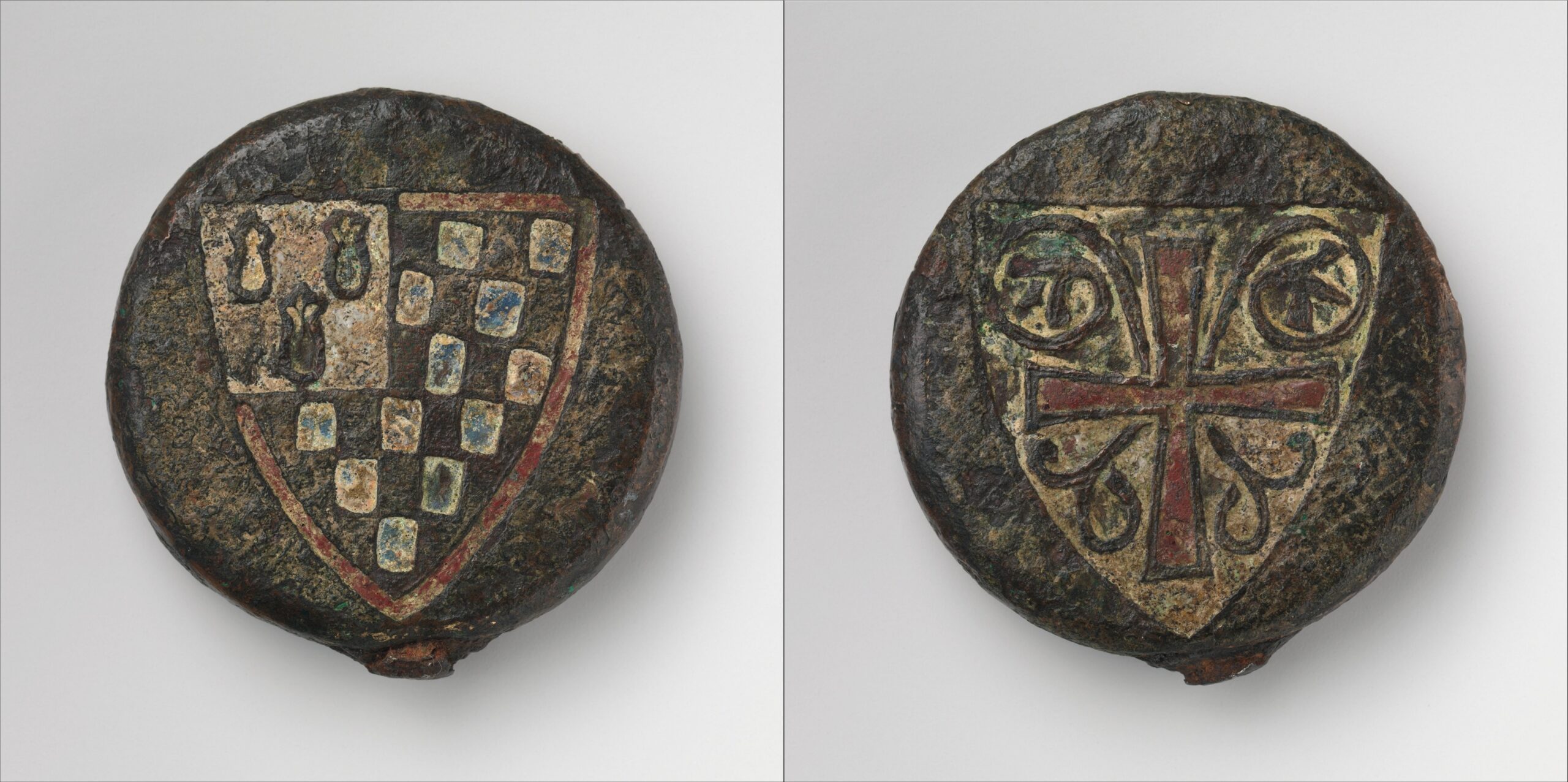
The mystery of the lost crusader sword begins, peculiarly enough, with Louis J. Cartier – of Cartier jewellery house fame – in the Damascus bazaar in the late 1920s. While rummaging through the historic wares on sale, he found a weighty metal disc made of copper. As he turned the object over in his hands, he noticed the fine gold and enamel decorations: a shield with a coat of arms on one side and a Christian motif – a red cross – on the other. Examining the iron protrusion at the base of the disc, he must have realised that this artefact had once been attached to a handle: Cartier had in his hands a medieval sword pommel. Appreciating this as an object of considerable historic value, but not knowing to whom it had belonged, or how it had come to Damascus, he purchased it and brought it back to France.
The crusader sword pommel re-discovered by Louis J. Cartier in the Damascus bazaar in the late 1920s. Image credit: Public domain, courtesy of The Metropolitan Museum of Art, New York
About a decade later, in 1938, Cartier gifted the sword pommel to The Metropolitan Museum of Art in New York as a symbol of friendship between the French and American peoples, whence it became the subject of scholarly study. The pommel has been dated to c. 1240–50 and the coat of arms on the artefact is so well preserved and distinctive (squares of blue and gold, quartered with ermines) that it was quickly identified as belonging to the French noble Peter of Dreux (1191–1250), whose tomb effigy in Braisne abbey bore the exact same design.
The distinctive coat of arms of Peter of Dreux: blue and gold squares quartered with ermines. Image credit: Public domain, courtesy of The Metropolitan Museum of Art, New York
Peter of Dreux was count of Brittany and earl of Richmond (an English title held by Breton nobles – a quirk of the cross-Channel networks that existed at the time) and was also of royal descent – his great-grandfather was King Louis VI of France (1108–37). Despite his nickname, ‘Mauclerc’ (literally: ‘bad cleric’) – bestowed upon him because of his terrible treatment of the Church in his lands, for which he was excommunicated – Peter was a committed crusader and he travelled to the East twice in his lifetime.
A stained-glass window in Chartres cathedral depicting Peter of Dreux. Image credit: Meluzína / Wikimedia Commons
He first fought in the Holy Land on the Barons’ Crusade in 1239. For his second campaign, the count went to Egypt with his liege lord, King Louis IX of France, as part of the Seventh Crusade (1248–54). During this expedition, the French crusaders invaded Egypt and recaptured the major port city of Damietta (which the army of the Fifth Crusade had conquered in 1219 and lost in 1221) before attempting to march south to strike at Cairo, just as the Fifth Crusaders had attempted some two decades earlier.
What makes the survival of Count Peter’s sword pommel even more extraordinary is that we can reconstruct its use from the textual sources. The pivotal moment in the Seventh Crusade came at the Battle of Mansurah on 8 February 1250, in which the count played a frontline role. The crusaders and the Egyptians were fighting along the River Nile and Peter was in the thick of the action, suffering a sword wound to the face. The eyewitness Jean of Joinville recorded that: “Count Peter of Brittany [came] from the direction of Mansurah. He had a sword wound across his face which blood ran down into his mouth.”
Jean of Joinville provides a memorable pen-portrait of Peter as a man who did not suffer fools gladly and had a dim view of his own soldiers. The chronicle goes on to say that Peter was:
Mounted on a small, sturdy horse, [and] he had thrown his reins over his saddle-bow and held on to it with both hands, so that his men, who were pressing close upon him at the rear, would not force him to quicken his pace. It certainly seemed that as if he did not think very much of these men, for when he spat the blood from his mouth [the result of the sword wound], he often said, ‘By God’s own head, look at them – have you seen such a rabble?’
Peter (left) on crusade, making a truce with an-Nasir Dawud (right) during the Barons’ Crusade – the count’s first crusading expedition. – Cambridge, Corpus Christi College, MS 016II, fol. 139v
When Peter was captured by the Egyptians, along with the other crusaders, Jean recorded that he and the count were imprisoned in the hold of a galley, where “we were lying so close together that my feet were touching the good Count Peter of Brittany and his were right next to my face.”
Peter was eventually ransomed and released, but he was so ill by this stage – partially a result of the poor conditions of his captivity – that he died three weeks after being released. His body was brought back to France and he was buried at Braisne Abbey, near Soissons.
Braisne abbey, where Peter was buried. Image credit: WilfriedB / Wikimedia Commons
An antiquarian sketch of his tomb effigy – sadly, now destroyed – shows Peter wearing a sword with the exact same pommel. This is probably a representation of the weapon that he lost during the crusade. The sketch therefore offers us an idea of what the rest of the sword may have looked like.
The tomb effigy of Peter of Dreux (now destroyed), which displays his matching coat of arms and a representation of the pommel – and the sword to which it was attached. Image credit: Public domain, courtesy of the Bibliothèque nationale de France.
The questions that remain are: what happened to Peter’s sword on the crusade, and how did its pommel end up in the Damascus bazaar nearly seven hundred years later? The only logical conclusion that we can draw is that Peter was using the sword on his crusade, and that he fought with it in Egypt and at the Battle of Mansurah, when he sustained a bloody wound to his face in hand-to-hand combat. Probably it was taken from him by his Egyptian captors as a trophy when the crusade was defeated and he was imprisoned. Thence, it must have passed down as a valued prize through Near Eastern networks, eventually making its way from Egypt to Syria.
At some point in the artefact’s life, the pommel was broken off from the rest of the sword. Apparently, while the rest of the sword was lost, the pommel was preserved since it was valued for its artistic and historic interest. And, thus, it ended up being offered for sale in the Damascus bazaar in the late 1920s, where Louis J. Cartier encountered it.
The pommel is a fascinating object which supplies a tangible link to the crusading campaigns of a leading French noble. It was clearly one of his treasured possessions, given the deluxe nature of its gold and enamel decoration, and that it featured so prominently on his tomb effigy. The fact that we can reconstruct its owner’s actions on the Seventh Crusade, when he was wielding the sword, makes it even more incredible. Peter’s sword pommel is a remarkable survival from the time of the crusades, and we have Louis J. Cartier – and his eye for antiquities – to thank for it.
Dr Thomas Smith is Keeper of the Scholars at Rugby School and an honorary research fellow at Royal Holloway and the University of Kent. His next book is ‘The Fifth Crusade: A History of the Epic Campaign to Conquer Egypt’, which will be published by Yale in summer 2026. Follow him on Instagram @medieval_tom and Facebook.

After being captured in Egypt during the Seventh Crusade (1248–54), Peter of Dreux’s sword disappeared. It was lost for nearly seven hundred years until the late 1920s, when its pommel was rediscovered in the Damascus bazaar by Louis J. Cartier – of House of Cartier fame – who purchased it and gifted it to The Met. This invaluable relic – one of the most remarkable personal objects to survive from the crusades – offers a fascinating window into the life and military campaigns of its owner.
By Thomas Smith
It is rare that scholars can identify medieval artefacts with the crusades. It is even rarer to be able to associate them with an individual warrior and a specific crusade, and to know the events and circumstances in which it was used. But that is exactly what we have in the sword pommel of Peter of Dreux – one of the most remarkable objects to survive from the crusades.
The mystery of the lost crusader sword begins, peculiarly enough, with Louis J. Cartier – of Cartier jewellery house fame – in the Damascus bazaar in the late 1920s. While rummaging through the historic wares on sale, he found a weighty metal disc made of copper. As he turned the object over in his hands, he noticed the fine gold and enamel decorations: a shield with a coat of arms on one side and a Christian motif – a red cross – on the other. Examining the iron protrusion at the base of the disc, he must have realised that this artefact had once been attached to a handle: Cartier had in his hands a medieval sword pommel. Appreciating this as an object of considerable historic value, but not knowing to whom it had belonged, or how it had come to Damascus, he purchased it and brought it back to France.
About a decade later, in 1938, Cartier gifted the sword pommel to The Metropolitan Museum of Art in New York as a symbol of friendship between the French and American peoples, whence it became the subject of scholarly study. The pommel has been dated to c. 1240–50 and the coat of arms on the artefact is so well preserved and distinctive (squares of blue and gold, quartered with ermines) that it was quickly identified as belonging to the French noble Peter of Dreux (1191–1250), whose tomb effigy in Braisne abbey bore the exact same design.
Peter of Dreux was count of Brittany and earl of Richmond (an English title held by Breton nobles – a quirk of the cross-Channel networks that existed at the time) and was also of royal descent – his great-grandfather was King Louis VI of France (1108–37). Despite his nickname, ‘Mauclerc’ (literally: ‘bad cleric’) – bestowed upon him because of his terrible treatment of the Church in his lands, for which he was excommunicated – Peter was a committed crusader and he travelled to the East twice in his lifetime.
He first fought in the Holy Land on the Barons’ Crusade in 1239. For his second campaign, the count went to Egypt with his liege lord, King Louis IX of France, as part of the Seventh Crusade (1248–54). During this expedition, the French crusaders invaded Egypt and recaptured the major port city of Damietta (which the army of the Fifth Crusade had conquered in 1219 and lost in 1221) before attempting to march south to strike at Cairo, just as the Fifth Crusaders had attempted some two decades earlier.
What makes the survival of Count Peter’s sword pommel even more extraordinary is that we can reconstruct its use from the textual sources. The pivotal moment in the Seventh Crusade came at the Battle of Mansurah on 8 February 1250, in which the count played a frontline role. The crusaders and the Egyptians were fighting along the River Nile and Peter was in the thick of the action, suffering a sword wound to the face. The eyewitness Jean of Joinville recorded that: “Count Peter of Brittany [came] from the direction of Mansurah. He had a sword wound across his face which blood ran down into his mouth.”
Jean of Joinville provides a memorable pen-portrait of Peter as a man who did not suffer fools gladly and had a dim view of his own soldiers. The chronicle goes on to say that Peter was:
Mounted on a small, sturdy horse, [and] he had thrown his reins over his saddle-bow and held on to it with both hands, so that his men, who were pressing close upon him at the rear, would not force him to quicken his pace. It certainly seemed that as if he did not think very much of these men, for when he spat the blood from his mouth [the result of the sword wound], he often said, ‘By God’s own head, look at them – have you seen such a rabble?’
When Peter was captured by the Egyptians, along with the other crusaders, Jean recorded that he and the count were imprisoned in the hold of a galley, where “we were lying so close together that my feet were touching the good Count Peter of Brittany and his were right next to my face.”
Peter was eventually ransomed and released, but he was so ill by this stage – partially a result of the poor conditions of his captivity – that he died three weeks after being released. His body was brought back to France and he was buried at Braisne Abbey, near Soissons.
An antiquarian sketch of his tomb effigy – sadly, now destroyed – shows Peter wearing a sword with the exact same pommel. This is probably a representation of the weapon that he lost during the crusade. The sketch therefore offers us an idea of what the rest of the sword may have looked like.
The questions that remain are: what happened to Peter’s sword on the crusade, and how did its pommel end up in the Damascus bazaar nearly seven hundred years later? The only logical conclusion that we can draw is that Peter was using the sword on his crusade, and that he fought with it in Egypt and at the Battle of Mansurah, when he sustained a bloody wound to his face in hand-to-hand combat. Probably it was taken from him by his Egyptian captors as a trophy when the crusade was defeated and he was imprisoned. Thence, it must have passed down as a valued prize through Near Eastern networks, eventually making its way from Egypt to Syria.
At some point in the artefact’s life, the pommel was broken off from the rest of the sword. Apparently, while the rest of the sword was lost, the pommel was preserved since it was valued for its artistic and historic interest. And, thus, it ended up being offered for sale in the Damascus bazaar in the late 1920s, where Louis J. Cartier encountered it.
The pommel is a fascinating object which supplies a tangible link to the crusading campaigns of a leading French noble. It was clearly one of his treasured possessions, given the deluxe nature of its gold and enamel decoration, and that it featured so prominently on his tomb effigy. The fact that we can reconstruct its owner’s actions on the Seventh Crusade, when he was wielding the sword, makes it even more incredible. Peter’s sword pommel is a remarkable survival from the time of the crusades, and we have Louis J. Cartier – and his eye for antiquities – to thank for it.
Dr Thomas Smith is Keeper of the Scholars at Rugby School and an honorary research fellow at Royal Holloway and the University of Kent. His next book is ‘The Fifth Crusade: A History of the Epic Campaign to Conquer Egypt’, which will be published by Yale in summer 2026. Follow him on Instagram @medieval_tom and Facebook.
See also: How Did a Chinese Sword End Up on a French Crusader’s Tomb? The Secret of the d’Aluye Knight
Further Readings:
‘Sword Pommel with the Arms of Pierre de Dreux (ca. 1187–1250), Duke of Brittany and Earl of Richmond’, available at: https://www.metmuseum.org/art/collection/search/27619
Stephen V. Grancsay, ‘A French Crusader’s Sword Pommel’, The Metropolitan Museum of Art Bulletin, 34 (1939), pp. 211–13
Donald J. La Rocca, ‘Sword and Dagger Pommels Associated with the Crusades, Part I’, The Metropolitan Museum of Art Journal, 46 (2011), pp. 135–6, available at:
Helmut Nickel, The Metropolitan Museum of Art Bulletin, No. 4: The Age of Chivalry (1973/4), available at: https://www.metmuseum.org/met-publications/arms-and-armor-the-metropolitan-museum-of-art-bulletin-v-32-no-4-1973-1974
Joinville and Villehardouin, Chronicles of the Crusades, translated by Caroline Smith (Penguin, 2008)
Subscribe to Medievalverse
Related Posts