A Viking-Age grave containing a woman buried with her dog has been identified as one of the most intriguing archaeological discoveries in Norway from 2025. Other top finds include 1,500-year-old hunting equipment and other graves dating from the early medieval period.
The discovery was made near the village of Sand on Senja, an island located in Troms in northern Norway, roughly 1,200 kilometres north of Oslo. In 2023, two metal detectorists searching farmland in the area uncovered several artefacts, including a pair of bowl-shaped brooches that date to the Viking Age, along with fragments of human bone. After the discovery was reported to local authorities, archaeologists returned to investigate the site.
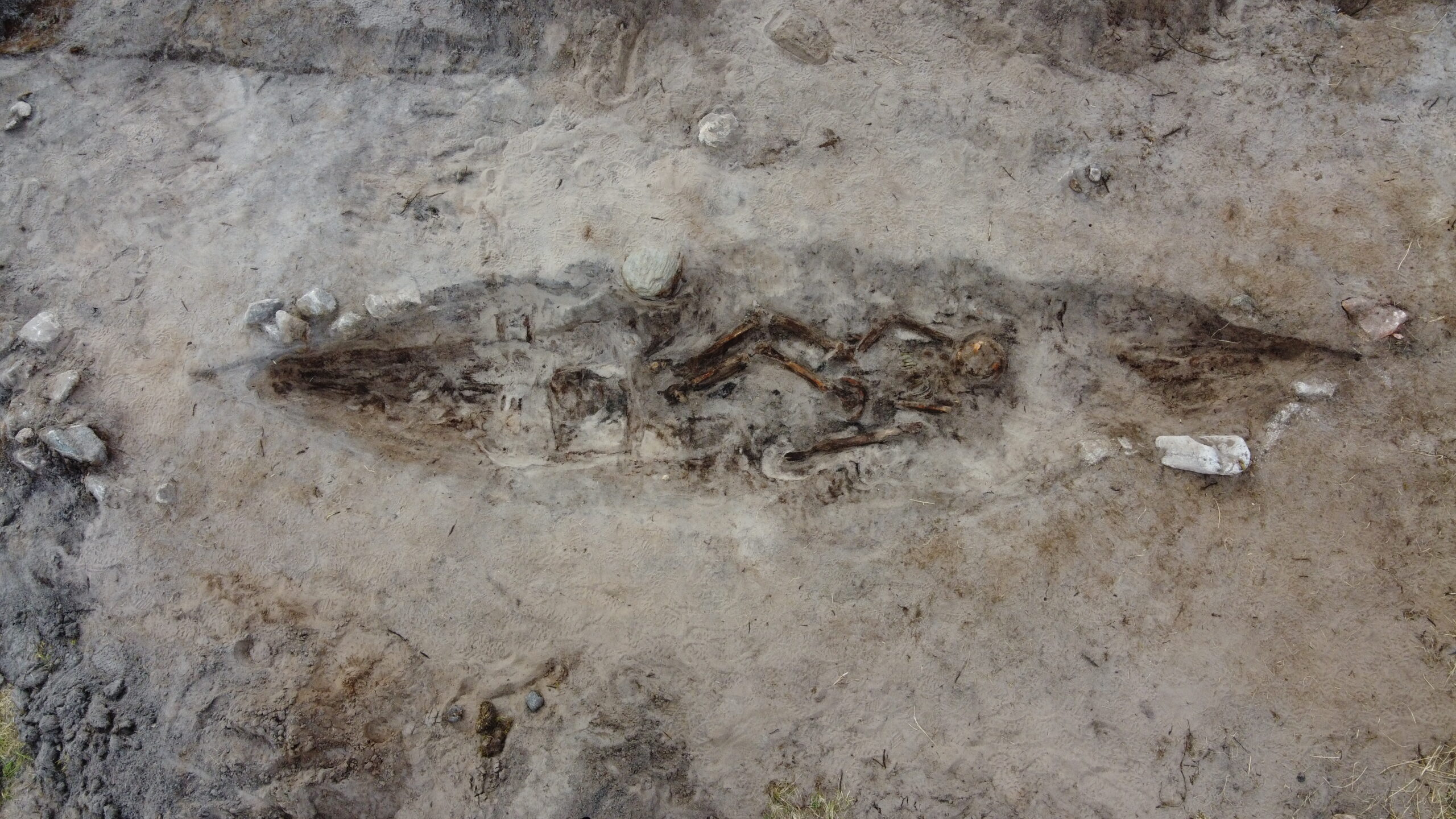
Photo courtesy The Arctic University of Norway
Excavations carried out in 2025 by the Arctic University Museum of Norway revealed that the artefacts came from a boat burial. The grave contained the skeleton of a woman placed inside a boat measuring about 5.5 metres in length. She had been buried together with a dog, suggesting the animal may have been an important companion in life.
Several objects had been placed in the grave alongside her. Archaeologists found tools and implements including a weaving sword, a handrail, a whetstone and a sickle. The woman also wore costume decorations , including disc-shaped beads made of bone or amber. In her hair or headdress was a ring with two glass beads attached.
Boat burials are among the most distinctive burial traditions of the Viking Age, but examples with preserved skeletons and associated animals remain relatively uncommon. The discovery provides valuable evidence about social status, burial customs and everyday activities in northern Norway during the early medieval period.
Ice patch reveals early hunting equipment
Found in Aurland – Photo: University Museum of Bergen
Another notable discovery came from the mountains of western Norway. On Aurlandsfjellet, a high mountain plateau in Vestland county between the fjords and the inland valleys, artefacts began emerging from an ice patch as the ice melted.
The objects were first spotted in the autumn of 2024 by a hiker named Helge Titland. Among the items were worked wooden pieces that had been preserved by the ice for centuries. Radiocarbon dating later showed that one of the wooden pieces dates to around the year 500, which Norwegian historians refer to as the Migration Period.
Archaeologists returned to the site in 2025 to investigate the find more closely. Their work uncovered several hundred worked wooden pieces, large quantities of antler fragments, two spearheads, three fragments of bows, three arrow shafts and a bone dress pin.
One particularly surprising discovery was a decorated piece of antler featuring intricate ornamentation. Because the ice had preserved the artefacts so well, they are expected to provide valuable evidence for scientific studies of early hunting practices in Norway’s mountains.
Unusual burial objects puzzle archaeologists
Early medieval burial – photo: Raymond Sauvage, NTNU Science Museum
Excavations in central Norway also uncovered an unusual burial that is raising new questions about early medieval funerary practices. The discovery was made at the Val farm in Ørland, a coastal district in Trøndelag about 60 kilometres west of the city of Trondheim. Metal detectorist Roy Søreng located artefacts in the area that suggested graves might lie beneath the field.
Archaeologists from the NTNU Science Museum carried out an excavation together with Trøndelag County Council and uncovered two well-preserved burials. One grave belonged to a man from the eighth century who had been buried with a sword, knife and whetstone. Nearby was the grave of a woman from the ninth century who had been buried with costume jewellery and a sickle.
What puzzled archaeologists most, however, was the presence of two scallop shells placed carefully on either side of the woman’s face. The unusual arrangement may offer new insights into burial customs along Norway’s outer coast during the early medieval period.
Researchers hope that further analysis, including osteological and DNA studies, will reveal more about the individuals buried there and their relationships to the surrounding community.
Discoveries supported by heritage funding
These finds are among the most notable archaeological discoveries highlighted in Norway from 2025. Many of the excavations and investigations were supported through funding from the Norwegian Agency for Cultural Heritage, which awarded 43 million kroner ($4.5 million US) in grants for archaeological cultural heritage projects during the year.
The programme supports a wide range of archaeological work, including field investigations, excavations linked to construction or agriculture, and projects designed to document and share Norway’s archaeological heritage with the public.
“Archaeological cultural heritage is incredibly important, regardless of whether they are visible on the ground surface today or not,” says Hanna Geiran, Norway’s National Heritage Commissioner. “Many of the discoveries made in 2025 are very interesting and have contributed to important new knowledge about the country’s history far back in time.”
Top Image: Woman with pet in grave -photo: Arctic University Museum of Norway

A Viking-Age grave containing a woman buried with her dog has been identified as one of the most intriguing archaeological discoveries in Norway from 2025. Other top finds include 1,500-year-old hunting equipment and other graves dating from the early medieval period.
The discovery was made near the village of Sand on Senja, an island located in Troms in northern Norway, roughly 1,200 kilometres north of Oslo. In 2023, two metal detectorists searching farmland in the area uncovered several artefacts, including a pair of bowl-shaped brooches that date to the Viking Age, along with fragments of human bone. After the discovery was reported to local authorities, archaeologists returned to investigate the site.
Excavations carried out in 2025 by the Arctic University Museum of Norway revealed that the artefacts came from a boat burial. The grave contained the skeleton of a woman placed inside a boat measuring about 5.5 metres in length. She had been buried together with a dog, suggesting the animal may have been an important companion in life.
Several objects had been placed in the grave alongside her. Archaeologists found tools and implements including a weaving sword, a handrail, a whetstone and a sickle. The woman also wore costume decorations , including disc-shaped beads made of bone or amber. In her hair or headdress was a ring with two glass beads attached.
Boat burials are among the most distinctive burial traditions of the Viking Age, but examples with preserved skeletons and associated animals remain relatively uncommon. The discovery provides valuable evidence about social status, burial customs and everyday activities in northern Norway during the early medieval period.
Ice patch reveals early hunting equipment
Another notable discovery came from the mountains of western Norway. On Aurlandsfjellet, a high mountain plateau in Vestland county between the fjords and the inland valleys, artefacts began emerging from an ice patch as the ice melted.
The objects were first spotted in the autumn of 2024 by a hiker named Helge Titland. Among the items were worked wooden pieces that had been preserved by the ice for centuries. Radiocarbon dating later showed that one of the wooden pieces dates to around the year 500, which Norwegian historians refer to as the Migration Period.
Archaeologists returned to the site in 2025 to investigate the find more closely. Their work uncovered several hundred worked wooden pieces, large quantities of antler fragments, two spearheads, three fragments of bows, three arrow shafts and a bone dress pin.
One particularly surprising discovery was a decorated piece of antler featuring intricate ornamentation. Because the ice had preserved the artefacts so well, they are expected to provide valuable evidence for scientific studies of early hunting practices in Norway’s mountains.
Unusual burial objects puzzle archaeologists
Excavations in central Norway also uncovered an unusual burial that is raising new questions about early medieval funerary practices. The discovery was made at the Val farm in Ørland, a coastal district in Trøndelag about 60 kilometres west of the city of Trondheim. Metal detectorist Roy Søreng located artefacts in the area that suggested graves might lie beneath the field.
Archaeologists from the NTNU Science Museum carried out an excavation together with Trøndelag County Council and uncovered two well-preserved burials. One grave belonged to a man from the eighth century who had been buried with a sword, knife and whetstone. Nearby was the grave of a woman from the ninth century who had been buried with costume jewellery and a sickle.
What puzzled archaeologists most, however, was the presence of two scallop shells placed carefully on either side of the woman’s face. The unusual arrangement may offer new insights into burial customs along Norway’s outer coast during the early medieval period.
Researchers hope that further analysis, including osteological and DNA studies, will reveal more about the individuals buried there and their relationships to the surrounding community.
Discoveries supported by heritage funding
These finds are among the most notable archaeological discoveries highlighted in Norway from 2025. Many of the excavations and investigations were supported through funding from the Norwegian Agency for Cultural Heritage, which awarded 43 million kroner ($4.5 million US) in grants for archaeological cultural heritage projects during the year.
The programme supports a wide range of archaeological work, including field investigations, excavations linked to construction or agriculture, and projects designed to document and share Norway’s archaeological heritage with the public.
“Archaeological cultural heritage is incredibly important, regardless of whether they are visible on the ground surface today or not,” says Hanna Geiran, Norway’s National Heritage Commissioner. “Many of the discoveries made in 2025 are very interesting and have contributed to important new knowledge about the country’s history far back in time.”
Top Image: Woman with pet in grave -photo: Arctic University Museum of Norway
Subscribe to Medievalverse
Related Posts