Two bronze doors created by Donatello in the fifteenth century have returned to their original setting in Florence following an extensive restoration project. The Door of the Martyrs and the Door of the Apostles, dating to around 1440–1442, were presented to the public last month in the Old Sacristy of the Basilica of San Lorenzo.
Commissioned by the Medici family, the two doors represent one of the most innovative examples of Donatello’s sculptural work during his mature artistic career. Each door consists of two panels cast using the lost-wax technique, a sophisticated method that allowed artists to produce detailed bronze reliefs.
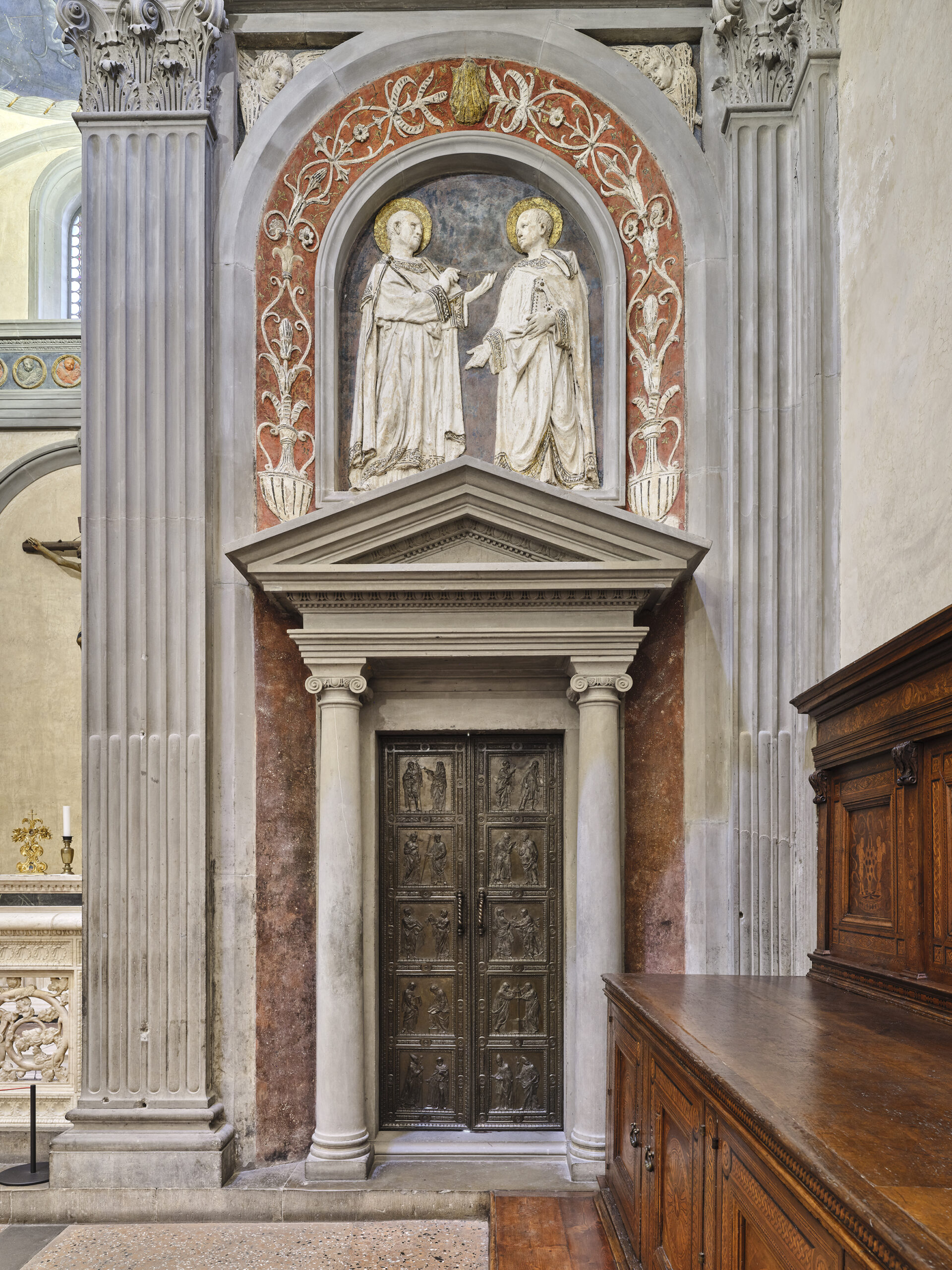
Door of the Martyrs at San Lorenzo – photo courtesy Opificio delle Pietre Dure
The panels are arranged as large relief compositions framed within an architectural structure. Ionic columns support an entablature topped with a triangular pediment, creating the impression of miniature sculptural altarpieces. Each door contains five large compartments depicting pairs of saints.
Some of the figures have been identified with certainty. The Door of the Martyrs includes saints such as Stephen, Lawrence, Cosmas and Damian, protectors of the Medici family. The latter two saints were especially important to the dynasty and frequently appeared in Medici artistic commissions. The Door of the Apostles includes figures such as John the Baptist, along with the Evangelists and the Fathers of the Church.
Detail from Door of the Martyrs at San Lorenzo – photo courtesy Opificio delle Pietre Dure
Decorative friezes filled with rosettes frame the sculpted panels, while the doors are fitted with later handles designed in the form of intertwined cords.
Scientific Study of the Doors
Researchers examining the Door of the Apostles – photo courtesy Opificio delle Pietre Dure
Before conservation work began, researchers carried out a detailed scientific investigation of the doors. Specialists from the Opificio delle Pietre Dure conducted a range of analyses, including 3D scanning and diagnostic studies designed to better understand both the condition of the bronze and the techniques used by Donatello.
These investigations revealed several technical features of the doors. Each panel appears to have been cast as a single piece, an impressive technical achievement given their size. The bronze panels are about 4–5 centimetres thick, with the upper portions slightly thicker to help the doors rotate on their hinges.
The analysis also showed how Donatello carefully refined the surfaces after casting. The backgrounds of the reliefs were polished to create a smooth finish, while the garments and hair of the saints were treated with delicate punchwork to produce subtle effects of light and shadow.
Cleaning and Conservation
Detail from Door of the Apostles at San Lorenzo – photo courtesy Opificio delle Pietre Dure
Over the centuries, the bronze surfaces accumulated thick deposits of waxes, oils and other materials from previous maintenance treatments. These deposits dulled the sharpness of the sculptural details and created discolouration, particularly near the bottom of the doors where corrosion products had developed.
Conservators began the restoration with careful dust removal and steam cleaning, followed by the use of solvent mixtures to remove the waxy residues. One of the more advanced techniques used during the project was cryogenic blasting, which uses small pellets of ice propelled by compressed air to gently clean delicate surfaces without damaging the underlying bronze.
Detail from Door of the Apostles at San Lorenzo – photo courtesy Opificio delle Pietre Dure
The backs of the doors were cleaned more cautiously to preserve traces of earlier patinas and residues left from the original casting process. Finally, the bronze surfaces were protected with microcrystalline wax coatings, helping to safeguard the doors from future deterioration.
The restoration was carried out by the Opificio delle Pietre Dure, a Florence-based institute of the Italian Ministry of Culture that is widely regarded as one of the world’s leading centres for the conservation and restoration of artworks. Work on the Door of the Apostles was supported by Friends of Florence through a donation from Michael and Sandy Collins.
The restored doors now stand once again in the Old Sacristy of San Lorenzo, allowing visitors to see one of the most remarkable examples of Renaissance bronze sculpture in the setting for which it was originally created.
Top Image: Door of the Apostles at San Lorenzo – photo courtesy Opificio delle Pietre Dure

Two bronze doors created by Donatello in the fifteenth century have returned to their original setting in Florence following an extensive restoration project. The Door of the Martyrs and the Door of the Apostles, dating to around 1440–1442, were presented to the public last month in the Old Sacristy of the Basilica of San Lorenzo.
Commissioned by the Medici family, the two doors represent one of the most innovative examples of Donatello’s sculptural work during his mature artistic career. Each door consists of two panels cast using the lost-wax technique, a sophisticated method that allowed artists to produce detailed bronze reliefs.
The panels are arranged as large relief compositions framed within an architectural structure. Ionic columns support an entablature topped with a triangular pediment, creating the impression of miniature sculptural altarpieces. Each door contains five large compartments depicting pairs of saints.
Some of the figures have been identified with certainty. The Door of the Martyrs includes saints such as Stephen, Lawrence, Cosmas and Damian, protectors of the Medici family. The latter two saints were especially important to the dynasty and frequently appeared in Medici artistic commissions. The Door of the Apostles includes figures such as John the Baptist, along with the Evangelists and the Fathers of the Church.
Decorative friezes filled with rosettes frame the sculpted panels, while the doors are fitted with later handles designed in the form of intertwined cords.
Scientific Study of the Doors
Before conservation work began, researchers carried out a detailed scientific investigation of the doors. Specialists from the Opificio delle Pietre Dure conducted a range of analyses, including 3D scanning and diagnostic studies designed to better understand both the condition of the bronze and the techniques used by Donatello.
These investigations revealed several technical features of the doors. Each panel appears to have been cast as a single piece, an impressive technical achievement given their size. The bronze panels are about 4–5 centimetres thick, with the upper portions slightly thicker to help the doors rotate on their hinges.
The analysis also showed how Donatello carefully refined the surfaces after casting. The backgrounds of the reliefs were polished to create a smooth finish, while the garments and hair of the saints were treated with delicate punchwork to produce subtle effects of light and shadow.
Cleaning and Conservation
Over the centuries, the bronze surfaces accumulated thick deposits of waxes, oils and other materials from previous maintenance treatments. These deposits dulled the sharpness of the sculptural details and created discolouration, particularly near the bottom of the doors where corrosion products had developed.
Conservators began the restoration with careful dust removal and steam cleaning, followed by the use of solvent mixtures to remove the waxy residues. One of the more advanced techniques used during the project was cryogenic blasting, which uses small pellets of ice propelled by compressed air to gently clean delicate surfaces without damaging the underlying bronze.
The backs of the doors were cleaned more cautiously to preserve traces of earlier patinas and residues left from the original casting process. Finally, the bronze surfaces were protected with microcrystalline wax coatings, helping to safeguard the doors from future deterioration.
The restoration was carried out by the Opificio delle Pietre Dure, a Florence-based institute of the Italian Ministry of Culture that is widely regarded as one of the world’s leading centres for the conservation and restoration of artworks. Work on the Door of the Apostles was supported by Friends of Florence through a donation from Michael and Sandy Collins.
The restored doors now stand once again in the Old Sacristy of San Lorenzo, allowing visitors to see one of the most remarkable examples of Renaissance bronze sculpture in the setting for which it was originally created.
Top Image: Door of the Apostles at San Lorenzo – photo courtesy Opificio delle Pietre Dure
Subscribe to Medievalverse
Related Posts