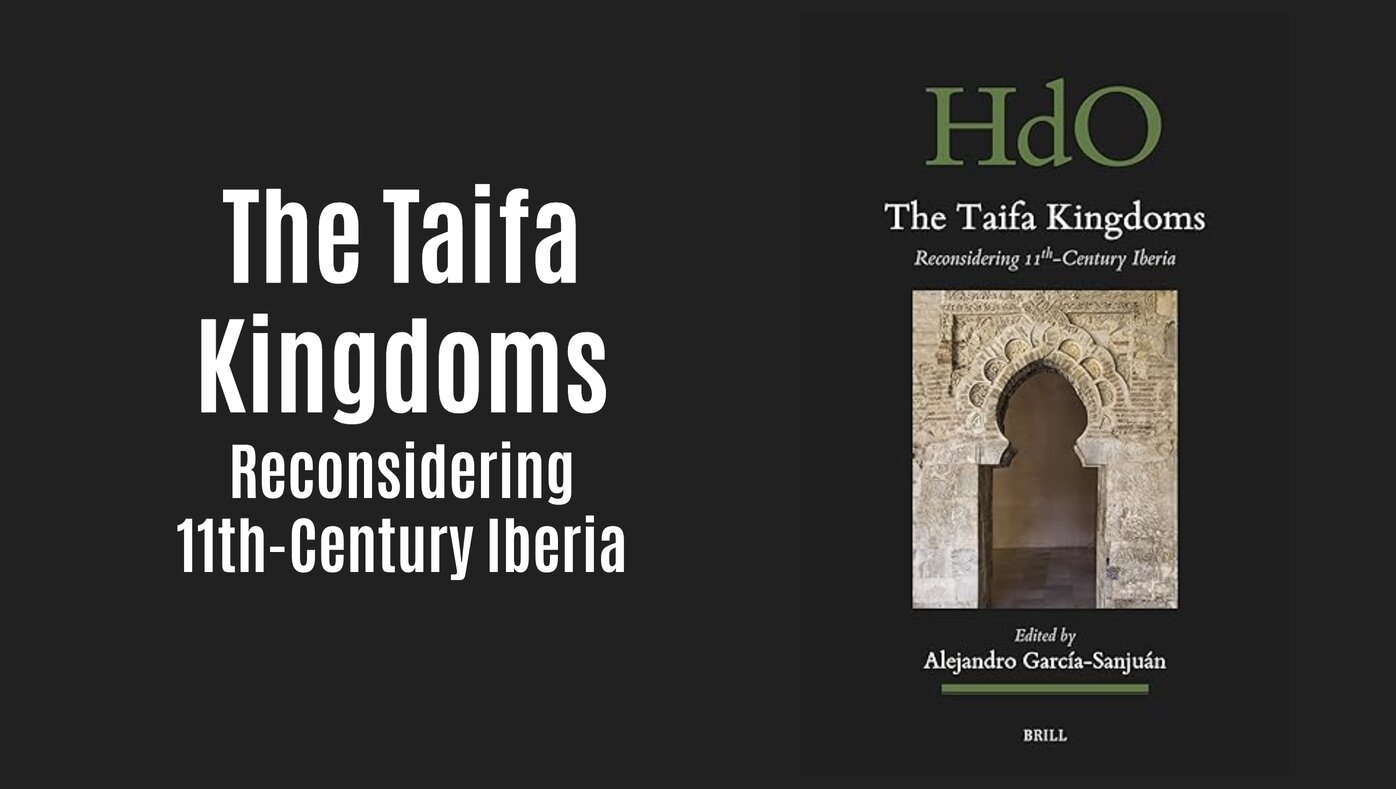
The Taifa Kingdoms: Reconsidering 11th-Century Iberia
Edited by Alejandro García-Sanjuán
Brill
ISBN: 978-90-04-73548-4
Iberia in the eleventh century fractured into dozens of rival states, triggering decades of warfare and political upheaval. Bringing together 23 papers, this volume offers the most comprehensive account of the taifa era and its wider impact.
Excerpt:
Al-Andalus can be fairly described as an Arab and Islamic country in Iberia eventually wiped out due to the conquering expansion of the Northern feudal kingdoms. Although the Muslims suffered some significant territorial setbacks over the eighth and ninth centuries (Narbonne, Pamplona, Girona, Barcelona), the limits between the Islamic territory and the “land of the infidels” remained quite stable until the early eleventh century, so that the long historical process leading to the end of al-Andalus in 1492 began in the 1060s, during the period of the so-called “taifa kingdoms.” Muslim power peaked during the tenth century, but the end of the Umayyad caliphate in 422/1031 gave way to a new context marked by a balance of forces that eventually broke out with the great leap forward of the Northern Christians in the thirteenth century.
Who is this book for?
There are very few books that focus squarely on the taifa period, so a study this thorough is especially welcome. Historians of al-Andalus, Spain, and Portugal will want it on their shelves, while general historians will find it a valuable case study in what happens when a powerful state splinters apart.
The volume is impressively comprehensive. Its first part maps the political landscape that emerged after the caliphate’s collapse, and the eleven essays here are necessarily dense, given the sheer number of states and competing forces in play. The second half shifts to a more thematic approach, with chapters ranging from architecture to inter-religious relations. The final three articles examine the main sources for studying the taifa period—written texts, coinage, and epigraphy—and, for many readers, they may actually be the best place to begin.
Alejandro Garcia-Sanjuan is Professor of Medieval History at the University of Huelva. His main field of research is Medieval Iberia, with a special focus on al-Andalus.

The Taifa Kingdoms: Reconsidering 11th-Century Iberia
Edited by Alejandro García-Sanjuán
Brill
ISBN: 978-90-04-73548-4
Iberia in the eleventh century fractured into dozens of rival states, triggering decades of warfare and political upheaval. Bringing together 23 papers, this volume offers the most comprehensive account of the taifa era and its wider impact.
Excerpt:
Al-Andalus can be fairly described as an Arab and Islamic country in Iberia eventually wiped out due to the conquering expansion of the Northern feudal kingdoms. Although the Muslims suffered some significant territorial setbacks over the eighth and ninth centuries (Narbonne, Pamplona, Girona, Barcelona), the limits between the Islamic territory and the “land of the infidels” remained quite stable until the early eleventh century, so that the long historical process leading to the end of al-Andalus in 1492 began in the 1060s, during the period of the so-called “taifa kingdoms.” Muslim power peaked during the tenth century, but the end of the Umayyad caliphate in 422/1031 gave way to a new context marked by a balance of forces that eventually broke out with the great leap forward of the Northern Christians in the thirteenth century.
Who is this book for?
There are very few books that focus squarely on the taifa period, so a study this thorough is especially welcome. Historians of al-Andalus, Spain, and Portugal will want it on their shelves, while general historians will find it a valuable case study in what happens when a powerful state splinters apart.
The volume is impressively comprehensive. Its first part maps the political landscape that emerged after the caliphate’s collapse, and the eleven essays here are necessarily dense, given the sheer number of states and competing forces in play. The second half shifts to a more thematic approach, with chapters ranging from architecture to inter-religious relations. The final three articles examine the main sources for studying the taifa period—written texts, coinage, and epigraphy—and, for many readers, they may actually be the best place to begin.
You can read the preliminary material here.
The Editor
Alejandro Garcia-Sanjuan is Professor of Medieval History at the University of Huelva. His main field of research is Medieval Iberia, with a special focus on al-Andalus.
You can learn more about this book from the publisher’s website.
You can buy this book on Amazon.com | Amazon.ca | Amazon.co.uk
Subscribe to Medievalverse
Related Posts