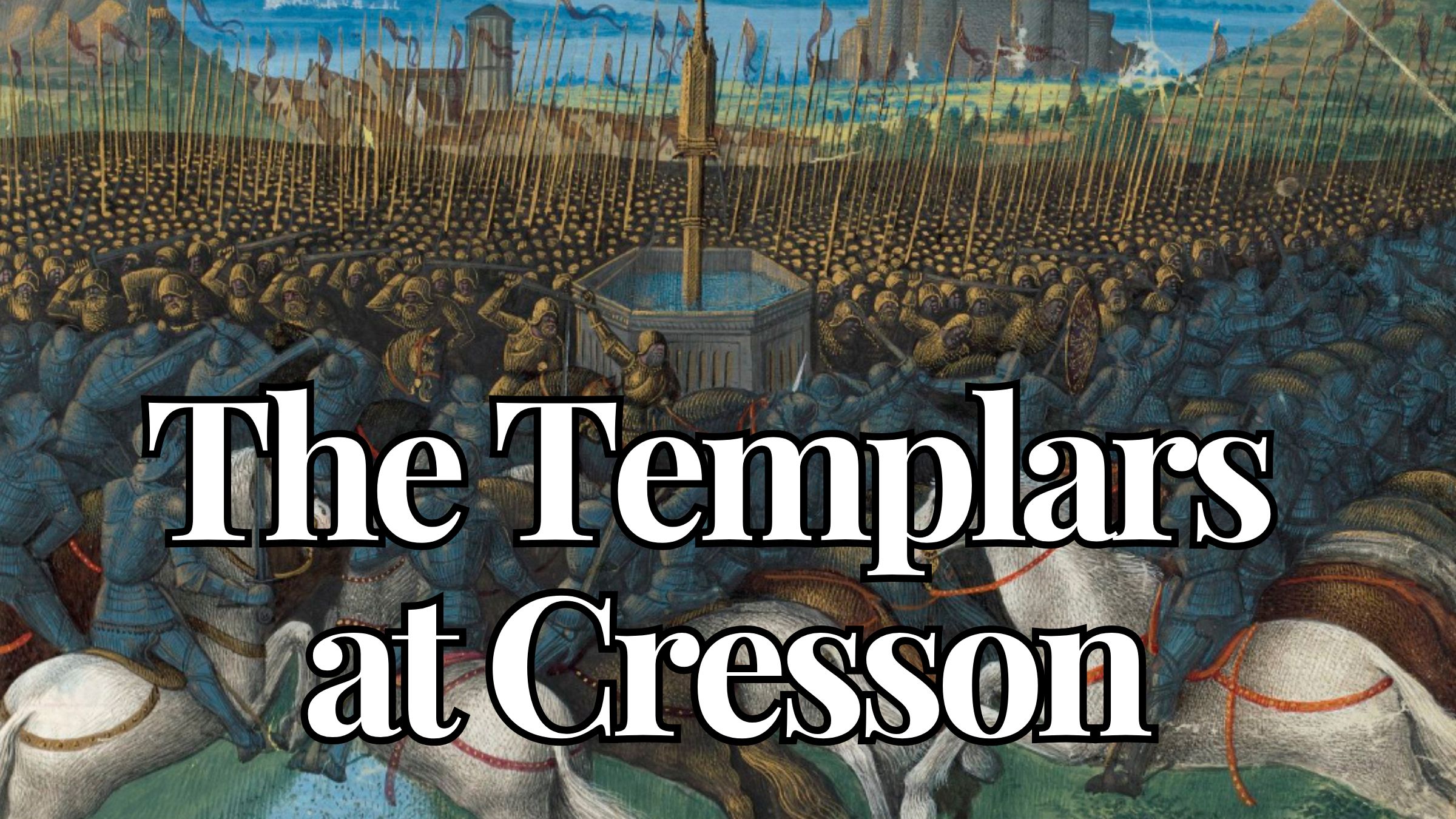
In May 1187, a small force of Templar knights charged headlong into overwhelming Muslim cavalry at the Springs of Cresson and were almost completely destroyed. The battle became more than a military disaster—it revealed a mindset in which martyrdom itself could be claimed as victory.
By Steve Tibble
The Templars and the Assassins both hated Saladin. After much bloodshed, the Assassins had come to an understanding with the sultan. But there could be no such truce for the Templars.
In 1119, just as the Templar order was being born, another proto-military order, the elite ‘confraternity of St. Peter’, came to an abrupt end. The scene was a place known, in the endearingly brutal and literal way of the medieval world, as the Field of Blood – Ager Sanguinis. Like the Templars, they too were given the position of honour – the right of the line and the first into combat.
On the Field of Blood, one eyewitness wrote that the confraternity crashed into the Muslim lines to their front, ‘giving their horses their heads, brandishing their lances as they made haste to strike the cohort in their path violently and quickly’ and succeeding in putting them to flight.
But despite their initial success, the Frankish forces were hopelessly outnumbered and surrounded. Like the rest of the army of Antioch, the brave warriors of St. Peter died on the field a few minutes later, wiped out almost to the last man.
Catastrophe at Cresson
The Battle of Cresson, miniature by Jean Colombe, in Passages d’outremer ca. 1474
Almost seventy years later, in May 1187, a similar bloodbath took place, but this time at the Springs of the Cresson, in the Latin Kingdom of Jerusalem. The horror played out on a smaller scale but was, for the Templars, every bit as dramatic. It was a crucible of bloodshed and a drama which came to embody the Templar ideology.
At the Springs of the Cresson, a predominantly Templar cavalry force, unsupported by infantry, crashed into a Muslim raiding party of perhaps some 6,000 or 7,000 cavalry. There were only 140 Christian knights on the field, of whom 90 were Templars, led by their master, Gerard of Ridefort, and taken from the order’s castles at nearby La Fève and Caco.
As they gathered to attack, we are told that ‘the knights of Christ rejoiced, saying: “the Lord has delivered them into our hands.” And when they came near to the enemy, the latter pretended flight, until those who had been hiding in ambush rose up and surrounded them, and “they smote them with the edge of the sword”.’
The results of the absurdly one-sided battle were catastrophic but predictable. It was a massacre. The heads of the Templars killed in the battle, together with those of the executed prisoners, were stuck on lances and paraded on the way back to Damascus. In a time and place where bloodshed was commonplace, this encounter was recognised as being something different. Even the Muslim chronicler Ibn al-Athir, a man used to writing about the brutality of warfare, knew that it was ‘a battle fit to turn black hair grey’.
It was a shocking defeat. But it was also a sublime moment when theology and military theory collided – a heady melting pot where the spiritual planes collided with the material world in the most violent manner.
Blood and Glory – ‘Christ is our life and death is our reward’
Templar cross in Cour de la Commanderie, La Rochelle. Photo by World Imaging / Wikimedia Commons
Strangely enough to modern sensibilities, the actions of the Templar brothers that day were felt to be a triumph – a vivid and glorious embodiment of the order’s ideology. Descriptions of the battle make clear that the martyrdom of the individual, as well as the destruction of the squadron as a whole, was felt to be admirable despite the disastrous outcome of the battle.
Only three men escaped the carnage, all of them Templars. The stories they told of the defeat served to emphasise the nature of Templar martyrdom and the way in which they believed, like the Assassins, that they could achieve victory even in death.
The prodigious bravery of one Templar knight, James of Mailly, was singled out by the survivors. A near contemporary account of his bravery, and martyrdom, is worth quoting at length, as it is a visceral display of how a brother knight would want to be remembered:
A certain Templar – a knight by profession, of Touraine by nation, [James] de Mailly by name – brought all the enemy assault on himself through his outstanding courage. While the rest of his fellow knights…had either been captured or killed, he bore all the force of the battle alone and shone out as a glorious champion for the law of his God. He was surrounded by enemy troops and almost abandoned by human aid, but when he saw so many thousands running towards him from all directions he strengthened his resolve and courageously undertook the battle, one man against all.
‘His commendable courage,’ wrote the chronicler, ‘won him his enemies’ approval. Many were sorry for him and affectionately urged him to surrender, but he ignored their urgings, for he was not afraid to die for Christ. At long last, crushed rather than conquered by spears, stones and lances, he sank to the ground and joyfully passed to heaven with the martyr’s crown, triumphant.’
For such a man, the Templars believed, death was just a beginning – despite the horrific violence, his personal last stand was characterised as ‘a gentle death with no place for sorrow, when one man’s sword had constructed such a great crown for himself from the crowd laid all around him.’ Comparisons with the saints of the Christian cause soon followed. It was said that because he had been riding ‘a white horse and had white armour and weapons, the Gentiles, who knew that Saint George had this appearance in battle, boasted that they had killed the Knight of Shining Armour, the protector of the Christians.’
Saints need relics and rituals as well as stories and, inevitably, these too quickly followed. ‘It is said,’ wrote one chronicler, ‘that there were some who sprinkled the body of the dead man with dust and placed the dust on their heads, believing that they would draw courage from the contact.’
Even his genitals had power. Their masculine strength was believed (with typical male optimism) to be capable of entirely unfeasible potency. One particularly devout Christian was said to have ‘cut off the man’s genitals, and kept them safely for begetting children so that even when dead the man’s members – if such a thing were possible – would produce an heir with courage as great as his.’
Grim but devout tales such as this tell us much about what constituted an ‘ideal’ Templar. James of Mailly was subsequently revered as a martyr and his story seems to have been designed to act, at least in part, as a motivational tool for the brothers in their moments of reflection. James is portrayed as being astonishingly brave, fully committed to the cause of his religion and his order, and explicitly associated with George, the warrior saint.
James made, or so it was said, a conscious decision to fight on against the enemies of Christ rather than retreat, and he embraced death rather than surrender. He was venerated for embodying the highest ambitions of the fighting Templar.
Interestingly, the almost spiritual nature of a Templar cavalry charge was widely recognised, even beyond the order. A letter written back to Europe, just a few weeks later in July 1187, stated that once the brother knights at Cresson realised just how outnumbered they were, they immediately made ‘the sign of the cross, and with the words, “Christ is our life and death is our reward”, they launched an attack.’
People knew that Cresson was different. The charge of the Templar knights at Mont Gisard was brave and full of risk. They were outnumbered but they had, literally, a fighting chance of success. The battle at the Springs of the Cresson, almost exactly ten years later, reveals a very different side of the order. Militarily, the Templar decision to charge a clearly overwhelming number of enemy cavalry makes very little sense. At best one might see it as an act of desperation. At worst, an obviously crazy mistake borne out of arrogance and overconfidence.
The Ideology of Victory in Death and Defeat
But in ideological terms one can see how it could happen. These were men who knew that Saint Bernard had exhorted them as warriors of Christ who ‘are mindful of the words of Maccabees, “It is simple enough for a multitude to be vanquished by a handful…victory in war does not depend on a big army, but bravery is the gift from heaven.”’
Even more to the point, Bernard had declared that ‘as they have on numerous occasions experienced, one man may pursue a thousand, and two put ten thousand to flight.’ This was all too easy to write in the quiet beauty of a French monastery, of course. But with an ideological heritage such as this, an almost incomprehensible catastrophe such as the battle of Cresson becomes far more explicable.
Where others would have seen a bloody defeat (and a foolishly unnecessary one at that), the Templars lingered over the details. This was a brutal conflict in which the brother knights were not only subjected to what they saw as martyrdom, but were also active agents in the process. They willingly embraced Saint Bernard’s maxims of martyrdom in doing so.
Despite the gory humiliation of its material outcome, Cresson was cherished as an occasion in which the order grasped spiritual victory through martyrdom – the binary, glorious moment when the knights could show the Christian world their true commitment. The battle was one of the ideological turning points for the order. The brothers could follow Christ’s example in the humiliation of death and, like him, rise all the stronger from the ashes of failure.
But Cresson was just the beginning. The Templars’ bloodletting continued on an unprecedented scale. In a few weeks they would face their greatest challenge – Hattin.
Steve Tibble, an honorary research associate at Royal Holloway, University of London, has a new book out – Assassins and Templars: A Battle in Myth and Blood – from Yale University Press. It tells the true history behind the hugely popular video game Assassin’s Creed and the medieval world’s two most extraordinary organisations, tracing their origins, strategies, violent clashes, and enduring legacy in myth and memory.
You can get your copy of Assassins and Templars: A Battle in Myth and Blood through

In May 1187, a small force of Templar knights charged headlong into overwhelming Muslim cavalry at the Springs of Cresson and were almost completely destroyed. The battle became more than a military disaster—it revealed a mindset in which martyrdom itself could be claimed as victory.
By Steve Tibble
The Templars and the Assassins both hated Saladin. After much bloodshed, the Assassins had come to an understanding with the sultan. But there could be no such truce for the Templars.
In 1119, just as the Templar order was being born, another proto-military order, the elite ‘confraternity of St. Peter’, came to an abrupt end. The scene was a place known, in the endearingly brutal and literal way of the medieval world, as the Field of Blood – Ager Sanguinis. Like the Templars, they too were given the position of honour – the right of the line and the first into combat.
On the Field of Blood, one eyewitness wrote that the confraternity crashed into the Muslim lines to their front, ‘giving their horses their heads, brandishing their lances as they made haste to strike the cohort in their path violently and quickly’ and succeeding in putting them to flight.
But despite their initial success, the Frankish forces were hopelessly outnumbered and surrounded. Like the rest of the army of Antioch, the brave warriors of St. Peter died on the field a few minutes later, wiped out almost to the last man.
Catastrophe at Cresson
Almost seventy years later, in May 1187, a similar bloodbath took place, but this time at the Springs of the Cresson, in the Latin Kingdom of Jerusalem. The horror played out on a smaller scale but was, for the Templars, every bit as dramatic. It was a crucible of bloodshed and a drama which came to embody the Templar ideology.
At the Springs of the Cresson, a predominantly Templar cavalry force, unsupported by infantry, crashed into a Muslim raiding party of perhaps some 6,000 or 7,000 cavalry. There were only 140 Christian knights on the field, of whom 90 were Templars, led by their master, Gerard of Ridefort, and taken from the order’s castles at nearby La Fève and Caco.
As they gathered to attack, we are told that ‘the knights of Christ rejoiced, saying: “the Lord has delivered them into our hands.” And when they came near to the enemy, the latter pretended flight, until those who had been hiding in ambush rose up and surrounded them, and “they smote them with the edge of the sword”.’
The results of the absurdly one-sided battle were catastrophic but predictable. It was a massacre. The heads of the Templars killed in the battle, together with those of the executed prisoners, were stuck on lances and paraded on the way back to Damascus. In a time and place where bloodshed was commonplace, this encounter was recognised as being something different. Even the Muslim chronicler Ibn al-Athir, a man used to writing about the brutality of warfare, knew that it was ‘a battle fit to turn black hair grey’.
It was a shocking defeat. But it was also a sublime moment when theology and military theory collided – a heady melting pot where the spiritual planes collided with the material world in the most violent manner.
Blood and Glory – ‘Christ is our life and death is our reward’
Strangely enough to modern sensibilities, the actions of the Templar brothers that day were felt to be a triumph – a vivid and glorious embodiment of the order’s ideology. Descriptions of the battle make clear that the martyrdom of the individual, as well as the destruction of the squadron as a whole, was felt to be admirable despite the disastrous outcome of the battle.
Only three men escaped the carnage, all of them Templars. The stories they told of the defeat served to emphasise the nature of Templar martyrdom and the way in which they believed, like the Assassins, that they could achieve victory even in death.
The prodigious bravery of one Templar knight, James of Mailly, was singled out by the survivors. A near contemporary account of his bravery, and martyrdom, is worth quoting at length, as it is a visceral display of how a brother knight would want to be remembered:
A certain Templar – a knight by profession, of Touraine by nation, [James] de Mailly by name – brought all the enemy assault on himself through his outstanding courage. While the rest of his fellow knights…had either been captured or killed, he bore all the force of the battle alone and shone out as a glorious champion for the law of his God. He was surrounded by enemy troops and almost abandoned by human aid, but when he saw so many thousands running towards him from all directions he strengthened his resolve and courageously undertook the battle, one man against all.
‘His commendable courage,’ wrote the chronicler, ‘won him his enemies’ approval. Many were sorry for him and affectionately urged him to surrender, but he ignored their urgings, for he was not afraid to die for Christ. At long last, crushed rather than conquered by spears, stones and lances, he sank to the ground and joyfully passed to heaven with the martyr’s crown, triumphant.’
For such a man, the Templars believed, death was just a beginning – despite the horrific violence, his personal last stand was characterised as ‘a gentle death with no place for sorrow, when one man’s sword had constructed such a great crown for himself from the crowd laid all around him.’ Comparisons with the saints of the Christian cause soon followed. It was said that because he had been riding ‘a white horse and had white armour and weapons, the Gentiles, who knew that Saint George had this appearance in battle, boasted that they had killed the Knight of Shining Armour, the protector of the Christians.’
Saints need relics and rituals as well as stories and, inevitably, these too quickly followed. ‘It is said,’ wrote one chronicler, ‘that there were some who sprinkled the body of the dead man with dust and placed the dust on their heads, believing that they would draw courage from the contact.’
Even his genitals had power. Their masculine strength was believed (with typical male optimism) to be capable of entirely unfeasible potency. One particularly devout Christian was said to have ‘cut off the man’s genitals, and kept them safely for begetting children so that even when dead the man’s members – if such a thing were possible – would produce an heir with courage as great as his.’
Grim but devout tales such as this tell us much about what constituted an ‘ideal’ Templar. James of Mailly was subsequently revered as a martyr and his story seems to have been designed to act, at least in part, as a motivational tool for the brothers in their moments of reflection. James is portrayed as being astonishingly brave, fully committed to the cause of his religion and his order, and explicitly associated with George, the warrior saint.
James made, or so it was said, a conscious decision to fight on against the enemies of Christ rather than retreat, and he embraced death rather than surrender. He was venerated for embodying the highest ambitions of the fighting Templar.
Interestingly, the almost spiritual nature of a Templar cavalry charge was widely recognised, even beyond the order. A letter written back to Europe, just a few weeks later in July 1187, stated that once the brother knights at Cresson realised just how outnumbered they were, they immediately made ‘the sign of the cross, and with the words, “Christ is our life and death is our reward”, they launched an attack.’
People knew that Cresson was different. The charge of the Templar knights at Mont Gisard was brave and full of risk. They were outnumbered but they had, literally, a fighting chance of success. The battle at the Springs of the Cresson, almost exactly ten years later, reveals a very different side of the order. Militarily, the Templar decision to charge a clearly overwhelming number of enemy cavalry makes very little sense. At best one might see it as an act of desperation. At worst, an obviously crazy mistake borne out of arrogance and overconfidence.
The Ideology of Victory in Death and Defeat
But in ideological terms one can see how it could happen. These were men who knew that Saint Bernard had exhorted them as warriors of Christ who ‘are mindful of the words of Maccabees, “It is simple enough for a multitude to be vanquished by a handful…victory in war does not depend on a big army, but bravery is the gift from heaven.”’
Even more to the point, Bernard had declared that ‘as they have on numerous occasions experienced, one man may pursue a thousand, and two put ten thousand to flight.’ This was all too easy to write in the quiet beauty of a French monastery, of course. But with an ideological heritage such as this, an almost incomprehensible catastrophe such as the battle of Cresson becomes far more explicable.
Where others would have seen a bloody defeat (and a foolishly unnecessary one at that), the Templars lingered over the details. This was a brutal conflict in which the brother knights were not only subjected to what they saw as martyrdom, but were also active agents in the process. They willingly embraced Saint Bernard’s maxims of martyrdom in doing so.
Despite the gory humiliation of its material outcome, Cresson was cherished as an occasion in which the order grasped spiritual victory through martyrdom – the binary, glorious moment when the knights could show the Christian world their true commitment. The battle was one of the ideological turning points for the order. The brothers could follow Christ’s example in the humiliation of death and, like him, rise all the stronger from the ashes of failure.
But Cresson was just the beginning. The Templars’ bloodletting continued on an unprecedented scale. In a few weeks they would face their greatest challenge – Hattin.
You can get your copy of Assassins and Templars: A Battle in Myth and Blood through
Yale University Press website
Amazon.com
Amazon.ca
Amazon.co.uk
To learn more about Steve, please visit his website or follow him on Instagram
Subscribe to Medievalverse
Related Posts