Archaeologists working beside the ruins of Selja Monastery — a major medieval pilgrimage site on the island of Selja, off Norway’s western coast — have uncovered the remains of a previously undocumented stone structure just metres from the monastic complex. The discovery, made within the first days of a new research excavation, could add a fresh chapter to what scholars know about daily life and activity on the island during the monastic period.
Regin Meyer and Dag-Øyvind Engtrø Solem of the Norwegian Institute for Cultural Heritage Research (NIKU) are carrying out a targeted excavation at Selja’s monastery and pilgrimage landscape. After only two days in the field, they encountered masonry and flagstone flooring belonging to a stone building that has not been recorded in earlier documentation of the site.
“This is a ruin we haven’t seen before, and it’s located just 30 meters from the monastery. The construction suggests it dates to the High Middle Ages,” says Regin Meyer.
In the Norwegian context, the High Middle Ages are generally dated to about 1130–1350 — a period when ecclesiastical institutions expanded, religious travel increased, and monastic communities became more embedded in regional economies and networks.
A familiar site — with new surprises
Regin Meyer (right) knows the ruins of Selja well and is excited to add yet another building to the monastery and pilgrimage complex. He and Dag-Øyvind Engtrø Solem are currently working in front of the monastery. Photo: NIKU
Selja has attracted archaeological attention for more than two centuries. The island’s medieval remains are well known: the monastery ruins, the former bishop’s seat, and the broader pilgrimage setting connected with the cult of St. Sunniva. Yet the new building suggests there are still substantial gaps in what has been mapped and understood about how the monastic complex functioned as a lived-in, worked-in landscape rather than a single monumental ruin.
“This discovery provides an important new contribution to Selja’s history and highlights the island’s continued research potential,” Meyer adds.
Regin Meyer is a building archaeologist with extensive experience at Selja. In earlier work at the site, he identified remains interpreted as an Anglo-Saxon stone church within the ruins of St. Sunniva’s Church — possibly among Norway’s earliest stone buildings.
Radar hints, trenches confirm
Several trenches are being opened. In this one, archaeologists discovered the remains of a previously unknown building. It was visible in the ground-penetrating radar results from 2021 and 2022. Photo: NIKU.
The current excavation follows ground-penetrating radar (GPR) surveys carried out by NIKU in 2021 and 2022. Those surveys detected subsurface anomalies that were interpreted as potential archaeological structures. The team has now opened trenches north and west of the monastery to investigate what the radar signals might represent on the ground.
The immediate research aims are straightforward but crucial: to establish how the building was constructed, to retrieve samples suitable for dating, and to begin assessing what purpose the structure served within the monastic landscape.
“So far, we’ve uncovered two rooms, but the building continues beneath the turf,” says Meyer. “Our hypothesis is that it may have been a production or craft-related structure connected to the monastery’s daily operations.”
If that hypothesis holds up, it could shift attention toward the practical infrastructure that kept a monastic community running — the kinds of spaces that often receive less public attention than churches, cloisters, and shrine sites, but which were essential to food production, repairs, storage, and skilled work.
What comes next
In 2021 and 2022, NIKU conducted ground-penetrating radar surveys that led them to the newly discovered ruin. Photo: NIKU
Excavation is set to continue in the days ahead, and the team expects that further traces may emerge — not only from the medieval period but potentially from earlier phases of activity on Selja as well.
Selja is located in Stad Municipality in Vestland county (the Nordfjord region) on Norway’s western seaboard, a short boat trip from the mainland near the village of Selje. NIKU has previously collaborated with Stad Municipality on the preservation and public presentation of Selja’s medieval ruins, and that relationship continues as new finds reshape the questions researchers can ask about the site and its wider landscape.
And as this latest discovery shows, even in a place investigated for generations, the medieval ground can still produce something genuinely unexpected.
Top Image: Drone photo: Dag-Øyvind Engtrø Solem, NIKU.

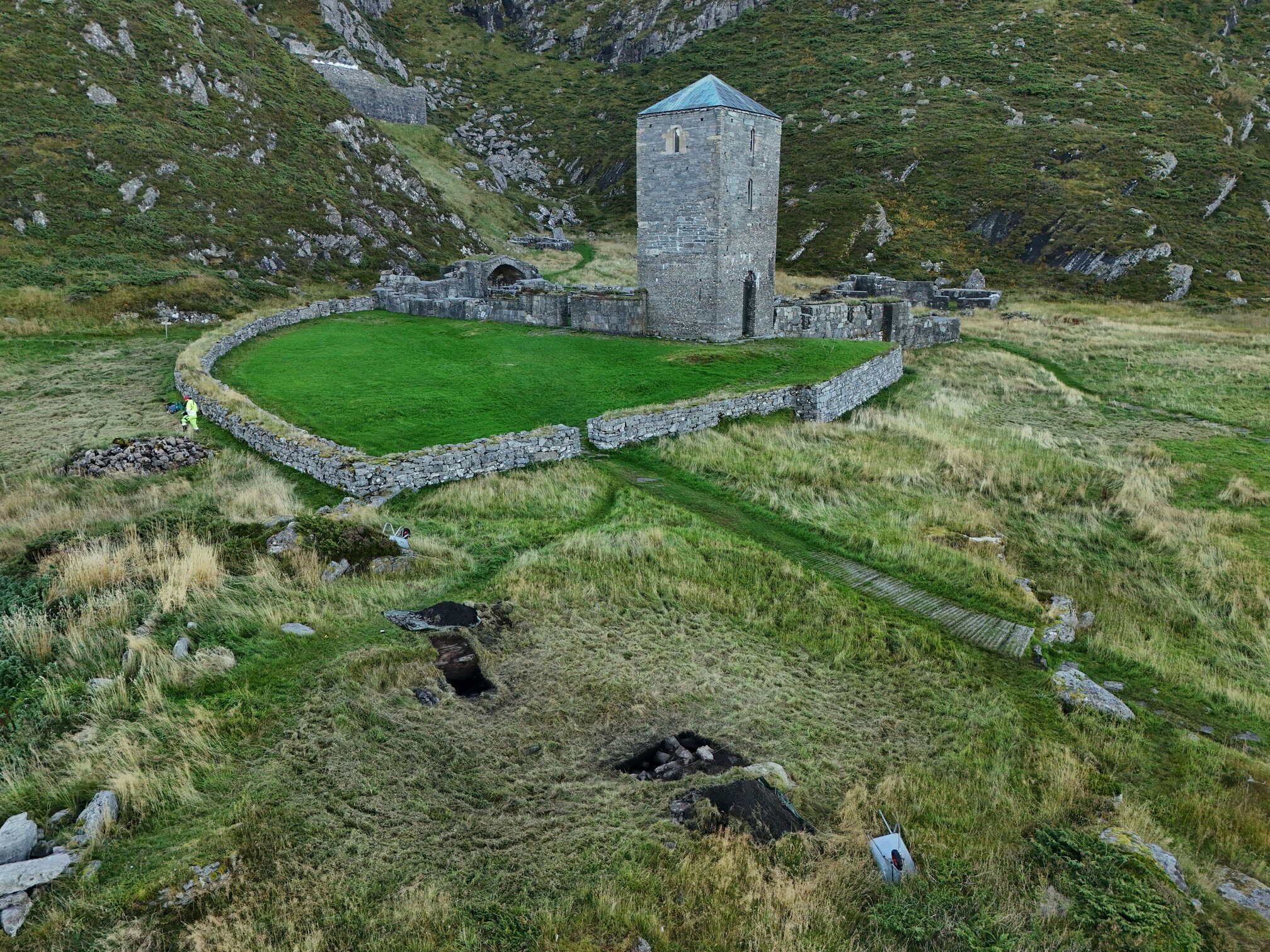
Archaeologists working beside the ruins of Selja Monastery — a major medieval pilgrimage site on the island of Selja, off Norway’s western coast — have uncovered the remains of a previously undocumented stone structure just metres from the monastic complex. The discovery, made within the first days of a new research excavation, could add a fresh chapter to what scholars know about daily life and activity on the island during the monastic period.
Regin Meyer and Dag-Øyvind Engtrø Solem of the Norwegian Institute for Cultural Heritage Research (NIKU) are carrying out a targeted excavation at Selja’s monastery and pilgrimage landscape. After only two days in the field, they encountered masonry and flagstone flooring belonging to a stone building that has not been recorded in earlier documentation of the site.
“This is a ruin we haven’t seen before, and it’s located just 30 meters from the monastery. The construction suggests it dates to the High Middle Ages,” says Regin Meyer.
In the Norwegian context, the High Middle Ages are generally dated to about 1130–1350 — a period when ecclesiastical institutions expanded, religious travel increased, and monastic communities became more embedded in regional economies and networks.
A familiar site — with new surprises
Selja has attracted archaeological attention for more than two centuries. The island’s medieval remains are well known: the monastery ruins, the former bishop’s seat, and the broader pilgrimage setting connected with the cult of St. Sunniva. Yet the new building suggests there are still substantial gaps in what has been mapped and understood about how the monastic complex functioned as a lived-in, worked-in landscape rather than a single monumental ruin.
“This discovery provides an important new contribution to Selja’s history and highlights the island’s continued research potential,” Meyer adds.
Regin Meyer is a building archaeologist with extensive experience at Selja. In earlier work at the site, he identified remains interpreted as an Anglo-Saxon stone church within the ruins of St. Sunniva’s Church — possibly among Norway’s earliest stone buildings.
Radar hints, trenches confirm
The current excavation follows ground-penetrating radar (GPR) surveys carried out by NIKU in 2021 and 2022. Those surveys detected subsurface anomalies that were interpreted as potential archaeological structures. The team has now opened trenches north and west of the monastery to investigate what the radar signals might represent on the ground.
The immediate research aims are straightforward but crucial: to establish how the building was constructed, to retrieve samples suitable for dating, and to begin assessing what purpose the structure served within the monastic landscape.
“So far, we’ve uncovered two rooms, but the building continues beneath the turf,” says Meyer. “Our hypothesis is that it may have been a production or craft-related structure connected to the monastery’s daily operations.”
If that hypothesis holds up, it could shift attention toward the practical infrastructure that kept a monastic community running — the kinds of spaces that often receive less public attention than churches, cloisters, and shrine sites, but which were essential to food production, repairs, storage, and skilled work.
What comes next
Excavation is set to continue in the days ahead, and the team expects that further traces may emerge — not only from the medieval period but potentially from earlier phases of activity on Selja as well.
Selja is located in Stad Municipality in Vestland county (the Nordfjord region) on Norway’s western seaboard, a short boat trip from the mainland near the village of Selje. NIKU has previously collaborated with Stad Municipality on the preservation and public presentation of Selja’s medieval ruins, and that relationship continues as new finds reshape the questions researchers can ask about the site and its wider landscape.
And as this latest discovery shows, even in a place investigated for generations, the medieval ground can still produce something genuinely unexpected.
Top Image: Drone photo: Dag-Øyvind Engtrø Solem, NIKU.
Subscribe to Medievalverse
Related Posts