Near-Death Folklore in Medieval China and Japan : A Comparative Analysis
James McClenon
Asian Folklore Studies, Volume 50 (1991)
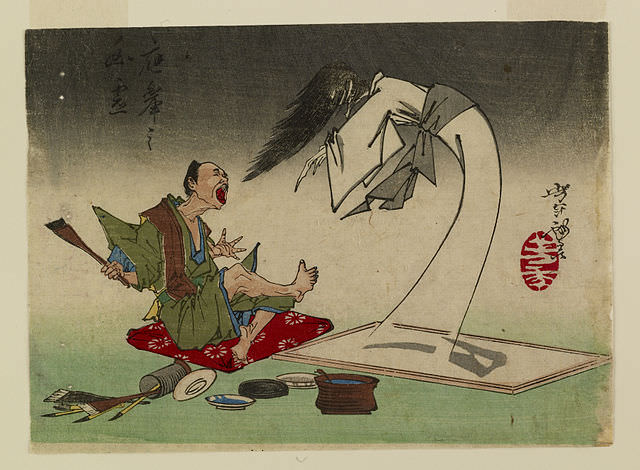
Yoshitoshi ryakuga by Tsukioka Yoshitoshi (1882)
Abstract: Western researchers have found common elements within modern near-death experiences (NDEs). Equivalent primary features exist in medieval European and Asian folklore accounts. These elements, which seemingly transcend culture, support belief in spiritual guides, immediate judgement by a deity follow in death, and transitional stages within the netherworld. Commonalities within NDE accounts may have contributed to cross-cultural convergences within religious ideologies.
Introduction: Medieval Chinese and Japanese literature provides numerous examples of near-death experiences, episodes in which the narrator claims to have gained personal images of the afterlife.1 Within this motif, individuals die, come close to death, or reach an equivalent meditative state, and later revive to describe their experiences. Modern near-death experience (NDE) researchers claim that cross-culturally uniform features exist within these reports. Could common elements inherent within NDEs contribute to a degree of cross-cultural agreement regarding the nature of heavens and hells? Although the evidence is not fully conclusive, an investigation of NDE accounts in medieval Europe, China, and Japan suggests that these episodes have the capacity to produce such convergences.
Sociologists of religion generally assume that religious ideologies are shaped by cultural needs. Durkheim’s formulations have established a dominant paradigm within religious studies; investigators explain belief systems through demonstrating social functions. When this orientation is applied to anomalous experiences, Hufford refers to it as the “ cultural source ” theory, since the researcher assumes that all anomalous experiences are products, in totality, of the narrator’s culture. Hufford argues that this supposition is allied with academic “ traditions of disbelief” that have distorted theorizing regarding anomalous experience. Because the cultural source hypothesis coincides so closely with the ethic of scientific skepticism regarding the supernatural, scholars frequently depart from normal academic standards, relying on a priori reasoning regarding what is “real” and ‘‘possible”.

Near-Death Folklore in Medieval China and Japan : A Comparative Analysis
James McClenon
Asian Folklore Studies, Volume 50 (1991)
Abstract: Western researchers have found common elements within modern near-death experiences (NDEs). Equivalent primary features exist in medieval European and Asian folklore accounts. These elements, which seemingly transcend culture, support belief in spiritual guides, immediate judgement by a deity follow in death, and transitional stages within the netherworld. Commonalities within NDE accounts may have contributed to cross-cultural convergences within religious ideologies.
Introduction: Medieval Chinese and Japanese literature provides numerous examples of near-death experiences, episodes in which the narrator claims to have gained personal images of the afterlife.1 Within this motif, individuals die, come close to death, or reach an equivalent meditative state, and later revive to describe their experiences. Modern near-death experience (NDE) researchers claim that cross-culturally uniform features exist within these reports. Could common elements inherent within NDEs contribute to a degree of cross-cultural agreement regarding the nature of heavens and hells? Although the evidence is not fully conclusive, an investigation of NDE accounts in medieval Europe, China, and Japan suggests that these episodes have the capacity to produce such convergences.
Sociologists of religion generally assume that religious ideologies are shaped by cultural needs. Durkheim’s formulations have established a dominant paradigm within religious studies; investigators explain belief systems through demonstrating social functions. When this orientation is applied to anomalous experiences, Hufford refers to it as the “ cultural source ” theory, since the researcher assumes that all anomalous experiences are products, in totality, of the narrator’s culture. Hufford argues that this supposition is allied with academic “ traditions of disbelief” that have distorted theorizing regarding anomalous experience. Because the cultural source hypothesis coincides so closely with the ethic of scientific skepticism regarding the supernatural, scholars frequently depart from normal academic standards, relying on a priori reasoning regarding what is “real” and ‘‘possible”.
Click here to read this article from Asian Folklore Studies
Click here to read this article from the Nanzan Institute for Religion and Culture
Subscribe to Medievalverse
Related Posts