Debating Lordly Landscapes: the Deer Park of Earlspark Loughrea, Co. Galway
Session: New Directions in Castle Research
By Fiona Beglane IT Sligo and NUI Galway
Paper given at the 45th International Congress on Medieval Studies (2010)
This paper explored the Medieval Peer Park and its social meaning in medieval Ireland and England.
There are 91 townlands called Deerpark in Ireland, but many are probably post-medieval. There are around 20 references to parks in Medieval Ireland. In England, there were up to 3,200 parks. They had a wide bank, internal ditch, wooden palings (or a wall), 30 – 4,300 acres and came in a variety of shapes. Most gentry owned parks around the 1,000 acre mark, as hunting was a very vital and important part of medieval aristocratic life.
Loughrea was founded in 1236 by Richard de Burgh, and was the caput of the holdings. In 1236, a castle and town was built at Loughrea. The castle is now part of a modern supermarket! In 1333, an inquisition into the lands of William de Burgh showed he held a park of 840 acres.
Townland boundary wall – the boundary wall is well preserved. It is a 7.4km long, 0.9m thick mortared stone wall and up to 2.6m high. Medieval cattle were smaller than today’s cattle so there was no need for a high enclosure above 1.6m (5′4″) to retain cattle, and even by modern standards for cattle, the wall would not need to be made that high. The townland boundary is a single construction and the height of the wall suggests it was used for a deer park. The wall was constructed between 1236 – 1333; mortar dating will be done to confirm these dates. Maps and historical evidence suggest that the park was obsolete prior to 1585. Walls were used to demarcate property boundaries, as barriers to restrict movement or to prevent people from seeing something beyond it, thus giving the perception of privacy. The wall took approximately 30 man-years to build., 31,450 tonnes of stone and it is highly visible from Loughrea.
The symbolism behind owning a deer park was that it was an essential feature of lordship. The deer park placed the de Burgh’s as part of the aristocratic elite. Deer parks were expensive to build and to maintain. The de Burgh’s were one of the most powerful famillies in Ireland – they were related to several Kings. The sheer size and scope of the deer park firmly set them in the upper echelons of the aristocratic elite and symbol of their lordly status in the 14th century. Changes to the nature of the de Burgh lordship made the park obsolete as the Anglo-Norman symbols were no longer in use.
Animals in the park included red deer, fallow deer, rabbits, and there were fish ponds (in England).

Debating Lordly Landscapes: the Deer Park of Earlspark Loughrea, Co. Galway
Session: New Directions in Castle Research
By Fiona Beglane IT Sligo and NUI Galway
Paper given at the 45th International Congress on Medieval Studies (2010)
This paper explored the Medieval Peer Park and its social meaning in medieval Ireland and England.
There are 91 townlands called Deerpark in Ireland, but many are probably post-medieval. There are around 20 references to parks in Medieval Ireland. In England, there were up to 3,200 parks. They had a wide bank, internal ditch, wooden palings (or a wall), 30 – 4,300 acres and came in a variety of shapes. Most gentry owned parks around the 1,000 acre mark, as hunting was a very vital and important part of medieval aristocratic life.
Loughrea was founded in 1236 by Richard de Burgh, and was the caput of the holdings. In 1236, a castle and town was built at Loughrea. The castle is now part of a modern supermarket!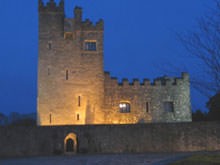 In 1333, an inquisition into the lands of William de Burgh showed he held a park of 840 acres.
Townland boundary wall – the boundary wall is well preserved. It is a 7.4km long, 0.9m thick mortared stone wall and up to 2.6m high. Medieval cattle were smaller than today’s cattle so there was no need for a high enclosure above 1.6m (5′4″) to retain cattle, and even by modern standards for cattle, the wall would not need to be made that high. The townland boundary is a single construction and the height of the wall suggests it was used for a deer park. The wall was constructed between 1236 – 1333; mortar dating will be done to confirm these dates. Maps and historical evidence suggest that the park was obsolete prior to 1585. Walls were used to demarcate property boundaries, as barriers to restrict movement or to prevent people from seeing something beyond it, thus giving the perception of privacy. The wall took approximately 30 man-years to build., 31,450 tonnes of stone and it is highly visible from Loughrea.
The symbolism behind owning a deer park was that it was an essential feature of lordship. The deer park placed the de Burgh’s as part of the aristocratic elite. Deer parks were expensive to build and to maintain. The de Burgh’s were one of the most powerful famillies in Ireland – they were related to several Kings. The sheer size and scope of the deer park firmly set them in the upper echelons of the aristocratic elite and symbol of their lordly status in the 14th century. Changes to the nature of the de Burgh lordship made the park obsolete as the Anglo-Norman symbols were no longer in use.
Animals in the park included red deer, fallow deer, rabbits, and there were fish ponds (in England).
Subscribe to Medievalverse
Related Posts