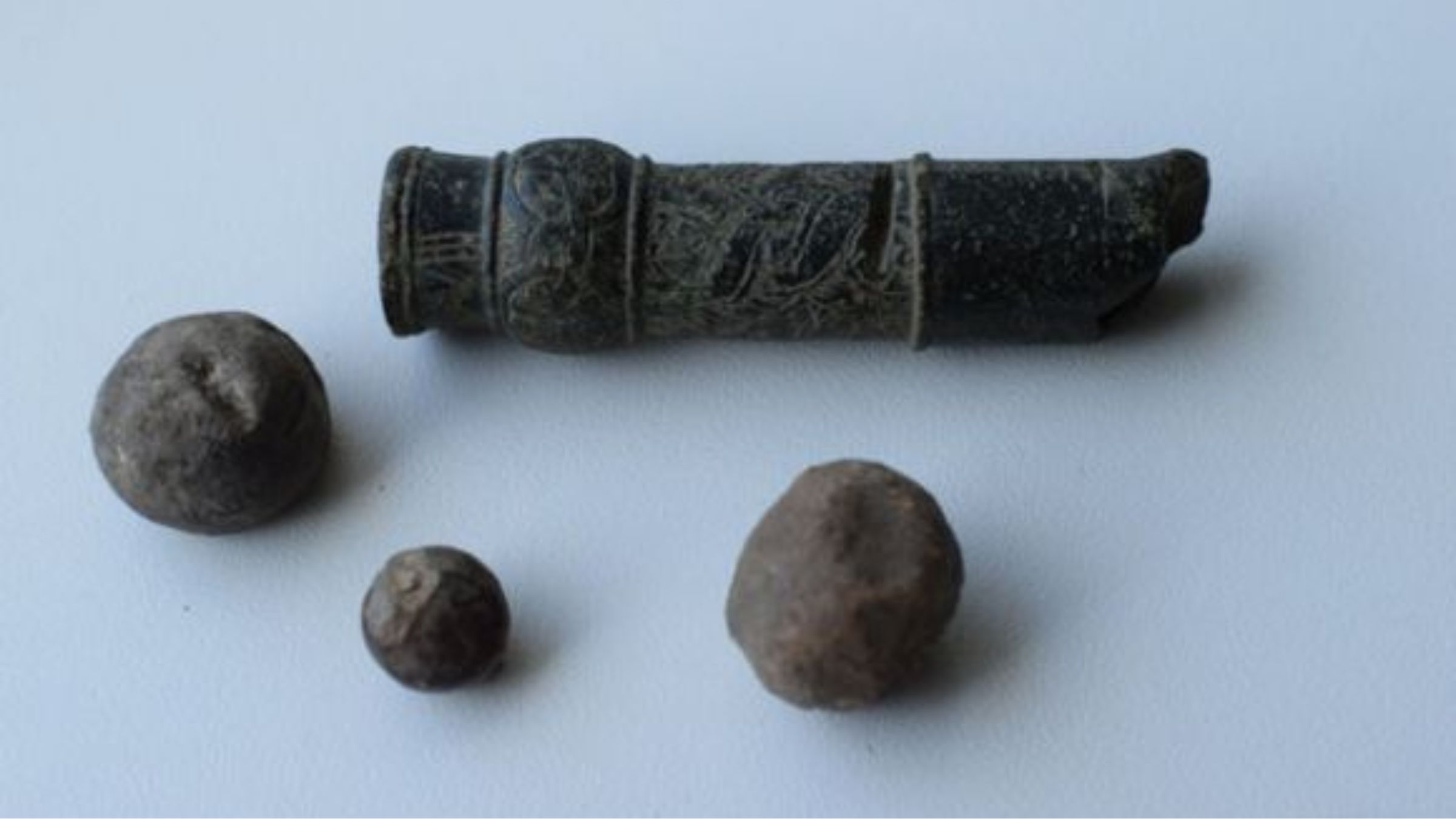
A small bronze fragment discovered in northern Germany may represent one of the earliest pieces of portable firearm technology yet found in Europe. Archaeologists believe the artifact, known as the Kletzke Hand Cannon, could date to around 1390—potentially making it older than the famous Tannenberg handgonne and one of the earliest known hand-held firearms.
The artifact was presented to specialists last month at the annual conference of the State Archaeology Department in Brandenburg an der Havel. Measuring about six centimetres in length and decorated with ornamental details, the fragment appears to be the front portion of a medieval hand cannon.
The piece was discovered in 2023 during a systematic field survey carried out by the Lower Monument Protection Authority of Prignitz. Matthias Dasse, a volunteer archaeological conservator, found the object during the survey. After initial examination, Gordon Thalmann, head of the monument authority, identified the bronze casting as part of an early firearm.
What makes the discovery particularly notable is its possible date. The “Tannenberg handgonne”, held today at the Germanisches Nationalmuseum in Nuremberg and dated to 1399, is widely regarded as the oldest securely dated hand-held firearm in Europe. The Kletzke fragment, however, may be slightly earlier.
The Tannenberg handgonne is the oldest surviving firearm in the world that can be dated with certainty. Discovered in 1849 in the cistern of Burg Tannenberg in southern Hesse, it must predate the castle’s destruction in 1399, and when it was found, its flash pan still contained traces of gunpowder.
Based on current assessments, archaeologists believe the piece could date to around 1390. If confirmed, this would make it the earliest known archaeological evidence for the use of portable black-powder weapons in Germany.
Researchers believe the artifact may be connected to a specific historical event: the siege of Kletzke Castle in 1390. Written evidence for this conflict comes from the Franciscan monk Detmar of Lübeck, whose chronicle describes a campaign against the powerful von Quitzow family.
According to historical sources, an army led by Duke Henry I of Brunswick-Lüneburg and Duke Eric IV of Saxe-Lauenburg marched against the Quitzow family, who had been granted the Kletzke estate by Emperor Charles IV in 1375. The siege appears to have been part of broader efforts to curb the influence of the powerful regional lords.
Recent archaeological investigations at the site have begun to uncover evidence supporting the historical accounts. Excavations conducted in 2024 and 2025 by the Young Archaeologists Prignitz and researchers from HTW Berlin, under the direction of Professor Thomas Schenk, revealed numerous finds linked to military activity around the castle.
The possible connection between the newly discovered hand cannon fragment and the siege has attracted particular attention from historians and archaeologists studying the early spread of gunpowder weapons in Europe.
“If this gun dates back to the siege of 1390, it would be spectacular for Brandenburg,” says Christof Krauskopf of the Brandenburg State Office for Monument Preservation and the State Archaeological Museum (BLDAM). “From this period we have so far had no written or archaeological evidence for the use of firearms—we have only been able to assume their presence in general.”
Even if the object was used during the siege, researchers believe it may not have been manufactured locally. According to Krauskopf, the weapon was probably produced elsewhere and brought to the region by forces participating in the campaign.
The discovery highlights how rapidly gunpowder technology was spreading across Europe in the late fourteenth century. Early hand cannons were simple devices, typically made of bronze or iron and fired by applying a burning match to a touch hole. Despite their rudimentary design, they represented a major shift in medieval warfare, gradually transforming siege tactics and battlefield combat.
Further research on the Kletzke fragment is planned under the supervision of the Brandenburg State Office for Heritage Management and Archaeology. Specialists hope that additional analysis will clarify the weapon’s exact date, origins, and role in the events surrounding the siege.
Local authorities are also exploring ways to develop the Kletzke site for archaeological tourism in the future. By highlighting the region’s medieval history and the dramatic conflicts that shaped it, researchers hope to make this new discovery accessible to a wider public.
Top Image: Hand cannon fragment discovered in Kletzke in 2023. Image credit: Landkreis Prignitz

A small bronze fragment discovered in northern Germany may represent one of the earliest pieces of portable firearm technology yet found in Europe. Archaeologists believe the artifact, known as the Kletzke Hand Cannon, could date to around 1390—potentially making it older than the famous Tannenberg handgonne and one of the earliest known hand-held firearms.
The artifact was presented to specialists last month at the annual conference of the State Archaeology Department in Brandenburg an der Havel. Measuring about six centimetres in length and decorated with ornamental details, the fragment appears to be the front portion of a medieval hand cannon.
The piece was discovered in 2023 during a systematic field survey carried out by the Lower Monument Protection Authority of Prignitz. Matthias Dasse, a volunteer archaeological conservator, found the object during the survey. After initial examination, Gordon Thalmann, head of the monument authority, identified the bronze casting as part of an early firearm.
What makes the discovery particularly notable is its possible date. The “Tannenberg handgonne”, held today at the Germanisches Nationalmuseum in Nuremberg and dated to 1399, is widely regarded as the oldest securely dated hand-held firearm in Europe. The Kletzke fragment, however, may be slightly earlier.
Based on current assessments, archaeologists believe the piece could date to around 1390. If confirmed, this would make it the earliest known archaeological evidence for the use of portable black-powder weapons in Germany.
Researchers believe the artifact may be connected to a specific historical event: the siege of Kletzke Castle in 1390. Written evidence for this conflict comes from the Franciscan monk Detmar of Lübeck, whose chronicle describes a campaign against the powerful von Quitzow family.
According to historical sources, an army led by Duke Henry I of Brunswick-Lüneburg and Duke Eric IV of Saxe-Lauenburg marched against the Quitzow family, who had been granted the Kletzke estate by Emperor Charles IV in 1375. The siege appears to have been part of broader efforts to curb the influence of the powerful regional lords.
Recent archaeological investigations at the site have begun to uncover evidence supporting the historical accounts. Excavations conducted in 2024 and 2025 by the Young Archaeologists Prignitz and researchers from HTW Berlin, under the direction of Professor Thomas Schenk, revealed numerous finds linked to military activity around the castle.
The possible connection between the newly discovered hand cannon fragment and the siege has attracted particular attention from historians and archaeologists studying the early spread of gunpowder weapons in Europe.
“If this gun dates back to the siege of 1390, it would be spectacular for Brandenburg,” says Christof Krauskopf of the Brandenburg State Office for Monument Preservation and the State Archaeological Museum (BLDAM). “From this period we have so far had no written or archaeological evidence for the use of firearms—we have only been able to assume their presence in general.”
Even if the object was used during the siege, researchers believe it may not have been manufactured locally. According to Krauskopf, the weapon was probably produced elsewhere and brought to the region by forces participating in the campaign.
The discovery highlights how rapidly gunpowder technology was spreading across Europe in the late fourteenth century. Early hand cannons were simple devices, typically made of bronze or iron and fired by applying a burning match to a touch hole. Despite their rudimentary design, they represented a major shift in medieval warfare, gradually transforming siege tactics and battlefield combat.
Further research on the Kletzke fragment is planned under the supervision of the Brandenburg State Office for Heritage Management and Archaeology. Specialists hope that additional analysis will clarify the weapon’s exact date, origins, and role in the events surrounding the siege.
Local authorities are also exploring ways to develop the Kletzke site for archaeological tourism in the future. By highlighting the region’s medieval history and the dramatic conflicts that shaped it, researchers hope to make this new discovery accessible to a wider public.
Top Image: Hand cannon fragment discovered in Kletzke in 2023. Image credit: Landkreis Prignitz
Subscribe to Medievalverse
Related Posts