A new open-access book is revealing fresh details about Finlaggan on Islay, a site long linked to the Lords of the Isles. The study argues the loch’s islands were not just symbolic, but the working centre of a medieval kingdom within Scotland.
The Archaeology of Finlaggan, Islay brings together the results of a major archaeological project carried out between 1989 and 1998, followed by nearly 30 years of analysis. Issued by the Society of Antiquaries of Scotland, the book offers a comprehensive account of the excavations and the material uncovered at Finlaggan.
Written by archaeologist David Caldwell—who directed the project on behalf of National Museums Scotland—the volume presents evidence that Finlaggan served as the ceremonial, administrative, and judicial heart of the Lordship of the Isles, a quasi-independent power in the 14th and 15th centuries. It also reports the remains of a previously unknown and unnamed royal castle dating to the 12th and 13th centuries, suggesting the site’s importance stretched further back into the medieval period than previously recognised.
Finlaggan and the Lords of the Isles
Drone photograph of Finlaggan (Credit – Open Virtual Worlds at University of St Andrews www.openvirtualworlds.org)
Finlaggan sits on two small islands in Loch Finlaggan, which itself is on the island of Islay on Scotland’s west coast. It is a landscape that later tradition associated with the MacDonald Lords of the Isles—leaders who controlled the Hebrides and held power across Argyll and the earldom of Ross. In Gaelic they were known as ‘Ri Innse Gall’ (‘King of the Isles’), and historians have often described the lordship as a serious political force that, at times, rivalled the Stewart monarchy.
Yet the historical record for Finlaggan itself is thin. With no contemporary medieval documents which specifically identify it as a place of any importance, the archaeological evidence offers a new understanding.
What the archaeology adds
Remains of the castle at Finlaggan (Credit – Dr David Caldwell FSAScot)
Caldwell’s study brings together a wide range of evidence to argue that Finlaggan was a working centre of authority, not merely a place later tradition invested with meaning. The book points to objects such as mounts and keys from caskets thought to have held documents and valuables, alongside structural evidence tied to governance.
One of the most important features is the council house, known from a much later written description. The excavations uncovered remains consistent with the council house described in a 1549 account, where meetings of the Council of the Isles were said to have taken place.
The book also reconstructs how the site functioned physically. Finlaggan’s main island appears to have been approached by boat to a jetty, with cobbled paths leading to the principal buildings—among them a feasting hall, chapel, and private accommodation—and then to a causeway linking to the smaller island and its council chamber. Taken together, the layout and the buildings help explain why the loch’s islands were suited to formal gatherings and high-status ceremony.
In architectural terms, the volume details evidence for a palatial complex and an imposing great hall—features more often associated with royal castles and palaces—supporting the argument that the Lords of the Isles projected leadership with clear royal aspirations.
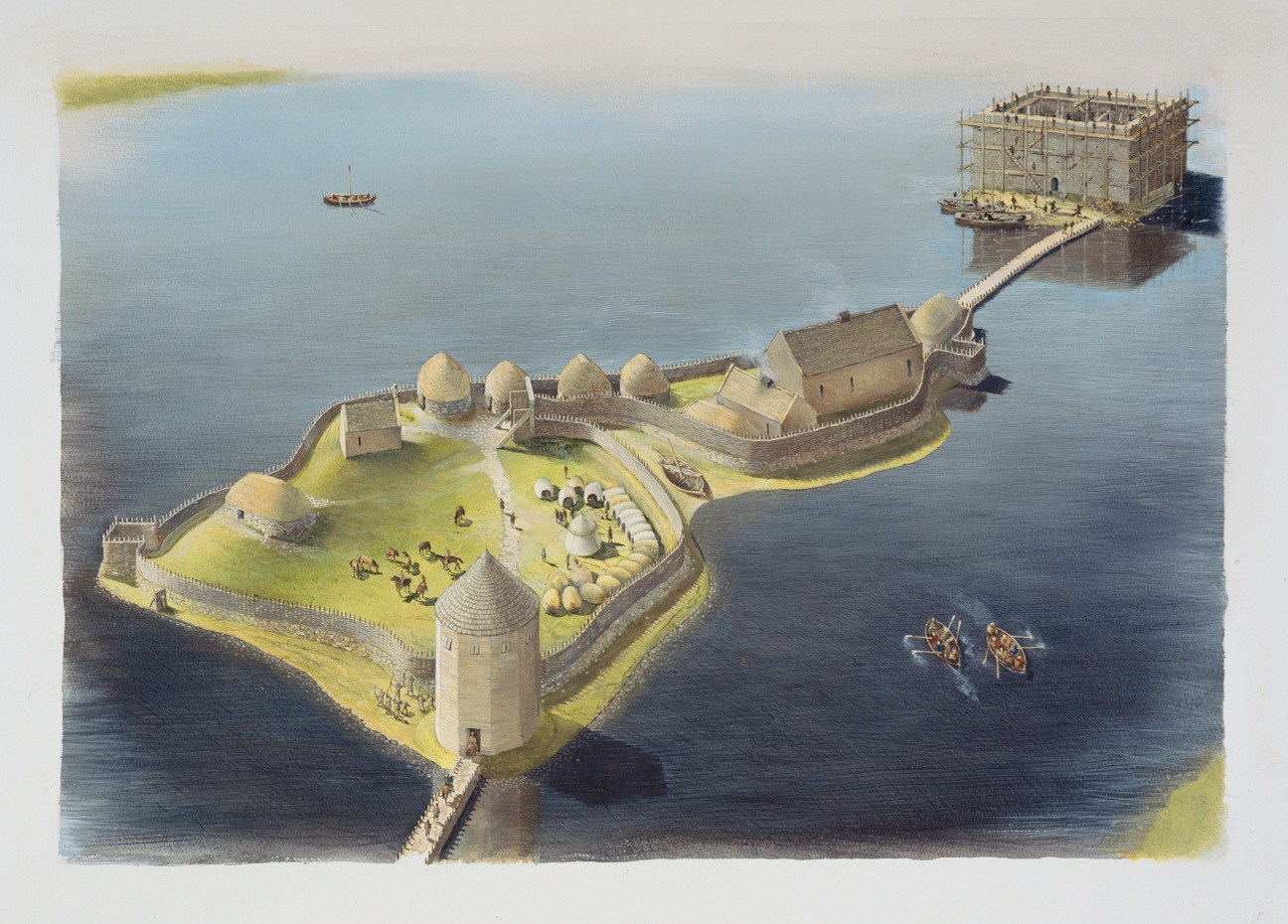
One of the book’s most striking conclusions is that Finlaggan’s importance did not begin in the 14th century. Caldwell presents evidence for a previously unknown and unnamed castle on the loch’s islands dating to the 12th and 13th centuries, indicating that Finlaggan was already a centre of power in an earlier medieval phase.
The archaeological interpretation suggests a complex spread across two islands. On one, a large stone tower provided living quarters and added security for the king or lord. On the other, one or more courtyards contained the working and ceremonial spaces of an elite household, including kitchens, houses, workshops, a great hall for feasting, and a chapel with a burial ground.
The tower is estimated at about 19 by 19 metres overall, or roughly 21 metres square when including its plinth—placing it in the size range of major stone keeps in Britain. Because large rectangular stone towers in Britain and Ireland were typically associated with high-ranking lords and kings, the construction can be read as both a practical fortress and a political statement about status, wealth, and connections.
The book also considers why this castle did not survive into the later medieval phase. It may have been dismantled because it was structurally unsound, or as a result of conflict, before the later palatial complex at Finlaggan began to take shape in the 14th century.
A project decades in the making
The excavations at Finlaggan were carried out from 1989 to 1998, with specialist involvement from Time Team in 1994. What makes this publication stand out is the long process of analysing and interpreting the material, with the book presenting the results of nearly 30 years of work since the fieldwork ended.
Caldwell, who directed the project on behalf of National Museums Scotland and later served as President of the Society of Antiquaries of Scotland from 2014 to 2020, emphasised the scale of the effort:
“I am privileged to have led a skilled and dedicated team of specialists and volunteers on such an important project on a key place of national significance. The processing of all the data that was gathered has been a major part of my life since the 1990s and I hope I have not only provided an account of interest but also a basis for others to carry out more research in the future.”
The Archaeology of Finlaggan, Islay is available as open-access book. Click here to read it. You can also buy a print copy through the Society of Antiquaries of Scotland.

A new open-access book is revealing fresh details about Finlaggan on Islay, a site long linked to the Lords of the Isles. The study argues the loch’s islands were not just symbolic, but the working centre of a medieval kingdom within Scotland.
The Archaeology of Finlaggan, Islay brings together the results of a major archaeological project carried out between 1989 and 1998, followed by nearly 30 years of analysis. Issued by the Society of Antiquaries of Scotland, the book offers a comprehensive account of the excavations and the material uncovered at Finlaggan.
Written by archaeologist David Caldwell—who directed the project on behalf of National Museums Scotland—the volume presents evidence that Finlaggan served as the ceremonial, administrative, and judicial heart of the Lordship of the Isles, a quasi-independent power in the 14th and 15th centuries. It also reports the remains of a previously unknown and unnamed royal castle dating to the 12th and 13th centuries, suggesting the site’s importance stretched further back into the medieval period than previously recognised.
Finlaggan and the Lords of the Isles
Finlaggan sits on two small islands in Loch Finlaggan, which itself is on the island of Islay on Scotland’s west coast. It is a landscape that later tradition associated with the MacDonald Lords of the Isles—leaders who controlled the Hebrides and held power across Argyll and the earldom of Ross. In Gaelic they were known as ‘Ri Innse Gall’ (‘King of the Isles’), and historians have often described the lordship as a serious political force that, at times, rivalled the Stewart monarchy.
Yet the historical record for Finlaggan itself is thin. With no contemporary medieval documents which specifically identify it as a place of any importance, the archaeological evidence offers a new understanding.
What the archaeology adds
Caldwell’s study brings together a wide range of evidence to argue that Finlaggan was a working centre of authority, not merely a place later tradition invested with meaning. The book points to objects such as mounts and keys from caskets thought to have held documents and valuables, alongside structural evidence tied to governance.
One of the most important features is the council house, known from a much later written description. The excavations uncovered remains consistent with the council house described in a 1549 account, where meetings of the Council of the Isles were said to have taken place.
The book also reconstructs how the site functioned physically. Finlaggan’s main island appears to have been approached by boat to a jetty, with cobbled paths leading to the principal buildings—among them a feasting hall, chapel, and private accommodation—and then to a causeway linking to the smaller island and its council chamber. Taken together, the layout and the buildings help explain why the loch’s islands were suited to formal gatherings and high-status ceremony.
In architectural terms, the volume details evidence for a palatial complex and an imposing great hall—features more often associated with royal castles and palaces—supporting the argument that the Lords of the Isles projected leadership with clear royal aspirations.
A nameless medieval royal castle
One of the book’s most striking conclusions is that Finlaggan’s importance did not begin in the 14th century. Caldwell presents evidence for a previously unknown and unnamed castle on the loch’s islands dating to the 12th and 13th centuries, indicating that Finlaggan was already a centre of power in an earlier medieval phase.
The archaeological interpretation suggests a complex spread across two islands. On one, a large stone tower provided living quarters and added security for the king or lord. On the other, one or more courtyards contained the working and ceremonial spaces of an elite household, including kitchens, houses, workshops, a great hall for feasting, and a chapel with a burial ground.
The tower is estimated at about 19 by 19 metres overall, or roughly 21 metres square when including its plinth—placing it in the size range of major stone keeps in Britain. Because large rectangular stone towers in Britain and Ireland were typically associated with high-ranking lords and kings, the construction can be read as both a practical fortress and a political statement about status, wealth, and connections.
The book also considers why this castle did not survive into the later medieval phase. It may have been dismantled because it was structurally unsound, or as a result of conflict, before the later palatial complex at Finlaggan began to take shape in the 14th century.
A project decades in the making
The excavations at Finlaggan were carried out from 1989 to 1998, with specialist involvement from Time Team in 1994. What makes this publication stand out is the long process of analysing and interpreting the material, with the book presenting the results of nearly 30 years of work since the fieldwork ended.
Caldwell, who directed the project on behalf of National Museums Scotland and later served as President of the Society of Antiquaries of Scotland from 2014 to 2020, emphasised the scale of the effort:
“I am privileged to have led a skilled and dedicated team of specialists and volunteers on such an important project on a key place of national significance. The processing of all the data that was gathered has been a major part of my life since the 1990s and I hope I have not only provided an account of interest but also a basis for others to carry out more research in the future.”
The Archaeology of Finlaggan, Islay is available as open-access book. Click here to read it. You can also buy a print copy through the Society of Antiquaries of Scotland.
Top Image: Visualisation of the castle at Finlaggan – © David Simon.
Subscribe to Medievalverse
Related Posts