Archaeologists working in northern Iraq say they have found fresh evidence that Christians and Zoroastrians may have lived peacefully side by side in the fifth century. After three years of research connected to the site of Gird-î Kazhaw in the Kurdistan Region of Iraq, a team from Goethe University Frankfurt and partner institutions reports that a long-misunderstood building complex dating to around 500 AD now looks very much like an early Christian meeting place—located just steps away from a small Sasanian-period fortification.
The ten-person team was led by Dr Alexander Tamm (Friedrich-Alexander-Universität Erlangen-Nürnberg) and Professor Dirk Wicke (Goethe University Frankfurt). Although they returned without portable artefacts, they say the architecture they uncovered—along with a small but telling piece of decorated pottery—adds up to a clearer picture of the building’s function and its place within a multi-religious landscape.
From “mysterious pillars” to a likely church
Brick pillars discovered at the site. Image courtesy DFG project Rural Settlements of the Sasanian Period, Tamm/Wicke
Gird-î Kazhaw was first identified in 2015, but the purpose of its main stone structure remained uncertain. Early clues included five square pillars built from quarry stone and partially coated in white gypsum plaster—features that had already made some researchers suspect a church. Geophysical survey work also indicated additional buried walls, raising the possibility that the building might once have belonged to a larger monastic complex.
This year’s excavation strengthened the “church” interpretation, and also complicated it in interesting ways. Just beneath the surface, the team uncovered brick walls and floor surfaces that shifted over time—from rammed earth to later phases that used stones and broken brick. More unexpectedly, additional stone pillars appeared, suggesting a larger layout than first thought: potentially a three-aisled structure with a central nave aligned roughly north-west to south-east, a plan known from early Christian religious architecture in this broader region.
The central nave’s dimensions stand out. The archaeologists estimate it may have measured about 25 metres by 5 metres—an unusual proportion that raises new questions about how the space was used, how many people it served, and what local building traditions shaped its design. Whether neighbouring rooms belong to monastic buildings is still unresolved, and the team emphasises that more seasons of work will be needed before they can describe the entire complex with confidence.
A semicircular feature and a cross on pottery
Room with brick floor unearthed at the site. Image courtesy DFG project Rural Settlements of the Sasanian Period, Tamm/Wicke
Another surprise emerged in a room whose floor was made of carefully laid fired bricks. At one end, the outline of a semicircle was visible—an architectural feature that the excavators flagged as significant in assessing how the space functioned within the overall complex.
Material evidence for Christian use also turned up in the form of decorated pottery bearing a Maltese cross motif. For the team, this combination—church-like architecture plus explicitly Christian decoration—provides the strongest case so far that the building served as a Christian meeting place in the fifth to sixth centuries. They note that an early date for church construction is not unusual for northern Mesopotamia, where comparable structures are known elsewhere in the region.
A Sasanian fortification nearby—and what it could mean
Pottery fragment with carved, cross-shaped decoration. Image courtesy DFG project Rural Settlements of the Sasanian Period, Tamm/Wicke
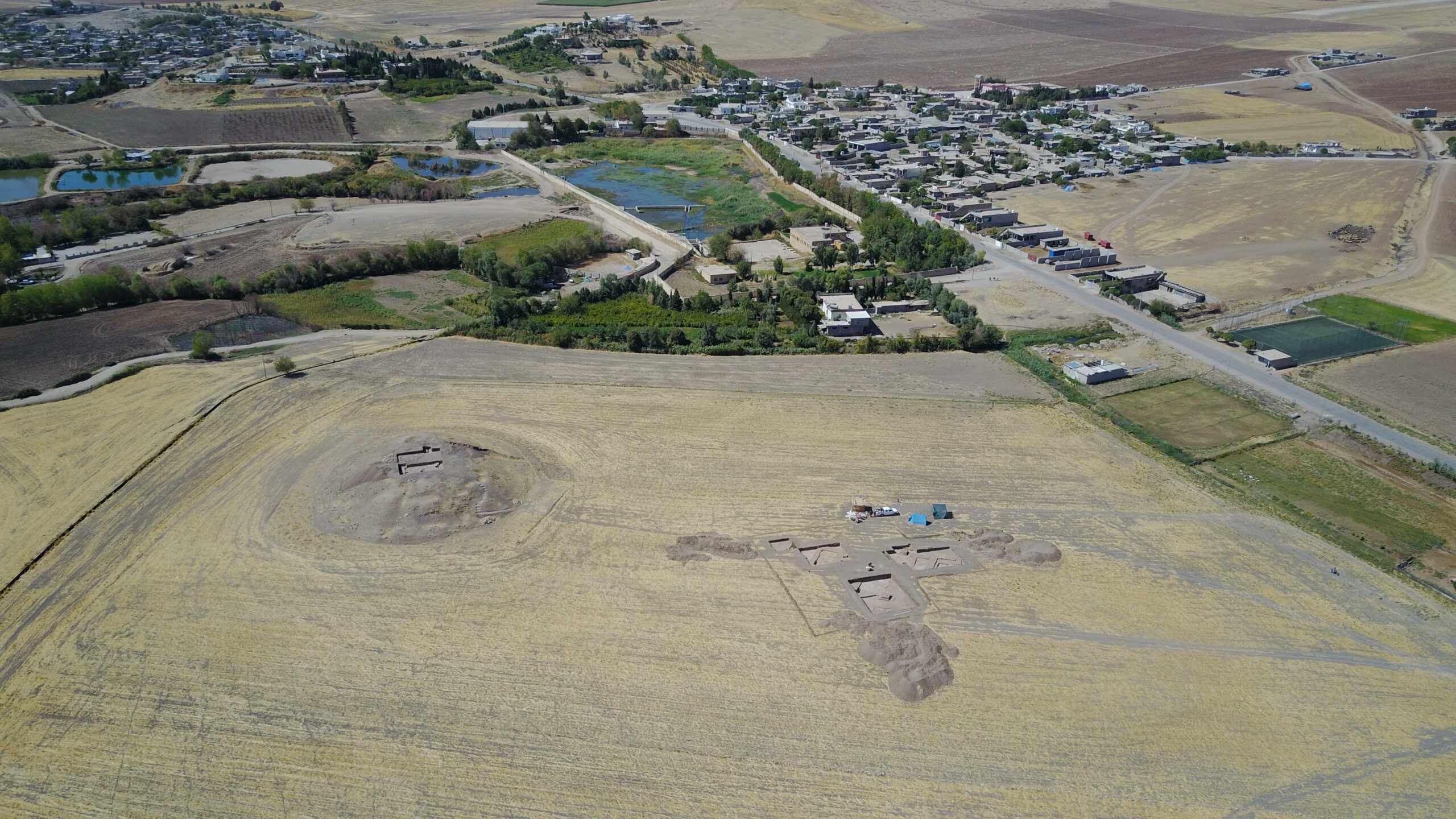
What makes Gird-î Kazhaw especially valuable is not only the likely church itself, but what lies immediately beside it: a settlement mound with a small fortification dating to the fifth or sixth century, during the Sasanian period. The relationship between the church complex and this fortified site is still unclear, but its proximity is central to the project’s bigger argument.
If the fortification and the church complex prove to be contemporary, the implication is striking: Christians and Zoroastrians—followers of Zarathustra (Zoroaster), whose religion was closely associated with Sasanian power—may have lived as neighbours in the same community. The team frames this as an important case study for “religious neighbourhoods,” where different faith communities occupied adjacent spaces and interacted within shared landscapes rather than existing in isolation.
Complicating the site’s long history is an Islamic cemetery that overlays the earlier fortification area. Documenting those burials is part of the team’s agenda as well, because the graves speak to later religious change in the community. Establishing when Kazhaw’s inhabitants converted to Islam is now one of the key research questions—one that will require careful dating and close collaboration between archaeology and biological anthropology.
Why rural sites matter
Excavation of a grave on the site. Image courtesy DFG project Rural Settlements of the Sasanian Period, Tamm/Wicke
The work at Gird-î Kazhaw forms part of a wider project by Tamm and Wicke investigating rural communities and settlements across the Shahrizor Plain. They argue that archaeology has often prioritised the great capital cities of ancient empires, leaving the countryside comparatively under-studied. Yet it was rural production—agriculture, herding, and local craft economies—that provided the material base that sustained urban life.
In that sense, the team’s goal is not only to label a building as a church, but to reconstruct what life looked like “within the excavated walls”: how people worked, what they ate, what animals they kept, and how a community’s economic routines connected to its religious spaces.
What happens next
Fieldwork at Kazhaw is expected to continue next year, with a stronger emphasis on the site’s economic infrastructure and daily life. The researchers plan to bring in archaeometric methods, including archaeobotany and zoological study, alongside forensic anthropology, to move from architectural identification toward a fuller social history of the community.
If the next seasons can securely tie the church complex and the Sasanian fortification to the same timeframe, Gird-î Kazhaw may become a particularly vivid example of how religious diversity functioned on the ground in late antiquity—at the scale of a rural settlement, where neighbours shared space long before later cemeteries and new faiths reshaped the landscape.
Top Image: Excavation site Gird-î Kazhaw in the foreground; the modern village of Bestansur in the background. Image courtesy DFG project Rural Settlements of the Sasanian Period, Tamm/Wicke

Archaeologists working in northern Iraq say they have found fresh evidence that Christians and Zoroastrians may have lived peacefully side by side in the fifth century. After three years of research connected to the site of Gird-î Kazhaw in the Kurdistan Region of Iraq, a team from Goethe University Frankfurt and partner institutions reports that a long-misunderstood building complex dating to around 500 AD now looks very much like an early Christian meeting place—located just steps away from a small Sasanian-period fortification.
The ten-person team was led by Dr Alexander Tamm (Friedrich-Alexander-Universität Erlangen-Nürnberg) and Professor Dirk Wicke (Goethe University Frankfurt). Although they returned without portable artefacts, they say the architecture they uncovered—along with a small but telling piece of decorated pottery—adds up to a clearer picture of the building’s function and its place within a multi-religious landscape.
From “mysterious pillars” to a likely church
Gird-î Kazhaw was first identified in 2015, but the purpose of its main stone structure remained uncertain. Early clues included five square pillars built from quarry stone and partially coated in white gypsum plaster—features that had already made some researchers suspect a church. Geophysical survey work also indicated additional buried walls, raising the possibility that the building might once have belonged to a larger monastic complex.
This year’s excavation strengthened the “church” interpretation, and also complicated it in interesting ways. Just beneath the surface, the team uncovered brick walls and floor surfaces that shifted over time—from rammed earth to later phases that used stones and broken brick. More unexpectedly, additional stone pillars appeared, suggesting a larger layout than first thought: potentially a three-aisled structure with a central nave aligned roughly north-west to south-east, a plan known from early Christian religious architecture in this broader region.
The central nave’s dimensions stand out. The archaeologists estimate it may have measured about 25 metres by 5 metres—an unusual proportion that raises new questions about how the space was used, how many people it served, and what local building traditions shaped its design. Whether neighbouring rooms belong to monastic buildings is still unresolved, and the team emphasises that more seasons of work will be needed before they can describe the entire complex with confidence.
A semicircular feature and a cross on pottery
Another surprise emerged in a room whose floor was made of carefully laid fired bricks. At one end, the outline of a semicircle was visible—an architectural feature that the excavators flagged as significant in assessing how the space functioned within the overall complex.
Material evidence for Christian use also turned up in the form of decorated pottery bearing a Maltese cross motif. For the team, this combination—church-like architecture plus explicitly Christian decoration—provides the strongest case so far that the building served as a Christian meeting place in the fifth to sixth centuries. They note that an early date for church construction is not unusual for northern Mesopotamia, where comparable structures are known elsewhere in the region.
A Sasanian fortification nearby—and what it could mean
What makes Gird-î Kazhaw especially valuable is not only the likely church itself, but what lies immediately beside it: a settlement mound with a small fortification dating to the fifth or sixth century, during the Sasanian period. The relationship between the church complex and this fortified site is still unclear, but its proximity is central to the project’s bigger argument.
If the fortification and the church complex prove to be contemporary, the implication is striking: Christians and Zoroastrians—followers of Zarathustra (Zoroaster), whose religion was closely associated with Sasanian power—may have lived as neighbours in the same community. The team frames this as an important case study for “religious neighbourhoods,” where different faith communities occupied adjacent spaces and interacted within shared landscapes rather than existing in isolation.
Complicating the site’s long history is an Islamic cemetery that overlays the earlier fortification area. Documenting those burials is part of the team’s agenda as well, because the graves speak to later religious change in the community. Establishing when Kazhaw’s inhabitants converted to Islam is now one of the key research questions—one that will require careful dating and close collaboration between archaeology and biological anthropology.
Why rural sites matter
The work at Gird-î Kazhaw forms part of a wider project by Tamm and Wicke investigating rural communities and settlements across the Shahrizor Plain. They argue that archaeology has often prioritised the great capital cities of ancient empires, leaving the countryside comparatively under-studied. Yet it was rural production—agriculture, herding, and local craft economies—that provided the material base that sustained urban life.
In that sense, the team’s goal is not only to label a building as a church, but to reconstruct what life looked like “within the excavated walls”: how people worked, what they ate, what animals they kept, and how a community’s economic routines connected to its religious spaces.
What happens next
Fieldwork at Kazhaw is expected to continue next year, with a stronger emphasis on the site’s economic infrastructure and daily life. The researchers plan to bring in archaeometric methods, including archaeobotany and zoological study, alongside forensic anthropology, to move from architectural identification toward a fuller social history of the community.
If the next seasons can securely tie the church complex and the Sasanian fortification to the same timeframe, Gird-î Kazhaw may become a particularly vivid example of how religious diversity functioned on the ground in late antiquity—at the scale of a rural settlement, where neighbours shared space long before later cemeteries and new faiths reshaped the landscape.
To learn more, please visit Sasanian-era rural communities. Case studies in the Shahrizor-plain (Iraqi-Kurdistan)
Top Image: Excavation site Gird-î Kazhaw in the foreground; the modern village of Bestansur in the background. Image courtesy DFG project Rural Settlements of the Sasanian Period, Tamm/Wicke
Subscribe to Medievalverse
Related Posts