The Higgins Collection—one of America’s most distinctive assemblies of arms and armor—has finally reopened to the public at the Worcester Art Museum. Its new galleries offer flashes of the old museum’s spirit, along with choices that may surprise longtime admirers.
By Ken Mondschein
Like many young, well-off men growing up in the late nineteenth century, Worcester, Massachusetts native John Woodman Higgins (1871–1961) was fascinated by stories of knights and castles — though he was also intrigued by the art and science of metalworking. In 1905, he and his father, industrialist Milton Higgins, purchased the Worcester Ferrule and Manufacturing Company, which they reorganized as the Worcester Pressed Steel Company. World War I proved profitable, and Higgins found himself with the funds to become a serious arms and armor collector. At the time, there was a positive craze for such acquisitions amongst the American moneyed class, fueled by both a desire to emulate traditional aristocracy and Europe’s desperate postwar economic state.
The Rise and Fall of the Higgins Armory Museum
Higgins Armory Building in Worcester, Massachusetts – photo by parkerjh / Wikimedia Commons
Advised by his friend Bashford Dean, a zoologist who became an arms and armor expert and the founding curator of the Metropolitan Museum of Art’s collection, Higgins purchased widely and somewhat indiscriminately and made plans for a museum of his own. The Higgins Armory Museum, a magnificent steel art deco building with an interior that suggested a medieval castle, opened at the height of the Great Depression in 1931. At first, it was an industrial museum showcasing metalworking from ancient times until the modern era, but arms and armor eventually became the museum’s sole focus.
Unfortunately, building an all-steel building in central Massachusetts is like building a radiator to heat all of New England. The Higgins was not a cheap place to keep warm: old photographs show children wearing winter overcoats on school visits. This was hardly in keeping with curatorial best practices, and attempts were made to insulate the museum and keep it at a stable temperature and humidity. Nonetheless, heating and cooling bills amounted to roughly half a million dollars per year, and, despite a steady stream of admission fees and the museum’s special place in the heart of Worcester residents, the small endowment Higgins had left could not sustain continued operating expenses.
The decision was made to close the Higgins in 2013, with the Worcester Art Museum (WAM) formally acquiring the collection in 2014. Much of the Higgins Collection, including composite pieces, 19th-century reproductions-cum-forgeries, and duplicates (how many Greek bronze helmets does one really need?), was auctioned off (“deaccessioned” in euphemistic museum-speak) in order to pay for the remainder’s continued maintenance. Finally, after an eleven-year delay, WAM’s arms and armor gallery opened to the public on November 22, 2025.
(Full disclosure: my fencing school got its start at the Higgins, and we were a part of the eclectic community around the museum from 2009 until its closing. We also got to handle many of the pieces in the collection.)
Courtesy Worcester Art Museum. Photo by Zachary Critchley
WAM’s efforts to construct a new home for the Higgins Collection have had decidedly mixed results. To be sure, the Higgins’s eccentric energy and emphasis on hands-on education is somewhat preserved. There are reproduction swords you can handle (within the few inches of freedom allowed by cables and loops), and helmets you can try on. There is a children’s area with books, stuffed animals, and activities. Higgins old-timers will be gratified to see Helmutt, the museum’s armored-dog mascot. There were reenactors and, incongruously, local minor-league team mascots present at the opening.
However, one has to wonder about the organization of the collection, which can best be described as reflecting Higgins’s indiscriminate collecting style and at worst seems to have been a committee-driven compromise between different factions at WAM rather than a unified curatorial vision. (Note that I was not privy to any of the decision-making processes.)
Inside the New Galleries
Courtesy Worcester Art Museum. Photo by Charles Stelliarmo
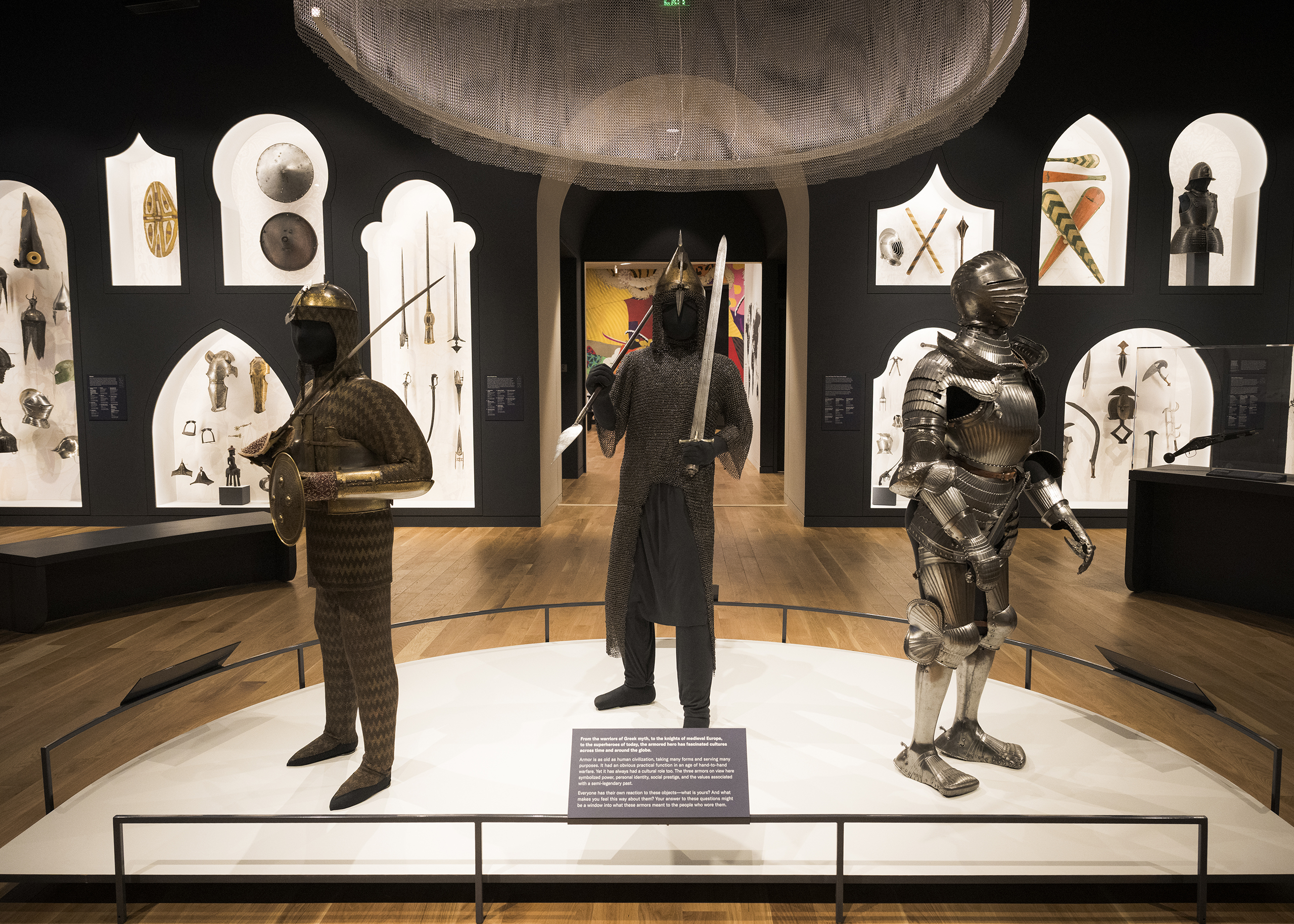
The actual gallery is divided between two large rooms: one with more standard museum displays, and one that focuses on large “open-storage” areas where the rest of the almost 1,000 pieces are displayed on racks and shelves. The logic behind the main displays is somewhat impenetrable: objets d’art, such as a steel crayfish, are mingled with weaponry from diverse cultures and time periods. An 18th-century executioner’s sword is displayed alongside a 3,000-year-old unified culture bronze sword. A long case of tsuba, or handguards for Japanese swords, was more thematically consistent. There are some amazing harnesses (complete armors) from the sixteenth century. Unfortunately, a few of the pieces were too high off the ground for close inspection.
A major highlight of this area is equipment for the Gioco di Ponte, a rough combat sport played in early-modern Pisa. Participants wore obsolete military equipment (such as burgonets modified with bar grills, making them somewhat resemble modern helmets used in the Society for Creative Anachronism) and used club-like shields to fight for control of the city’s central bridge. The game was ended by Napoleon in 1807, but revived as a less violent contest in modern times.
The open-storage area is mostly a success, with mail shirts behind glass but still so close you can see the details in the riveting. Informative displays taking up an entire wall give a vocabulary of arms and armor for the uninitiated. However, since there is nothing calling out any particular piece, some rarities are blink-and-you-miss-it, including one of the few fencing longswords, sometimes called federschwert, in American museum collections. (This example was acquired in 2015, after the museum’s closing.) A rare example of a messer, or knife-handled sword, with an unusual long sabre-like blade in excavated condition, is hidden away on a bottom shelf. The jousting lances are squirreled away in a corner, and a 14th-century bascinet with associated visor is easy to miss. Yet, for some reason, a chastity belt (a product of Victorian fantasy) is prominently displayed.
Courtesy Worcester Art Museum. Photo by Zachary Critchley
Though there are no informative placards for the items in open storage, there are innovative digital displays that connect to a comprehensive database of items in the collection. This system is not, however, accessible or necessarily easy to use: one needs to be able to identify the zone of the case in which the artifact of interest is located, identify its outline, press on that outline, and then be able to read and scroll through the description. Closing the description annoyingly scrolls along the open-storage images rather than returning you to where you had been a moment before. (The chastity belt, incidentally, was not glossed in the digital guide.)
A few items from the old Higgins collection were sorely missed. In particular, Bill Short’s collection of Viking swords, which he had loaned to the Higgins, is not anywhere to be seen. Nor were most of the saddles and the horse models immortalized by Norman Rockwell. However, the sixteenth-century saddle on display in open storage is mounted such that one can peer under it to see the construction, which is quite welcome.
The arms and armor galleries are complemented by an exhibition of prints, including the Higgins’s copy of Joachim Meyer’s 1570 fencing treatise (which gives a context for the fencing longsword). Unfortunately, the other historical fencing treatises in the Higgins collection were not on display.
Overall, the new Higgins galleries, with the rest of Worcester Art Museum’s quite interesting collections, make for a compelling visit. One can hope that Worcester Art Museum will take feedback on what works and what does not and modify the exhibits as time goes on.

The Higgins Collection—one of America’s most distinctive assemblies of arms and armor—has finally reopened to the public at the Worcester Art Museum. Its new galleries offer flashes of the old museum’s spirit, along with choices that may surprise longtime admirers.
By Ken Mondschein
Like many young, well-off men growing up in the late nineteenth century, Worcester, Massachusetts native John Woodman Higgins (1871–1961) was fascinated by stories of knights and castles — though he was also intrigued by the art and science of metalworking. In 1905, he and his father, industrialist Milton Higgins, purchased the Worcester Ferrule and Manufacturing Company, which they reorganized as the Worcester Pressed Steel Company. World War I proved profitable, and Higgins found himself with the funds to become a serious arms and armor collector. At the time, there was a positive craze for such acquisitions amongst the American moneyed class, fueled by both a desire to emulate traditional aristocracy and Europe’s desperate postwar economic state.
The Rise and Fall of the Higgins Armory Museum
Higgins Armory Building in Worcester, Massachusetts – photo by parkerjh / Wikimedia Commons
Advised by his friend Bashford Dean, a zoologist who became an arms and armor expert and the founding curator of the Metropolitan Museum of Art’s collection, Higgins purchased widely and somewhat indiscriminately and made plans for a museum of his own. The Higgins Armory Museum, a magnificent steel art deco building with an interior that suggested a medieval castle, opened at the height of the Great Depression in 1931. At first, it was an industrial museum showcasing metalworking from ancient times until the modern era, but arms and armor eventually became the museum’s sole focus.
Unfortunately, building an all-steel building in central Massachusetts is like building a radiator to heat all of New England. The Higgins was not a cheap place to keep warm: old photographs show children wearing winter overcoats on school visits. This was hardly in keeping with curatorial best practices, and attempts were made to insulate the museum and keep it at a stable temperature and humidity. Nonetheless, heating and cooling bills amounted to roughly half a million dollars per year, and, despite a steady stream of admission fees and the museum’s special place in the heart of Worcester residents, the small endowment Higgins had left could not sustain continued operating expenses.
The decision was made to close the Higgins in 2013, with the Worcester Art Museum (WAM) formally acquiring the collection in 2014. Much of the Higgins Collection, including composite pieces, 19th-century reproductions-cum-forgeries, and duplicates (how many Greek bronze helmets does one really need?), was auctioned off (“deaccessioned” in euphemistic museum-speak) in order to pay for the remainder’s continued maintenance. Finally, after an eleven-year delay, WAM’s arms and armor gallery opened to the public on November 22, 2025.
(Full disclosure: my fencing school got its start at the Higgins, and we were a part of the eclectic community around the museum from 2009 until its closing. We also got to handle many of the pieces in the collection.)
WAM’s efforts to construct a new home for the Higgins Collection have had decidedly mixed results. To be sure, the Higgins’s eccentric energy and emphasis on hands-on education is somewhat preserved. There are reproduction swords you can handle (within the few inches of freedom allowed by cables and loops), and helmets you can try on. There is a children’s area with books, stuffed animals, and activities. Higgins old-timers will be gratified to see Helmutt, the museum’s armored-dog mascot. There were reenactors and, incongruously, local minor-league team mascots present at the opening.
However, one has to wonder about the organization of the collection, which can best be described as reflecting Higgins’s indiscriminate collecting style and at worst seems to have been a committee-driven compromise between different factions at WAM rather than a unified curatorial vision. (Note that I was not privy to any of the decision-making processes.)
Inside the New Galleries
The actual gallery is divided between two large rooms: one with more standard museum displays, and one that focuses on large “open-storage” areas where the rest of the almost 1,000 pieces are displayed on racks and shelves. The logic behind the main displays is somewhat impenetrable: objets d’art, such as a steel crayfish, are mingled with weaponry from diverse cultures and time periods. An 18th-century executioner’s sword is displayed alongside a 3,000-year-old unified culture bronze sword. A long case of tsuba, or handguards for Japanese swords, was more thematically consistent. There are some amazing harnesses (complete armors) from the sixteenth century. Unfortunately, a few of the pieces were too high off the ground for close inspection.
A major highlight of this area is equipment for the Gioco di Ponte, a rough combat sport played in early-modern Pisa. Participants wore obsolete military equipment (such as burgonets modified with bar grills, making them somewhat resemble modern helmets used in the Society for Creative Anachronism) and used club-like shields to fight for control of the city’s central bridge. The game was ended by Napoleon in 1807, but revived as a less violent contest in modern times.
The open-storage area is mostly a success, with mail shirts behind glass but still so close you can see the details in the riveting. Informative displays taking up an entire wall give a vocabulary of arms and armor for the uninitiated. However, since there is nothing calling out any particular piece, some rarities are blink-and-you-miss-it, including one of the few fencing longswords, sometimes called federschwert, in American museum collections. (This example was acquired in 2015, after the museum’s closing.) A rare example of a messer, or knife-handled sword, with an unusual long sabre-like blade in excavated condition, is hidden away on a bottom shelf. The jousting lances are squirreled away in a corner, and a 14th-century bascinet with associated visor is easy to miss. Yet, for some reason, a chastity belt (a product of Victorian fantasy) is prominently displayed.
Though there are no informative placards for the items in open storage, there are innovative digital displays that connect to a comprehensive database of items in the collection. This system is not, however, accessible or necessarily easy to use: one needs to be able to identify the zone of the case in which the artifact of interest is located, identify its outline, press on that outline, and then be able to read and scroll through the description. Closing the description annoyingly scrolls along the open-storage images rather than returning you to where you had been a moment before. (The chastity belt, incidentally, was not glossed in the digital guide.)
A few items from the old Higgins collection were sorely missed. In particular, Bill Short’s collection of Viking swords, which he had loaned to the Higgins, is not anywhere to be seen. Nor were most of the saddles and the horse models immortalized by Norman Rockwell. However, the sixteenth-century saddle on display in open storage is mounted such that one can peer under it to see the construction, which is quite welcome.
The arms and armor galleries are complemented by an exhibition of prints, including the Higgins’s copy of Joachim Meyer’s 1570 fencing treatise (which gives a context for the fencing longsword). Unfortunately, the other historical fencing treatises in the Higgins collection were not on display.
Overall, the new Higgins galleries, with the rest of Worcester Art Museum’s quite interesting collections, make for a compelling visit. One can hope that Worcester Art Museum will take feedback on what works and what does not and modify the exhibits as time goes on.
Click here to learn more about the Higgins Collection at the Worcester Art Museum
Ken Mondschein is a scholar, writer, college professor, fencing master, and occasional jouster. Ken’s latest book is On Time: A History of Western Timekeeping. Click here to visit his website.
Click here to read more from Ken Mondschein
Subscribe to Medievalverse
Related Posts