Trained as a historian of medieval warfare, Yuval Noah Harari has become one of the most influential public intellectuals in the world, shaping global debates about artificial intelligence, human identity, and the future of society. Richard Utz traces how a medievalist moved from specialist scholarship to cultural prophecy—and why the habits of medieval history still matter for understanding his voice today.
By Richard Utz
When Umberto Eco died in 2016, the world lost its most widely known public medievalist. Eco, whose work incorporates books on the aesthetics of Thomas Aquinas, the novel The Name of the Rose (50 million copies sold!), and a vast number of other novels, scholarly publications, and newspaper articles, commented freely on political, cultural, and social matters, and his views reached millions of readers. While other medievalists have had – for a variety of reasons – considerable audiences beyond the academy (think: Marc Bloch, Fernand Braudel, Norman Cantor, Irina Dumitrescu, Jacques Le Goff, Johan Huizinga, Eleanor Janega, Ernst Kantorowicz, Henri Pirenne, Arnold Toynbee, Barbara Tuchman), nobody even gets close to Eco’s overall impact. That is until Yuval Noah Harari entered the scene.
Just recently, when Harari likened agentic Artificial Intelligence to immigration at the 2026 World Economic Forum in Davos, a worldwide audience paid rapt attention. Harari warned that:
The AI immigrants will take many human jobs. The AI immigrants will completely change the culture of every country. They will change art, religion, and even romance. Some people don’t like it if their son or daughter is dating an immigrant boyfriend. What would these people think when their son or daughter starts dating an AI boyfriend? But of course the AI immigrants will have some dubious political loyalties. They are likely to be loyal not to your country, but back to some corporation or government across the ocean, most probably in one of only two countries, China or the USA.
The person who boldly asserts to have sufficient authority to profess to the entire world about what the future holds for all of humanity was trained at Oxford University as a historian of medieval warfare. His book-length writings include his 2002 doctoral dissertation, “History and I: War and the Relations between History and Personal Identity in Renaissance Military Memoirs, c. 1450–1600,” Renaissance Military Memoirs: War, History and Identity (2004), and Special Operations in the Age of Chivalry, 1100–1550 (2007).
After that, in what has been called “one of the 21st century’s most astonishing academic careers,” he extended his observations to macro-historical issues, the future of human cognition, and human identity in the face of AI and biotechnology, producing the bestsellers Sapiens (2011), Homo Deus (2015), 21 Lessons for the 21st Century (2018), and Nexus (2024). These non-medieval publications have been translated into 65 languages, sold about 50 million copies, and have received prestigious awards.
His op-eds, features, and interviews from the New York Times through The Economist have reached a global audience, and top world leaders consult with him on a regular basis. For now, at least, Harari seems to have left medieval studies behind. His non-medieval books pay no more attention to the Middle Ages than to the Stone Age or Early Modernity.
How did Harari move from a little-known medievalist to global stature?
Studying “change” instead of “the past”
Harari holds that it is not enough for historians to study the past for its own sake, but for “understanding how things change” so that we can “prevent or correct the injustices of the present and the future.” In fact, he has even spoken of “the curse of history,” warning that “fixating on the past can prevent us from embracing the future.” While it is impossible to go back to the past and correct the wrongs that happened, “forging a path to future peace is possible.” Instead of “using the past as an excuse to incite more violence and conflict,” the goal must be “to seek healing” and reconciliation. History, to Harari, is a tool for understanding the past and for liberating ourselves from it so as to imagine different futures.
He does credit his experience with researching the Crusades and medieval warfare with helping him understand how cultural fictions drive human action (a focal point in Sapiens). His goal as a historian, he summarizes, is “to be able to tell the difference between what’s really happening in the world and what the fictions are that humans have been creating for thousands of years in order to explain or in order to control what’s happening in the world.” Creating and organizing around these fictions in complex social communities was humanity’s major evolutionary advantage over all other species. The task of the medievalist or other students of the past is to encourage skepticism about the fictions we have created for ourselves.
Teaching world history
These tenets offer nothing particularly original. They often feel like applied versions of existing theories about critical historical thinking. What helped Harari make the move beyond individual, regional, or national observations that guided his scholarship in military history was when he started teaching a new course in world history at Hebrew University in Jerusalem.
While his colleagues, all traditional historians, thought it beneath their scholarly dignity to teach the introductory course, Harari recognized the scope of the course as an enabling obstacle. It obliged him to move away from a focus on the history of one nation or time period to transnational and macro-historical structural considerations, and the lecture notes for this course became the foundation for his breakout book, Sapiens, in 2011. Harari credits his transformation from a specialized historian to a systems historian and cultural critic to the need to explain to his students all of humanity’s genesis and development during a single semester.
As he explains in Sapiens:
This is one of the distinguishing marks of history as an academic discipline—the better you know a particular historical period, the harder it becomes to explain why things happened one way and not another.
Harari clearly experienced what David Epstein, in his book Range: Why Generalists Triumph in a Specialized World(2019), has called a moment of “deliberate amateurism,” when an individual reaches beyond their primary field of specialization to cultivate a beginner’s attitude in the pursuit of new kinds of knowledge. His intentional and risqué “de-specialization” (Harari listens to non-fiction books aimed at the general reader for half an hour a day while swimming) resembles the convictions expressed by microbiologist and immunologist Arturo Casadevall, who claims that hyper-specialized academics in medical research and education, if they remain within a narrow paradigm, will produce mediocre work and work only of value to a small number of like-minded academics. Unsurprisingly, many “real” historians denounced Harari’s deliberate amateurism (“the jack of all trades is master of none”).
Reenacting medieval chroniclers as modern cultural prophet
The search for the origins of Harari’s panoramic analyses of the contemporary imagined order and its impending human-made technological challenges has also led to various examples of medievalism, as critics project stock features about the medieval past onto Harari’s practices and claims.
Since everyone knows about his medievalist training, but perhaps also because he is bald, bespectacled, and practices silent meditation, The Atlantic attributed to him a vague “monastic aura.” Slate intimated something of a premodern agriculturalist mentality when calling him a medievalist who lives “on a farming cooperative outside Jerusalem.” The Guardian seems to signal parallels between the well-known medieval apocalyptic tradition and Harari’s prophetic warnings about the “last days” of humanity. The London Review of Books would have preferred if Harari, like most traditional modern historians, had confined himself to knowing what he can about specific pasts, leaving unknowable futures to (premodern) “seers and fools.” And a reviewer of Nexus (2024) for The Times manages to liken Harari to a priest or pope “pontificating” on matters he knows little about and disparages his “exotic accent” and “owlish face,” ill-fated descriptors for a Jewish individual considering their antisemitic history from medieval art and poetry (The Owl and the Nightingale) through Richard Wagner’s Meistersinger.
As apparent as these critics’ fervent dislike for Harari’s grand narratives of human civilization is, they may have a point about the medievalist origins of his preferred rhetorical mode: Harari’s habit of mixing empirical analysis with partisan ethical exhortation and loosening up documentary evidence with persuasive anecdotes resembles more the habit of a medieval historiographer than that of a modern academic historian.
In fact, already when writing for a scholarly audience he was attracted by the untethered voice of the medieval chronicler. In Special Operations in the Age of Chivalry (2007) he not only chides “modern historians – whose life is not at risk –,” for “almost always prefer[ing] to exercise scholarly caution” and discounting medieval chroniclers’ accounts as confabulations. He asks his readers to bear with him, “even if I was duped here and there by the rich imagination of a medieval chronicler,” because “it hardly detracts from the general conclusions.”
This mindset would suggest that Harari is now reenacting the voices of medieval chroniclers, a journey on which not even the most daring (and tenured) academic public historians will join him. As a medievalist, his preference for cultural prophecy was disciplined by the academic boundaries within which he operated. Now he prophesies freely and, unfortunately, repeats (in Sapiens) ye olde misconception that premodern religions – including medieval Christianity – prevented all curiosity since “everything that is important to know about the world was already known.” Dark Ages indeed.
Richard Utz is Professor of Medievalism Studies in the School of Literature, Media, and Communication at Georgia Tech.
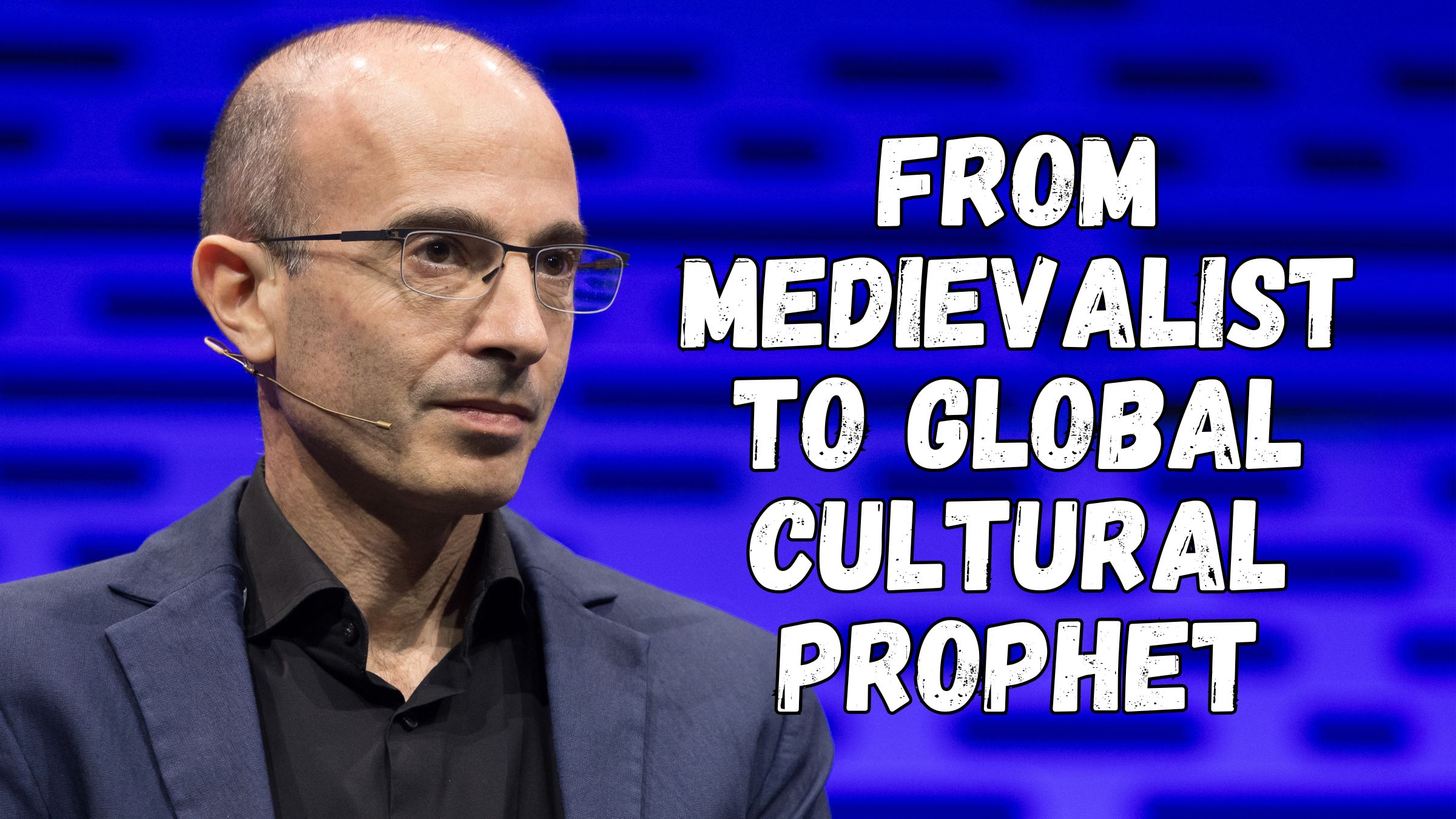
Top Image: Yuval Noah Harari at the 2024 Frankfurt Book Fair. Photo by Martin Kraft / Wikimedia Commons CC BY-SA 4.0

Trained as a historian of medieval warfare, Yuval Noah Harari has become one of the most influential public intellectuals in the world, shaping global debates about artificial intelligence, human identity, and the future of society. Richard Utz traces how a medievalist moved from specialist scholarship to cultural prophecy—and why the habits of medieval history still matter for understanding his voice today.
By Richard Utz
When Umberto Eco died in 2016, the world lost its most widely known public medievalist. Eco, whose work incorporates books on the aesthetics of Thomas Aquinas, the novel The Name of the Rose (50 million copies sold!), and a vast number of other novels, scholarly publications, and newspaper articles, commented freely on political, cultural, and social matters, and his views reached millions of readers. While other medievalists have had – for a variety of reasons – considerable audiences beyond the academy (think: Marc Bloch, Fernand Braudel, Norman Cantor, Irina Dumitrescu, Jacques Le Goff, Johan Huizinga, Eleanor Janega, Ernst Kantorowicz, Henri Pirenne, Arnold Toynbee, Barbara Tuchman), nobody even gets close to Eco’s overall impact. That is until Yuval Noah Harari entered the scene.
Just recently, when Harari likened agentic Artificial Intelligence to immigration at the 2026 World Economic Forum in Davos, a worldwide audience paid rapt attention. Harari warned that:
The AI immigrants will take many human jobs. The AI immigrants will completely change the culture of every country. They will change art, religion, and even romance. Some people don’t like it if their son or daughter is dating an immigrant boyfriend. What would these people think when their son or daughter starts dating an AI boyfriend? But of course the AI immigrants will have some dubious political loyalties. They are likely to be loyal not to your country, but back to some corporation or government across the ocean, most probably in one of only two countries, China or the USA.
The person who boldly asserts to have sufficient authority to profess to the entire world about what the future holds for all of humanity was trained at Oxford University as a historian of medieval warfare. His book-length writings include his 2002 doctoral dissertation, “History and I: War and the Relations between History and Personal Identity in Renaissance Military Memoirs, c. 1450–1600,” Renaissance Military Memoirs: War, History and Identity (2004), and Special Operations in the Age of Chivalry, 1100–1550 (2007).
After that, in what has been called “one of the 21st century’s most astonishing academic careers,” he extended his observations to macro-historical issues, the future of human cognition, and human identity in the face of AI and biotechnology, producing the bestsellers Sapiens (2011), Homo Deus (2015), 21 Lessons for the 21st Century (2018), and Nexus (2024). These non-medieval publications have been translated into 65 languages, sold about 50 million copies, and have received prestigious awards.
His op-eds, features, and interviews from the New York Times through The Economist have reached a global audience, and top world leaders consult with him on a regular basis. For now, at least, Harari seems to have left medieval studies behind. His non-medieval books pay no more attention to the Middle Ages than to the Stone Age or Early Modernity.
How did Harari move from a little-known medievalist to global stature?
Studying “change” instead of “the past”
Harari holds that it is not enough for historians to study the past for its own sake, but for “understanding how things change” so that we can “prevent or correct the injustices of the present and the future.” In fact, he has even spoken of “the curse of history,” warning that “fixating on the past can prevent us from embracing the future.” While it is impossible to go back to the past and correct the wrongs that happened, “forging a path to future peace is possible.” Instead of “using the past as an excuse to incite more violence and conflict,” the goal must be “to seek healing” and reconciliation. History, to Harari, is a tool for understanding the past and for liberating ourselves from it so as to imagine different futures.
The role of cultural fictions
He does credit his experience with researching the Crusades and medieval warfare with helping him understand how cultural fictions drive human action (a focal point in Sapiens). His goal as a historian, he summarizes, is “to be able to tell the difference between what’s really happening in the world and what the fictions are that humans have been creating for thousands of years in order to explain or in order to control what’s happening in the world.” Creating and organizing around these fictions in complex social communities was humanity’s major evolutionary advantage over all other species. The task of the medievalist or other students of the past is to encourage skepticism about the fictions we have created for ourselves.
Teaching world history
These tenets offer nothing particularly original. They often feel like applied versions of existing theories about critical historical thinking. What helped Harari make the move beyond individual, regional, or national observations that guided his scholarship in military history was when he started teaching a new course in world history at Hebrew University in Jerusalem.
While his colleagues, all traditional historians, thought it beneath their scholarly dignity to teach the introductory course, Harari recognized the scope of the course as an enabling obstacle. It obliged him to move away from a focus on the history of one nation or time period to transnational and macro-historical structural considerations, and the lecture notes for this course became the foundation for his breakout book, Sapiens, in 2011. Harari credits his transformation from a specialized historian to a systems historian and cultural critic to the need to explain to his students all of humanity’s genesis and development during a single semester.
As he explains in Sapiens:
This is one of the distinguishing marks of history as an academic discipline—the better you know a particular historical period, the harder it becomes to explain why things happened one way and not another.
Harari clearly experienced what David Epstein, in his book Range: Why Generalists Triumph in a Specialized World (2019), has called a moment of “deliberate amateurism,” when an individual reaches beyond their primary field of specialization to cultivate a beginner’s attitude in the pursuit of new kinds of knowledge. His intentional and risqué “de-specialization” (Harari listens to non-fiction books aimed at the general reader for half an hour a day while swimming) resembles the convictions expressed by microbiologist and immunologist Arturo Casadevall, who claims that hyper-specialized academics in medical research and education, if they remain within a narrow paradigm, will produce mediocre work and work only of value to a small number of like-minded academics. Unsurprisingly, many “real” historians denounced Harari’s deliberate amateurism (“the jack of all trades is master of none”).
Reenacting medieval chroniclers as modern cultural prophet
The search for the origins of Harari’s panoramic analyses of the contemporary imagined order and its impending human-made technological challenges has also led to various examples of medievalism, as critics project stock features about the medieval past onto Harari’s practices and claims.
Since everyone knows about his medievalist training, but perhaps also because he is bald, bespectacled, and practices silent meditation, The Atlantic attributed to him a vague “monastic aura.” Slate intimated something of a premodern agriculturalist mentality when calling him a medievalist who lives “on a farming cooperative outside Jerusalem.” The Guardian seems to signal parallels between the well-known medieval apocalyptic tradition and Harari’s prophetic warnings about the “last days” of humanity. The London Review of Books would have preferred if Harari, like most traditional modern historians, had confined himself to knowing what he can about specific pasts, leaving unknowable futures to (premodern) “seers and fools.” And a reviewer of Nexus (2024) for The Times manages to liken Harari to a priest or pope “pontificating” on matters he knows little about and disparages his “exotic accent” and “owlish face,” ill-fated descriptors for a Jewish individual considering their antisemitic history from medieval art and poetry (The Owl and the Nightingale) through Richard Wagner’s Meistersinger.
As apparent as these critics’ fervent dislike for Harari’s grand narratives of human civilization is, they may have a point about the medievalist origins of his preferred rhetorical mode: Harari’s habit of mixing empirical analysis with partisan ethical exhortation and loosening up documentary evidence with persuasive anecdotes resembles more the habit of a medieval historiographer than that of a modern academic historian.
In fact, already when writing for a scholarly audience he was attracted by the untethered voice of the medieval chronicler. In Special Operations in the Age of Chivalry (2007) he not only chides “modern historians – whose life is not at risk –,” for “almost always prefer[ing] to exercise scholarly caution” and discounting medieval chroniclers’ accounts as confabulations. He asks his readers to bear with him, “even if I was duped here and there by the rich imagination of a medieval chronicler,” because “it hardly detracts from the general conclusions.”
This mindset would suggest that Harari is now reenacting the voices of medieval chroniclers, a journey on which not even the most daring (and tenured) academic public historians will join him. As a medievalist, his preference for cultural prophecy was disciplined by the academic boundaries within which he operated. Now he prophesies freely and, unfortunately, repeats (in Sapiens) ye olde misconception that premodern religions – including medieval Christianity – prevented all curiosity since “everything that is important to know about the world was already known.” Dark Ages indeed.
Richard Utz is Professor of Medievalism Studies in the School of Literature, Media, and Communication at Georgia Tech.
Top Image: Yuval Noah Harari at the 2024 Frankfurt Book Fair. Photo by Martin Kraft / Wikimedia Commons CC BY-SA 4.0
Subscribe to Medievalverse
Related Posts