On a winter’s day in 1177 at Mont Gisard, the Templars launched a desperate charge that brought them within striking distance of Saladin himself. It was the closest the order ever came to killing their greatest enemy—and the consequences of that failed hit would echo through the next campaigns in the Kingdom of Jerusalem.
By Steve Tibble
November 25, 1177. A difficult winter’s day in Palestine – one in which death and destruction were paramount.
There was a sense of panic in the air. The enemy stretched out in front of the Frankish lines, largely lost in the dust and sand kicked up by the thousands of horses and baggage animals. They had the numbers. But something was not right. Men were shuffling across the field, trying to force a way into the ranks, and disordering their comrades. Others moved more or less surreptitiously away, perhaps under orders to change position, or perhaps just getting nervous, edging away from a position of danger. A hint of indecision. Maybe even the smell of fear.
Saladin’s armies had rolled over the southern frontiers of the Latin Kingdom of Jerusalem just a few days earlier – in overwhelming force. The Frankish field army took refuge in their castles, waiting for an opportunity to strike back. Lulled into complacency by their huge numerical superiority and the inactivity of the crusaders, the sultan’s troops, in the words of the chronicler Ibn al-Athir, ‘scattered throughout those regions in raiding parties…[and] became over eager and relaxed, moving around the country secure and confident’.
Overconfident, in fact.
The Charge That Nearly Reached Saladin
16th-century depiction of Saladin by Cristofano dell’Altissimo (1527–1605)
Saladin had fully mobilised his armies in Egypt for the invasion, determined to destroy the Latin Kingdom of Jerusalem by sheer weight of numbers. He had an army of over 20,000 men at his command, including a core of some 8,000 well-disciplined household cavalry.
Against such an overwhelming force the Franks could muster just 375 knights, supplemented by infantry and their Turcopole light cavalry auxiliaries. Over-confidence is rarely helpful, but given the huge mismatch in the size of the two armies, it is easy to see why Saladin’s troops had begun to relax.
Now, as they met on the battlefield, the crusaders knew they had just one chance. One charge, one roll of the dice. That charge to be spearheaded by those who were best qualified for the (almost) suicidal task ahead – the Templars.
The Templar brothers took on the most hazardous roles in this and many other battles. However outnumbered they might be, they could still take death to the enemy. A Frankish charge was a brutally effective, almost elemental, force – but that single charge had to succeed if they were to have any chance of turning the tide.
The Templar squadron was less than a hundred men. They were risking everything in a single attempt to break the centre of the Muslim army. They could see the standards of the enemy commanders. Their focus was precise – Saladin and his inner circle, surrounded by a wall of mounted bodyguards. The stakes could not have been higher, and the outcome was nothing short of extraordinary.
Depiction of the Templars by Matthew Paris
English chronicler Ralph of Diceto, writing from London and drawing on a Templar eyewitness account sent back home to the West, noted the pivotal role played by this assault. He singled out the master of the Templars, Odo of Saint-Amand, who personally led his knights into the very heart of the Muslim army.
According to Ralph, the Templars struck with such force that Saladin’s men were scattered in all directions, fleeing in disorder:
‘Odo the master of the Knighthood of the Temple, like another Judas Maccabaeus, had eighty-four knights of his Order with him in his personal company. He took himself into battle with his men, strengthened by the sign of the cross. Spurring all together, as one man, they made a charge, turning neither to the left nor to the right. Recognising the body of troops in which Saladin commanded many knights, they manfully approached it, immediately penetrated it, incessantly knocked down, scattered, struck and crushed. Saladin was smitten with admiration, seeing his men dispersed everywhere, everywhere turned in flight, everywhere given to the mouth of the sword.’
The Templar knights’ sudden, all-out charge sent shockwaves through the Muslim ranks, especially at the centre of the army. Saladin’s nephew, Taqi al-Din, and his heavy cavalry tried to slow down the Templar advance. Large numbers of Saladin’s bodyguards, including one of his young relatives, died in the attempt. But the Templars still managed to push through.
Saladin became increasingly nervous as ‘the Franks crowded him’, getting dangerously close. In the chaotic seconds that followed, one knight, braver and stronger than those alongside him, hacked his way through to the front. He could see Saladin just a few yards away and charged forward. He was within striking distance of the sultan.
The Templars’ ideology of death now had a chance to change the course of history.
So close. But not close enough.
When the Sultan Got Away
The Battle of Mont Sigard depicted in a 15th-century manuscript – Bibliothèque nationale de France MS Français 5594 fol. 176v
The Battle of Mont Gisard in 1177 was the Templars’ first, and best, chance to kill him. They never got so close again.
The lone knight within striking distance of the sultan was cut down at the last moment. Once again, as with the fidais attacks, it was a very close call. Saladin abandoned his armour and ran, leaving his army to be hunted down in detail over the days that followed. It was a disaster, and nearly destroyed his empire before it was even fully formed.
But Saladin survived. The Templars had tried and failed, like the Assassins before them, to kill their enemy. They now had to live with the consequences of that failure.
The Assassins tried to get to Saladin several times between 1174 and 1176, but always without success. Now the threat he posed grew greater every year. The Templar ideology of martyrdom and death was needed more than ever. Perhaps, where the subtlety of the fidais had failed, the blunter, more direct violence of the order could prevail.
The Templars had been buoyed up by an ideology which taught them, correctly in this case, that one highly motivated man could overpower large numbers of the enemy. The power of their commitment and their elite training had destroyed Saladin’s armies – but bad luck (and the racing camel on which he fled the battlefield) meant that they failed to kill the man himself.
Revenge and Retribution
Saladin never forgot and never forgave. He swore to take revenge on the Templars and took every opportunity to do so – on a grand scale.
Less than two years later, on 10 June 1179, the Frankish field army was ambushed and badly cut up at Marj Ayun, near the eastern frontiers of the Latin Kingdom of Jerusalem. Many Frankish lords were killed or captured, along with their troops. The Templars played a major part in the battle but their master, Odo of Saint-Amand, the hero of Mont Gisard, was blamed by many of the participants for their defeat. He was captured and died in captivity a year later, ‘lamented’, as William of Tyre rather unkindly put it, ‘by no one’.
Worse was to follow. The Templars already had a substantial castle at Safad, guarding some of the eastern approaches to the Latin Kingdom. But, aggressive as ever, they wanted to push their defences still further forward, to a part of the frontier more suitable for launching threatening raids into Muslim territory. Over the winter of 1178–1179, at a crossing point on the River Jordan known as Jacob’s Ford, they started to build a magnificent, state-of-the-art castle. They called it Chastellet.
This could not be allowed to stand. Work on the inner walls of the castle continued until April 1179, but the ultimate Templar plan was to construct a double line of walls in the classic concentric fashion of later crusader fortifications. Because the building of the outer wall was still unfinished, however, the castle was, for a brief moment, vulnerable.
Saladin was quick to take advantage of this temporary weakness. With morale in the Latin Kingdom of Jerusalem still low after its recent defeat at Marj Ayun, Saladin felt confident enough to start a full-scale siege. He and his troops arrived at Chastellet on 24 August 1179.
The ruins of Chastellet – Photo by Bukvoed / Wikimedia Commons
The Ayyubid engineers quickly ‘mined the fort and deepened the mine’. With five gates to defend around the site (always weak spots), the Templar garrison knew that their position was extremely precarious. There were about 700–1,000 men in the castle, but many were non-combatants. Not surprisingly, given that it was still a building site, most of the men were construction workers – a Muslim letter written after the event mentioned the large number of artisans taken prisoner, including architects, blacksmiths, masons, and carpenters.
The siege ground on. Part of the defences began to give way. As soon as it was clear that a breach was imminent, the Templar garrison positioned wooden barricades behind the walls. As Saladin’s men tried to push their way in, the knights set the barricades alight and formed up to make a last stand. There was a short pause in the fighting, with the Muslim assault squads understandably reticent about fighting their way across the flames. But there was no hurry. The fires would die down. And the Templars weren’t going anywhere.
The attackers poured through the gap. The fighting, partially obscured by smoke and dying flames, was brief but terrible. The Templar commander provided a horrific example of their ideology of death before dishonour – perhaps wounded and preferring a death he could control to the prospect of execution or captivity, he threw himself into what remained of the fires. It was all over in a matter of minutes.
Saladin questioned all the prisoners to determine which of the mercenaries or local Christians might be considered ‘Muslim converts’ – he had these killed first. All the Templar prisoners were also singled out for execution – this was an interesting, if unwelcome, testament to their military prowess and the embarrassment they had recently caused him at Mont Gisard. Most of the remaining Christian prisoners were butchered over the next few days.
Ironically, however, the most significant death toll in the siege of Chastellet was still to come. The mass of Templar casualties had been dumped into the castle’s cistern. The rotting corpses took their own macabre revenge while the demolition works on the half-built castle were underway.
The August heat, the unsanitary siege conditions and the unburied bodies in the water supply were a lethal cocktail. Disease broke out, killing far more of Saladin’s men than had fallen in the assaults. His nephew, Taqi al-Din, became seriously ill and ten of his commanders died, along with large numbers of the rank and file.
The Templars got some belated revenge.
Steve Tibble, an honorary research associate at Royal Holloway, University of London, has a new book out – Assassins and Templars: A Battle in Myth and Blood – from Yale University Press. It tells the true history behind the hugely popular video game Assassin’s Creed and the medieval world’s two most extraordinary organisations, tracing their origins, strategies, violent clashes, and enduring legacy in myth and memory.
You can get your copy of Assassins and Templars: A Battle in Myth and Blood through

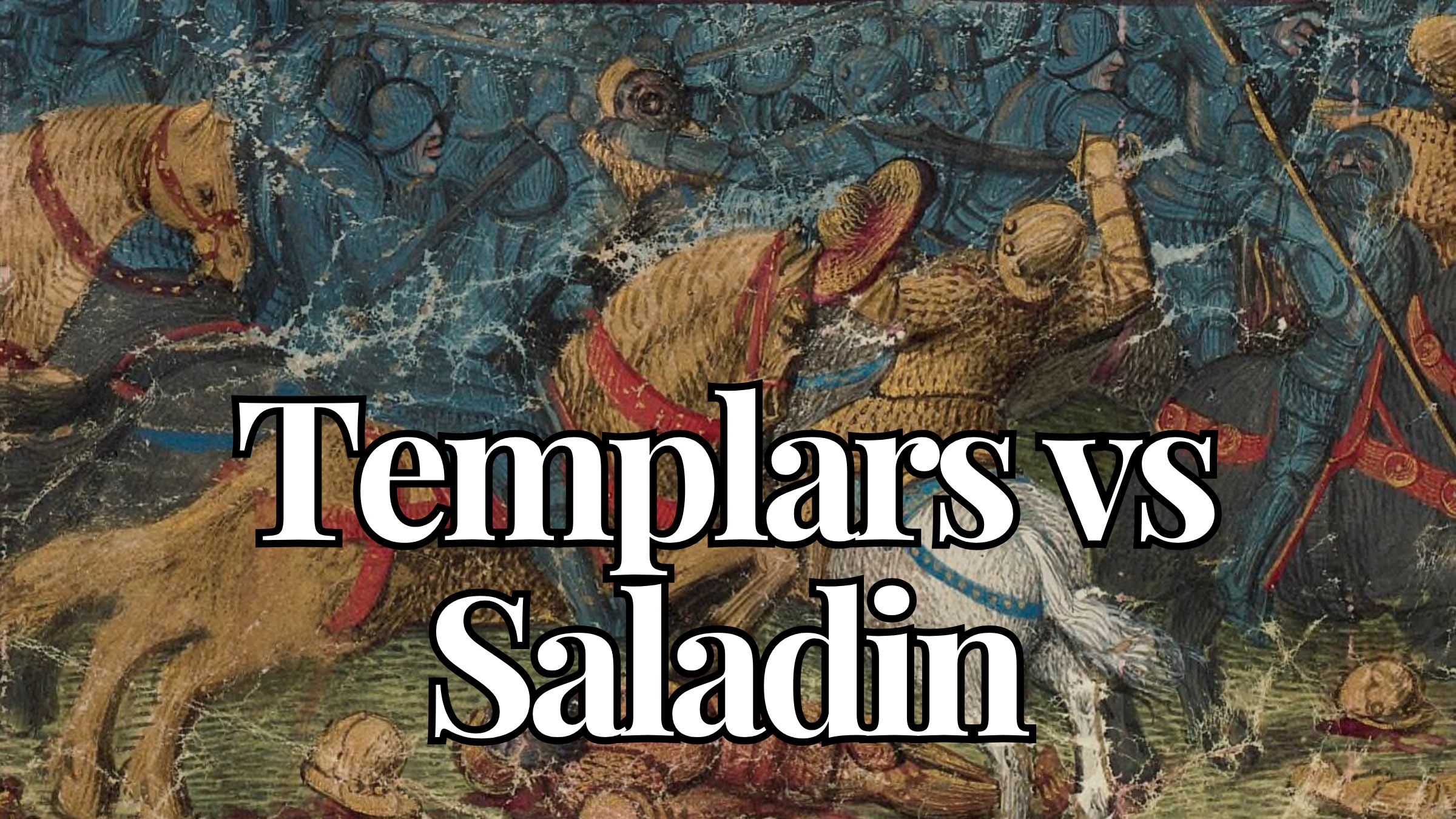
On a winter’s day in 1177 at Mont Gisard, the Templars launched a desperate charge that brought them within striking distance of Saladin himself. It was the closest the order ever came to killing their greatest enemy—and the consequences of that failed hit would echo through the next campaigns in the Kingdom of Jerusalem.
By Steve Tibble
November 25, 1177. A difficult winter’s day in Palestine – one in which death and destruction were paramount.
There was a sense of panic in the air. The enemy stretched out in front of the Frankish lines, largely lost in the dust and sand kicked up by the thousands of horses and baggage animals. They had the numbers. But something was not right. Men were shuffling across the field, trying to force a way into the ranks, and disordering their comrades. Others moved more or less surreptitiously away, perhaps under orders to change position, or perhaps just getting nervous, edging away from a position of danger. A hint of indecision. Maybe even the smell of fear.
Saladin’s armies had rolled over the southern frontiers of the Latin Kingdom of Jerusalem just a few days earlier – in overwhelming force. The Frankish field army took refuge in their castles, waiting for an opportunity to strike back. Lulled into complacency by their huge numerical superiority and the inactivity of the crusaders, the sultan’s troops, in the words of the chronicler Ibn al-Athir, ‘scattered throughout those regions in raiding parties…[and] became over eager and relaxed, moving around the country secure and confident’.
Overconfident, in fact.
The Charge That Nearly Reached Saladin
Saladin had fully mobilised his armies in Egypt for the invasion, determined to destroy the Latin Kingdom of Jerusalem by sheer weight of numbers. He had an army of over 20,000 men at his command, including a core of some 8,000 well-disciplined household cavalry.
Against such an overwhelming force the Franks could muster just 375 knights, supplemented by infantry and their Turcopole light cavalry auxiliaries. Over-confidence is rarely helpful, but given the huge mismatch in the size of the two armies, it is easy to see why Saladin’s troops had begun to relax.
Now, as they met on the battlefield, the crusaders knew they had just one chance. One charge, one roll of the dice. That charge to be spearheaded by those who were best qualified for the (almost) suicidal task ahead – the Templars.
The Templar brothers took on the most hazardous roles in this and many other battles. However outnumbered they might be, they could still take death to the enemy. A Frankish charge was a brutally effective, almost elemental, force – but that single charge had to succeed if they were to have any chance of turning the tide.
The Templar squadron was less than a hundred men. They were risking everything in a single attempt to break the centre of the Muslim army. They could see the standards of the enemy commanders. Their focus was precise – Saladin and his inner circle, surrounded by a wall of mounted bodyguards. The stakes could not have been higher, and the outcome was nothing short of extraordinary.
English chronicler Ralph of Diceto, writing from London and drawing on a Templar eyewitness account sent back home to the West, noted the pivotal role played by this assault. He singled out the master of the Templars, Odo of Saint-Amand, who personally led his knights into the very heart of the Muslim army.
According to Ralph, the Templars struck with such force that Saladin’s men were scattered in all directions, fleeing in disorder:
‘Odo the master of the Knighthood of the Temple, like another Judas Maccabaeus, had eighty-four knights of his Order with him in his personal company. He took himself into battle with his men, strengthened by the sign of the cross. Spurring all together, as one man, they made a charge, turning neither to the left nor to the right. Recognising the body of troops in which Saladin commanded many knights, they manfully approached it, immediately penetrated it, incessantly knocked down, scattered, struck and crushed. Saladin was smitten with admiration, seeing his men dispersed everywhere, everywhere turned in flight, everywhere given to the mouth of the sword.’
The Templar knights’ sudden, all-out charge sent shockwaves through the Muslim ranks, especially at the centre of the army. Saladin’s nephew, Taqi al-Din, and his heavy cavalry tried to slow down the Templar advance. Large numbers of Saladin’s bodyguards, including one of his young relatives, died in the attempt. But the Templars still managed to push through.
Saladin became increasingly nervous as ‘the Franks crowded him’, getting dangerously close. In the chaotic seconds that followed, one knight, braver and stronger than those alongside him, hacked his way through to the front. He could see Saladin just a few yards away and charged forward. He was within striking distance of the sultan.
The Templars’ ideology of death now had a chance to change the course of history.
So close. But not close enough.
When the Sultan Got Away
The Battle of Mont Gisard in 1177 was the Templars’ first, and best, chance to kill him. They never got so close again.
The lone knight within striking distance of the sultan was cut down at the last moment. Once again, as with the fidais attacks, it was a very close call. Saladin abandoned his armour and ran, leaving his army to be hunted down in detail over the days that followed. It was a disaster, and nearly destroyed his empire before it was even fully formed.
But Saladin survived. The Templars had tried and failed, like the Assassins before them, to kill their enemy. They now had to live with the consequences of that failure.
The Assassins tried to get to Saladin several times between 1174 and 1176, but always without success. Now the threat he posed grew greater every year. The Templar ideology of martyrdom and death was needed more than ever. Perhaps, where the subtlety of the fidais had failed, the blunter, more direct violence of the order could prevail.
The Templars had been buoyed up by an ideology which taught them, correctly in this case, that one highly motivated man could overpower large numbers of the enemy. The power of their commitment and their elite training had destroyed Saladin’s armies – but bad luck (and the racing camel on which he fled the battlefield) meant that they failed to kill the man himself.
Revenge and Retribution
Saladin never forgot and never forgave. He swore to take revenge on the Templars and took every opportunity to do so – on a grand scale.
Less than two years later, on 10 June 1179, the Frankish field army was ambushed and badly cut up at Marj Ayun, near the eastern frontiers of the Latin Kingdom of Jerusalem. Many Frankish lords were killed or captured, along with their troops. The Templars played a major part in the battle but their master, Odo of Saint-Amand, the hero of Mont Gisard, was blamed by many of the participants for their defeat. He was captured and died in captivity a year later, ‘lamented’, as William of Tyre rather unkindly put it, ‘by no one’.
Worse was to follow. The Templars already had a substantial castle at Safad, guarding some of the eastern approaches to the Latin Kingdom. But, aggressive as ever, they wanted to push their defences still further forward, to a part of the frontier more suitable for launching threatening raids into Muslim territory. Over the winter of 1178–1179, at a crossing point on the River Jordan known as Jacob’s Ford, they started to build a magnificent, state-of-the-art castle. They called it Chastellet.
This could not be allowed to stand. Work on the inner walls of the castle continued until April 1179, but the ultimate Templar plan was to construct a double line of walls in the classic concentric fashion of later crusader fortifications. Because the building of the outer wall was still unfinished, however, the castle was, for a brief moment, vulnerable.
Saladin was quick to take advantage of this temporary weakness. With morale in the Latin Kingdom of Jerusalem still low after its recent defeat at Marj Ayun, Saladin felt confident enough to start a full-scale siege. He and his troops arrived at Chastellet on 24 August 1179.
The Ayyubid engineers quickly ‘mined the fort and deepened the mine’. With five gates to defend around the site (always weak spots), the Templar garrison knew that their position was extremely precarious. There were about 700–1,000 men in the castle, but many were non-combatants. Not surprisingly, given that it was still a building site, most of the men were construction workers – a Muslim letter written after the event mentioned the large number of artisans taken prisoner, including architects, blacksmiths, masons, and carpenters.
The siege ground on. Part of the defences began to give way. As soon as it was clear that a breach was imminent, the Templar garrison positioned wooden barricades behind the walls. As Saladin’s men tried to push their way in, the knights set the barricades alight and formed up to make a last stand. There was a short pause in the fighting, with the Muslim assault squads understandably reticent about fighting their way across the flames. But there was no hurry. The fires would die down. And the Templars weren’t going anywhere.
The attackers poured through the gap. The fighting, partially obscured by smoke and dying flames, was brief but terrible. The Templar commander provided a horrific example of their ideology of death before dishonour – perhaps wounded and preferring a death he could control to the prospect of execution or captivity, he threw himself into what remained of the fires. It was all over in a matter of minutes.
Saladin questioned all the prisoners to determine which of the mercenaries or local Christians might be considered ‘Muslim converts’ – he had these killed first. All the Templar prisoners were also singled out for execution – this was an interesting, if unwelcome, testament to their military prowess and the embarrassment they had recently caused him at Mont Gisard. Most of the remaining Christian prisoners were butchered over the next few days.
Ironically, however, the most significant death toll in the siege of Chastellet was still to come. The mass of Templar casualties had been dumped into the castle’s cistern. The rotting corpses took their own macabre revenge while the demolition works on the half-built castle were underway.
The August heat, the unsanitary siege conditions and the unburied bodies in the water supply were a lethal cocktail. Disease broke out, killing far more of Saladin’s men than had fallen in the assaults. His nephew, Taqi al-Din, became seriously ill and ten of his commanders died, along with large numbers of the rank and file.
The Templars got some belated revenge.
You can get your copy of Assassins and Templars: A Battle in Myth and Blood through
Yale University Press website
Amazon.com
Amazon.ca
Amazon.co.uk
To learn more about Steve, please visit his website or follow him on Instagram
Subscribe to Medievalverse
Related Posts