Medieval artists did not just paint saints and kings—they sometimes slipped themselves into the scene, leaving behind portraits that can be devotional, witty, and surprisingly personal. From monks and manuscript painters to sculptors and court artists, these self-portraits offer glimpses of how people in the Middle Ages wanted to be seen.
In his book The Self-Portrait: A Cultural History, James Hall examines how this style of art emerged and developed over the last thousand years. While self-portraits did exist in ancient times, Hall explains that “in the Middle Ages self-portraiture becomes very much a Christian concern, connected with personal salvation, honour and love.” Here are ten portraits that Hall examines in his book:
1. St. Dunstan
St. Dunstan (909-988) served as the Abbot of Glastonbury and later as Archbishop of Canterbury, and Hall stresses that few “artists” in history were ever as politically powerful or socially elevated as he was. While he was at Glastonbury, he produced a Latin grammar book, and on the frontispiece he drew a giant figure of Christ. Dunstan then placed a much smaller portrait of himself beside Christ, making it both a personal statement and a devotional act, and he added a short prayer: “I ask, merciful Christ, that you may protect me, Dunstan, and that you do not let the Taenerian storms drown me.” Hall notes that the “storms” are best read as worldly temptations and spiritual peril, and he also points out how Dunstan’s identity is underlined by the prominence of the inscription above him.
2. Hildebertus
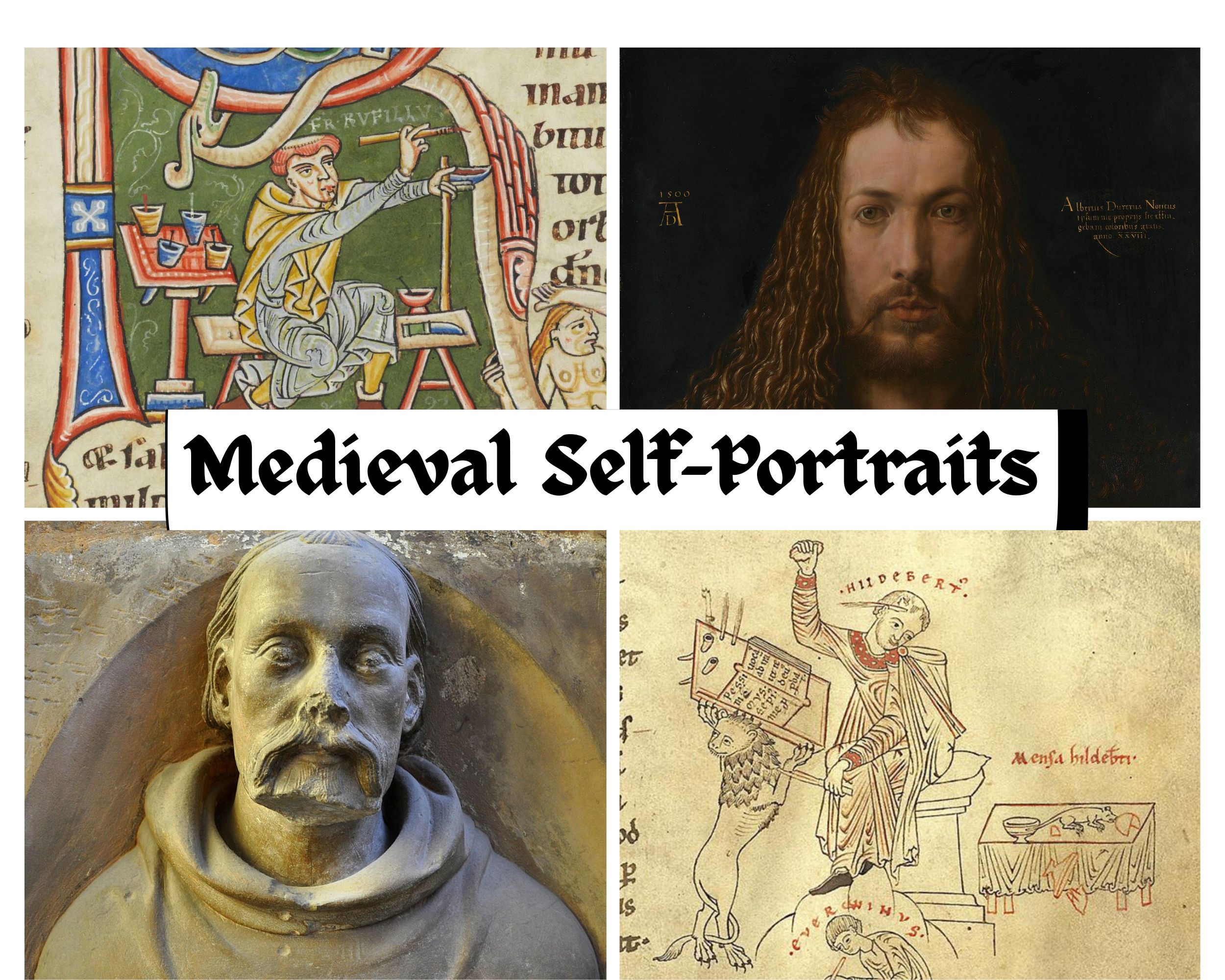
In 1136 the Bohemian lay painter Hildebertus added a self-portrait to a copy of St. Augustine’s City of God. Hall notes that two self-portraits by Hildebertus survive, and in both he shows himself working alongside his young assistant Everwinus, with identifying inscriptions above them. In the City of God image, Hildebertus sits cross-legged at a lectern supported by a lion, quill in hand, but he turns aside to deal with a mouse, raising a sponge to throw. The open book beside him says, “Damn you, wretched mouse exasperating me so often!” Hall reads the scene as more than a throwaway joke: the mouse has upset his meal, and the text becomes a parody of judgement language, while the whole composition doubles as a statement about the artist’s discipline and concentration, finishing a huge project despite constant “distractions”.
3. Rufillus of Weissenau
Rufillus inside a letter R (Cologny, Fondation Martin Bodmer, Cod. Bodmer 127, fol. 244r, late 12th century)
In the late 12th century, the canon Rufillus of Weissenau created a Passionale (Lives of Saints), and in his section on St. Martin he worked a self-portrait into the letter ‘R’. Hall draws attention to how deliberately the craft is displayed: Rufillus holds a paint pot, props his hand on a mahlstick, and keeps his brush level at eye height, turning the miniature into a study of hand-eye coordination. The signature ‘FR. RUFILLUS’ is integrated into the image, running along the brush itself. Hall also highlights the extraordinary “stage” Rufillus builds around his self-image: the letterform becomes an inhabited structure assembled from fantastical creatures, including a serpent-bodied “tail” with different heads, making the artist’s calm focus part of the point.
4. Peter Parler
Bust of Peter Parler, the second architect of St. Vitus Cathedral in Prague. Sandstone. Very likely self-portrait. Photo by Packare / Wikimedia Commons
The German architect and sculptor Peter Parler (c.1333-99) made a self-portrait at St. Vitus Cathedral in Prague, and Hall treats it as a turning point for self-portraiture in the fabric of churches. The sandstone bust, dated to about 1379-1386, is set high in the cathedral’s triforium, and Hall notes the striking animation created by the head’s tilt and intense expression. Crucially, Parler’s image is not isolated: it sits alongside nineteen other busts, largely members of the ruling family and their circle, arranged as part of a coherent programme. Hall emphasises the social meaning of this placement, since it puts the master mason within a permanent elite gallery rather than leaving him as an anonymous maker.
5. Taddeo di Bartolo
Taddeo Di Bartolo, Self Portrait, Detail of Assumption of the Virgin, Located in the Duomo di Santa Maria dell’Assunta at Montepulciano – Wikimedia Commons
In 1401 the Sienese artist Taddeo di Bartolo created the altarpiece ‘Assumption and Coronation of the Virgin’. Hall notes that it was painted in Siena for the high altar of Montepulciano’s cathedral and financed by the city’s leading family, the Aragazzi. It is believed that Taddeo depicted himself as St Thaddeus, his name saint, among the apostles gathered at the Virgin’s tomb, and Hall links this choice to the book’s larger theme of artists inserting themselves into sacred narratives. The figure’s direct engagement with the viewer helps set him apart, and Hall also points out that the face is rendered with unusual subtlety and naturalism, including the treatment of facial hair.
6. ‘Marcia’
The first depiction of an artist painting a self-portrait appears in a manuscript dated to 1402 containing Giovanni Boccaccio’s On Famous Women. Hall notes that the illuminator’s name is unknown, but the image is carefully staged: ‘Marcia’ sits in a richly appointed workshop, studying her reflection in a small convex mirror as she paints. The circular mirror image is being translated into a large, rectangular portrait, scaled up to include her neck and shoulders. Hall even draws attention to the brush tip touching the painted lips, an arresting detail that makes the painted “second self” seem almost on the verge of speaking.
7. Jan van Eyck
Jan van Eyck (c. 1390 – 1441), court painter to Philip the Good, Duke of Burgundy, created a work that is often identified as his self-portrait. Hall describes it as a hypnotic head-and-shoulders image of a man in a turban-like red chaperon, with an unusually direct, outward gaze, and with the painter’s motto made unusually prominent. He also highlights the way the painting plays with age and time: the date is written with “33” in Arabic numerals, which he links to religious ideas about Christ’s age at death and resurrection, and to a wider late medieval culture of self-scrutiny. On the portrait’s frame, these words are inscribed: “As I can Jan van Eyck made me on 21 October 1433”
8. Leon Battista Alberti
Leon Battista Alberti, Self-Portrait, c. 1435, NGA 43845
Leon Battista Alberti (1404 – 1472) was deeply interested in art and set out his ideas in his treatise ‘On Painting’, and Hall places him at the centre of a culture fascinated by mirrors and self-knowledge. Hall notes Alberti’s role in elevating the visual arts as a learned, “speculative” pursuit, and he discusses Alberti’s use of Narcissus (the pool-gazer) as a model for the artist, which he reads as part of a longer medieval “mirror craze” rather than a sudden break. Hall identifies Alberti’s self-portrait as a bronze plaquette made around 1435, and he also points to Alberti’s own autobiographical interest in portraiture and self-portraiture, including this line: “He strove to render his own features and characteristic appearances, so that, by the painted or modelled image, he might be already known to strangers who summoned him.”
9. Israhel van Meckenem
The earliest example of a self-portrait in print was done by Israhel van Meckenem around 1490. Hall underlines what makes it unusual: it is a double portrait including his wife Ida, and it presents the artist’s identity publicly rather than privately. He sets it against earlier norms where artists’ wives are largely absent from self-representation, and he treats this print as a new kind of declaration, a self-portrait designed for circulation. Hall also notes that van Meckenem was extraordinarily prolific and often reworked existing print designs, but that this only strengthens the point that, here, he chose to make something unmistakably personal and public.
10. Albrecht Dürer
Dürer’s Self-Portrait at 28, 1500, Alte Pinakothek, Munich
Albrecht Dürer (1471 – 1528) produced several self-portraits, and Hall treats the 1500 painting as the most intentionally iconic. He describes it as intensely “hieratic” and sombre, a full-frontal half-length figure against a dark background, with a gesture and symmetry that has often been compared to devotional images of Christ (including Mandylion and Veronica traditions). Hall also points out how the inscriptions carry meaning as well as information: the date “1500” sits alongside the “AD” monogram, encouraging a pun on Anno Domini and thoughts about sacred time, while the longer inscription insists on permanence. Dürer added this inscription: “I, Albrecht Durer of Nuremberg painted myself thus, with undying colour, at the age of twenty-eight years.” Hall notes that the painting was later displayed in Nuremberg’s town hall, making it, in his view, one of the earliest portable self-portraits to be treated as a public civic image.
Together, these portraits show that medieval self-portraiture was not just about capturing a face, but about signalling identity, status, faith, and even humour. Whether tucked into a letterform, carved into stone, or painted with a direct gaze, each example offers a small, vivid glimpse of how artists wanted to be remembered.

Medieval artists did not just paint saints and kings—they sometimes slipped themselves into the scene, leaving behind portraits that can be devotional, witty, and surprisingly personal. From monks and manuscript painters to sculptors and court artists, these self-portraits offer glimpses of how people in the Middle Ages wanted to be seen.
In his book The Self-Portrait: A Cultural History, James Hall examines how this style of art emerged and developed over the last thousand years. While self-portraits did exist in ancient times, Hall explains that “in the Middle Ages self-portraiture becomes very much a Christian concern, connected with personal salvation, honour and love.” Here are ten portraits that Hall examines in his book:
1. St. Dunstan
St. Dunstan (909-988) served as the Abbot of Glastonbury and later as Archbishop of Canterbury, and Hall stresses that few “artists” in history were ever as politically powerful or socially elevated as he was. While he was at Glastonbury, he produced a Latin grammar book, and on the frontispiece he drew a giant figure of Christ. Dunstan then placed a much smaller portrait of himself beside Christ, making it both a personal statement and a devotional act, and he added a short prayer: “I ask, merciful Christ, that you may protect me, Dunstan, and that you do not let the Taenerian storms drown me.” Hall notes that the “storms” are best read as worldly temptations and spiritual peril, and he also points out how Dunstan’s identity is underlined by the prominence of the inscription above him.
2. Hildebertus
In 1136 the Bohemian lay painter Hildebertus added a self-portrait to a copy of St. Augustine’s City of God. Hall notes that two self-portraits by Hildebertus survive, and in both he shows himself working alongside his young assistant Everwinus, with identifying inscriptions above them. In the City of God image, Hildebertus sits cross-legged at a lectern supported by a lion, quill in hand, but he turns aside to deal with a mouse, raising a sponge to throw. The open book beside him says, “Damn you, wretched mouse exasperating me so often!” Hall reads the scene as more than a throwaway joke: the mouse has upset his meal, and the text becomes a parody of judgement language, while the whole composition doubles as a statement about the artist’s discipline and concentration, finishing a huge project despite constant “distractions”.
3. Rufillus of Weissenau
In the late 12th century, the canon Rufillus of Weissenau created a Passionale (Lives of Saints), and in his section on St. Martin he worked a self-portrait into the letter ‘R’. Hall draws attention to how deliberately the craft is displayed: Rufillus holds a paint pot, props his hand on a mahlstick, and keeps his brush level at eye height, turning the miniature into a study of hand-eye coordination. The signature ‘FR. RUFILLUS’ is integrated into the image, running along the brush itself. Hall also highlights the extraordinary “stage” Rufillus builds around his self-image: the letterform becomes an inhabited structure assembled from fantastical creatures, including a serpent-bodied “tail” with different heads, making the artist’s calm focus part of the point.
4. Peter Parler
The German architect and sculptor Peter Parler (c.1333-99) made a self-portrait at St. Vitus Cathedral in Prague, and Hall treats it as a turning point for self-portraiture in the fabric of churches. The sandstone bust, dated to about 1379-1386, is set high in the cathedral’s triforium, and Hall notes the striking animation created by the head’s tilt and intense expression. Crucially, Parler’s image is not isolated: it sits alongside nineteen other busts, largely members of the ruling family and their circle, arranged as part of a coherent programme. Hall emphasises the social meaning of this placement, since it puts the master mason within a permanent elite gallery rather than leaving him as an anonymous maker.
5. Taddeo di Bartolo
In 1401 the Sienese artist Taddeo di Bartolo created the altarpiece ‘Assumption and Coronation of the Virgin’. Hall notes that it was painted in Siena for the high altar of Montepulciano’s cathedral and financed by the city’s leading family, the Aragazzi. It is believed that Taddeo depicted himself as St Thaddeus, his name saint, among the apostles gathered at the Virgin’s tomb, and Hall links this choice to the book’s larger theme of artists inserting themselves into sacred narratives. The figure’s direct engagement with the viewer helps set him apart, and Hall also points out that the face is rendered with unusual subtlety and naturalism, including the treatment of facial hair.
6. ‘Marcia’
The first depiction of an artist painting a self-portrait appears in a manuscript dated to 1402 containing Giovanni Boccaccio’s On Famous Women. Hall notes that the illuminator’s name is unknown, but the image is carefully staged: ‘Marcia’ sits in a richly appointed workshop, studying her reflection in a small convex mirror as she paints. The circular mirror image is being translated into a large, rectangular portrait, scaled up to include her neck and shoulders. Hall even draws attention to the brush tip touching the painted lips, an arresting detail that makes the painted “second self” seem almost on the verge of speaking.
7. Jan van Eyck
Jan van Eyck (c. 1390 – 1441), court painter to Philip the Good, Duke of Burgundy, created a work that is often identified as his self-portrait. Hall describes it as a hypnotic head-and-shoulders image of a man in a turban-like red chaperon, with an unusually direct, outward gaze, and with the painter’s motto made unusually prominent. He also highlights the way the painting plays with age and time: the date is written with “33” in Arabic numerals, which he links to religious ideas about Christ’s age at death and resurrection, and to a wider late medieval culture of self-scrutiny. On the portrait’s frame, these words are inscribed: “As I can Jan van Eyck made me on 21 October 1433”
8. Leon Battista Alberti
Leon Battista Alberti (1404 – 1472) was deeply interested in art and set out his ideas in his treatise ‘On Painting’, and Hall places him at the centre of a culture fascinated by mirrors and self-knowledge. Hall notes Alberti’s role in elevating the visual arts as a learned, “speculative” pursuit, and he discusses Alberti’s use of Narcissus (the pool-gazer) as a model for the artist, which he reads as part of a longer medieval “mirror craze” rather than a sudden break. Hall identifies Alberti’s self-portrait as a bronze plaquette made around 1435, and he also points to Alberti’s own autobiographical interest in portraiture and self-portraiture, including this line: “He strove to render his own features and characteristic appearances, so that, by the painted or modelled image, he might be already known to strangers who summoned him.”
9. Israhel van Meckenem
The earliest example of a self-portrait in print was done by Israhel van Meckenem around 1490. Hall underlines what makes it unusual: it is a double portrait including his wife Ida, and it presents the artist’s identity publicly rather than privately. He sets it against earlier norms where artists’ wives are largely absent from self-representation, and he treats this print as a new kind of declaration, a self-portrait designed for circulation. Hall also notes that van Meckenem was extraordinarily prolific and often reworked existing print designs, but that this only strengthens the point that, here, he chose to make something unmistakably personal and public.
10. Albrecht Dürer
Albrecht Dürer (1471 – 1528) produced several self-portraits, and Hall treats the 1500 painting as the most intentionally iconic. He describes it as intensely “hieratic” and sombre, a full-frontal half-length figure against a dark background, with a gesture and symmetry that has often been compared to devotional images of Christ (including Mandylion and Veronica traditions). Hall also points out how the inscriptions carry meaning as well as information: the date “1500” sits alongside the “AD” monogram, encouraging a pun on Anno Domini and thoughts about sacred time, while the longer inscription insists on permanence. Dürer added this inscription: “I, Albrecht Durer of Nuremberg painted myself thus, with undying colour, at the age of twenty-eight years.” Hall notes that the painting was later displayed in Nuremberg’s town hall, making it, in his view, one of the earliest portable self-portraits to be treated as a public civic image.
Together, these portraits show that medieval self-portraiture was not just about capturing a face, but about signalling identity, status, faith, and even humour. Whether tucked into a letterform, carved into stone, or painted with a direct gaze, each example offers a small, vivid glimpse of how artists wanted to be remembered.
The Self-Portrait: A Cultural History, by James Hall, was published in 2014 by Thames & Hudson. Click here to buy a copy from Amazon.com
Subscribe to Medievalverse
Related Posts