In the early Middle Ages, a river could be as formidable an obstacle as any fortress wall. To cross it in the face of an enemy required not only soldiers, but planning, deception, and logistical preparation on a remarkable scale.
By David Bachrach
Military strategists have once again learned during the ongoing war in Ukraine that attempting to cross a river in the face of active enemy resistance is one of the most difficult tasks undertaken by an army on the offensive. The challenges involved in moving men and equipment across a water barrier are compounded by enemy fire. As John Hosler recently has argued, “gap-crossing operations,” as they are denoted by modern military writers, were just as problematic for armies in the high and late medieval periods. Indeed, the difficulties of forcing a river crossing had pride of place in military manuals dating back to the Hellenistic period and the Roman Principate.
Frontinus and the Logic of Misdirection
The Roman engineer and military officer Sextus Julius Frontinus (40–103 AD) devoted considerable attention to this problem in his Strategemata, a collection of historical accounts about a wide range of military problems. In his section on “leading an army through an area occupied by enemy forces,” Frontinus included a group of examples of military leaders confronted by an enemy on the opposite side of a river that the army had to cross.
One of these examples concerned Alexander the Great’s confrontation with the Indian ruler Porus. Frontinus explained that Alexander had his troops stage several mock crossings in the face of the defenders. These repeated feints led Porus to concentrate his army where Alexander had deployed his decoy forces. After the majority of the Indian army was committed, Alexander led his army upstream to make a crossing and thereby get around the flank of the enemy.
Battle at the Hydaspes – map by Frank Martini, Department of History United States Military Academy
Taken together, a careful reader of the various cases treated by Frontinus, including that of Alexander, could discern the basic principle that the attacking force requires an element of misdirection or distraction so that the defenders concentrate their men in the wrong place. A number of examples of forced river crossings undertaken by rulers of the Ottonian dynasty in Germany reveal that they had absorbed Frontinus’s lesson on this point. Indeed, at least in the case of Otto I (936–973) it is possible that the German ruler learned directly from Frontinus’s text, a copy of which he received as a gift from his brother Archbishop Brun of Cologne (954–965).
Otto I at the Recknitz: Feints, Night Bridges, and a Rout
Following his famous victory on the Lechfeld against the Hungarians in August 955, Otto I hurried northeast to deal with an uprising among the Obodrites against German rule. Leading his army from Magdeburg, Otto arrived at the Recknitz on 15 October, where an enormous Obodrite army under the command of their rulers, Nacco and Stoignew, awaited them on the other side of a principal ford over the river. According to our main source, Widukind of Corvey, Otto immediately deployed archers and siege engines to keep the attention of the Obodrites at this location.
Subsequently, under the cover of night, Otto dispatched his frontier field commander, Margrave Gero, with a flying column downstream. Gero’s orders were to construct bridges across the river out of sight or hearing of the enemy. Gero’s men were able to build these temporary bridges very quickly, and by early the next morning the margrave sent a rider to the king to let him know that the project had been completed.
The Recknitz – photo by Erell / Wikimedia Commons
The ability to construct temporary bridges this quickly points to the possession by Otto’s army of a substantial quantity of prefabricated parts, including wooden decking and strut sections, a very large quantity of rope, and likely inflatable animal bladders that gave extra buoyancy to the temporary structure. Given the terrain in the area, it is almost certainly the case that this materiel was carried on packhorses rather than in carts.
As soon as he received a messenger from Gero, Otto dispatched his mounted forces down the river and ordered them to launch a flank attack on the Obodrites. Otto then commanded his foot soldiers to attack across the ford, protected by his archers and engines. Facing an assault to the front and from the flank, the Obodrite forces quickly broke and fled. Prince Stoignew was killed during the rout.
Henry II on the Oder: Holding the Enemy, Finding the Ford
Emperor Henry II depicted in a manuscript – Bamberg, Staatsbibliothek, Msc.Bibl.95, fol. 7v
A half century later, Otto I’s great-nephew King Henry II (1002–1024) faced a similar challenge in his 1005 campaign against the Polish duke Boleslav Chrobry (992–1025). Henry’s goal was to drive into the heartland of Boleslav’s territory, and he had advanced all the way to the Oder River. The Polish duke had mobilized a substantial force, which the contemporary writer Thietmar of Merseburg described as an exercitus grandus, albeit not nearly as strong as that of the German king. As the two sides faced each other across the Oder at Krosno Odrzanskie (German Krossen), Boleslav knew that if the Germans were able to cross, he would have to retreat.
King Henry was well aware of his advantage and, according to Thietmar, ordered his men to begin construction of both boats and a bridge to force a crossing. It appears, once again, that the German army was equipped with prefabricated parts. The much greater width of the Oder River as compared with the Recknitz meant that Henry’s troops required an entire week to complete their work. This continuous labor on both bridges and boats also served the purpose of keeping Boleslav’s focus on this point of the river.
In the meantime, Henry dispatched scouts up and down the Oder looking for places where the army could cross by a ford. The scouts were successful, and in the early morning hours of the eighth day of the standoff, Henry dispatched a column to secure a bridgehead on the other side of the river. As soon as he received word from his own scouts that the Germans had crossed, Boleslav retreated from his position, thereby permitting the main element of Henry II’s army to cross the Oder without any opposition. In contrast to the battle of the Recknitz, however, Henry was not able to catch Boleslav’s troops in a pincer, a failure that Thietmar bitterly laments.
Ten years later, in yet another campaign against the Poles, Henry II dispatched three separate columns to invade Boleslav’s territory. The main force, under the German ruler’s direct command, marched from Magdeburg to the Oder and once again confronted a Polish army on the other bank at Krosno Odrzanskie, this time under the command of Boleslav’s son Miesco. Matters worked out very differently on this occasion, however. According to Thietmar, Henry ordered a direct assault on Miesco’s troops and inflicted heavy casualties on them.
Thietmar, who was very careful in his use of numbers and was an eyewitness to this campaign, claimed that 600 Polish men were killed in the battle. He also emphasized that Henry’s men captured the Polish camp intact and obtained a large quantity of plunder. It seems likely, therefore, that having learned from his previous encounter with Boleslav, Henry dispatched a significant force toward the ford that his scouts had discovered ten years earlier and coordinated his attack across the river with the arrival of his men, whom he had dispatched earlier, at the Polish camp
The three examples of forced river crossings by the Ottonian kings make clear that they had developed techniques for dislodging an enemy force from a fixed position. In 955 and 1005, Otto I and Henry II made use of the tactics illuminated by Frontinus in his Strategemata, namely freezing the main enemy force in place while finding a means of crossing the river undetected and catching the opponent in a pincer.
By contrast, Henry II used his knowledge of the local terrain to send part of his army across the Oder unopposed. The German ruler then undertook a crossing in the face of the enemy to freeze them in place, allowing other forces to cross the river unopposed. This approach worked in 1015 because Miesco, unlike his father, was not sufficiently forewarned by his scouts that the Germans were already on his side of the river.
David Bachrach is a Professor at the University of New Hampshire, where he researches medieval military history, particularly in England and Germany.

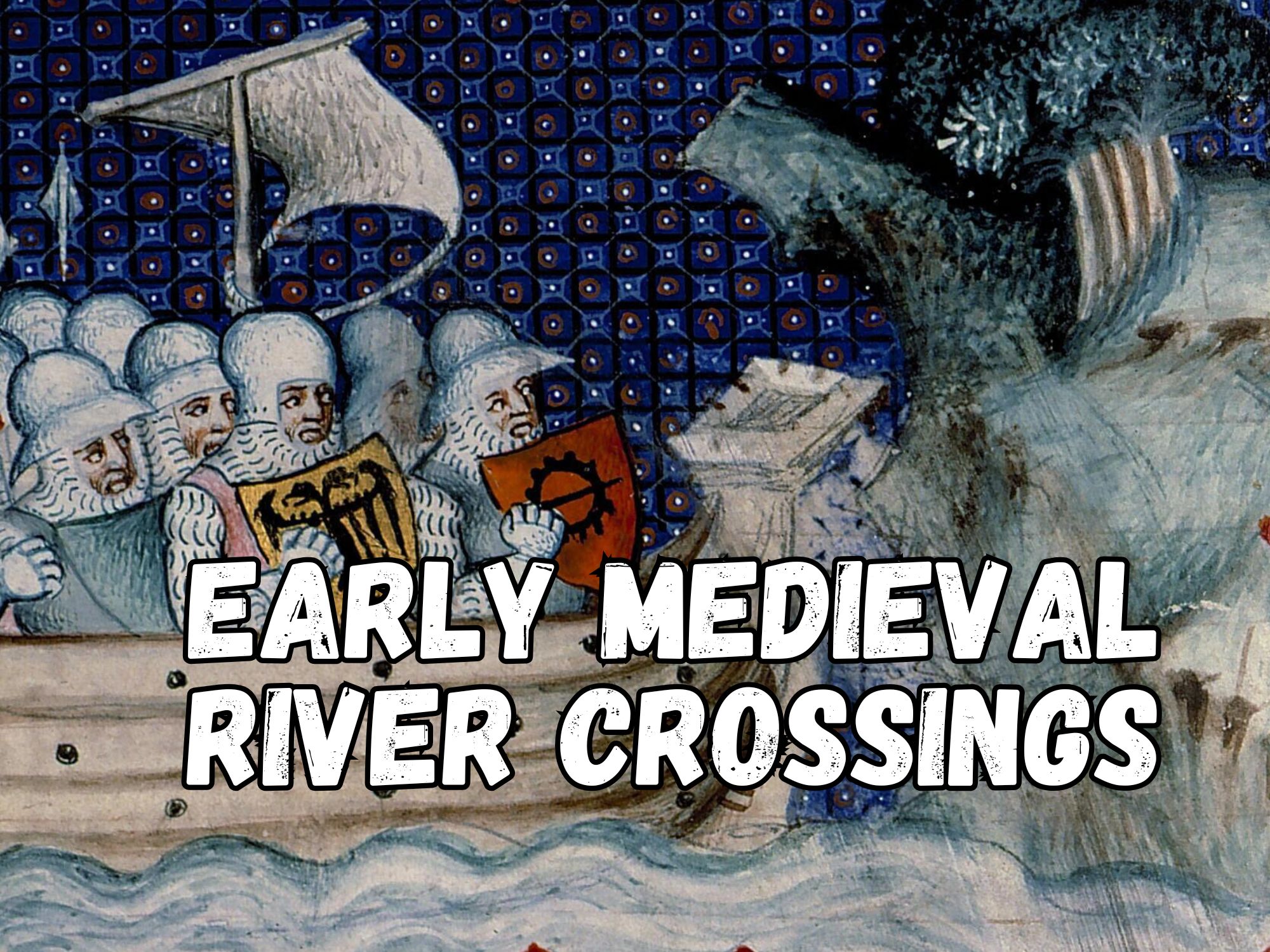
In the early Middle Ages, a river could be as formidable an obstacle as any fortress wall. To cross it in the face of an enemy required not only soldiers, but planning, deception, and logistical preparation on a remarkable scale.
By David Bachrach
Military strategists have once again learned during the ongoing war in Ukraine that attempting to cross a river in the face of active enemy resistance is one of the most difficult tasks undertaken by an army on the offensive. The challenges involved in moving men and equipment across a water barrier are compounded by enemy fire. As John Hosler recently has argued, “gap-crossing operations,” as they are denoted by modern military writers, were just as problematic for armies in the high and late medieval periods. Indeed, the difficulties of forcing a river crossing had pride of place in military manuals dating back to the Hellenistic period and the Roman Principate.
Frontinus and the Logic of Misdirection
The Roman engineer and military officer Sextus Julius Frontinus (40–103 AD) devoted considerable attention to this problem in his Strategemata, a collection of historical accounts about a wide range of military problems. In his section on “leading an army through an area occupied by enemy forces,” Frontinus included a group of examples of military leaders confronted by an enemy on the opposite side of a river that the army had to cross.
One of these examples concerned Alexander the Great’s confrontation with the Indian ruler Porus. Frontinus explained that Alexander had his troops stage several mock crossings in the face of the defenders. These repeated feints led Porus to concentrate his army where Alexander had deployed his decoy forces. After the majority of the Indian army was committed, Alexander led his army upstream to make a crossing and thereby get around the flank of the enemy.
United States Military Academy
Taken together, a careful reader of the various cases treated by Frontinus, including that of Alexander, could discern the basic principle that the attacking force requires an element of misdirection or distraction so that the defenders concentrate their men in the wrong place. A number of examples of forced river crossings undertaken by rulers of the Ottonian dynasty in Germany reveal that they had absorbed Frontinus’s lesson on this point. Indeed, at least in the case of Otto I (936–973) it is possible that the German ruler learned directly from Frontinus’s text, a copy of which he received as a gift from his brother Archbishop Brun of Cologne (954–965).
Otto I at the Recknitz: Feints, Night Bridges, and a Rout
Following his famous victory on the Lechfeld against the Hungarians in August 955, Otto I hurried northeast to deal with an uprising among the Obodrites against German rule. Leading his army from Magdeburg, Otto arrived at the Recknitz on 15 October, where an enormous Obodrite army under the command of their rulers, Nacco and Stoignew, awaited them on the other side of a principal ford over the river. According to our main source, Widukind of Corvey, Otto immediately deployed archers and siege engines to keep the attention of the Obodrites at this location.
Subsequently, under the cover of night, Otto dispatched his frontier field commander, Margrave Gero, with a flying column downstream. Gero’s orders were to construct bridges across the river out of sight or hearing of the enemy. Gero’s men were able to build these temporary bridges very quickly, and by early the next morning the margrave sent a rider to the king to let him know that the project had been completed.
The ability to construct temporary bridges this quickly points to the possession by Otto’s army of a substantial quantity of prefabricated parts, including wooden decking and strut sections, a very large quantity of rope, and likely inflatable animal bladders that gave extra buoyancy to the temporary structure. Given the terrain in the area, it is almost certainly the case that this materiel was carried on packhorses rather than in carts.
As soon as he received a messenger from Gero, Otto dispatched his mounted forces down the river and ordered them to launch a flank attack on the Obodrites. Otto then commanded his foot soldiers to attack across the ford, protected by his archers and engines. Facing an assault to the front and from the flank, the Obodrite forces quickly broke and fled. Prince Stoignew was killed during the rout.
Henry II on the Oder: Holding the Enemy, Finding the Ford
A half century later, Otto I’s great-nephew King Henry II (1002–1024) faced a similar challenge in his 1005 campaign against the Polish duke Boleslav Chrobry (992–1025). Henry’s goal was to drive into the heartland of Boleslav’s territory, and he had advanced all the way to the Oder River. The Polish duke had mobilized a substantial force, which the contemporary writer Thietmar of Merseburg described as an exercitus grandus, albeit not nearly as strong as that of the German king. As the two sides faced each other across the Oder at Krosno Odrzanskie (German Krossen), Boleslav knew that if the Germans were able to cross, he would have to retreat.
King Henry was well aware of his advantage and, according to Thietmar, ordered his men to begin construction of both boats and a bridge to force a crossing. It appears, once again, that the German army was equipped with prefabricated parts. The much greater width of the Oder River as compared with the Recknitz meant that Henry’s troops required an entire week to complete their work. This continuous labor on both bridges and boats also served the purpose of keeping Boleslav’s focus on this point of the river.
In the meantime, Henry dispatched scouts up and down the Oder looking for places where the army could cross by a ford. The scouts were successful, and in the early morning hours of the eighth day of the standoff, Henry dispatched a column to secure a bridgehead on the other side of the river. As soon as he received word from his own scouts that the Germans had crossed, Boleslav retreated from his position, thereby permitting the main element of Henry II’s army to cross the Oder without any opposition. In contrast to the battle of the Recknitz, however, Henry was not able to catch Boleslav’s troops in a pincer, a failure that Thietmar bitterly laments.
Ten years later, in yet another campaign against the Poles, Henry II dispatched three separate columns to invade Boleslav’s territory. The main force, under the German ruler’s direct command, marched from Magdeburg to the Oder and once again confronted a Polish army on the other bank at Krosno Odrzanskie, this time under the command of Boleslav’s son Miesco. Matters worked out very differently on this occasion, however. According to Thietmar, Henry ordered a direct assault on Miesco’s troops and inflicted heavy casualties on them.
Thietmar, who was very careful in his use of numbers and was an eyewitness to this campaign, claimed that 600 Polish men were killed in the battle. He also emphasized that Henry’s men captured the Polish camp intact and obtained a large quantity of plunder. It seems likely, therefore, that having learned from his previous encounter with Boleslav, Henry dispatched a significant force toward the ford that his scouts had discovered ten years earlier and coordinated his attack across the river with the arrival of his men, whom he had dispatched earlier, at the Polish camp
The three examples of forced river crossings by the Ottonian kings make clear that they had developed techniques for dislodging an enemy force from a fixed position. In 955 and 1005, Otto I and Henry II made use of the tactics illuminated by Frontinus in his Strategemata, namely freezing the main enemy force in place while finding a means of crossing the river undetected and catching the opponent in a pincer.
By contrast, Henry II used his knowledge of the local terrain to send part of his army across the Oder unopposed. The German ruler then undertook a crossing in the face of the enemy to freeze them in place, allowing other forces to cross the river unopposed. This approach worked in 1015 because Miesco, unlike his father, was not sufficiently forewarned by his scouts that the Germans were already on his side of the river.
David Bachrach is a Professor at the University of New Hampshire, where he researches medieval military history, particularly in England and Germany.
Click here to read more from David Bachrach
Further Readings:
John D. Hosler, “Gap-Crossing Operations: Medieval and Modern,” Military Review (March-April, 2020), 58-65.
David S. Bachrach, “The Eastern Campaigns of King Henry II of Germany, 1003-1017,” Journal of Medieval Military History 17 (2020), 1-36.
Top Image: Paris. Sainte-Geneviève Library, Ms. 777
Subscribe to Medievalverse
Related Posts