Governed by strict adherence to fixed times, the daily prayers sung by religious men and women were at the heart of monastic life in the Middle Ages. Each day, religious houses would resonate with the unified voices of their faithful inhabitants, who would sing prayers at different hours throughout the day, beginning in the early morning and continuing into the night. Collectively, these prayers were a part of the Divine Office (or the Liturgy of the Hours), a tradition that has endured in select denominations of the Western Christian church to the present day.
Origin of the Divine Office
The custom of singing daily prayers stems from ancient Jewish practices that can be found in Hebrew scripture (or the “Old Testament” as it is called in the Christian Bible). Most notably, the psalms (hymns and poems) of Jewish sacred writings – many of which have traditionally been credited to the hand of King David – prescribe that one should pray in the morning, evening, and at night, which has led to the belief that prayer should occur continuously throughout each day. This is further emphasized by Psalm 119:164a which specifies: “seven times a day I praise you [God].” In addition to the psalms, Jews have long prayed the “Shema” (a prayer that extols God’s majesty and proclaims His nature as one being), which was recited several times daily.
King David playing the harp. Detail from The Alphonso Psalter, c. 1284–1316 – British Library Add MS 24686
In the Christian New Testament, Christ and his followers – who were observant Jews – are described as praying according to the Jewish customs of the time. Following his crucifixion, Christ’s followers participated in everyday communal prayer (there are descriptions of communal prayer among Christians in the book of Acts 1:14, among others). Additionally, repeated throughout the New Testament is the phrase “pray without ceasing,” which further stressed the importance of continuing the legacy of daily prayer while proselytizing to those outside of the Jewish faith. As Christianity developed into an independent religion apart from Judaism, the Mass, which was attended by both laity and clergy, frequently amalgamated prayer and music, but for those who lived a life rooted in monasticism, joining music with prayer was particularly important to worship.
Christian monasticism can be traced back as early as the second century AD in Egypt and other areas in the Levant. The earliest monastics were hermits who lived lives of solitude in the desert. By the third century AD, a significant number of ascetics known as the Desert Fathers emerged who lived in isolation and abandoned all worldly possessions in exchange for a contemplative life of continuous prayer, which included the singing of psalms.
Saint Anthony the Great and Saint Paul the Anchorite. Saint Paul (AD 227–341, the first Christian hermit) and Saint Anthony (AD 251–356, The Father of All Monks) are two of the earliest Desert Fathers. This painting by Diego Velázquez (1599–1660) depicts the two conversing in the desert in Egypt. Saint Anthony dreamt about Saint Paul and sought him out in the desert, where they talked for one day and one night. Saint Paul was 113 years old at the time of their meeting and had subsisted solely on fruit from a nearby tree and the bread brought to him every day by a raven. Currently housed at the Museo del Prado. – Wikimedia Commons.
Over time, the Desert Fathers attracted followers who wished to live a similar life of devotion. As the number of followers grew, the Desert Fathers formed small communal dwellings, which served as the earliest versions of Christian monasteries. Saint Pachomius the Great is credited with establishing the first monastery in Egypt in the fourth century (the monastery housed both men and women).
Singing the Hours of the Divine Office
As the appeal of monastic life grew and spread to the Western world, the need for secluded indoor living quarters (that were cloistered from the secular world) increased, since the extreme isolation that the Desert Fathers experienced in the desert was not as accessible or feasible in Europe. Eventually, the increase of physical monastic structures, the implementation of monastic regulations, and the daily practice of singing prayers paved the way for the Divine Office.
In c. 530, when Saint Benedict of Nursia penned his directive for monastic living called The Rule of Saint Benedict (Saint Benedict was the head of a monastery – called an “abbot” – in Monte Cassino, Italy), instructions for singing prayers, notably the psalms, were further codified and recorded.
Accordingly, praying the Divine Office and singing the accompanying psalms were organized within the twenty-four hours of each day. The canonical hours of prayer were named and prayed as follows:
Matins occurred at 2 a.m.
Lauds was prayed at dawn
Prime at 6 a.m.
Terce at 9 a.m.
Sext at noon
None at 3 p.m.
Vespers at sunset
Compline was prayed prior to sleeping.
In the following passage, we can see an excerpt from The Rule of Benedict, in which the saint outlines the procedures for singing and prayer on Sunday nights:
On Sundays, the brothers should rise earlier for the night office for which the following arrangements apply. When the six psalms and the verse have been chanted and everyone is duly sitting in their stalls in the correct order, the four readings with their responsories should be read out from the book as we stated earlier. Only with the fourth responsory should the reader chant the Gloria. As soon as he begins everyone should stand up out of respect. After these readings the remaining six psalms should follow in order, together with their antiphons (as in the case of the earlier ones) and a verse. Then another four readings should be read with their responsories, in the same order as above. After this there should be three canticles from the prophets, as decided by the abbot, and these should be chanted with the Alleluia. When the verse has been said and the abbot has given the blessing, another four readings from the New Testament should be read, in the same order as above. After the fourth responsory the abbot should begin the hymn “Te Deum laudamus.” When this has been sung right through, the abbot should read the lesson from the Gospel while everyone stands out of reverence and fear. At the end of the reading everyone should respond “Amen.”
Then the abbot should immediately follow with the hymn “Te decet laus,” and after he has given the blessing Lauds should begin. This order for the night office should be kept on Sundays all year round both in summer and winter, unless the monks happen to be a bit late getting up (which God forbid) and have to shorten the readings or responsories in some way. Great care must be taken that this does not happen, but if it does, then the one whose carelessness was responsible must make amends to God in the oratory. ~ From The Rule of Benedict, translated with an introduction and notes by Carolinne White
As indicated in this quote from The Rule of Benedict, time was not only imperative to the inner workings of monastic life, but it strongly presided over all prayers and songs that were chanted each day.
Dr. Sonja Maurer-Dass is a Canadian musicologist and harpsichordist. She holds a PhD in Musicology from The University of Western Ontario (London, Ontario, Canada) and a master’s degree in Musicology specializing in late medieval English music from York University (Toronto, Ontario, Canada). Sonja has taught Baroque music history at McMaster University (Hamilton, Ontario, Canada) and undergraduate tutorials on different topics in musicology and music theory at The University of Western Ontario. Her work has been published in the Medieval Magazine, Ancient History Magazine, Ceræ: An Australasian Journal of Medieval and Early Modern Studies, and Medievalists.net
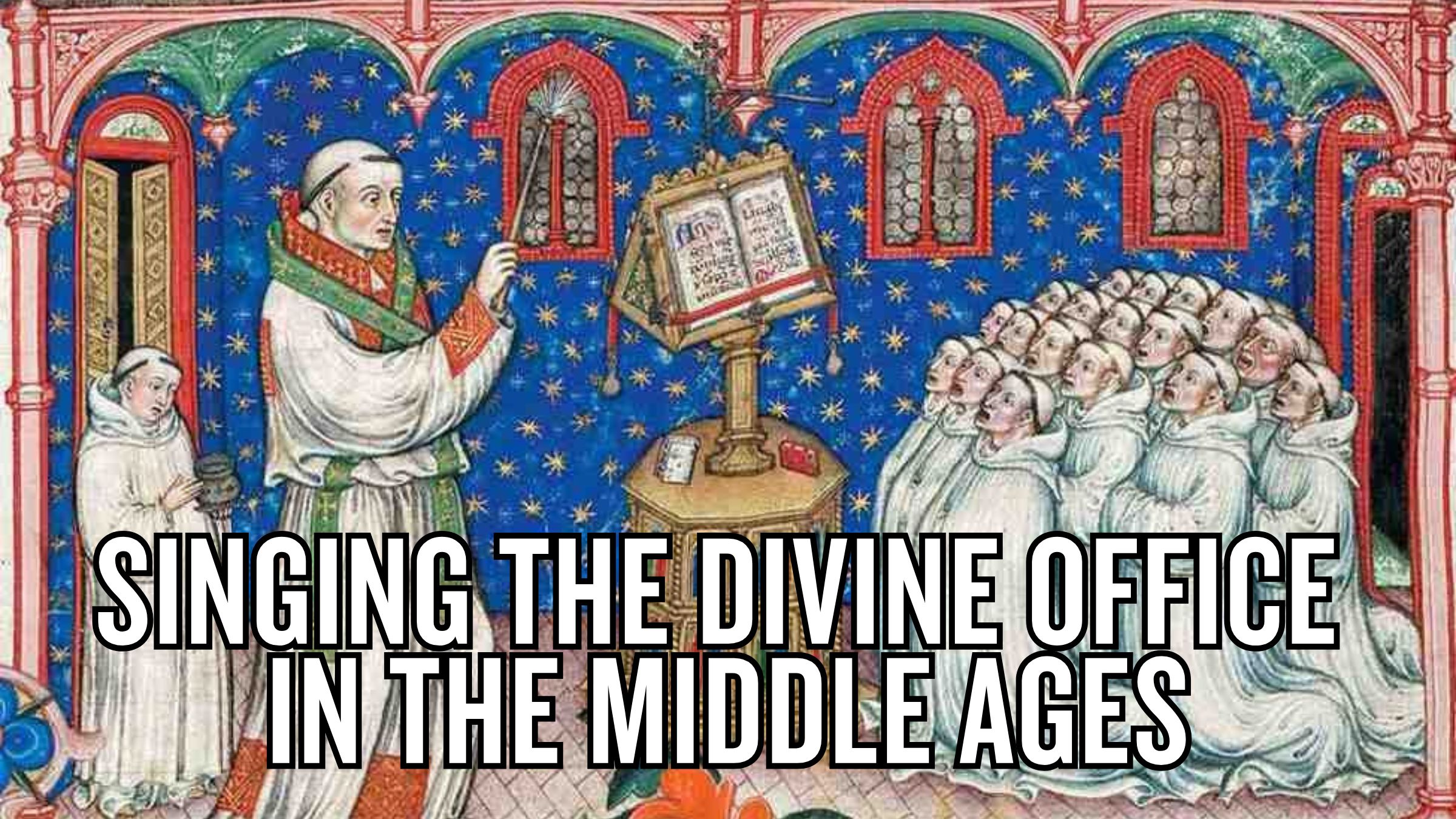
Top Image: Monks singing the office in the Olivetan Gradual. 15th-century manuscript of an illuminated and decorated gradual made for use in the choir of the Olivetan monks of the monastery of Santa Maria di Baggio near Milan, Italy – Beinecke MS 1184

By Sonja Maurer-Dass
Governed by strict adherence to fixed times, the daily prayers sung by religious men and women were at the heart of monastic life in the Middle Ages. Each day, religious houses would resonate with the unified voices of their faithful inhabitants, who would sing prayers at different hours throughout the day, beginning in the early morning and continuing into the night. Collectively, these prayers were a part of the Divine Office (or the Liturgy of the Hours), a tradition that has endured in select denominations of the Western Christian church to the present day.
Origin of the Divine Office
The custom of singing daily prayers stems from ancient Jewish practices that can be found in Hebrew scripture (or the “Old Testament” as it is called in the Christian Bible). Most notably, the psalms (hymns and poems) of Jewish sacred writings – many of which have traditionally been credited to the hand of King David – prescribe that one should pray in the morning, evening, and at night, which has led to the belief that prayer should occur continuously throughout each day. This is further emphasized by Psalm 119:164a which specifies: “seven times a day I praise you [God].” In addition to the psalms, Jews have long prayed the “Shema” (a prayer that extols God’s majesty and proclaims His nature as one being), which was recited several times daily.
In the Christian New Testament, Christ and his followers – who were observant Jews – are described as praying according to the Jewish customs of the time. Following his crucifixion, Christ’s followers participated in everyday communal prayer (there are descriptions of communal prayer among Christians in the book of Acts 1:14, among others). Additionally, repeated throughout the New Testament is the phrase “pray without ceasing,” which further stressed the importance of continuing the legacy of daily prayer while proselytizing to those outside of the Jewish faith. As Christianity developed into an independent religion apart from Judaism, the Mass, which was attended by both laity and clergy, frequently amalgamated prayer and music, but for those who lived a life rooted in monasticism, joining music with prayer was particularly important to worship.
Christian monasticism can be traced back as early as the second century AD in Egypt and other areas in the Levant. The earliest monastics were hermits who lived lives of solitude in the desert. By the third century AD, a significant number of ascetics known as the Desert Fathers emerged who lived in isolation and abandoned all worldly possessions in exchange for a contemplative life of continuous prayer, which included the singing of psalms.
Over time, the Desert Fathers attracted followers who wished to live a similar life of devotion. As the number of followers grew, the Desert Fathers formed small communal dwellings, which served as the earliest versions of Christian monasteries. Saint Pachomius the Great is credited with establishing the first monastery in Egypt in the fourth century (the monastery housed both men and women).
Singing the Hours of the Divine Office
As the appeal of monastic life grew and spread to the Western world, the need for secluded indoor living quarters (that were cloistered from the secular world) increased, since the extreme isolation that the Desert Fathers experienced in the desert was not as accessible or feasible in Europe. Eventually, the increase of physical monastic structures, the implementation of monastic regulations, and the daily practice of singing prayers paved the way for the Divine Office.
In c. 530, when Saint Benedict of Nursia penned his directive for monastic living called The Rule of Saint Benedict (Saint Benedict was the head of a monastery – called an “abbot” – in Monte Cassino, Italy), instructions for singing prayers, notably the psalms, were further codified and recorded.
Accordingly, praying the Divine Office and singing the accompanying psalms were organized within the twenty-four hours of each day. The canonical hours of prayer were named and prayed as follows:
Matins occurred at 2 a.m.
Lauds was prayed at dawn
Prime at 6 a.m.
Terce at 9 a.m.
Sext at noon
None at 3 p.m.
Vespers at sunset
Compline was prayed prior to sleeping.
In the following passage, we can see an excerpt from The Rule of Benedict, in which the saint outlines the procedures for singing and prayer on Sunday nights:
On Sundays, the brothers should rise earlier for the night office for which the following arrangements apply. When the six psalms and the verse have been chanted and everyone is duly sitting in their stalls in the correct order, the four readings with their responsories should be read out from the book as we stated earlier. Only with the fourth responsory should the reader chant the Gloria. As soon as he begins everyone should stand up out of respect. After these readings the remaining six psalms should follow in order, together with their antiphons (as in the case of the earlier ones) and a verse. Then another four readings should be read with their responsories, in the same order as above. After this there should be three canticles from the prophets, as decided by the abbot, and these should be chanted with the Alleluia. When the verse has been said and the abbot has given the blessing, another four readings from the New Testament should be read, in the same order as above. After the fourth responsory the abbot should begin the hymn “Te Deum laudamus.” When this has been sung right through, the abbot should read the lesson from the Gospel while everyone stands out of reverence and fear. At the end of the reading everyone should respond “Amen.”
Then the abbot should immediately follow with the hymn “Te decet laus,” and after he has given the blessing Lauds should begin. This order for the night office should be kept on Sundays all year round both in summer and winter, unless the monks happen to be a bit late getting up (which God forbid) and have to shorten the readings or responsories in some way. Great care must be taken that this does not happen, but if it does, then the one whose carelessness was responsible must make amends to God in the oratory. ~ From The Rule of Benedict, translated with an introduction and notes by Carolinne White
As indicated in this quote from The Rule of Benedict, time was not only imperative to the inner workings of monastic life, but it strongly presided over all prayers and songs that were chanted each day.
Dr. Sonja Maurer-Dass is a Canadian musicologist and harpsichordist. She holds a PhD in Musicology from The University of Western Ontario (London, Ontario, Canada) and a master’s degree in Musicology specializing in late medieval English music from York University (Toronto, Ontario, Canada). Sonja has taught Baroque music history at McMaster University (Hamilton, Ontario, Canada) and undergraduate tutorials on different topics in musicology and music theory at The University of Western Ontario. Her work has been published in the Medieval Magazine, Ancient History Magazine, Ceræ: An Australasian Journal of Medieval and Early Modern Studies, and Medievalists.net
Click here to read more from Sonja Maurer-Dass
Top Image: Monks singing the office in the Olivetan Gradual. 15th-century manuscript of an illuminated and decorated gradual made for use in the choir of the Olivetan monks of the monastery of Santa Maria di Baggio near Milan, Italy – Beinecke MS 1184
Subscribe to Medievalverse
Related Posts