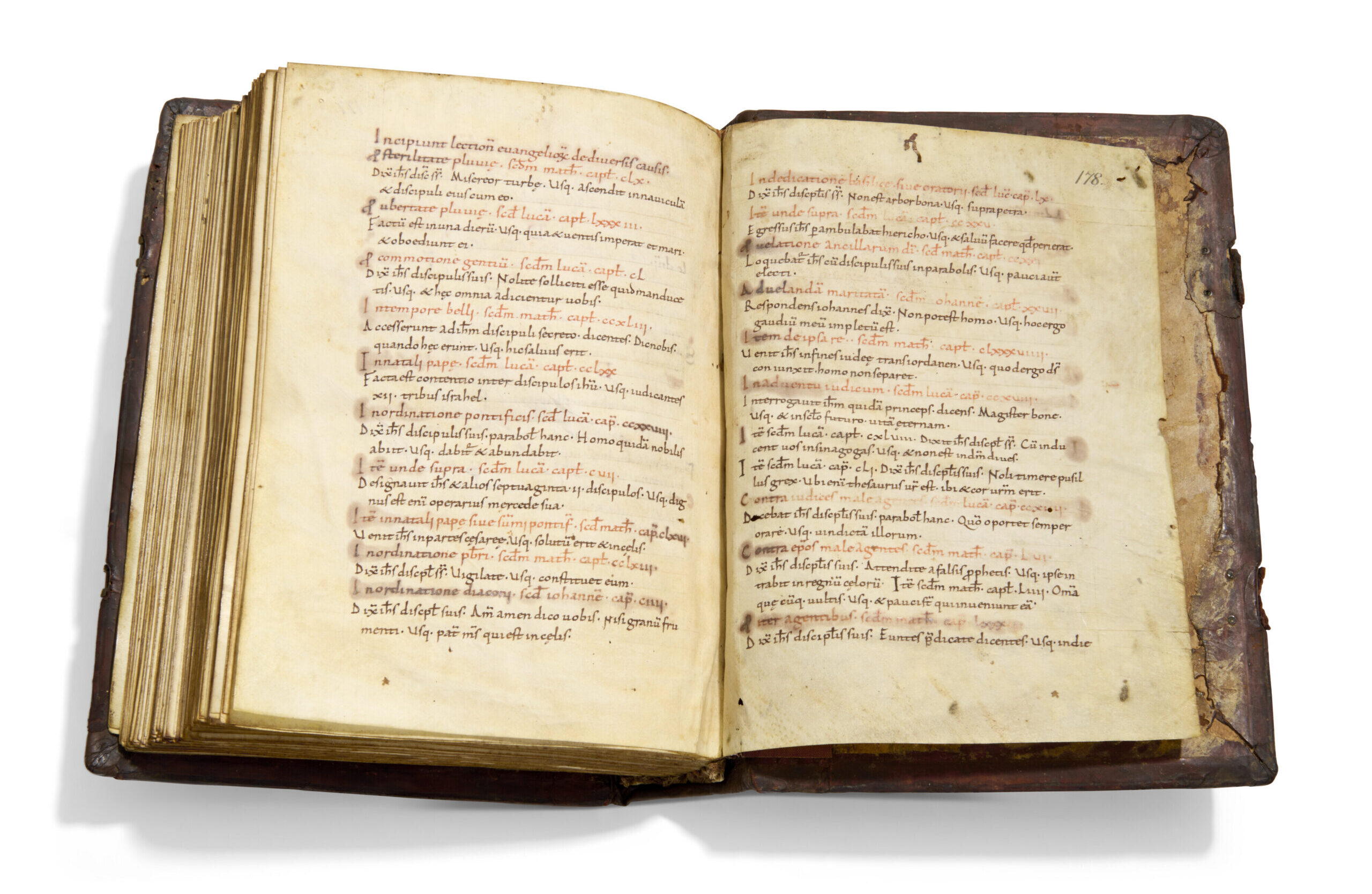
One of the rarest early medieval manuscripts to appear on the market in a century — a thousand-year-old Gospel book potentially produced by a community of women in 10th-century Germany — will be offered at Christie’s London on December 10th. Estimated at $880,000 to $1.26 million (£700,000–£1 million), the manuscript is being hailed as one of the most significant medieval discoveries in decades.
The Gospel, written in elegant Carolingian minuscule, is closely associated with Essen Abbey, a renowned centre of women’s scholarship during the early Middle Ages. Only a handful of female scriptoria are known across medieval Europe. This manuscript may be the first Gospel associated with a women’s house to reach public auction in the modern era.
A Rare Witness to Medieval Women’s Literary Culture
The text contains prayers “for the veiling of handmaidens of God”, language used for women taking religious vows. This strongly suggests the manuscript was created by canonesses—aristocratic women who lived in religious communities while maintaining wealth, status, and high levels of literacy. Their scriptoria played a crucial role in preserving and transmitting learned culture during the early medieval period.
Rosamond McKitterick, Professor Emerita of Medieval History at the University of Cambridge, notes: “This is a wonderful codex, carefully presented and beautifully written very early in the 10th century. It deserves further serious study.”
The rediscovery of the Gospel—long held in the Chicago Theological Seminary’s Hammond Library but not identified as an early medieval manuscript until recently—marks a major addition to the evidence for women’s scribal activity in Europe around the year 900.
On the Market for the First Time in a Century
Photos courtesy Christie’s London
Fewer than ten Latin Gospel manuscripts from the 10th century or earlier have appeared at public auction in the last hundred years, and none with a documented link to a female scriptorium. The codex, written by at least two scribes, survives in a 16th-century blind-stamped binding from a known German workshop and remains in excellent condition with notably wide margins.
Christie’s specialist Eugenio Donadoni explains the excitement surrounding its emergence: “It is an extraordinary privilege to have a manuscript of this importance at Christie’s — and with such a compelling connection to women’s scholarship. To encounter a thousand-year-old Gospel so well preserved, and so eloquent in what it reveals about the intellectual and spiritual lives of medieval women, is truly exciting. This rediscovery sheds new light on the role of female communities in shaping early European culture, and its appearance at auction offers collectors and institutions a once-in-a-generation opportunity to engage directly with that remarkable history.”
Tracing the Gospel’s Origins
Scholarly assessment places the manuscript’s production in the North Rhine region around the year 900. The distinctive script, use of particular abbreviation signs, and unusual letter forms offer strong parallels with other known Essen manuscripts, including a 10th-century Missal now housed in Düsseldorf.
Founded c. 845, Essen Abbey became one of the most influential centres of female monastic culture in the Carolingian and Ottonian worlds. Supported by the Liudolfing dynasty — the family of the future emperors — the abbey developed into a highly productive scriptorium and a guardian of some of the finest manuscripts and treasures of the age.
The structure and contents of the Gospel volume reflect a sophisticated scribal environment. Despite the loss of several leaves over the centuries, it preserves:
Prologues, capitula, and full texts of the Gospels of Matthew, Mark, Luke, and John (each missing only its initial opening).
A Roman Capitulary of Gospel Lessons.
Twenty-five votive masses, closely aligned with other major Carolingian Gospel books from Corbie, Lyon, and Lotharingia.
Its format and quality suggest it may have been a prestigious personal Gospel, possibly linked to an early abbess such as Wicburg (c. 896–906).
A Manuscript with an Eventful History
After leaving Essen centuries earlier, the Gospel appeared in the 19th century in the collection of German theologian August Friedrich Christian Vilmar. It was sold in 1869 and eventually entered the Chicago Theological Seminary, where it remained largely unnoticed as a major early medieval artefact. Its full significance has only recently been recognised.
Christie’s notes that the nail-holes on the first flyleaf suggest it once possessed a treasure binding, perhaps of metalwork, underscoring the manuscript’s importance in its original context.
The manuscript will be on public exhibition at Christie’s London from December 6–10, ahead of the sale. It is one of a few dozen medieval manuscripts and folios that are going up for auction – click here to see the complete list.

One of the rarest early medieval manuscripts to appear on the market in a century — a thousand-year-old Gospel book potentially produced by a community of women in 10th-century Germany — will be offered at Christie’s London on December 10th. Estimated at $880,000 to $1.26 million (£700,000–£1 million), the manuscript is being hailed as one of the most significant medieval discoveries in decades.
The Gospel, written in elegant Carolingian minuscule, is closely associated with Essen Abbey, a renowned centre of women’s scholarship during the early Middle Ages. Only a handful of female scriptoria are known across medieval Europe. This manuscript may be the first Gospel associated with a women’s house to reach public auction in the modern era.
A Rare Witness to Medieval Women’s Literary Culture
The text contains prayers “for the veiling of handmaidens of God”, language used for women taking religious vows. This strongly suggests the manuscript was created by canonesses—aristocratic women who lived in religious communities while maintaining wealth, status, and high levels of literacy. Their scriptoria played a crucial role in preserving and transmitting learned culture during the early medieval period.
Rosamond McKitterick, Professor Emerita of Medieval History at the University of Cambridge, notes: “This is a wonderful codex, carefully presented and beautifully written very early in the 10th century. It deserves further serious study.”
The rediscovery of the Gospel—long held in the Chicago Theological Seminary’s Hammond Library but not identified as an early medieval manuscript until recently—marks a major addition to the evidence for women’s scribal activity in Europe around the year 900.
On the Market for the First Time in a Century
Fewer than ten Latin Gospel manuscripts from the 10th century or earlier have appeared at public auction in the last hundred years, and none with a documented link to a female scriptorium. The codex, written by at least two scribes, survives in a 16th-century blind-stamped binding from a known German workshop and remains in excellent condition with notably wide margins.
Christie’s specialist Eugenio Donadoni explains the excitement surrounding its emergence: “It is an extraordinary privilege to have a manuscript of this importance at Christie’s — and with such a compelling connection to women’s scholarship. To encounter a thousand-year-old Gospel so well preserved, and so eloquent in what it reveals about the intellectual and spiritual lives of medieval women, is truly exciting. This rediscovery sheds new light on the role of female communities in shaping early European culture, and its appearance at auction offers collectors and institutions a once-in-a-generation opportunity to engage directly with that remarkable history.”
Tracing the Gospel’s Origins
Scholarly assessment places the manuscript’s production in the North Rhine region around the year 900. The distinctive script, use of particular abbreviation signs, and unusual letter forms offer strong parallels with other known Essen manuscripts, including a 10th-century Missal now housed in Düsseldorf.
Founded c. 845, Essen Abbey became one of the most influential centres of female monastic culture in the Carolingian and Ottonian worlds. Supported by the Liudolfing dynasty — the family of the future emperors — the abbey developed into a highly productive scriptorium and a guardian of some of the finest manuscripts and treasures of the age.
The structure and contents of the Gospel volume reflect a sophisticated scribal environment. Despite the loss of several leaves over the centuries, it preserves:
Its format and quality suggest it may have been a prestigious personal Gospel, possibly linked to an early abbess such as Wicburg (c. 896–906).
A Manuscript with an Eventful History
After leaving Essen centuries earlier, the Gospel appeared in the 19th century in the collection of German theologian August Friedrich Christian Vilmar. It was sold in 1869 and eventually entered the Chicago Theological Seminary, where it remained largely unnoticed as a major early medieval artefact. Its full significance has only recently been recognised.
Christie’s notes that the nail-holes on the first flyleaf suggest it once possessed a treasure binding, perhaps of metalwork, underscoring the manuscript’s importance in its original context.
The manuscript will be on public exhibition at Christie’s London from December 6–10, ahead of the sale. It is one of a few dozen medieval manuscripts and folios that are going up for auction – click here to see the complete list.
Subscribe to Medievalverse
Related Posts