The only complete surviving copy of Richard Rolle’s original version of Emendatio vitae (The Emending of Life)—one of late medieval England’s most widely read spiritual works—has been identified by Dr Timothy Glover. The finding suggests that every other surviving copy preserves an abridged form of the text produced by someone else, restoring Rolle’s work in full and offering new evidence for how his writing first circulated.
In a study published in Mediaeval Studies, Glover argues that this manuscript preserves Rolle’s complete original draft rather than a later, expanded version. It also contains distinctive fingerprints of Rolle’s style and vocabulary, including the unusual coined term “melliphono” (“sweet-sounding”), which Glover says helps confirm that this is the author’s own version of the text.
The manuscript is Shrewsbury School’s “MS 25”, a fourteenth-century copy long known to scholarship but, according to Glover, misunderstood—especially after a 2009 study concluded it was a text with added passages and that its dedication was forged. Glover’s research challenges those conclusions, arguing that the Shrewsbury manuscript instead preserves the earliest and fullest form of Emendatio vitae now known to survive.
A rare line to a neglected medieval author
Chapter on prayer in Richard Rolle’s Emendatio vitae – Title ‘De oracione’ (‘On Prayer’) appears in the left-hand margin – Shrewsbury School MS 25. Image credit: Timothy Glover
Richard Rolle (c.1300–1349) was a spiritual writer whose devotional works made him one of the most widely read authors of late medieval England. Often described as a medieval mystic—associated with the tradition later called the “Middle English Mystics”—Rolle wrote about prayer, contemplation, and the experience of divine love in both Latin and English. While other mystics like Julian of Norwich and Margery Kempe are widely published and frequently discussed, Rolle has often been treated as a lesser figure—despite the extraordinary reach his writing had in the later Middle Ages.
In fact, Rolle was the most widely circulated English writer of the late medieval period. More than 650 manuscripts containing his work survive today, compared to roughly 144 for Geoffrey Chaucer. How a hermit became England’s most widely read author—during a period shaped by upheaval and crisis—has long been a puzzle for scholars. Glover’s discovery, and his argument that one manuscript preserves Rolle’s complete original text, brings that question into sharper focus.
“I’m the only person since the Middle Ages to have read this knowing that it’s Rolle’s original,” Dr Glover said. “It’s such an important manuscript and it offers a direct connection with an author who deserves far greater recognition.”
He also points out that Rolle’s appeal was not limited to elite Latin readers. “Medieval people struggled with distractions as we do today. They were trying to still their wandering minds. Rolle offered practical strategies to help, and some people treated him like a saint for it.”
Richard Rolle, “Richard the hermit,” and the reach of his writing
Rolle lived as a hermit in Yorkshire and may have died from plague. In the Middle Ages he was known as “Richard the hermit” or “Richard of Hampole.” Hampole was the site of a Cistercian nunnery in South Yorkshire, where Rolle is thought to have mentored nuns; it may also have been the location of his burial or shrine.
Although he mostly wrote in Latin, Rolle was among the earliest authors after the Norman Conquest to write about advanced Christian teachings in English. His best known English work is The Form of Living. In the decades after his death, his sophisticated religious texts gained an ever-growing readership. He was prayed to and developed a local following as a saint, despite never quite becoming one.
That combination—Latin learning, English spiritual instruction, and a posthumous reputation for holiness—helped place Rolle at the centre of late medieval devotional reading. Emendatio vitae became his most widely circulated text.
What Emendatio vitae is—and what this manuscript changes
Chapter on Avoiding Sin in Emendatio vitae – Title ‘De institutione vite’ (‘On the Disciplining of Life’) appears in the left-hand margin – Shrewsbury School MS 25. Image credit: Timothy Glover
Emendatio vitae offers Rolle’s account of the spiritual life in twelve stages, beginning with the most basic: turning towards God and away from the world. It then moves through prayer and meditation to contemplation and the love of God. Rolle writes about contempt for worldliness, but also offers pragmatic advice on living virtuously, dealing with sin, praying, and meditating.
Glover’s interest in early copies of Rolle’s writing began with a practical problem: Rolle rarely tells readers what he has been reading, and as a hermit he would not have had easy access to an institutional library. “As a hermit, Rolle probably didn’t have a regular access to an institutional library and he rarely tells us what he’s been reading. To try to find out, I went looking for early copies of his work.”
Shrewsbury School’s “MS 25” was on his list. Like virtually all medieval manuscripts, it was not physically written out by the author himself; this copy appears to have been made several decades after Rolle’s death. The crucial point, Glover argues, is that unlike all other surviving copies, this manuscript preserves Rolle’s complete original text—while all others transmit an abridgement made by someone else.
If correct, the implications are significant. Modern readers encountering Emendatio vitae in print are not reading Rolle’s full text, and in many cases are not reading Rolle’s most distinctive language. The Shrewsbury manuscript, Glover contends, restores what was cut away.
The historian’s “Eureka moment”
One of the turning points in Glover’s work came after a full day photographing the manuscript. Only later did he notice something appended at the end—an excerpt describing six different kinds of dreams. He had seen a closely related passage in Rolle’s English writing.
“I spent all day taking photos of the manuscript so it wasn’t until I got back to the hostel that I noticed an excerpt attached at the end which described six different kinds of dreams. I’d seen something similar in one of Rolle’s English texts, The Form of Living, so I compared them and realised they were identical. That was my Eureka moment.”
The manuscript had been known to scholarship since the 1920s, but later debate shaped how it was interpreted. In 2009, a German study compared all 120 copies of the text in an effort to reconstruct the original form. It concluded that the Shrewsbury manuscript was a copy with extra passages added by an unknown individual, and that its dedication was a forgery. Glover’s study argues both claims are incorrect.
The “sweet-sounding” smoking gun: melliphono
Melliphono appears in the right column split across lines 16-17 -Emendatio vitae – Shrewsbury School MS 25. Image credit: Timothy Glover
Glover’s case rests on a broad set of textual clues—what he calls Rolle’s fingerprints. Among them is one striking piece of evidence: the word melliphono.
Glover argues that “the presence of the word ‘melliphono’ is a smoking gun that Rolle wrote this version of the text.”
Rolle invented the word melliphono to mean “sweet-sounding,” and it appears in several of his writings. The likelihood that a later scribe independently created and inserted the same coined term is, Glover says, “vanishingly small”.
For Glover, melliphono is not simply a quirky word. It connects directly to Rolle’s distinctive spiritual vocabulary—especially his insistence that the highest experience of God can be understood as song.
“Melliphono is a very Rolle word, he’s all about this idea of spiritual song and experience of angelic heavenly music being the highest experience of God. He had an enormous Latin vocabulary and creatively deployed a huge range of very specific terms for music to explain his ultimate experience of God.”
“He’s using music as a metaphor for an inner experience. Like Augustine, he was sceptical of audible music and singing. Rolle talks of praying and having this experience of hearing music as if from above but also welling up inside him, and he says his meditation becomes song. He’s describing a free-flowing experience of divine love.”
A dedication to “William” and the question of Rolle’s connections
Dedication: The word ‘Willelme’ appears over the line, six lines down from the top – Shrewsbury School MS 25. Image credit: Timothy Glover
The manuscript’s dedication to “William” is another key point in Glover’s argument. He is convinced the dedication is authentic and written by Rolle, noting that its wording closely resembles Rolle’s dedication to Margaret Kirkby—an anchorite and previously a Hampole nun—in The Form of Living.
Translated into English, the dedication reads:
‘Behold, William, in a few words I have described the form of living. If you wish to follow it, without doubt you will attain great perfection. And, when it has been well for you, remember me, who spurred you on (to the extent that I could) so that it would turn out well for you.’
“William” was a common medieval name, but Glover suggests a likely candidate: a monk from Yorkshire named William Stoups. Glover notes that we only know the names of two associates of Rolle—Margaret Kirkby and a William Stoups—and that a collection of Rolle’s writing that made it to Prague in the early fifteenth century contains marginalia claiming Stoups translated Rolle’s English into Latin. That claim is inaccurate (Rolle wrote his own Latin), but it strongly implies that Stoups and Rolle knew each other, and that Stoups played some role in the transmission of his work.
Glover also points to previous research by Professor Ralph Hanna, who argued that Stoups is an unusual name unlikely to have been invented, that there was a Stoups family in Yorkshire in the period (including one called William), and that he may have been a monk at Meaux Abbey.
“We can’t be certain but it is a striking coincidence,” Glover explains. “The possibility that Rolle dedicated this text to William Stoups adds to this sense that he was much better connected than we’ve previously assumed. He had human contact and this helped to ensure that his writings travelled a long way and reached many more people.
“Rolle has been cast as a bad hermit, an isolated hostile figure living an unconventional religious life. The possibility that a monk at a wealthy abbey would go to him for spiritual guidance reinforces the sense that actually he was accepted as an authority.”
If Rolle’s audience included a monk linked to a wealthy abbey, it offers a plausible mechanism for how a hermit’s writing could travel so far, so quickly—and help explain his remarkable manuscript afterlife.
Restoring Rolle’s craft and originality
Dr Timothy Glover – photo courtesy University of Cambridge
Glover argues that versions of Emendatio vitae in print today lack many of Rolle’s original sentences. As scribes copied the abridged text, they also replaced much of Rolle’s more unusual and creative language with something more conventional.
“Someone cut out lots of Rolle’s original words,” Glover said. “Reading Rolle’s original restores his craft and creativity.”
The Shrewsbury manuscript also suggests Rolle was reading widely and that he often appended excerpts to his texts. Glover argues that this habit has implications beyond Emendatio vitae, because it shaped Rolle’s English writing and influenced a tradition of women’s religious writing that developed from it.
Glover’s assessment of Rolle as an author is candid—and ultimately admiring. “I admire Rolle as a writer,” Glover said. “He was a messy writer. He didn’t always write in a very poetic way but when he did, he rivals the great Latin religious writers of the Middle Ages.”
Rolle’s tone, Glover notes, can be aggressive or defensive, but it can also be extraordinarily generous. Rolle aimed to write for all, “for the simple and the untaught”. In Emendatio vitae, he insisted that “the virtue of love is worth incomparably more than all abstinence or fasting or other works.”
At the heart of Rolle’s Latin experimentation is his conviction that the highest experience of God is an experience of song—an inner music that words can only partly capture. Rolle’s own language pushes toward poetry in an effort to express that experience, as this example shows:
‘Make my mind drunk on the boiling wine of your honeysounding sweetness’.
Dr Glover is completing a book about Richard Rolle, and his work on Shrewsbury School’s MS 25 may ensure that future readers encounter Rolle not only as a name attached to hundreds of manuscripts, but as a distinctive medieval writer whose full voice has, until now, been preserved in just one surviving copy.
Timothy Glover’s article, “The Original Text, Recipient, and Manuscript Presentation of Richard Rolle’s Emendatio vitae,” is published in Mediaeval Studies. You can get a copy through the Pontifical Institute of Mediaeval Studies or access the article on Érudit.

The only complete surviving copy of Richard Rolle’s original version of Emendatio vitae (The Emending of Life)—one of late medieval England’s most widely read spiritual works—has been identified by Dr Timothy Glover. The finding suggests that every other surviving copy preserves an abridged form of the text produced by someone else, restoring Rolle’s work in full and offering new evidence for how his writing first circulated.
In a study published in Mediaeval Studies, Glover argues that this manuscript preserves Rolle’s complete original draft rather than a later, expanded version. It also contains distinctive fingerprints of Rolle’s style and vocabulary, including the unusual coined term “melliphono” (“sweet-sounding”), which Glover says helps confirm that this is the author’s own version of the text.
The manuscript is Shrewsbury School’s “MS 25”, a fourteenth-century copy long known to scholarship but, according to Glover, misunderstood—especially after a 2009 study concluded it was a text with added passages and that its dedication was forged. Glover’s research challenges those conclusions, arguing that the Shrewsbury manuscript instead preserves the earliest and fullest form of Emendatio vitae now known to survive.
A rare line to a neglected medieval author
Richard Rolle (c.1300–1349) was a spiritual writer whose devotional works made him one of the most widely read authors of late medieval England. Often described as a medieval mystic—associated with the tradition later called the “Middle English Mystics”—Rolle wrote about prayer, contemplation, and the experience of divine love in both Latin and English. While other mystics like Julian of Norwich and Margery Kempe are widely published and frequently discussed, Rolle has often been treated as a lesser figure—despite the extraordinary reach his writing had in the later Middle Ages.
In fact, Rolle was the most widely circulated English writer of the late medieval period. More than 650 manuscripts containing his work survive today, compared to roughly 144 for Geoffrey Chaucer. How a hermit became England’s most widely read author—during a period shaped by upheaval and crisis—has long been a puzzle for scholars. Glover’s discovery, and his argument that one manuscript preserves Rolle’s complete original text, brings that question into sharper focus.
“I’m the only person since the Middle Ages to have read this knowing that it’s Rolle’s original,” Dr Glover said. “It’s such an important manuscript and it offers a direct connection with an author who deserves far greater recognition.”
He also points out that Rolle’s appeal was not limited to elite Latin readers. “Medieval people struggled with distractions as we do today. They were trying to still their wandering minds. Rolle offered practical strategies to help, and some people treated him like a saint for it.”
Glover published his findings while working at Corpus Christi College at the University of Cambridge, and has since become a Postdoctoral Fellow at the University of Bergen. Earlier this year he curated the exhibition ‘Ordinary Encounters with Medieval Manuscripts: Practical Books of Pastoral Care‘ at the Parker Library.
Richard Rolle, “Richard the hermit,” and the reach of his writing
Rolle lived as a hermit in Yorkshire and may have died from plague. In the Middle Ages he was known as “Richard the hermit” or “Richard of Hampole.” Hampole was the site of a Cistercian nunnery in South Yorkshire, where Rolle is thought to have mentored nuns; it may also have been the location of his burial or shrine.
Although he mostly wrote in Latin, Rolle was among the earliest authors after the Norman Conquest to write about advanced Christian teachings in English. His best known English work is The Form of Living. In the decades after his death, his sophisticated religious texts gained an ever-growing readership. He was prayed to and developed a local following as a saint, despite never quite becoming one.
That combination—Latin learning, English spiritual instruction, and a posthumous reputation for holiness—helped place Rolle at the centre of late medieval devotional reading. Emendatio vitae became his most widely circulated text.
What Emendatio vitae is—and what this manuscript changes
Emendatio vitae offers Rolle’s account of the spiritual life in twelve stages, beginning with the most basic: turning towards God and away from the world. It then moves through prayer and meditation to contemplation and the love of God. Rolle writes about contempt for worldliness, but also offers pragmatic advice on living virtuously, dealing with sin, praying, and meditating.
Glover’s interest in early copies of Rolle’s writing began with a practical problem: Rolle rarely tells readers what he has been reading, and as a hermit he would not have had easy access to an institutional library. “As a hermit, Rolle probably didn’t have a regular access to an institutional library and he rarely tells us what he’s been reading. To try to find out, I went looking for early copies of his work.”
Shrewsbury School’s “MS 25” was on his list. Like virtually all medieval manuscripts, it was not physically written out by the author himself; this copy appears to have been made several decades after Rolle’s death. The crucial point, Glover argues, is that unlike all other surviving copies, this manuscript preserves Rolle’s complete original text—while all others transmit an abridgement made by someone else.
If correct, the implications are significant. Modern readers encountering Emendatio vitae in print are not reading Rolle’s full text, and in many cases are not reading Rolle’s most distinctive language. The Shrewsbury manuscript, Glover contends, restores what was cut away.
The historian’s “Eureka moment”
One of the turning points in Glover’s work came after a full day photographing the manuscript. Only later did he notice something appended at the end—an excerpt describing six different kinds of dreams. He had seen a closely related passage in Rolle’s English writing.
“I spent all day taking photos of the manuscript so it wasn’t until I got back to the hostel that I noticed an excerpt attached at the end which described six different kinds of dreams. I’d seen something similar in one of Rolle’s English texts, The Form of Living, so I compared them and realised they were identical. That was my Eureka moment.”
The manuscript had been known to scholarship since the 1920s, but later debate shaped how it was interpreted. In 2009, a German study compared all 120 copies of the text in an effort to reconstruct the original form. It concluded that the Shrewsbury manuscript was a copy with extra passages added by an unknown individual, and that its dedication was a forgery. Glover’s study argues both claims are incorrect.
The “sweet-sounding” smoking gun: melliphono
Glover’s case rests on a broad set of textual clues—what he calls Rolle’s fingerprints. Among them is one striking piece of evidence: the word melliphono.
Glover argues that “the presence of the word ‘melliphono’ is a smoking gun that Rolle wrote this version of the text.”
Rolle invented the word melliphono to mean “sweet-sounding,” and it appears in several of his writings. The likelihood that a later scribe independently created and inserted the same coined term is, Glover says, “vanishingly small”.
For Glover, melliphono is not simply a quirky word. It connects directly to Rolle’s distinctive spiritual vocabulary—especially his insistence that the highest experience of God can be understood as song.
“Melliphono is a very Rolle word, he’s all about this idea of spiritual song and experience of angelic heavenly music being the highest experience of God. He had an enormous Latin vocabulary and creatively deployed a huge range of very specific terms for music to explain his ultimate experience of God.”
“He’s using music as a metaphor for an inner experience. Like Augustine, he was sceptical of audible music and singing. Rolle talks of praying and having this experience of hearing music as if from above but also welling up inside him, and he says his meditation becomes song. He’s describing a free-flowing experience of divine love.”
A dedication to “William” and the question of Rolle’s connections
The manuscript’s dedication to “William” is another key point in Glover’s argument. He is convinced the dedication is authentic and written by Rolle, noting that its wording closely resembles Rolle’s dedication to Margaret Kirkby—an anchorite and previously a Hampole nun—in The Form of Living.
Translated into English, the dedication reads:
‘Behold, William, in a few words I have described the form of living. If you wish to follow it, without doubt you will attain great perfection. And, when it has been well for you, remember me, who spurred you on (to the extent that I could) so that it would turn out well for you.’
“William” was a common medieval name, but Glover suggests a likely candidate: a monk from Yorkshire named William Stoups. Glover notes that we only know the names of two associates of Rolle—Margaret Kirkby and a William Stoups—and that a collection of Rolle’s writing that made it to Prague in the early fifteenth century contains marginalia claiming Stoups translated Rolle’s English into Latin. That claim is inaccurate (Rolle wrote his own Latin), but it strongly implies that Stoups and Rolle knew each other, and that Stoups played some role in the transmission of his work.
Glover also points to previous research by Professor Ralph Hanna, who argued that Stoups is an unusual name unlikely to have been invented, that there was a Stoups family in Yorkshire in the period (including one called William), and that he may have been a monk at Meaux Abbey.
“We can’t be certain but it is a striking coincidence,” Glover explains. “The possibility that Rolle dedicated this text to William Stoups adds to this sense that he was much better connected than we’ve previously assumed. He had human contact and this helped to ensure that his writings travelled a long way and reached many more people.
“Rolle has been cast as a bad hermit, an isolated hostile figure living an unconventional religious life. The possibility that a monk at a wealthy abbey would go to him for spiritual guidance reinforces the sense that actually he was accepted as an authority.”
If Rolle’s audience included a monk linked to a wealthy abbey, it offers a plausible mechanism for how a hermit’s writing could travel so far, so quickly—and help explain his remarkable manuscript afterlife.
Restoring Rolle’s craft and originality
Glover argues that versions of Emendatio vitae in print today lack many of Rolle’s original sentences. As scribes copied the abridged text, they also replaced much of Rolle’s more unusual and creative language with something more conventional.
“Someone cut out lots of Rolle’s original words,” Glover said. “Reading Rolle’s original restores his craft and creativity.”
The Shrewsbury manuscript also suggests Rolle was reading widely and that he often appended excerpts to his texts. Glover argues that this habit has implications beyond Emendatio vitae, because it shaped Rolle’s English writing and influenced a tradition of women’s religious writing that developed from it.
Glover’s assessment of Rolle as an author is candid—and ultimately admiring. “I admire Rolle as a writer,” Glover said. “He was a messy writer. He didn’t always write in a very poetic way but when he did, he rivals the great Latin religious writers of the Middle Ages.”
Rolle’s tone, Glover notes, can be aggressive or defensive, but it can also be extraordinarily generous. Rolle aimed to write for all, “for the simple and the untaught”. In Emendatio vitae, he insisted that “the virtue of love is worth incomparably more than all abstinence or fasting or other works.”
At the heart of Rolle’s Latin experimentation is his conviction that the highest experience of God is an experience of song—an inner music that words can only partly capture. Rolle’s own language pushes toward poetry in an effort to express that experience, as this example shows:
‘Make my mind drunk on the boiling wine of your honeysounding sweetness’.
Dr Glover is completing a book about Richard Rolle, and his work on Shrewsbury School’s MS 25 may ensure that future readers encounter Rolle not only as a name attached to hundreds of manuscripts, but as a distinctive medieval writer whose full voice has, until now, been preserved in just one surviving copy.
Timothy Glover’s article, “The Original Text, Recipient, and Manuscript Presentation of Richard Rolle’s Emendatio vitae,” is published in Mediaeval Studies. You can get a copy through the Pontifical Institute of Mediaeval Studies or access the article on Érudit.
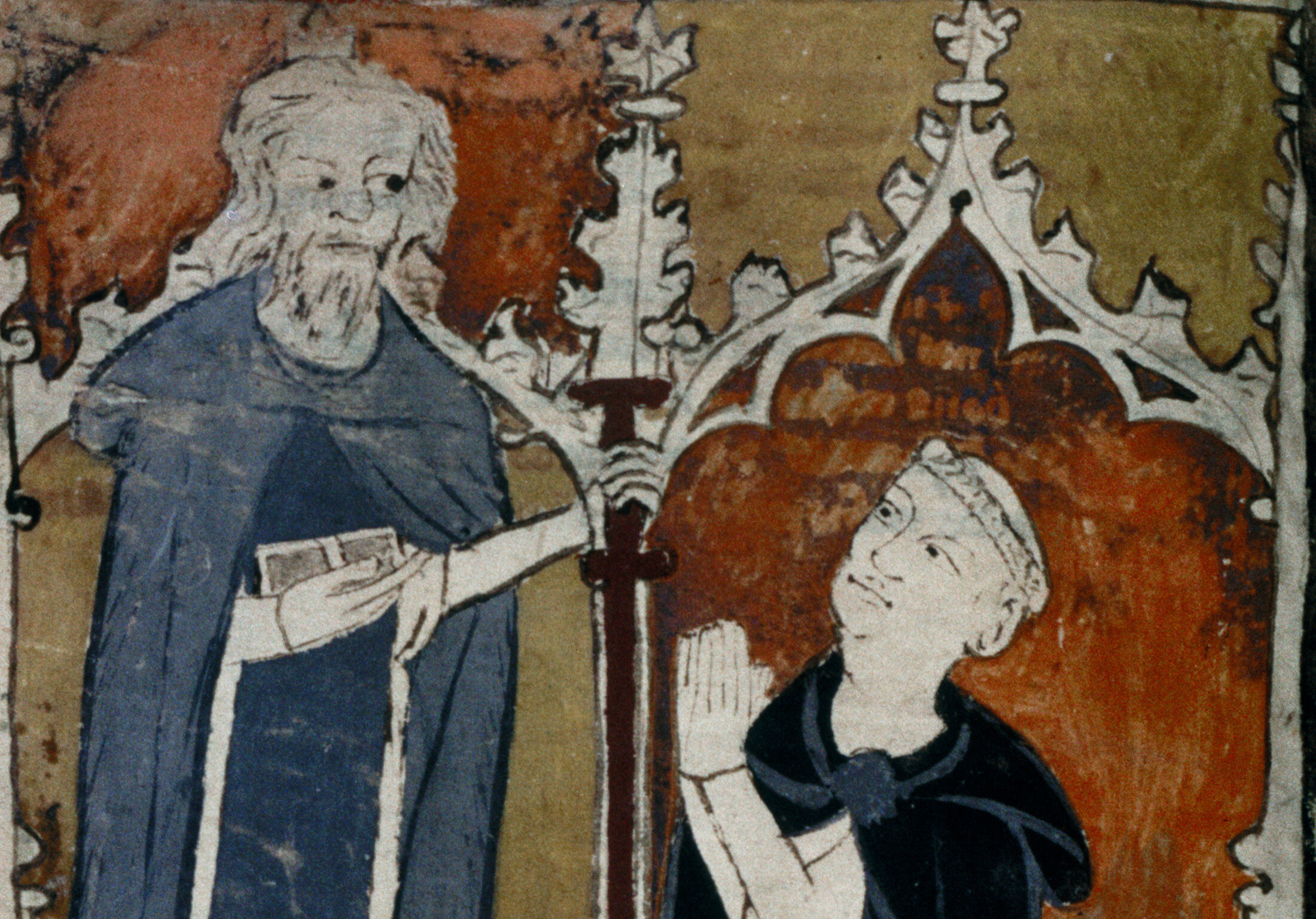
Top Image: Richard Rolle depicted on the left with shaggy hair and holding a hermits staff – c.1400 – Bodleian Library MS Laud Misc 528 fol 2v ©Bodleian Libraries, University of Oxford
Subscribe to Medievalverse
Related Posts