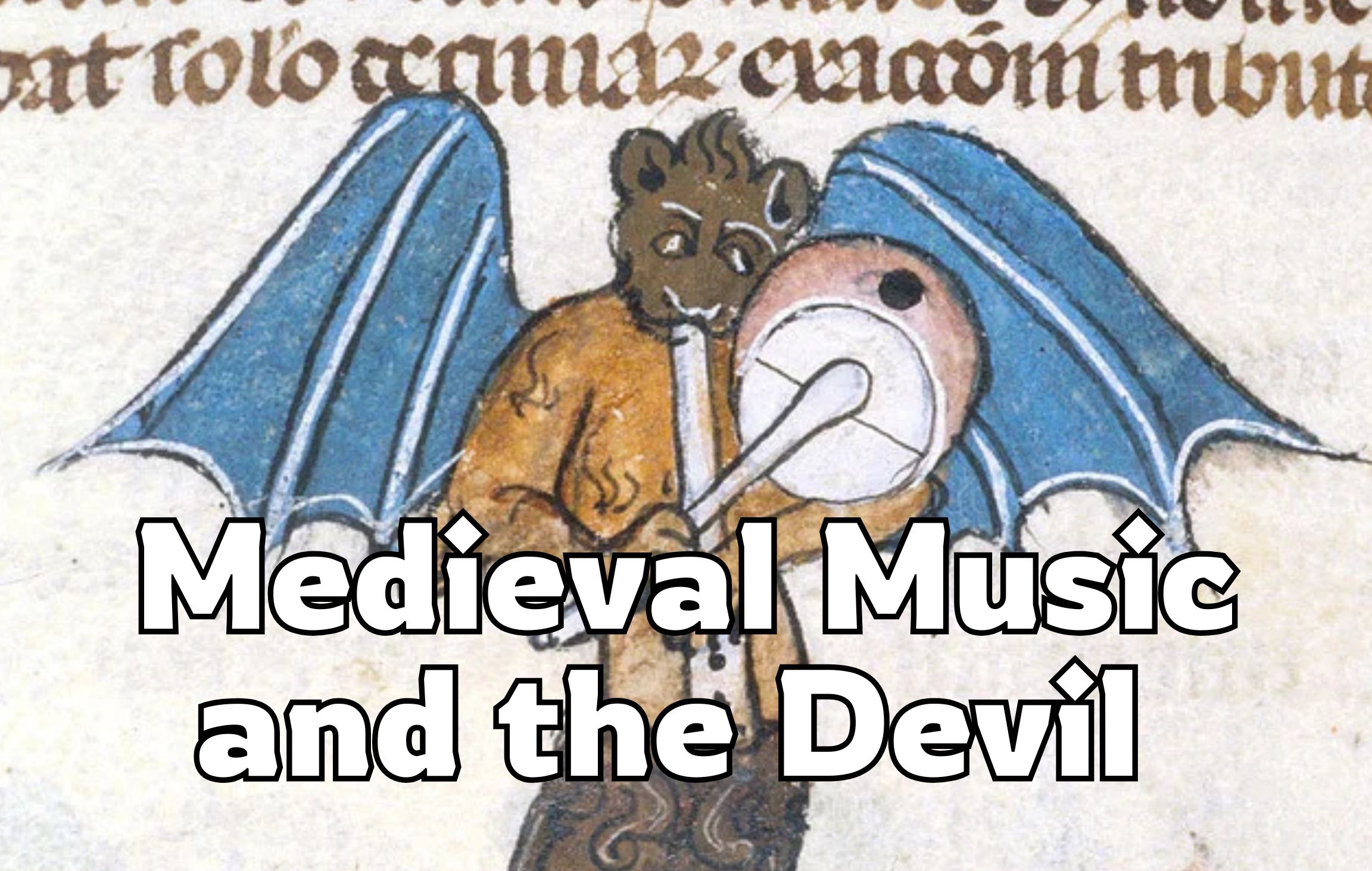
The Devil is a pervasive figure in medieval European sacred art. For every extant portrayal of Christ, the saints, angels, or biblical heroes, there also exists a multitude of spine-chilling images depicting the underworld’s torments, grotesque demons, or Satan himself. These pictorial renditions of the Devil provide us with a frightening glimpse into the ways in which medieval minds envisioned evil incarnate, which included physical attributes ranging from angelic and humanoid to entirely bestial. Apart from his outward appearance, what did the Devil sound like to those who feared him? Did medieval men and women believe that the Devil had audible features that could be perceived by human senses, just as his corporeal characteristics could be expressed in the visual arts?
According to many popular sources on music theory and history (especially those that distribute their content online or through social media platforms), in the Middle Ages, the Church believed that the Devil could be summoned by playing or singing two notes that formed an interval called the “tritone”. (In Western music theory, an interval is the distance between two notes. Two notes played or sung together are called “harmonic intervals” and two notes played or sung consecutively are called “melodic intervals.” This differs from a chord, which is constructed of three or more notes.)
So powerful was the sinister effect of the tritone that the medieval Church categorically prohibited composing or singing music that included this interval for fear that Satan would – quite literally – come knocking on their doors. Considering that the Church exerted great power and control over many facets of medieval society, including the arts, it seems probable that religious authorities would have been compelled to prevent the performance of musical devices that were deemed to be particularly menacing. Indeed, some musical activities were already restricted in the medieval Church, such as the performance of musical instruments (other than the organ or the voice) and the inclusion of female singers in liturgical choirs (except for those in convents).
However, the prevailing notion that the Church forbade the use of the tritone in musical compositions because it was believed to conjure the Prince of Darkness is largely rooted in myth. It was indeed avoided in medieval music, but not because it was thought to be associated with satanic powers.
The Devil’s Identity in the Middle Ages: Representation in Visual Art
Known by many names, the Devil has undergone a vast series of changes throughout Christianity’s history. The Bible offers little insight into his personal characteristics or appearance. Indeed, many of the details that comprise current views of the Devil – including his appearance – were first brought to light in the Middle Ages and further embellished by artists and theologians throughout the era and in subsequent centuries.
In Jewish scripture – which forms the Old Testament in the Christian Bible – Satan plays a less malevolent role than he does in the New Testament. In the Old Testament, he is generally one who challenges humanity rather than one who is purely evil; he is not presented as a being who has a proclivity for collecting damned souls (the Hebrew word “satan” translates to “adversary” or “accuser”).
In the New Testament, Satan evolves into the personification of wickedness. It is this that the medieval perception of the Devil largely drew upon, in addition to the later testimonies of saints and the Church Fathers, many of whom were believed to have experienced physical, psychological, and spiritual torment from the Devil and his demons (one of the most famous saints to experience such affliction was Anthony the Great). Additionally, notable medieval works of literature such as Dante’s Divine Comedy elaborated on the agonies of the underworld and its demonic inhabitants, which further inspired artistic impressions of the Devil.
Jeffrey Burton Russell’s book Lucifer: The Devil in the Middle Ages explores some of the earliest artistic representations of Satan, dating back to the sixth century, and continues into the High Middle Ages. As noted by Russell, the oldest surviving image of the Devil (from the sixth century) is a mosaic in San Apollinare Nuovo in Ravenna. Here, we see three figures. Christ is positioned in the middle of the work with an angel to his right. This angel is robed in red and has sheep standing next to him (the sheep are likely a reference to Christ’s role as a shepherd among his followers). To the left of Christ stands Satan, who is portrayed as a blue angel accompanied by goats (goats have traditionally been associated with the Devil).
This representation of Satan is strikingly different from artists’ later, grotesque likenesses and hearkens back to the Christian tradition that Satan was originally a celestial entity prior to his fall from grace. From the eleventh century onwards, artistic renderings of the Devil began to adopt more animalistic and monstrous qualities that resembled creatures including serpents, goats, and dragons.
Thus far, we have looked at some of the ways in which the Devil was physically characterized in the Middle Ages; however, as mentioned earlier, there are some popular music theory and history sources – as well as prominent musicians – who assert that medieval people believed that the Devil’s terror could also be experienced through sound, specifically, through the discordant sound of the tritone. This assertion is a popular rumour that has circulated among Western music enthusiasts for a very long time, although now it has reached a broader audience largely due to social media.
According to the rumour, the “diabolus in musica” (“the Devil in music” as the tritone has since been dubbed from at least the the eighteenth century onward) was so frightening and unpleasant to hear that it had the power to bring forth the Devil himself. Because of its dangerous conjuring abilities, ecclesiastical authorities purportedly took drastic measures to prevent the performance of the tritone, which included banning it entirely from musical compositions and excommunicating singers or musicians who dared to sing or play it.
This claim, however, is not based in fact – it is largely mythical. For one, there is clear evidence that the tritone was not forbidden in medieval music as it can be heard in the compositions of the celebrated thirteenth-century composer Pérotin (who is known for his sacred works). For example, Pérotin’s choral piece “Dum Sigillum Summi Patris” contains a number of instances in which the tritone is sung.
That being said, the tritone was an interval that occurred very rarely in medieval compositions, and it was generally discouraged from use. If it was not avoided because of the Devil, what were the reasons behind its absence from music of the time? In short, the reasons for avoiding the tritone were mostly theoretical. Not only did it sound extremely dissonant and jarring to the ear, but it was also very difficult to sing with accuracy.
There was no shortage of physical descriptions of the Devil in the Middle Ages, as indicated by the many written accounts recorded by saints and church authorities, and the numerous paintings that detailed every revolting trait imaginable. These were traits that were believed to be real and tangible for many people of the time, and which truly inspired fear. As for the Devil’s presence in music, it certainly makes an interesting myth – but nothing more.
Dr. Sonja Maurer-Dass is a Canadian musicologist and harpsichordist. She holds a PhD in Musicology from The University of Western Ontario (London, Ontario, Canada) and a master’s degree in Musicology specializing in late medieval English music from York University (Toronto, Ontario, Canada). Sonja has taught Baroque music history at McMaster University (Hamilton, Ontario, Canada) and undergraduate tutorials on different topics in musicology and music theory at The University of Western Ontario. Her work has been published in the Medieval Magazine, Ancient History Magazine, Ceræ: An Australasian Journal of Medieval and Early Modern Studies, and Medievalists.net

By Sonja Maurer-Dass
The Devil is a pervasive figure in medieval European sacred art. For every extant portrayal of Christ, the saints, angels, or biblical heroes, there also exists a multitude of spine-chilling images depicting the underworld’s torments, grotesque demons, or Satan himself. These pictorial renditions of the Devil provide us with a frightening glimpse into the ways in which medieval minds envisioned evil incarnate, which included physical attributes ranging from angelic and humanoid to entirely bestial. Apart from his outward appearance, what did the Devil sound like to those who feared him? Did medieval men and women believe that the Devil had audible features that could be perceived by human senses, just as his corporeal characteristics could be expressed in the visual arts?
According to many popular sources on music theory and history (especially those that distribute their content online or through social media platforms), in the Middle Ages, the Church believed that the Devil could be summoned by playing or singing two notes that formed an interval called the “tritone”. (In Western music theory, an interval is the distance between two notes. Two notes played or sung together are called “harmonic intervals” and two notes played or sung consecutively are called “melodic intervals.” This differs from a chord, which is constructed of three or more notes.)
So powerful was the sinister effect of the tritone that the medieval Church categorically prohibited composing or singing music that included this interval for fear that Satan would – quite literally – come knocking on their doors. Considering that the Church exerted great power and control over many facets of medieval society, including the arts, it seems probable that religious authorities would have been compelled to prevent the performance of musical devices that were deemed to be particularly menacing. Indeed, some musical activities were already restricted in the medieval Church, such as the performance of musical instruments (other than the organ or the voice) and the inclusion of female singers in liturgical choirs (except for those in convents).
However, the prevailing notion that the Church forbade the use of the tritone in musical compositions because it was believed to conjure the Prince of Darkness is largely rooted in myth. It was indeed avoided in medieval music, but not because it was thought to be associated with satanic powers.
The Devil’s Identity in the Middle Ages: Representation in Visual Art
Known by many names, the Devil has undergone a vast series of changes throughout Christianity’s history. The Bible offers little insight into his personal characteristics or appearance. Indeed, many of the details that comprise current views of the Devil – including his appearance – were first brought to light in the Middle Ages and further embellished by artists and theologians throughout the era and in subsequent centuries.
In Jewish scripture – which forms the Old Testament in the Christian Bible – Satan plays a less malevolent role than he does in the New Testament. In the Old Testament, he is generally one who challenges humanity rather than one who is purely evil; he is not presented as a being who has a proclivity for collecting damned souls (the Hebrew word “satan” translates to “adversary” or “accuser”).
In the New Testament, Satan evolves into the personification of wickedness. It is this that the medieval perception of the Devil largely drew upon, in addition to the later testimonies of saints and the Church Fathers, many of whom were believed to have experienced physical, psychological, and spiritual torment from the Devil and his demons (one of the most famous saints to experience such affliction was Anthony the Great). Additionally, notable medieval works of literature such as Dante’s Divine Comedy elaborated on the agonies of the underworld and its demonic inhabitants, which further inspired artistic impressions of the Devil.
Jeffrey Burton Russell’s book Lucifer: The Devil in the Middle Ages explores some of the earliest artistic representations of Satan, dating back to the sixth century, and continues into the High Middle Ages. As noted by Russell, the oldest surviving image of the Devil (from the sixth century) is a mosaic in San Apollinare Nuovo in Ravenna. Here, we see three figures. Christ is positioned in the middle of the work with an angel to his right. This angel is robed in red and has sheep standing next to him (the sheep are likely a reference to Christ’s role as a shepherd among his followers). To the left of Christ stands Satan, who is portrayed as a blue angel accompanied by goats (goats have traditionally been associated with the Devil).
This representation of Satan is strikingly different from artists’ later, grotesque likenesses and hearkens back to the Christian tradition that Satan was originally a celestial entity prior to his fall from grace. From the eleventh century onwards, artistic renderings of the Devil began to adopt more animalistic and monstrous qualities that resembled creatures including serpents, goats, and dragons.
The Devil in Music?
Thus far, we have looked at some of the ways in which the Devil was physically characterized in the Middle Ages; however, as mentioned earlier, there are some popular music theory and history sources – as well as prominent musicians – who assert that medieval people believed that the Devil’s terror could also be experienced through sound, specifically, through the discordant sound of the tritone. This assertion is a popular rumour that has circulated among Western music enthusiasts for a very long time, although now it has reached a broader audience largely due to social media.
According to the rumour, the “diabolus in musica” (“the Devil in music” as the tritone has since been dubbed from at least the the eighteenth century onward) was so frightening and unpleasant to hear that it had the power to bring forth the Devil himself. Because of its dangerous conjuring abilities, ecclesiastical authorities purportedly took drastic measures to prevent the performance of the tritone, which included banning it entirely from musical compositions and excommunicating singers or musicians who dared to sing or play it.
This claim, however, is not based in fact – it is largely mythical. For one, there is clear evidence that the tritone was not forbidden in medieval music as it can be heard in the compositions of the celebrated thirteenth-century composer Pérotin (who is known for his sacred works). For example, Pérotin’s choral piece “Dum Sigillum Summi Patris” contains a number of instances in which the tritone is sung.
That being said, the tritone was an interval that occurred very rarely in medieval compositions, and it was generally discouraged from use. If it was not avoided because of the Devil, what were the reasons behind its absence from music of the time? In short, the reasons for avoiding the tritone were mostly theoretical. Not only did it sound extremely dissonant and jarring to the ear, but it was also very difficult to sing with accuracy.
There was no shortage of physical descriptions of the Devil in the Middle Ages, as indicated by the many written accounts recorded by saints and church authorities, and the numerous paintings that detailed every revolting trait imaginable. These were traits that were believed to be real and tangible for many people of the time, and which truly inspired fear. As for the Devil’s presence in music, it certainly makes an interesting myth – but nothing more.
Dr. Sonja Maurer-Dass is a Canadian musicologist and harpsichordist. She holds a PhD in Musicology from The University of Western Ontario (London, Ontario, Canada) and a master’s degree in Musicology specializing in late medieval English music from York University (Toronto, Ontario, Canada). Sonja has taught Baroque music history at McMaster University (Hamilton, Ontario, Canada) and undergraduate tutorials on different topics in musicology and music theory at The University of Western Ontario. Her work has been published in the Medieval Magazine, Ancient History Magazine, Ceræ: An Australasian Journal of Medieval and Early Modern Studies, and Medievalists.net
Click here to read more from Sonja Maurer-Dass
Top Image: A devil with a musical instrument – British Library MS Royal 10 E IV, fol. 201v
Subscribe to Medievalverse
Related Posts