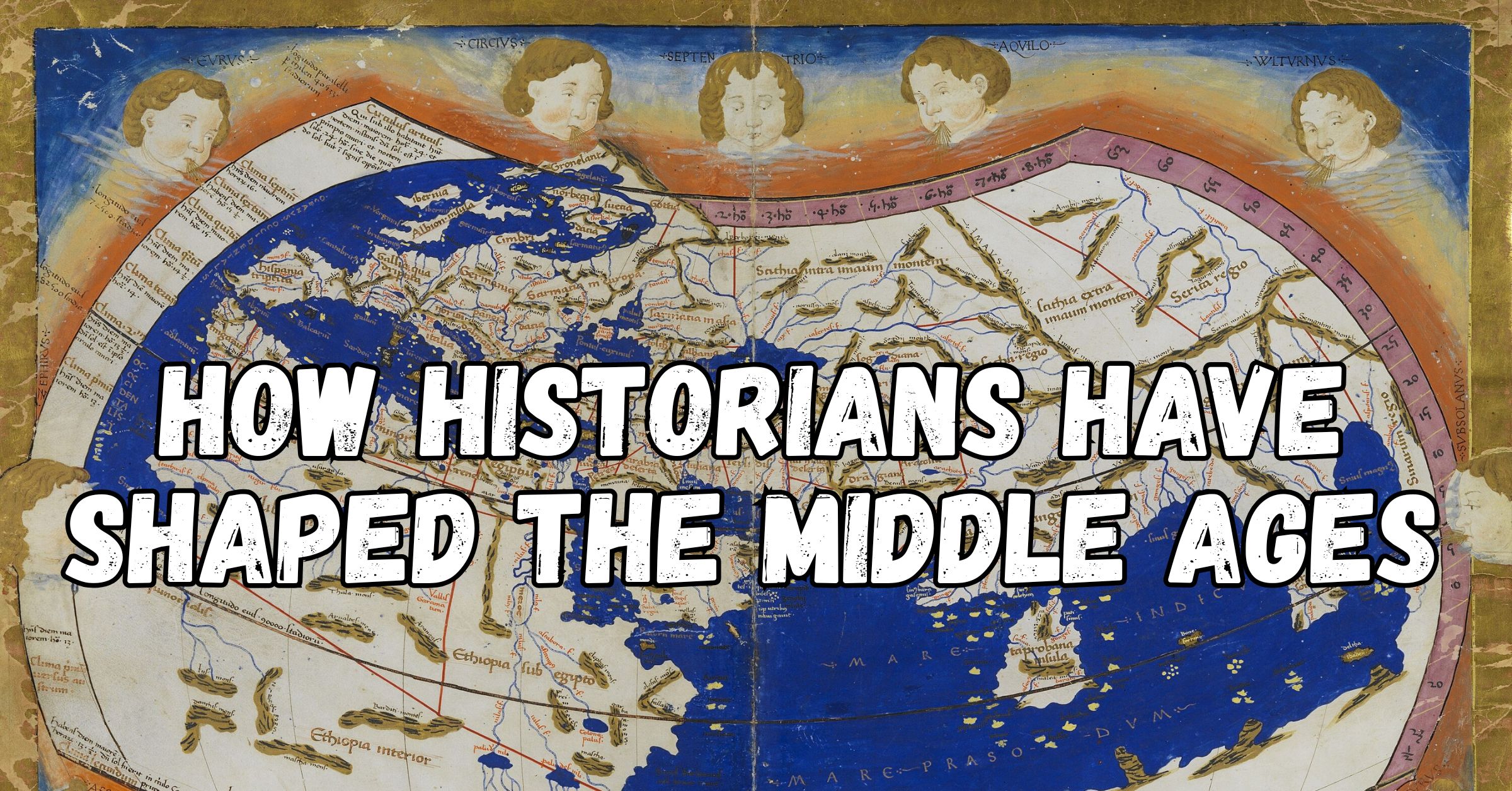
The Middle Ages we study today isn’t just a record of what happened — it’s also a product of how historians have chosen to describe it. Over the centuries, scholars have coined terms and frameworks to make sense of medieval society, culture, and power. Concepts like the Viking Age, the 12th-Century Renaissance, and the Silk Road didn’t exist in the Middle Ages themselves — they were created later to explain its complexities. Here are 25 of the most influential historiographical constructs that have shaped how we understand the medieval world.
1. The Middle Ages
Even the Middle Ages itself is a historiographical construct. The term was coined by Renaissance humanists, who saw the centuries between classical antiquity and their own time as a middle period — an era in between two supposedly superior ages. Medieval people did not think of themselves as living in a “middle age,” nor did they see their world as a temporary or inferior phase of history.
Over time, historians adopted the label as a convenient way to organise the past, usually dating the Middle Ages roughly from the fall of the Western Roman Empire in the fifth century to the fifteenth century. Yet these boundaries have always been flexible and contested, varying by region and scholarly tradition.
To impose further structure on this long and diverse period, historians later subdivided it into three parts:
The Early Middle Ages (roughly 500–1000), often associated with political fragmentation, new kingdoms, and the transformation of the Roman world
The High Middle Ages (roughly 1000–1300), typically framed as a period of population growth, institutional expansion, and cultural production
The Late Middle Ages (roughly 1300–1500), commonly characterised by crisis, adaptation, and profound social change
These subdivisions, like the term Middle Ages itself, are modern analytical tools rather than medieval realities. They help historians organise evidence and identify broad patterns, but they also shape how the period is interpreted — sometimes obscuring regional diversity and long-term continuity in favour of neat chronological divisions. To learn more, see When were the Middle Ages?
2. Late Antiquity
bLate Antiquity is a historiographical construct developed by modern historians to describe the period of transition between the classical ancient world and the medieval era, usually dated from the third to the eighth centuries. Rather than treating the fall of the Western Roman Empire as a sharp rupture, this framework emphasises continuity, adaptation, and transformation across the Mediterranean and beyond.
The concept gained prominence in the later twentieth century, particularly through the work of scholars such as Peter Brown, who argued that these centuries were not a time of simple decline but of profound cultural, religious, and social change. Christianity became institutionalised, new forms of political authority emerged, and classical traditions were reshaped rather than abandoned.
Medieval people did not understand themselves as living in “Late Antiquity,” nor did they see their world as transitional in the way modern historians describe it. The term reflects a scholarly decision to blur the boundary between ancient and medieval history, challenging older narratives that treated the end of Rome as a sudden collapse. As a result, Late Antiquity has reshaped how historians understand the origins of the medieval world itself.
3. The Barbarian Invasions / The Age of Migration
Map of the “Barbarian” invasions by the Angles, Saxons, Jutes, Franks, Goths, Visigoths, Ostrogoths, Huns and Vandals of the Roman Empire showing the major incursions from 100 to 500 CE. – Wikimedia Commons
For much of modern historiography, the centuries surrounding the collapse of the Western Roman Empire were framed as the “Barbarian Invasions.” This term, inherited from Roman authors and reinforced by early modern and nineteenth-century historians, portrayed groups such as the Goths, Vandals, Franks, and Lombards as external, destructive forces that violently overran a civilised Roman world.
Over the past several decades, historians have increasingly moved away from this language. From the late twentieth century onward, particularly in the 1970s and 1980s, scholars began to challenge both the assumptions and the implications of the invasion model. Archaeology, re-readings of written sources, and new approaches to ethnicity and identity revealed that these movements were often gradual, negotiated, and complex, involving settlement, alliance, and integration as much as warfare.
As a result, many historians now prefer the term “Age of Migration.” This alternative framing emphasises long-term population movements across Europe between roughly the fourth and seventh centuries, rather than sudden military collapse. It also avoids the value-laden term “barbarian,” which reflects Roman cultural prejudice more than historical reality.
That said, Age of Migration is itself a historiographical construct. It simplifies a wide range of experiences into a single narrative and can obscure the fact that not all change during this period was driven by migration alone. The shift in terminology reflects a broader change in medieval scholarship — away from stories of invasion and decline, and toward models that stress continuity, adaptation, and the transformation of the Roman world.
4. The Age of Conversion
The Age of Conversion is a modern historiographical term used to describe the long medieval process by which Christianity became dominant across much of Europe. Rather than referring to a single event or moment, it captures centuries of gradual change, negotiation, and adaptation, roughly from Late Antiquity into the early Middle Ages.
Historians use this framework to emphasise that conversion was rarely sudden or complete. New religious identities emerged unevenly, often alongside older beliefs, local traditions, and political considerations. Rulers, missionaries, monastic communities, and local elites all played roles in shaping how religious change unfolded, making conversion as much a social and cultural process as a spiritual one.
Within this broader period, some scholars have identified more focused cultural moments, such as the Age of Bede. This term refers to the late seventh and early eighth centuries, centred on the work of the Northumbrian monk Bede, whose writings reveal a world in which Christianity had taken root but was still being intellectually organised, explained, and historicised. The phrase highlights the emergence of learned Christian scholarship in post-Roman Britain and the role of historians themselves in shaping how conversion was remembered.
5. The Viking Age
Twelfth-century image of Danes about to invade England. – Pierpont Morgan Library MS M.736 fol. 9v
The Viking Age is a modern label used by historians to describe a period when people from Scandinavia travelled widely as raiders, traders, settlers, and explorers. It is usually dated from the late eighth century to the mid-eleventh century, beginning with the first recorded raids and ending as Scandinavian kingdoms became more firmly Christian and politically organised.
People living at the time did not think of themselves as part of a “Viking Age,” nor did most of them see raiding as their main way of life. The term viking referred to an activity rather than a people, and many who lived in Scandinavia never went abroad at all. By focusing on dramatic overseas activity, the label can give a misleading impression of what everyday life in the region was like.
Historians continue to use the Viking Age because it provides a convenient way to group together several centuries of increased movement and contact across northern Europe and the North Atlantic. Viking is also a term deeply ingrained in the popular imagination, so it is one that will almost certainly persist.
6. The Carolingian Renaissance
The Carolingian Renaissance is a term coined by modern historians to describe a period of cultural and intellectual renewal associated with the reign of Charlemagne and his successors in the late eighth and ninth centuries. It refers to renewed interest in learning, education, manuscript production, and administrative reform within the Carolingian Empire.
People living at the time did not think of themselves as experiencing a “renaissance,” nor did they see their efforts as a revival of a lost classical past in the later Renaissance sense. The changes were limited in scope and largely centred on royal courts, monasteries, and cathedral schools, rather than society as a whole.
Historians use the term to highlight the ways Carolingian rulers promoted literacy, standardised Latin, and preserved many classical texts that might otherwise have been lost. At the same time, the label reflects modern scholarly priorities, grouping a range of reforms and cultural developments into a single moment of renewal within the early medieval world.
7. The Tenth-Century Crisis
The Tenth-Century Crisis is a term used by earlier historians to describe the ninth and tenth centuries in Western Europe as a period of political instability and cultural decline following the breakup of the Carolingian Empire. Measured against Carolingian ideals of strong kingship, literacy, and central administration, this era was long portrayed as a low point between the Carolingian Renaissance and later medieval revivals. That impression was reinforced by the relative scarcity of narrative sources, such as chronicles, which made the period appear silent or stagnant compared to earlier and later centuries.
In recent decades, this interpretation has been widely challenged. Archaeological evidence and regional studies reveal continuity in settlement, economic life, and local governance, even as central authority weakened. What earlier scholars described as crisis is now more often understood as a period of reorganisation, with power shifting away from imperial centres toward local elites and institutions. As a result, the term Tenth-Century Crisis is now used cautiously, if at all, reflecting changes in both the available evidence and the ways historians approach the medieval past.
8. The Norman Yoke
Harold’s death, scene 57 – Harold rex interfectus est, “Harold the King is killed”, the Bayeux Tapestry .
The Norman Yoke is a historiographical idea that portrayed the Norman Conquest of 1066 as the harsh imposition of foreign rule over an otherwise free and self-governing Anglo-Saxon England. According to this view, the conquest marked a sudden and damaging break in English history, destroying native institutions and liberties and replacing them with Norman domination. The idea became especially popular in later political and historical writing, where it was used to explain long-term struggles over English freedom and identity.
Today, the Norman Yoke is not used at all by medieval historians. Research has shown that while the conquest brought significant change, it also involved continuity in law, administration, and governance. The term survives mainly as a historical curiosity: modern historians will still encounter it when reading older works on the Norman Conquest, but only as an example of how earlier generations shaped the past to fit their own concerns, not as a way to understand medieval England itself.
9. The Gregorian Reform
The Gregorian Reform is a term used by historians to describe a series of changes within the medieval Church during the eleventh century, particularly efforts to regulate clerical behaviour, redefine the relationship between church and secular power, and strengthen papal authority. The label takes its name from Pope Gregory VII, who served as pope from 1073 to 1085, but the reforms themselves began earlier and continued well beyond his lifetime.
Historians use the term as a convenient way to group together related developments that unfolded over several decades rather than as a single, unified programme. While the phrase remains in common use, scholars increasingly stress that reform looked very different from one region to another and was shaped by local politics as much as by papal ideals.
10. The Investiture Controversy
Henry IV requests mediation from Matilda of Tuscany and abbot Hugh of Cluny.
The Investiture Controversy is a term used by historians to describe a series of conflicts in the eleventh and early twelfth centuries over who had the authority to appoint bishops and other senior church officials. At the heart of these disputes was the question of whether secular rulers, such as kings and emperors, or church leaders should control offices that carried both spiritual authority and significant political power.
One of the most famous episodes associated with this struggle was the Walk to Canossa in 1077, when the German king Henry IV sought absolution from Pope Gregory VII after being excommunicated. Although often presented as a dramatic turning point, Canossa was only one moment in a much longer and uneven conflict. Historians use the term Investiture Controversy to group together these overlapping struggles, which varied widely by region and continued for decades, eventually leading to compromises such as the Concordat of Worms in 1122.
11. The Twelfth-Century Renaissance
The Twelfth-Century Renaissance is a term used by historians to describe a period of intellectual and cultural growth in Western Europe during the 1100s. It was first defined by the historian Charles Homer Haskins in his 1927 book The Renaissance of the Twelfth Century, where he argued that the Middle Ages experienced a revival of learning long before the better-known Italian Renaissance. Haskins pointed to developments such as the expansion of schools, renewed interest in classical texts, and advances in law, philosophy, and administration.
Many historians still employ it as a convenient way to signal heightened intellectual and institutional activity in the twelfth century, especially in teaching and general surveys. In more specialised scholarship, however, the term often appears only briefly or is avoided altogether, with scholars preferring to focus on particular developments rather than treating the century as a single renaissance. As a result, the phrase continues to circulate, but more as a useful label than as a dominant explanatory framework.
12. The Crusading Movement
A mitred Adhémar de Monteil carrying the Holy Lance in one of the battles of the First Crusade – British Library Yates Thompson MS 12
The Crusading Movement is a term historians use to describe a wide range of military campaigns, religious ideas, and social practices associated with crusading from the late eleventh century onward. Rather than treating each expedition as an isolated event, the phrase frames crusading as an ongoing phenomenon that included warfare in the eastern Mediterranean, Iberia, the Baltic, and even within Europe itself.
Historians adopted this broader label in the twentieth century as scholarship moved away from focusing solely on the major expeditions to Jerusalem. The concept allows crusading to be studied as a set of shared ideals—such as holy war, pilgrimage, and papal authority—applied in different contexts over time.
13. The Reconquista
The Reconquista is a term used by historians to describe the long process by which Christian rulers expanded their control over the Iberian Peninsula from territories governed by Muslim powers, beginning in the eleventh century and culminating in the conquest of Granada in 1492. The label suggests a single, continuous effort to “reconquer” land that had once belonged to Christian kingdoms.
Modern historians treat the term with caution. The conflicts grouped under Reconquista unfolded over several centuries and involved shifting alliances, periods of coexistence, and wars between Christian rulers as often as between Christians and Muslims. The idea of a unified reconquest reflects later interpretations rather than medieval realities, and the term itself gained prominence in early modern and modern historical writing, especially in connection with Spanish national identity.
14. Feudalism
Feudalism is one of the most familiar terms used to describe medieval society, often invoked to explain relationships between kings, nobles, knights, and landholding. In its classic form, it refers to a system in which land was granted in exchange for loyalty and service, creating a hierarchy of obligations that structured medieval politics and warfare.
Modern historians, however, increasingly treat feudalism as a problematic and oversimplified model rather than a description of how medieval societies actually functioned. The term was developed largely by early modern and nineteenth-century scholars who tried to impose order on a wide range of local practices that varied greatly by region and period. While feudalism remains common in textbooks and popular history, many specialists now avoid it altogether, preferring to describe specific legal, social, or political arrangements without relying on a single, catch-all label.
Courtly Love is a term coined by modern scholars to describe ideals of romance, desire, and behaviour found in medieval literature, especially from the twelfth century onward. These ideals are closely associated with aristocratic settings and often emphasise admiration from afar, emotional restraint, secrecy, and the tension between love and social obligation.
The concept draws heavily on medieval literary sources, most famously De amore (On Love), attributed to Andreas Capellanus, a twelfth-century cleric writing at the French court. While this text discusses rules and behaviours associated with love, it does not prove that such a system governed real relationships. The term courtly love itself was created much later, in the nineteenth century, by scholars trying to categorise recurring themes in medieval poetry and prose. Today, historians and literary scholars continue to use the label as a useful way to talk about medieval literary conventions, rather than as a description of everyday medieval life.
16. Chivalry
Chivalry is a term historians use to describe a collection of ideals associated with medieval knights, including courage, loyalty, honour, and proper conduct in war and society. It is often linked to mounted warfare, noble status, and expectations about how elite warriors should behave toward their lords, peers, and, in some accounts, women.
The concept of chivalry as a single, coherent code is largely a product of later interpretation. Medieval texts discussed knightly behaviour in many different ways, and expectations varied widely depending on time, place, and circumstance. Modern historians continue to use chivalry as a convenient shorthand for these overlapping ideals, especially in literary and cultural studies, but few now treat it as a fixed or universally followed system.
The Papal Monarchy is a term historians use to describe the period, mainly in the twelfth and thirteenth centuries, when the papacy exercised an unusually high level of authority over the Western Church and claimed a central role in European political life. This concentration of power is often seen as reaching its height under Pope Innocent III (1198–1216), whose pontificate marked the most confident expression of papal authority over both spiritual and secular matters.
The phrase reflects a modern effort to capture how the papacy functioned during this period, using the language of monarchy to describe its administrative reach and political ambitions. Historians continue to use the term as a useful way to discuss papal power at its peak, while recognising that such authority was frequently challenged and unevenly applied.
18. The Islamicate
The Islamicate is a term coined by the historian Marshall Hodgson to describe the broader cultural, social, and political world shaped by Muslim societies, without limiting it strictly to religion. It allows historians to distinguish between what is explicitly Islamic—such as theology or law—and the wider range of literature, art, science, governance, and everyday life that developed in regions where Muslims were politically or culturally dominant.
The term has become increasingly important in modern scholarship because it avoids treating Islam as the sole explanation for all developments in medieval Muslim-majority societies. By using Islamicate, historians can more clearly account for the roles played by Christians and Jews, regional traditions, and secular institutions, especially in culturally diverse empires. While not universally adopted, the concept has had a lasting influence on how medieval Islamic history is framed and discussed.
19. The Abbasid Revolution
The Abbasid Revolution is a modern term used by historians to describe the overthrow of the Umayyad Caliphate in the mid-eighth century and the rise of the Abbasid dynasty in 750. The label presents this transition as a decisive political and social break, marked by changes in leadership, ideology, and the geographic centre of power, which shifted eastward toward Iraq.
Historians continue to debate how revolutionary this change actually was. While the term highlights real transformations in governance and culture, it also groups together a complex series of uprisings, alliances, and negotiations under a single heading. As a result, the Abbasid Revolution functions as a convenient shorthand for a major turning point in early Islamic history, even as scholars recognise that continuity played an important role alongside change.
20. The Islamic Golden Age
The Islamic Golden Age is a widely used term that refers to a period of intellectual, scientific, and cultural activity in the medieval Islamic world, often dated roughly from the eighth to the thirteenth centuries. It is commonly associated with advances in fields such as mathematics, medicine, astronomy, philosophy, and literature, as well as with centres of learning connected to Abbasid rule.
At the same time, historians increasingly treat the phrase with caution. The idea of a single “golden age” can oversimplify a long and uneven history, shaped by regional variation and continued development well beyond the period usually highlighted. While the term remains popular in both academic and public discussions, many scholars now use it more as a general reference point than as a precise or self-contained historical framework.
21. The Silk Road
The red lines indicate major overland trade routes (silk roads). The blue lines indicate the sea route more commonly taken after Vasco de Gama’s fleet landed in Calicut in 1498. The overland route was considered to have extended to the Indonesian archipelago, but new research indicates it stretched to the waters to the north of Australia. Image: Wikipedia
The Silk Road is a term used by historians to describe the network of trade routes that linked East Asia, Central Asia, the Middle East, and Europe during antiquity and the Middle Ages. Despite the singular name, it was never a single road but a shifting web of land and sea routes through which goods, people, technologies, and ideas moved across Eurasia.
The term itself was coined in the nineteenth century, long after the medieval period it describes. Historians continue to use the Silk Road as a convenient way to discuss long-distance connections, even as they increasingly stress its plural and changing nature. Today, the phrase functions less as a precise description of how trade operated and more as a shorthand for the broader patterns of exchange that connected medieval societies across continents.
22. The Pax Mongolica
The Pax Mongolica is a modern term used to describe the period of relative stability and increased connectivity across much of Eurasia under Mongol rule in the thirteenth and early fourteenth centuries. By bringing vast territories under a single imperial framework, the Mongol Empire facilitated the movement of merchants, envoys, religious figures, and information over long distances.
Historians use the term to highlight how Mongol governance made large-scale exchange more reliable, rather than to suggest an absence of violence. While warfare and coercion remained central to Mongol power, the idea of a Pax Mongolica draws attention to the conditions that allowed trade and communication to flourish on an unprecedented scale. As with many such labels, it serves as a way to organise complex developments rather than as a literal description of peaceful rule.
23. The Medieval Warm Period
The Medieval Warm Period is a term used by historians and climate scientists to describe a phase of relatively warmer temperatures in parts of the Northern Hemisphere, usually dated from roughly the ninth to the thirteenth centuries. It is often discussed in relation to agricultural expansion, population growth, and settlement in regions such as northern Europe and the North Atlantic world, especially when contrasted with later climatic shifts.
The concept is frequently paired with the Little Ice Age, a period of cooler temperatures that followed in the late medieval and early modern periods. Historians use this comparison to explore how changing environmental conditions may have shaped medieval societies over time. While the term remains common, scholars emphasise that both the Medieval Warm Period and the Little Ice Age varied significantly by region and did not affect all parts of the world in the same way.
24. The Medieval Military Revolution
A 14th-century depiction of a cannon
The Medieval Military Revolution is a term used by historians to describe major changes in warfare during the later Middle Ages, particularly the growing importance of infantry, new weapons, and shifts in tactics and organisation. It is often associated with developments such as the increased use of longbows and pikes, changes in fortifications, and the declining dominance of heavily armoured cavalry on the battlefield.
The idea draws on broader debates about “military revolutions” in European history and reflects a modern attempt to identify moments of transformation rather than gradual change. While some historians continue to use the term to highlight significant developments in medieval warfare, others question whether these changes were revolutionary at all, pointing instead to long-term evolution and regional variation. As a result, the Medieval Military Revolution remains a contested but influential historical concept for thinking about how war changed in the later Middle Ages.
The Global Middle Ages is a historiographical framework that treats the medieval period as a worldwide phenomenon rather than one centred primarily on Europe. Instead of focusing on developments within a single region, this approach highlights connections across Africa, Asia, Europe, and the Americas, emphasising trade, migration, religion, diplomacy, and cultural exchange across long distances.
This concept is one of the most recent to emerge in medieval studies, gaining momentum in the late twentieth century and especially in the twenty-first century. It developed alongside broader interest in globalisation, as historians began asking how earlier societies were connected long before the modern era. Scholars such as Geraldine Heng, Peter Frankopanand Suzanne Conklin Akbari have been particularly influential in promoting comparative and interconnected approaches that challenge older, Eurocentric narratives of the Middle Ages.
Rather than replacing traditional medieval history, the Global Middle Ages reframes it by focusing on shared processes such as empire-building, environmental change, mobility, and long-distance exchange. As a historiographical construct, it reflects both the global turn in the humanities and contemporary concerns about interconnectedness, encouraging historians to see the medieval past as part of a much longer history of global interaction.
Together, these terms remind us that the Middle Ages we study today is not only inherited from the past, but continually reshaped by the historians who interpret it. This list is only partial, so look for future pieces focusing on historiographical constructs for Byzantium, medieval Asia and more.

The Middle Ages we study today isn’t just a record of what happened — it’s also a product of how historians have chosen to describe it. Over the centuries, scholars have coined terms and frameworks to make sense of medieval society, culture, and power. Concepts like the Viking Age, the 12th-Century Renaissance, and the Silk Road didn’t exist in the Middle Ages themselves — they were created later to explain its complexities. Here are 25 of the most influential historiographical constructs that have shaped how we understand the medieval world.
1. The Middle Ages
Even the Middle Ages itself is a historiographical construct. The term was coined by Renaissance humanists, who saw the centuries between classical antiquity and their own time as a middle period — an era in between two supposedly superior ages. Medieval people did not think of themselves as living in a “middle age,” nor did they see their world as a temporary or inferior phase of history.
Over time, historians adopted the label as a convenient way to organise the past, usually dating the Middle Ages roughly from the fall of the Western Roman Empire in the fifth century to the fifteenth century. Yet these boundaries have always been flexible and contested, varying by region and scholarly tradition.
To impose further structure on this long and diverse period, historians later subdivided it into three parts:
These subdivisions, like the term Middle Ages itself, are modern analytical tools rather than medieval realities. They help historians organise evidence and identify broad patterns, but they also shape how the period is interpreted — sometimes obscuring regional diversity and long-term continuity in favour of neat chronological divisions. To learn more, see When were the Middle Ages?
2. Late Antiquity
bLate Antiquity is a historiographical construct developed by modern historians to describe the period of transition between the classical ancient world and the medieval era, usually dated from the third to the eighth centuries. Rather than treating the fall of the Western Roman Empire as a sharp rupture, this framework emphasises continuity, adaptation, and transformation across the Mediterranean and beyond.
The concept gained prominence in the later twentieth century, particularly through the work of scholars such as Peter Brown, who argued that these centuries were not a time of simple decline but of profound cultural, religious, and social change. Christianity became institutionalised, new forms of political authority emerged, and classical traditions were reshaped rather than abandoned.
Medieval people did not understand themselves as living in “Late Antiquity,” nor did they see their world as transitional in the way modern historians describe it. The term reflects a scholarly decision to blur the boundary between ancient and medieval history, challenging older narratives that treated the end of Rome as a sudden collapse. As a result, Late Antiquity has reshaped how historians understand the origins of the medieval world itself.
3. The Barbarian Invasions / The Age of Migration
For much of modern historiography, the centuries surrounding the collapse of the Western Roman Empire were framed as the “Barbarian Invasions.” This term, inherited from Roman authors and reinforced by early modern and nineteenth-century historians, portrayed groups such as the Goths, Vandals, Franks, and Lombards as external, destructive forces that violently overran a civilised Roman world.
Over the past several decades, historians have increasingly moved away from this language. From the late twentieth century onward, particularly in the 1970s and 1980s, scholars began to challenge both the assumptions and the implications of the invasion model. Archaeology, re-readings of written sources, and new approaches to ethnicity and identity revealed that these movements were often gradual, negotiated, and complex, involving settlement, alliance, and integration as much as warfare.
As a result, many historians now prefer the term “Age of Migration.” This alternative framing emphasises long-term population movements across Europe between roughly the fourth and seventh centuries, rather than sudden military collapse. It also avoids the value-laden term “barbarian,” which reflects Roman cultural prejudice more than historical reality.
That said, Age of Migration is itself a historiographical construct. It simplifies a wide range of experiences into a single narrative and can obscure the fact that not all change during this period was driven by migration alone. The shift in terminology reflects a broader change in medieval scholarship — away from stories of invasion and decline, and toward models that stress continuity, adaptation, and the transformation of the Roman world.
4. The Age of Conversion
The Age of Conversion is a modern historiographical term used to describe the long medieval process by which Christianity became dominant across much of Europe. Rather than referring to a single event or moment, it captures centuries of gradual change, negotiation, and adaptation, roughly from Late Antiquity into the early Middle Ages.
Historians use this framework to emphasise that conversion was rarely sudden or complete. New religious identities emerged unevenly, often alongside older beliefs, local traditions, and political considerations. Rulers, missionaries, monastic communities, and local elites all played roles in shaping how religious change unfolded, making conversion as much a social and cultural process as a spiritual one.
Within this broader period, some scholars have identified more focused cultural moments, such as the Age of Bede. This term refers to the late seventh and early eighth centuries, centred on the work of the Northumbrian monk Bede, whose writings reveal a world in which Christianity had taken root but was still being intellectually organised, explained, and historicised. The phrase highlights the emergence of learned Christian scholarship in post-Roman Britain and the role of historians themselves in shaping how conversion was remembered.
5. The Viking Age
The Viking Age is a modern label used by historians to describe a period when people from Scandinavia travelled widely as raiders, traders, settlers, and explorers. It is usually dated from the late eighth century to the mid-eleventh century, beginning with the first recorded raids and ending as Scandinavian kingdoms became more firmly Christian and politically organised.
People living at the time did not think of themselves as part of a “Viking Age,” nor did most of them see raiding as their main way of life. The term viking referred to an activity rather than a people, and many who lived in Scandinavia never went abroad at all. By focusing on dramatic overseas activity, the label can give a misleading impression of what everyday life in the region was like.
Historians continue to use the Viking Age because it provides a convenient way to group together several centuries of increased movement and contact across northern Europe and the North Atlantic. Viking is also a term deeply ingrained in the popular imagination, so it is one that will almost certainly persist.
6. The Carolingian Renaissance
The Carolingian Renaissance is a term coined by modern historians to describe a period of cultural and intellectual renewal associated with the reign of Charlemagne and his successors in the late eighth and ninth centuries. It refers to renewed interest in learning, education, manuscript production, and administrative reform within the Carolingian Empire.
People living at the time did not think of themselves as experiencing a “renaissance,” nor did they see their efforts as a revival of a lost classical past in the later Renaissance sense. The changes were limited in scope and largely centred on royal courts, monasteries, and cathedral schools, rather than society as a whole.
Historians use the term to highlight the ways Carolingian rulers promoted literacy, standardised Latin, and preserved many classical texts that might otherwise have been lost. At the same time, the label reflects modern scholarly priorities, grouping a range of reforms and cultural developments into a single moment of renewal within the early medieval world.
7. The Tenth-Century Crisis
The Tenth-Century Crisis is a term used by earlier historians to describe the ninth and tenth centuries in Western Europe as a period of political instability and cultural decline following the breakup of the Carolingian Empire. Measured against Carolingian ideals of strong kingship, literacy, and central administration, this era was long portrayed as a low point between the Carolingian Renaissance and later medieval revivals. That impression was reinforced by the relative scarcity of narrative sources, such as chronicles, which made the period appear silent or stagnant compared to earlier and later centuries.
In recent decades, this interpretation has been widely challenged. Archaeological evidence and regional studies reveal continuity in settlement, economic life, and local governance, even as central authority weakened. What earlier scholars described as crisis is now more often understood as a period of reorganisation, with power shifting away from imperial centres toward local elites and institutions. As a result, the term Tenth-Century Crisis is now used cautiously, if at all, reflecting changes in both the available evidence and the ways historians approach the medieval past.
8. The Norman Yoke
The Norman Yoke is a historiographical idea that portrayed the Norman Conquest of 1066 as the harsh imposition of foreign rule over an otherwise free and self-governing Anglo-Saxon England. According to this view, the conquest marked a sudden and damaging break in English history, destroying native institutions and liberties and replacing them with Norman domination. The idea became especially popular in later political and historical writing, where it was used to explain long-term struggles over English freedom and identity.
Today, the Norman Yoke is not used at all by medieval historians. Research has shown that while the conquest brought significant change, it also involved continuity in law, administration, and governance. The term survives mainly as a historical curiosity: modern historians will still encounter it when reading older works on the Norman Conquest, but only as an example of how earlier generations shaped the past to fit their own concerns, not as a way to understand medieval England itself.
9. The Gregorian Reform
The Gregorian Reform is a term used by historians to describe a series of changes within the medieval Church during the eleventh century, particularly efforts to regulate clerical behaviour, redefine the relationship between church and secular power, and strengthen papal authority. The label takes its name from Pope Gregory VII, who served as pope from 1073 to 1085, but the reforms themselves began earlier and continued well beyond his lifetime.
Historians use the term as a convenient way to group together related developments that unfolded over several decades rather than as a single, unified programme. While the phrase remains in common use, scholars increasingly stress that reform looked very different from one region to another and was shaped by local politics as much as by papal ideals.
10. The Investiture Controversy
The Investiture Controversy is a term used by historians to describe a series of conflicts in the eleventh and early twelfth centuries over who had the authority to appoint bishops and other senior church officials. At the heart of these disputes was the question of whether secular rulers, such as kings and emperors, or church leaders should control offices that carried both spiritual authority and significant political power.
One of the most famous episodes associated with this struggle was the Walk to Canossa in 1077, when the German king Henry IV sought absolution from Pope Gregory VII after being excommunicated. Although often presented as a dramatic turning point, Canossa was only one moment in a much longer and uneven conflict. Historians use the term Investiture Controversy to group together these overlapping struggles, which varied widely by region and continued for decades, eventually leading to compromises such as the Concordat of Worms in 1122.
11. The Twelfth-Century Renaissance
The Twelfth-Century Renaissance is a term used by historians to describe a period of intellectual and cultural growth in Western Europe during the 1100s. It was first defined by the historian Charles Homer Haskins in his 1927 book The Renaissance of the Twelfth Century, where he argued that the Middle Ages experienced a revival of learning long before the better-known Italian Renaissance. Haskins pointed to developments such as the expansion of schools, renewed interest in classical texts, and advances in law, philosophy, and administration.
Many historians still employ it as a convenient way to signal heightened intellectual and institutional activity in the twelfth century, especially in teaching and general surveys. In more specialised scholarship, however, the term often appears only briefly or is avoided altogether, with scholars preferring to focus on particular developments rather than treating the century as a single renaissance. As a result, the phrase continues to circulate, but more as a useful label than as a dominant explanatory framework.
12. The Crusading Movement
The Crusading Movement is a term historians use to describe a wide range of military campaigns, religious ideas, and social practices associated with crusading from the late eleventh century onward. Rather than treating each expedition as an isolated event, the phrase frames crusading as an ongoing phenomenon that included warfare in the eastern Mediterranean, Iberia, the Baltic, and even within Europe itself.
Historians adopted this broader label in the twentieth century as scholarship moved away from focusing solely on the major expeditions to Jerusalem. The concept allows crusading to be studied as a set of shared ideals—such as holy war, pilgrimage, and papal authority—applied in different contexts over time.
13. The Reconquista
The Reconquista is a term used by historians to describe the long process by which Christian rulers expanded their control over the Iberian Peninsula from territories governed by Muslim powers, beginning in the eleventh century and culminating in the conquest of Granada in 1492. The label suggests a single, continuous effort to “reconquer” land that had once belonged to Christian kingdoms.
Modern historians treat the term with caution. The conflicts grouped under Reconquista unfolded over several centuries and involved shifting alliances, periods of coexistence, and wars between Christian rulers as often as between Christians and Muslims. The idea of a unified reconquest reflects later interpretations rather than medieval realities, and the term itself gained prominence in early modern and modern historical writing, especially in connection with Spanish national identity.
14. Feudalism
Feudalism is one of the most familiar terms used to describe medieval society, often invoked to explain relationships between kings, nobles, knights, and landholding. In its classic form, it refers to a system in which land was granted in exchange for loyalty and service, creating a hierarchy of obligations that structured medieval politics and warfare.
Modern historians, however, increasingly treat feudalism as a problematic and oversimplified model rather than a description of how medieval societies actually functioned. The term was developed largely by early modern and nineteenth-century scholars who tried to impose order on a wide range of local practices that varied greatly by region and period. While feudalism remains common in textbooks and popular history, many specialists now avoid it altogether, preferring to describe specific legal, social, or political arrangements without relying on a single, catch-all label.
To learn more, see The Historiography of a Construct: “Feudalism” and the Medieval Historian
15. Courtly Love
Courtly Love is a term coined by modern scholars to describe ideals of romance, desire, and behaviour found in medieval literature, especially from the twelfth century onward. These ideals are closely associated with aristocratic settings and often emphasise admiration from afar, emotional restraint, secrecy, and the tension between love and social obligation.
The concept draws heavily on medieval literary sources, most famously De amore (On Love), attributed to Andreas Capellanus, a twelfth-century cleric writing at the French court. While this text discusses rules and behaviours associated with love, it does not prove that such a system governed real relationships. The term courtly love itself was created much later, in the nineteenth century, by scholars trying to categorise recurring themes in medieval poetry and prose. Today, historians and literary scholars continue to use the label as a useful way to talk about medieval literary conventions, rather than as a description of everyday medieval life.
16. Chivalry
Chivalry is a term historians use to describe a collection of ideals associated with medieval knights, including courage, loyalty, honour, and proper conduct in war and society. It is often linked to mounted warfare, noble status, and expectations about how elite warriors should behave toward their lords, peers, and, in some accounts, women.
The concept of chivalry as a single, coherent code is largely a product of later interpretation. Medieval texts discussed knightly behaviour in many different ways, and expectations varied widely depending on time, place, and circumstance. Modern historians continue to use chivalry as a convenient shorthand for these overlapping ideals, especially in literary and cultural studies, but few now treat it as a fixed or universally followed system.
To learn more, see What does chivalry mean?
17. The Papal Monarchy
The Papal Monarchy is a term historians use to describe the period, mainly in the twelfth and thirteenth centuries, when the papacy exercised an unusually high level of authority over the Western Church and claimed a central role in European political life. This concentration of power is often seen as reaching its height under Pope Innocent III (1198–1216), whose pontificate marked the most confident expression of papal authority over both spiritual and secular matters.
The phrase reflects a modern effort to capture how the papacy functioned during this period, using the language of monarchy to describe its administrative reach and political ambitions. Historians continue to use the term as a useful way to discuss papal power at its peak, while recognising that such authority was frequently challenged and unevenly applied.
18. The Islamicate
The Islamicate is a term coined by the historian Marshall Hodgson to describe the broader cultural, social, and political world shaped by Muslim societies, without limiting it strictly to religion. It allows historians to distinguish between what is explicitly Islamic—such as theology or law—and the wider range of literature, art, science, governance, and everyday life that developed in regions where Muslims were politically or culturally dominant.
The term has become increasingly important in modern scholarship because it avoids treating Islam as the sole explanation for all developments in medieval Muslim-majority societies. By using Islamicate, historians can more clearly account for the roles played by Christians and Jews, regional traditions, and secular institutions, especially in culturally diverse empires. While not universally adopted, the concept has had a lasting influence on how medieval Islamic history is framed and discussed.
19. The Abbasid Revolution
The Abbasid Revolution is a modern term used by historians to describe the overthrow of the Umayyad Caliphate in the mid-eighth century and the rise of the Abbasid dynasty in 750. The label presents this transition as a decisive political and social break, marked by changes in leadership, ideology, and the geographic centre of power, which shifted eastward toward Iraq.
Historians continue to debate how revolutionary this change actually was. While the term highlights real transformations in governance and culture, it also groups together a complex series of uprisings, alliances, and negotiations under a single heading. As a result, the Abbasid Revolution functions as a convenient shorthand for a major turning point in early Islamic history, even as scholars recognise that continuity played an important role alongside change.
20. The Islamic Golden Age
The Islamic Golden Age is a widely used term that refers to a period of intellectual, scientific, and cultural activity in the medieval Islamic world, often dated roughly from the eighth to the thirteenth centuries. It is commonly associated with advances in fields such as mathematics, medicine, astronomy, philosophy, and literature, as well as with centres of learning connected to Abbasid rule.
At the same time, historians increasingly treat the phrase with caution. The idea of a single “golden age” can oversimplify a long and uneven history, shaped by regional variation and continued development well beyond the period usually highlighted. While the term remains popular in both academic and public discussions, many scholars now use it more as a general reference point than as a precise or self-contained historical framework.
21. The Silk Road
The Silk Road is a term used by historians to describe the network of trade routes that linked East Asia, Central Asia, the Middle East, and Europe during antiquity and the Middle Ages. Despite the singular name, it was never a single road but a shifting web of land and sea routes through which goods, people, technologies, and ideas moved across Eurasia.
The term itself was coined in the nineteenth century, long after the medieval period it describes. Historians continue to use the Silk Road as a convenient way to discuss long-distance connections, even as they increasingly stress its plural and changing nature. Today, the phrase functions less as a precise description of how trade operated and more as a shorthand for the broader patterns of exchange that connected medieval societies across continents.
22. The Pax Mongolica
The Pax Mongolica is a modern term used to describe the period of relative stability and increased connectivity across much of Eurasia under Mongol rule in the thirteenth and early fourteenth centuries. By bringing vast territories under a single imperial framework, the Mongol Empire facilitated the movement of merchants, envoys, religious figures, and information over long distances.
Historians use the term to highlight how Mongol governance made large-scale exchange more reliable, rather than to suggest an absence of violence. While warfare and coercion remained central to Mongol power, the idea of a Pax Mongolica draws attention to the conditions that allowed trade and communication to flourish on an unprecedented scale. As with many such labels, it serves as a way to organise complex developments rather than as a literal description of peaceful rule.
23. The Medieval Warm Period
The Medieval Warm Period is a term used by historians and climate scientists to describe a phase of relatively warmer temperatures in parts of the Northern Hemisphere, usually dated from roughly the ninth to the thirteenth centuries. It is often discussed in relation to agricultural expansion, population growth, and settlement in regions such as northern Europe and the North Atlantic world, especially when contrasted with later climatic shifts.
The concept is frequently paired with the Little Ice Age, a period of cooler temperatures that followed in the late medieval and early modern periods. Historians use this comparison to explore how changing environmental conditions may have shaped medieval societies over time. While the term remains common, scholars emphasise that both the Medieval Warm Period and the Little Ice Age varied significantly by region and did not affect all parts of the world in the same way.
24. The Medieval Military Revolution
The Medieval Military Revolution is a term used by historians to describe major changes in warfare during the later Middle Ages, particularly the growing importance of infantry, new weapons, and shifts in tactics and organisation. It is often associated with developments such as the increased use of longbows and pikes, changes in fortifications, and the declining dominance of heavily armoured cavalry on the battlefield.
The idea draws on broader debates about “military revolutions” in European history and reflects a modern attempt to identify moments of transformation rather than gradual change. While some historians continue to use the term to highlight significant developments in medieval warfare, others question whether these changes were revolutionary at all, pointing instead to long-term evolution and regional variation. As a result, the Medieval Military Revolution remains a contested but influential historical concept for thinking about how war changed in the later Middle Ages.
To learn more, see The Medieval Military Revolution: How War Shaped the Rise of the State
25. The Global Middle Ages
The Global Middle Ages is a historiographical framework that treats the medieval period as a worldwide phenomenon rather than one centred primarily on Europe. Instead of focusing on developments within a single region, this approach highlights connections across Africa, Asia, Europe, and the Americas, emphasising trade, migration, religion, diplomacy, and cultural exchange across long distances.
This concept is one of the most recent to emerge in medieval studies, gaining momentum in the late twentieth century and especially in the twenty-first century. It developed alongside broader interest in globalisation, as historians began asking how earlier societies were connected long before the modern era. Scholars such as Geraldine Heng, Peter Frankopan and Suzanne Conklin Akbari have been particularly influential in promoting comparative and interconnected approaches that challenge older, Eurocentric narratives of the Middle Ages.
Rather than replacing traditional medieval history, the Global Middle Ages reframes it by focusing on shared processes such as empire-building, environmental change, mobility, and long-distance exchange. As a historiographical construct, it reflects both the global turn in the humanities and contemporary concerns about interconnectedness, encouraging historians to see the medieval past as part of a much longer history of global interaction.
Together, these terms remind us that the Middle Ages we study today is not only inherited from the past, but continually reshaped by the historians who interpret it. This list is only partial, so look for future pieces focusing on historiographical constructs for Byzantium, medieval Asia and more.
Subscribe to Medievalverse
Related Posts